
The Vehicles Nobody Remembers
7 Forgotten Police Cars That Built Modern American Policing
By Badges & Chrome · researched and verified from period records and primary sources · About the research →
About this VIDEO
-
Some were experiments, some were embarrassments, and one started a fight with the federal government.
Seven vehicles across forty-seven years that turned American policing from a profession which mostly walked into a fully motorised, radio-equipped, pursuit-capable institution. Every one of them has been almost completely forgotten.
-
Era
1908–1955
-
Departments
Detroit, Berkeley, California Highway Patrol and others
-
Runtime
21:02
-
Published
Jun 25, 2026
1. Introduction
-
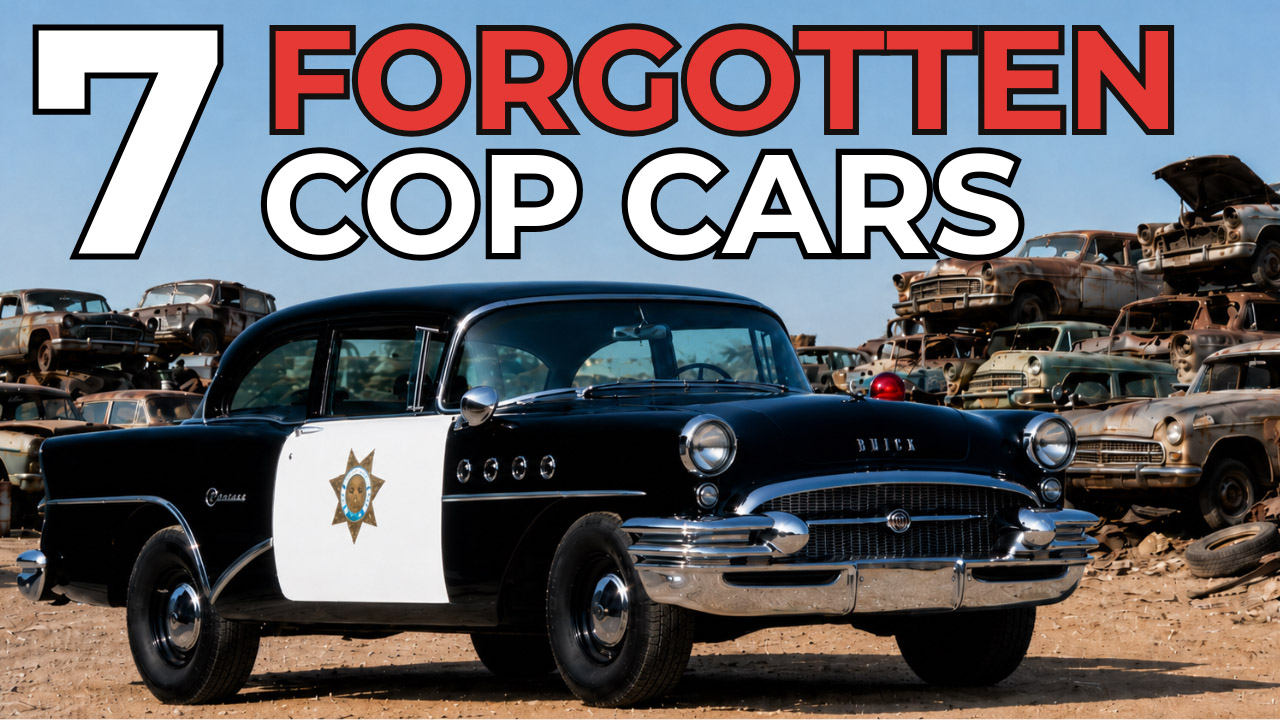
Why could only police buy the 1955 Buick Century Model 68?
Between 1908 and 1955, American policing transformed from a profession that mostly walked, rode horses or pedalled bicycles into a fully motorised, radio-equipped, pursuit-capable institution. Each step was driven by a specific vehicle that has since been largely forgotten.
The sequence runs from the police motorcycle that reached departments in 1908, through the Packard that Detroit’s police commissioner bought with his own money in 1909 after the city council refused to fund one, to the Ford Model T that made motorisation affordable nationwide and became the rolling laboratory in which the police radio was invented. Then came the 1932 Ford V8 that finally gave police parity with bootleggers, the Oldsmobile Rocket 88 that brought the modern overhead-valve V8 to patrol work, the Hudson Hornet that a handful of Southern departments ran while it was dominating NASCAR, and finally a Buick built for the California Highway Patrol that no member of the public could buy.
2. What You Will Learn
-
Why motorcycles put police on wheels a decade before cars did, and where the term “motor cop” comes from.
-
How one Detroit commissioner proved the case for the police car out of his own pocket, and what the car achieved in seven months.
-
Why the Model T mattered less for its speed than for what Detroit officers bolted into its back seat.
-
How the federal government classified a police radio station as entertainment, and the commissioner’s response.
-
Why the 1932 Ford V8 solved the police speed problem and created a new one at the same time.
-
What made a mid-size Oldsmobile and a six-cylinder Hudson credible pursuit cars.
-
The Buick that never appeared in a showroom or a sales brochure.
3. Historical Background
The motorcycle reached police departments almost as soon as it became a practical machine. Harley-Davidson’s own history holds that its first police motorcycle went to the Detroit Police Department in 1908, the same year Detroit formally created its Motorcycle Squad, widely cited as the first of its kind in America. Indian machines followed close behind: in 1909 a Portland, Oregon officer named Merle Sims began patrolling on his own personal Indian, and the department was impressed enough to buy more and build a squad around them.
These early machines were single-cylinder, made a few horsepower, and managed roughly 40 mph on a good road, which was still faster than every horse-drawn vehicle, every bicycle officer, and most early civilian cars. In 1911 the Berkeley, California police chief August Vollmer, often called the father of modern American policing, organised one of the first dedicated motor patrol units in the country.
There is a piece of vocabulary buried in this era that survives today. Around 1908 an Evanston, Illinois officer named Leo Larkin took to a motorcycle and his colleagues began calling him “Motor” Larkin, reportedly the first time an American police officer was called a “motor.” More than a century later, motorcycle officers are still called motors.
4. The Machine Explained
Seven machines, in the order they changed the job. Each one solved the problem the last one had exposed, and each was superseded quickly enough that almost nobody remembers it was ever there.
-
Police motorcycle (from 1908)
Single-cylinder, a few horsepower, roughly 40 mph. Harley-Davidson to Detroit, Indian to Portland.
-
1909 Packard (Detroit)
Bought by Commissioner Frank Croul for $350 of his own money after the council refused to fund it.
-
Ford Model T (1910s–20s)
Around $300 by the early 1920s, roughly 45 mph. The first affordable nationwide police car.
-
1932 Ford V8
221 cu in, around 65 hp, from roughly $460. Parity with the bootleggers at last.
-
Oldsmobile Rocket 88 (1949)
303 cu in overhead-valve V8, 135 hp, approaching 95 mph in a lighter mid-size body.
-
Hudson Hornet (early 1950s)
308 cu in straight-six, around 145 hp, closer to 170 with Twin H-Power. Step-down chassis for a low centre of gravity.
-
Buick Century Model 68 (1955)
322 cu in Nailhead V8, about 236 hp, under 3,800 lb. Built for the CHP and sold to nobody else.
5. What The Records Show
The most consequential thing about the Model T police car was not the car. Between 1921 and 1927, radio-obsessed Detroit officers, Kenneth Cox among them, bolted experimental receivers into the back seat of a Model T patrol car. Reception was poor, fading out whenever the car passed a tall building or went under a railway bridge, but they persisted. What they built changed policing more than any engine did.
-
The Packard that paid for itself
Commissioner Frank H. Croul bought Detroit’s first police car in 1909 for $350 of his own money, to test “the fitness of such a vehicle for police work.” Between 1 December 1909 and 30 June 1910 it answered 2,235 calls. Its first passenger was Henry Calhoun, picked up for public intoxication. In July 1910 the same council that had refused him approved seven patrol cars, a seven-passenger car and a truck.
-
The police station licensed as entertainment
By April 1928 Detroit launched a one-way radio system broadcasting to patrol cars from a station on Belle Isle. The Federal Radio Commission did not regard policing as a legitimate use of the airwaves and required the station, call sign KOP, to register as an entertainment station. Officers had to broadcast music between lists of stolen cars and descriptions of suspects. After one refusal to renew the licence, Commissioner William Rutledge asked whether they were expected to play a violin solo before dispatching police to catch a criminal.
-
Two-way radio, and a set costing more than the car
One-way radio meant a car could hear headquarters but could not answer, and anyone with an ordinary AM set could listen in, including criminals. That changed in 1933, when the Bayonne, New Jersey police department built the first practical two-way police radio system. Early two-way sets cost more than $700 each, more than some of the cars they were fitted to.
-
The Buick nobody could buy
The Century Model 68 was a parts-bin special. Buick took the lightweight body of the cheap Special, fitted the larger Nailhead V8 from the pricier Century line, and added oversized drum brakes from the flagship Roadmaster. Only around 270 were built, reportedly split evenly between manual and automatic transmissions, and virtually all went to the California Highway Patrol. Buick’s own sales literature did not list it.
6. Why It Mattered
None of these seven vehicles is famous. Some came from companies that would not survive the decade: Hudson merged with Nash in 1954 to form American Motors, and the Hornet faded from police service. Others belonged to a category of policing that later receded.
But each made the next one possible. The motorcycle put police on wheels. Croul’s Packard proved a car could outwork a horse, and did it on a commissioner’s personal cheque. The Model T made motorisation affordable for everyone and became the laboratory in which the police radio was born. The 1932 Ford V8 made the police car fast enough to fight on equal terms and, because Ford sold it to anyone, made speed alone insufficient, which is precisely what made the radio essential. The Rocket 88 brought the modern V8 to patrol work. And by 1955, when the California Highway Patrol could simply order a purpose-built car from Buick that the public could not have, the entire infrastructure of modern police-car procurement had been assembled, one forgotten vehicle at a time.
There is a visual legacy too. The CHP had chosen white cars from its founding in 1929 so they would stand out against mostly-black civilian traffic. By the mid-1950s that instinct was hardening into the two-tone, high-contrast scheme that would spread nationwide: the black-and-white, chosen precisely because it made a patrol car impossible to mistake for anything else on the road.
7. Key Takeaways
-
1908 was the real starting line. Police motorcycles reached departments a decade before cars became practical patrol vehicles.
-
$350 changed Detroit. Commissioner Frank Croul bought the department’s first Packard himself after the council refused; it answered 2,235 calls in seven months.
-
The Model T’s legacy is the radio. Detroit officers spent 1921 to 1927 experimenting with receivers in a Model T back seat.
-
Detroit’s police station was licensed as entertainment. Call sign KOP had to broadcast music between crime bulletins.
-
1933 brought two-way radio in Bayonne, New Jersey, with sets costing more than $700, sometimes more than the car.
-
The Buick Century 68 was never sold to the public. Roughly 270 were built, almost all for the CHP, and it was absent from Buick’s sales literature.
8. Frequently Asked Questions
9. Sources
Every claim on this page is drawn from municipal records, manufacturer histories and period reporting. These are the sources behind it.
-
Detroit News historical archive and the Detroit Police Museum
Records of Commissioner Croul’s $350 Packard, the 2,235 calls it answered between December 1909 and June 1910, and the July 1910 council approval of a fleet.
-
The Detroit News, 8 January 1910
Contemporary reporting on Henry Calhoun, the first passenger carried in Detroit’s auto patrol, picked up for public intoxication.
-
Federal Radio Commission licensing records
Documentation relating to station KOP and its classification as an entertainment station, alongside Commissioner William Rutledge’s response.
-
Harley-Davidson and Indian company histories
Records of early police motorcycle deliveries, including the 1908 Detroit machine and the 1909 Portland Indian.
-
Ford Motor Company and Buick production records
Specification for the Model T and the 1932 Model 18, and production data for the 1955 Buick Century Model 68.
10. Related VIDEOs
By Badges & Chrome — researching the history of American police vehicles from published automotive history, period records, and primary sources. Every claim is verified before publication.
About the research →