
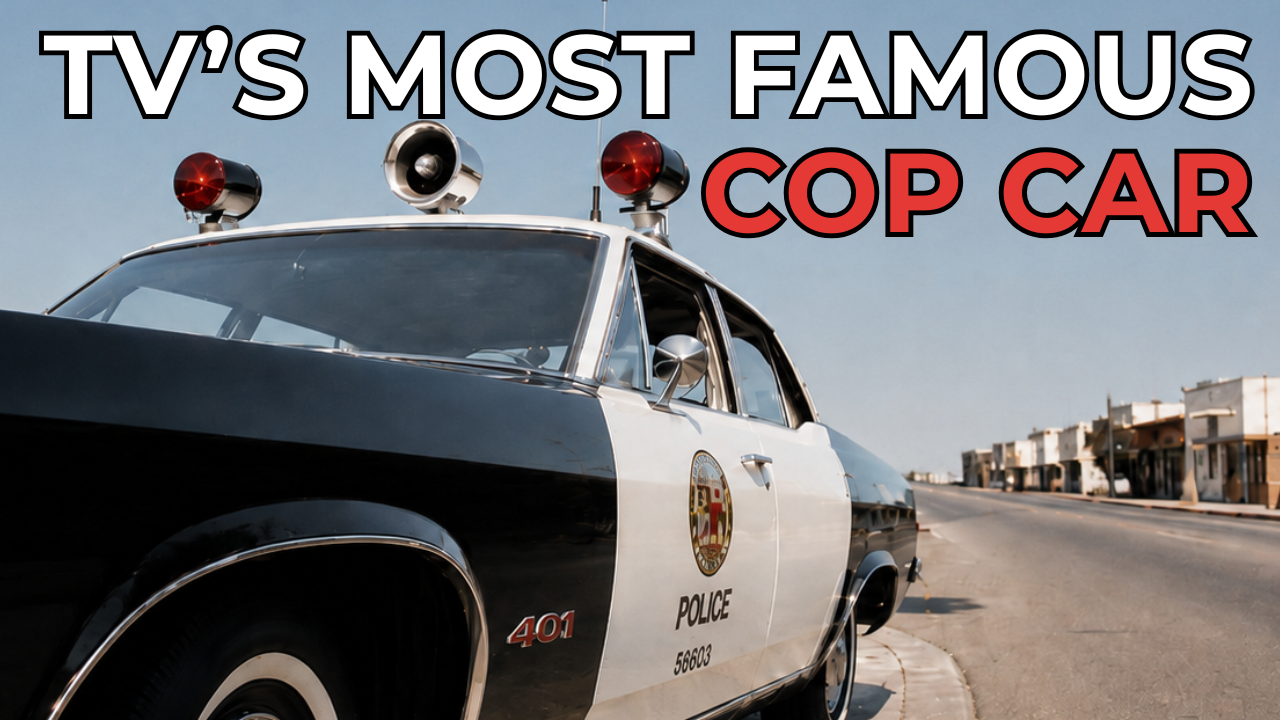
TV’s Most Famous Cop Car
The AMC Matador: The Underdog Cop Car That Beat Ford and Dodge
By Badges & Chrome · researched and verified from period records and primary sources · About the research →
About this VIDEO
-
The smallest, poorest automaker in America built a police car good enough to beat the giants.
In 1972 the LAPD tested the AMC Matador head to head against Plymouth and Dodge and chose the underdog, then put that car on national television as the face of the department. For a few years, the little guy won.
-
Era
1971–1975
-
Department
Los Angeles Police Department
-
Runtime
17:27
-
Published
Aug 18, 2026
1. Introduction
-
Why could only police buy the 1955 Buick Century Model 68?
Because it won on merit. In 1972 the Los Angeles Police Department ran a genuine head-to-head competition, putting the 401-powered AMC Matador against the Plymouths and Dodges that had ruled police work for years, and the underdog took the order. The 401 cubic inch V8 in police tune made 255 horsepower and pulled the mid-size Matador from zero to sixty in around seven and a half seconds, genuinely quick for a 1972 patrol car.
There was also a quiet piece of cleverness behind its reliability. For 1972 AMC had swallowed its pride and adopted Chrysler’s TorqueFlite automatic, one of the toughest transmissions in the business, rather than building its own, and the police cars were air-conditioned for long hot Los Angeles shifts. Good power, a bulletproof transmission borrowed from a rival, and a comfortable cabin. The LAPD was not settling for a cheaper option.
2. What You Will Learn
-
Just how much of an underdog American Motors was, and why its survival was genuinely in doubt.
-
The racing pedigree that proved AMC could build engines when nobody expected it.
-
Why the LAPD was one of the most demanding and fickle police-car customers in America.
-
What officers who actually drove the Matador said about it, including how it compared on brakes.
-
How the car became the most recognisable police vehicle on American television.
-
Why AMC’s finest hour could not save the company.
3. Historical Background
American Motors was the runt of the American auto industry from the beginning. It was born in 1954 from the merger of two struggling old names, Nash and Hudson, who joined forces for a simple reason: neither was big enough to survive the Big Three alone. For decades that is what AMC remained, the fourth automaker, permanently dwarfed by General Motors, Ford and Chrysler, fighting for whatever scraps of the market the giants did not bother to chase.
It survived the only way a small company can, by being scrappy and different, chasing the buyers everyone else ignored. That strategy produced some of the most memorable oddball cars in American history: the stubby Gremlin, the fishbowl Pacer, the compact Hornet.
But being small and underfunded was a grinding problem that was getting worse. The 1970s brought a wave of expensive federal emissions and safety regulations, and the giants could absorb those costs while AMC, with a fraction of their resources, could not keep up. That is not the profile of a company that builds a great police car. Except AMC could build engines. It made a big, torquey 401 cubic inch V8, and it had genuine racing pedigree: in 1971 an AMC Javelin campaigned by Mark Donohue and Penske Racing won the Trans-American championship, beating Ford, Chevrolet and Chrysler in front of everyone.
4. The Machine Explained
Before the police car, AMC had flirted with turning the Matador into an outright muscle car, a hot version called the Machine Go Package with heavy-duty suspension and loud graphics, of which fewer than seventy were built, making it one of the rarest AMCs of all. The performance intent was there from the start.
-
Engine
401 cu in V8, police tune.
-
Output
255 hp, the net rating used from 1972. The same engine had carried a 330 hp gross rating the previous year under the older measurement standard.
-
0–60 mph
Around 7.5 seconds.
-
Transmission
Chrysler TorqueFlite automatic, adopted by AMC for 1972.
-
Equipment
Air conditioning, a real advantage on long Los Angeles shifts.
-
Body
Mid-size four-door sedan, also offered as a wagon and a coupe.
-
Introduced
1971, replacing the aging Rebel.
-
Training fleet
Eighteen new cars supplied to the LAPD driving-instruction division.
5. What The Records Show
The Los Angeles Police Department was one of the most demanding and closely watched police-car customers in the country, and it was fickle. It bought on performance rather than loyalty and switched makes constantly: Plymouth Belvederes in 1969, Mercury Montegos in 1970 that officers disliked so much they lasted a single year, back to Plymouth in 1971. This was an agency that tested its cars hard and dropped them the moment something better came along.
-
What the officers said
Jerry Bush, a veteran LAPD driving instructor, put it plainly in a 2005 interview with Hemmings Muscle Machines. At that time American Motors did not have that great a reputation, he said, but the Matador was an extremely good police car. It was fast, he explained, it had superior brakes to the Plymouths, and it handled pretty well. By the account of the professionals who trained on it, the Matador actually out-braked and out-handled the Plymouth police cars it was up against. Bush’s division was convinced enough to push for training officers in the Matador itself, and was given a fleet of eighteen new ones to do it.
-
The Adam-12 years
From its fifth season in September 1972 through 1975, the black-and-white that Officers Malloy and Reed climbed into every week was an AMC Matador. The show prided itself on authenticity, real LAPD procedures, real radio codes and real LAPD cars, so when the department switched, the show switched with it. The cars carried the full police package with the “401” badges on the front fenders for the whole country to see.
-
The most-filmed cop car of the decade
Once the Matador became visual shorthand for “police car,” it turned up everywhere in 1970s film and television: in the Adam-12 spin-off Emergency!, in The Rockford Files and The Incredible Hulk, and in a handful of 1979 episodes of The Dukes of Hazzard, whose patrol cars were otherwise late-1970s Dodge and Plymouth B-bodies. The redesigned coupe even appeared in the 1974 James Bond film The Man with the Golden Gun, where it famously sprouted wings and flew, though the takeoff was shot with a mocked-up stunt car and the flight itself with a radio-controlled scale model.
-
Five NASCAR wins, and a disc-brake first
AMC ran the Matador in NASCAR with Penske Racing. Mark Donohue gave the car AMC’s first NASCAR win in over twenty years at Riverside in 1973, and his winning car ran disc brakes, new to NASCAR at the time. The same car officers praised for out-braking the Plymouths was pioneering stopping power on the racetrack. Bobby Allison then made it a genuine winner, capping the run with victory in the 1975 Southern 500 at Darlington, weeks after Donohue was killed in a crash in Europe. Across those seasons the Matador collected five NASCAR wins.
6. Why It Mattered
Time was never on AMC’s side. In 1974 the Matador was redesigned and the new coupe adopted a radical, love-it-or-hate-it styling that never caught on. The sedans grew larger and heavier. And no amount of television fame could fix the company’s fundamental problem: it was still too small, still too underfunded, still squeezed harder than anyone by the rising cost of building cars in the modern era. Fame on screen never translated into showroom sales.
The rest is the underdog’s story told to its conclusion. AMC limped through the remainder of the 1970s, kept alive for a while by a partnership with Renault, before being absorbed by Chrysler in 1987. By 1988 the AMC name was gone entirely, folded into a giant it had spent its whole life fighting.
But that makes the Matador’s moment shine brighter, not dimmer. For a few years in the early 1970s the smallest and poorest carmaker in America built a police car good enough to beat Plymouth and Dodge in a fair fight, for the fleet of one of the most famous police departments on earth, and then watched that car become a television icon recognised by millions as the very picture of American law enforcement.
Police-car history is almost always written by the giants: Ford, General Motors, Chrysler, the companies with the money and the fleets. But every so often the smallest player in the room builds something so good it beats them all.
7. Key Takeaways
-
It won on merit. The LAPD ran a genuine head-to-head test against Plymouth and Dodge and chose the AMC.
-
255 horsepower and 0–60 in about 7.5 seconds from the 401 V8 in police tune.
-
The secret was partly a rival’s transmission. AMC adopted Chrysler’s TorqueFlite for 1972.
-
Officers rated its brakes above the Plymouths’, confirmed by an LAPD driving instructor.
-
Adam-12 made it famous, with the “401” fender badges visible to a national audience from 1972 to 1975.
-
AMC’s finest hour could not save it. The company was absorbed by Chrysler in 1987.
8. Frequently Asked Questions
9. Sources
Every claim on this page is drawn from period interviews, racing records and production documentation. These are the sources behind it.
-
Hemmings Muscle Machines, 2005
Interview with LAPD driving instructor Jerry Bush on the Matador’s speed, braking and handling relative to the Plymouths it replaced.
-
AMC police-fleet historians
Documentation of the 1972 LAPD head-to-head competition against Plymouth and Dodge, and the resulting order.
-
NASCAR Grand National and Winston Cup records, 1973–1975
Race results establishing Donohue’s 1973 Riverside win, Allison’s subsequent victories including the 1975 Southern 500, and the five-win total, alongside Team Penske’s own race history.
-
Adam-12 production records, seasons five to seven
Documentation of the show’s fleet accuracy and the switch to the Matador following the LAPD’s own purchasing decision.
-
AMC 401 V8 specification data
Period road tests and factory documentation for the police-tune engine, including the 1972 change from gross to net horsepower ratings.
10. Related VIDEOs
By Badges & Chrome — researching the history of American police vehicles from published automotive history, period records, and primary sources. Every claim is verified before publication.
About the research →