
The Year The Pursuit Car Got Small
The Cop Car That Chased Porsches For A Living
By Badges & Chrome · researched and verified from period records and primary sources · About the research →
About this VIDEO
-
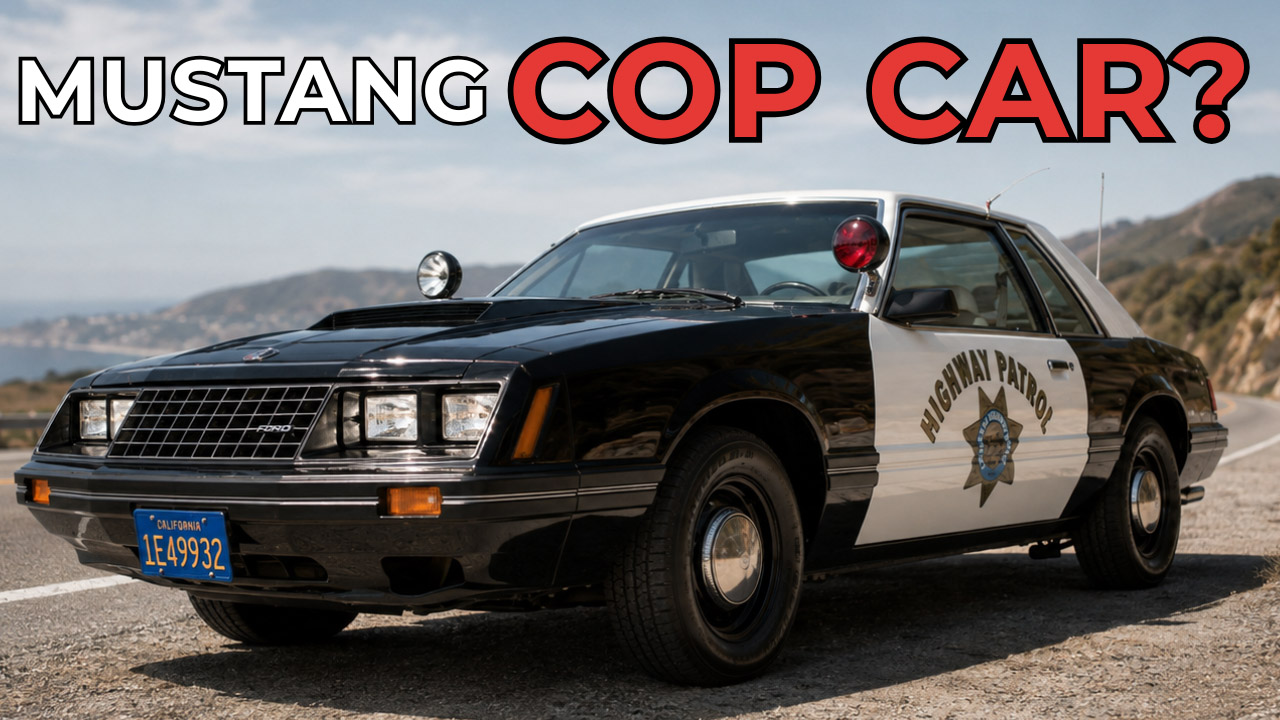
Ford put it on the sales literature in plain black and white: this Ford chases Porsches for a living.
How the American pursuit car got small. A state patrol so desperate for speed it had been reduced to cars that could not crack ninety went looking for an answer, rejected the obvious candidate, and ended up with a Mustang.
-
Era
1982–1993
-
Departments
California Highway Patrol, and 60+ agencies nationwide
-
Runtime
17:27
-
Published
Aug 26, 2026
1. Introduction
-
Why could only police buy the 1955 Buick Century Model 68?
Because by 1980 it had run out of alternatives. The CHP was patrolling the fastest highways in America in Dodge St. Regis sedans that topped out at eighty-five miles an hour on flat ground and around sixty-five going uphill. The officers called them dog cars. California’s highways were full of genuinely fast machinery, the emissions crackdown had strangled every big American V8, and Detroit had nothing to sell them.
So the patrol stopped waiting for the sedan to get better and asked a different question entirely: what if the pursuit car did not have to be a sedan? For thirty years an American police car had meant one thing, a big, heavy, four-door, rear-wheel-drive machine with room for two officers, a prisoner and a boot full of equipment. That was not a preference. That was the definition. Then, in 1982, the CHP bought four hundred and six two-door coupes with tiny back seats and almost no boot space, and handed them to its officers.
2. What You Will Learn
-
Why the California Highway Patrol abandoned the full-size sedan entirely.
-
The car it tested first, for eighteen months, and then rejected.
-
The bid comparison that made the decision easy, and it was not close.
-
What Ford actually re-engineered, including one detail under the dash that is pure police car.
-
Why the Air Force bought police Mustangs to chase aeroplanes.
-
What the Mustang could not do, which is the part almost nobody tells.
3. Historical Background
The obvious answer was not the Mustang. Before Ford, there was Chevrolet. The California Highway Patrol had been running Camaros since the late 1970s, and when the search for a proper high-speed pursuit car began in earnest, the Camaro was the natural candidate. It was light, it was quick, and the patrol already knew it. So they tested it properly, a rigorous evaluation of the Camaro Z28 that ran for eighteen months.
And it failed. The problem, by the accounts of people who documented that programme, came down to the engine, and specifically a soft camshaft in Chevrolet’s three-hundred-and-five cubic inch V8. A camshaft that wears is not a minor complaint in a police car. It means a car that gets slower and sicker the longer it stays in service, and police service is the hardest duty a car can be given. At the end of the trial, the California Highway Patrol declined to adopt it.
That left the patrol in an awkward position. They had proven the concept, a small, light, two-door pursuit car really could do the job, and then the car they had tested it with had failed on durability. They needed the same idea in a machine that would survive.
4. The Machine Explained
What Ford handed back was not a hot rod with a light bar. It was a Mustang systematically re-engineered to survive police work, and the changes tell you exactly what police work does to a car. The small details are the most revealing: everything on this list exists because of something that happens on a shift.
-
Body
Fox-body notchback coupe, chosen because it was the lightest body Ford offered, with reinforced floor pans for rigidity.
-
Engine
Five-litre V8. Around 157 hp in the carburetted 1982 cars, roughly 200 with fuel injection, and 225 hp SAE by 1987 according to Ford’s own police drivetrain listing.
-
0–60 mph (MSP measured)
7.64 seconds with the five-speed, 8.16 with the automatic (Michigan State Police, MY1987).
-
Top speed
139.1 mph (MSP, MY1987). Michigan recorded the same specification at 135.0 in 1988 and 137.2 in 1989, so treat any single figure as a measurement rather than a fixed property. The CHP reported it was the only car it tested that would exceed 125 mph.
-
Cooling
Engine oil cooler, transmission fluid cooler, silicone radiator hoses secured with aircraft-style clamps.
-
Electrical
Heavy-duty alternators rated at 130 and 135 amps, because a patrol car is a rolling power station.
-
Throttle lock
Fitted under the dash to hold a higher-than-normal idle, so an officer could sit at the roadside for hours running radios and lights without flattening the battery.
-
Instrumentation
Certified, calibrated speedometer reading to 140 mph, later raised to 160.
-
VASCAR
A two-piece speedometer cable, so the car could drive the timing computer.
-
Courtesy lights
Deliberately disabled, so opening the door at night did not light the officer up like a target.
-
Other
Anti-static bonding straps, a single key working doors and boot, Kevlar drive belts, shields over the brake rotors, a full-size spare.
5. What The Records Show
In 1981 the California Highway Patrol did the sensible bureaucratic thing. It took bids. General Motors and Ford both put a car forward, and what happened next made the decision straightforward.
-
Not a close contest
By the accounts of people who have gone back through that procurement, the per-car price General Motors quoted was around eleven thousand four hundred dollars. Ford came in at roughly six thousand eight hundred. Ford was not slightly cheaper. Ford was close to forty percent cheaper, for a car that was lighter, quicker, and had just watched its rival fail on durability.
-
The number everyone gets wrong
You will read almost everywhere that the SSP reached sixty miles an hour in 6.3 seconds. It did not. Ford’s own 1982 advertisement, the one carrying the “chases Porsches” line, states in print that the car “accelerates from zero to 50 in 6.3 seconds.” Zero to fifty. Somewhere in the decades since, the fifty became a sixty, and the error has been repeated ever since — including on this site. Michigan State Police testing settles it independently: 7.64 seconds to sixty with the five-speed, 8.16 with the automatic. Respectable for the period, and nowhere near a sports car. What the slogan actually meant is that on an open freeway the SSP would run down almost anything a civilian could buy, for less than seven thousand dollars of state money.
-
406 cars, and a verdict that changed Ford’s plans
The CHP bought four hundred and six for 1982. Almost all were notchback coupes; just five were hatchbacks built specially for evaluation. Those first cars all ran a four-speed manual gearbox. They had been bought as a real-world test of whether the idea would survive severe duty, and it did. The reviews were strong enough that Ford formalised the whole thing for 1983 as a factory option, the Special Service Package, and opened it to any agency that wanted one.
-
Fifteen thousand cars, sixty agencies
Roughly forty agencies ordered in that first year, across Florida, Georgia, North Carolina, Texas and Washington. Over the full run from 1982 to 1993, Ford built close to fifteen thousand Special Service Package Mustangs for more than sixty law enforcement and government organisations. Florida became the second-largest user after California. Individual agencies specified their own modifications: Oregon and Kentucky state police cars got roll cages, and the New York State Police asked for power windows.
-
The car that chased spy planes
The United States Air Force bought Mustangs to chase aeroplanes. The Lockheed U-2 is notoriously difficult to land, a glider-like machine on bicycle landing gear that has to be talked down by another pilot following it along the runway at speed. The Air Force needed a car quick enough to keep up with a landing U-2 and stable enough to do it while the driver called out altitude. They used the Mustang. The Border Patrol ran them for drug interdiction work.
-
What it could not do
The back seat was tiny, and putting a handcuffed adult into the rear of a Fox-body coupe with the front seat tipped forward is awkward at best. The boot was small, and the notchback body chosen to save weight was precisely the body with the least room in it. The early manual gearbox was a real drawback, which is why most agencies took the automatic once Ford offered the choice: an officer driving one-handed while working a radio, a light bar and a siren does not want to be changing gear as well.
6. Why It Mattered
A police car is not primarily a pursuit vehicle. It is an office, a storage locker, a prisoner transport and a mobile command post, and it happens to need to go fast occasionally. The Mustang was superb at the last of those and poor at all the others. So the Special Service Package was never really a replacement for the patrol sedan. It was a specialist tool, bought in ones and twos and dozens for the specific job of catching fast cars on open highway, while the four-door fleet went on doing everything else.
There is a handling question too, and the evidence is mixed. Contemporary accounts praised the SSP’s handling against the wallowing full-size sedans it replaced, but officers who worked these cars have described real limitations at the edge, a nose-heavy car that could get away from you on a wet road, and recollections of departments restricting when the Mustangs could be used in bad weather. What is not in dispute is the underlying physics: a light, powerful, rear-wheel-drive coupe with a big V8 over the front axle demands respect in the rain, and police officers do not get to choose the weather they work in.
The moment a sedan came along that could do both jobs, the specialist tool became unnecessary. That moment arrived in 1994, when Chevrolet dropped the LT1 into the Caprice police package and American law enforcement suddenly had a full-size four-door that would run a hundred and forty-one miles an hour, carry prisoners and swallow equipment in one car. At the same time Ford was replacing the Fox-body Mustang and showed no interest in a police version of the new one. Special Service Package production ended in 1993, after eleven years.
Read Ford’s slogan again and notice what it does not say. It does not say this Ford patrols a beat, or transports prisoners, or gives an officer somewhere to write up a report at three in the morning. Ford was selling one capability, brilliantly, and being perfectly honest about it. The Special Service Package was the American police car reduced to a single function, and for eleven years, for that one function, nothing else came close.
7. Key Takeaways
-
The CHP tested the Camaro Z28 first, for eighteen months, and rejected it over a soft camshaft in Chevrolet’s 305.
-
Ford’s bid was roughly 40 percent below General Motors’: about $6,800 against around $11,400 per car.
-
406 cars for 1982, almost all notchbacks, all with four-speed manual gearboxes.
-
The famous 6.3-second figure is zero to fifty, not zero to sixty. Ford’s own advertisement says so; Michigan measured 7.64.
-
Roughly 15,000 built from 1982 to 1993 for more than 60 agencies, including Air Force U-2 chase cars.
-
The 1994 LT1 Caprice ended it, by doing the pursuit job and the patrol job in one car.
8. Frequently Asked Questions
9. Sources
Every claim on this page is drawn from fleet literature, period road tests and procurement records. These are the sources behind it.
-
Ford Special Service Package fleet literature, 1982–1993
Factory specification of the package, including the cooling, electrical, instrumentation and equipment items, and the origin of the “chases Porsches for a living” line as Ford’s own sales copy.
-
California Highway Patrol vehicle evaluation records
Documentation of the eighteen-month Camaro programme and its rejection, the 1981 bidding, and the 1982 order of 406 cars including the five evaluation hatchbacks.
-
Car and Driver period testing
Instrumented figures for the Special Service Package, including the acceleration comparison against contemporary sports cars.
-
Hagerty, “Fleet Foxes”
The Life and Times of Ford’s 5.0 Mustang and LTD Special Service Packages. Marque history of the programme, its agencies and its production run.
-
Special Service Mustang registry and collector documentation
Enthusiast cataloguing of surviving cars, agency-specific options such as the Oregon and Kentucky roll cages, and the identifying features of genuine fleet cars.
10. Related VIDEOs
By Badges & Chrome — researching the history of American police vehicles from published automotive history, period records, and primary sources. Every claim is verified before publication.
About the research →