
Michigan test archive
1990 Michigan State Police Patrol Vehicle Test
Acceleration, top speed and braking move to Ford’s proving ground, a five-speed Mustang posts the quickest acceleration times in the books held here to that point, and the Caprice 5.7 beats the Crown Victoria in every scored category.
The 1990 test was run in September 1989, and this is the full book. Its preface lists “6 police patrol package cars and 2 special pursuit package cars”: three Chevrolet Caprices (5.7 and 5.0 V8 and 4.3 V6, all with throttle-body injection), two Ford Crown Victorias (the 5.8 variable-venturi V8 and the port-injected 5.0), a port-injected 3.8 Ford Taurus, the first Taurus in the books held here, and two 5.0 H.O. Ford Mustangs, one five-speed and one automatic. No Chrysler product appears in the book; the preface thanks “the vehicle manufacturers-Ford Motor Company, and the Chevrolet Division of General Motors” for the test cars.
The straight-line work moved for the year. The preface explains: “Those of you familiar with our evaluation from previous years may notice that our acceleration, top speed and braking tests were conducted this year at the Ford Motor Company, Michigan Proving Grounds. In prior years, we have used the Chrysler Proving Grounds, however, due to a major construction project involving their high speed oval, their facilities were not available to us this year.” Every acceleration and brake sheet is dated 16 September 1989. The lap times were set on the Michigan International Speedway road course; the book does not date them.
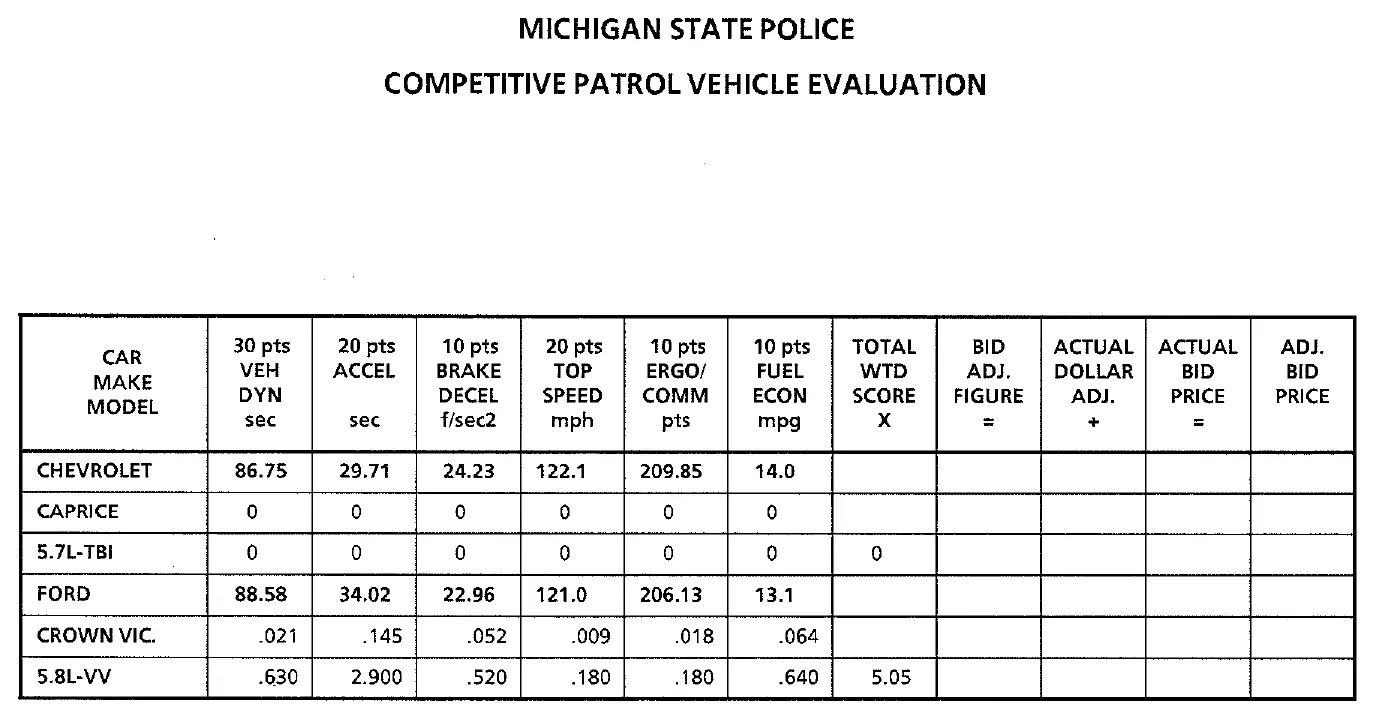
Only two cars were scored: the Caprice 5.7 and the Crown Victoria 5.8, the only Caprice and Crown Victoria variants inside all four qualification standards (the book does not say why the others were not scored). The Caprice was best in all six categories, so its total weighted score is 0; the Crown Victoria’s is 5.05. The specification’s rule is that “The vehicle to be purchased will be determined by the adjusted low bid price”, but the bid columns of the results page are blank, and the book does not say which car Michigan bought.
The quickest car was the five-speed Mustang: 60 mph in 6.64 seconds, 100 in 18.66 and the quarter mile in 15.22 seconds at 91.90 mph. Each is the quickest in the books held here to that point; the 1988 five-speed had run 6.90, 19.07 and 15.48. One of its four runs was lost, “Unavailable Due To Timer Malfunction”, so its figures are averages of three. The automatic Mustang was the fastest car, at 136.0 mph.
All eight cars — acceleration, top speed and the road course
| Car | Engine | 0–60 (s) | 0–80 (s) | 0–100 (s) | ¼-mile (s @ mph) | Top speed (mph) | Miles to 100 mph | Miles to 110 mph | Dynamics |
|---|---|---|---|---|---|---|---|---|---|
| Scored for the bid (pages 44–45) | |||||||||
| Chevrolet Caprice 5.7L-TBI | 5.7L (350) V8 TBI | 9.36 | 16.85 | 29.71 | 17.16 @ 80.58 | 122.1 | 0.57 | 1.08 | 1:26.75 |
| Ford Crown Victoria 5.8L-VV | 5.8L (351) V8 VV | 11.19 | 18.95 | 34.02 | 18.31 @ 78.35 | 121.0 | 0.64 | 1.06 | 1:28.58 |
| Police patrol package cars with acceleration, top-speed and lap data, not scored | |||||||||
| Chevrolet Caprice 5.0L-TBI | 5.0L (305) V8 TBI | 11.99 | 22.34 | 42.60 | 18.77 @ 74.70 | 113.0 | 0.84 | 2.46 | 1:29.74 |
| Ford Crown Victoria 5.0L-PFI | 5.0L (302) V8 PFI | 11.23 | 20.39 | 38.67 | 18.24 @ 75.88 | 107.3 | 0.76 | — | 1:28.77 |
| Chevrolet Caprice 4.3L-TBI | 4.3L (262) V6 TBI | 13.41 | 25.86 | 53.09 | 19.52 @ 71.35 | 110.2 | 1.08 | 6.08 | 1:30.65 |
| Ford Taurus | 3.8L (232) V6 PFI | 10.43 | 19.01 | 34.00 | 17.81 @ 77.38 | 114.0 | 0.66 | 1.27 | 1:27.31 |
| Special pursuit package cars, not scored | |||||||||
| Ford Mustang (5-speed) | 5.0L (302) V8 PFI-HO | 6.64 | 11.39 | 18.66 | 15.22 @ 91.90 | 135.4 | 0.34 | 0.49 | 1:22.18 |
| Ford Mustang (automatic) | 5.0L (302) V8 PFI-HO | 7.97 | 13.01 | 21.25 | 16.17 @ 88.93 | 136.0 | 0.38 | 0.57 | 1:22.55 |
Between the two scored cars the gap was wide in a straight line. The Caprice 5.7 reached 100 mph 4.31 seconds sooner, 29.71 against 34.02, and lapped 1.83 seconds quicker. Its 9.36 seconds to 60 is quicker than any sedan in the books held here from 1980 to 1989, including the Canadian-market Caprices of 1986 and 1987, at 9.59 and 9.49; only the 1978 Plymouth Fury, at 9.23, was quicker. Top speed was close: 122.1 against 121.0.
The front-drive Taurus lapped in 1:27.31, 0.56 seconds behind the Caprice 5.7 and quicker than both Crown Victorias and the two smaller Caprices. The best lap average by a front-drive car on the earlier year pages had been the 1986 Celebrity’s 1:29.76. The Taurus also reached 100 mph two hundredths of a second sooner than the 5.8 Crown Victoria, but topped out at 114.0.
Measured against the printed qualification times (12.5, 22.2 and 39.3 seconds, and 110 mph within two miles), the Caprice 5.7, the Crown Victoria 5.8, the Taurus and both Mustangs are inside all four. The other three are not:
- the 5.0 Caprice is outside the 80 and 100 mph times, at 22.34 and 42.60 seconds, and took 2.46 miles to reach 110;
- the 5.0 Crown Victoria is inside all three times but topped out at 107.3 mph;
- the 4.3 Caprice is outside all three times, at 13.41, 25.86 and 53.09 seconds, and took 6.08 miles to reach 110.
The book prints no pass or fail for any car. Only the sheets of the two scored cars fill in the time-requirement column.
See the original pages: the 1990 book’s summary pages
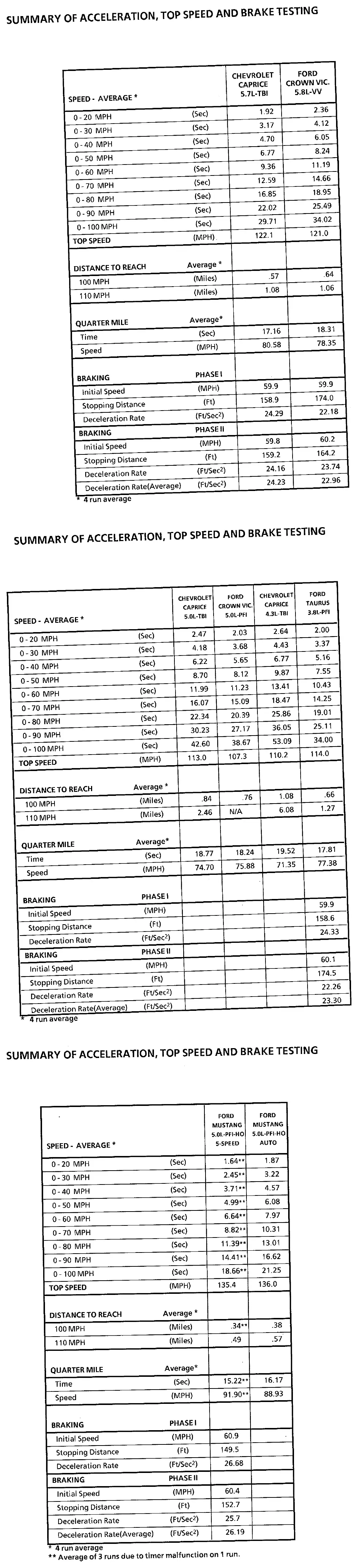
Acceleration ladders — every 10-mph step for all eight cars
| 0 to… | Chevrolet Caprice 5.7L-TBI | Ford Crown Victoria 5.8L-VV | Chevrolet Caprice 5.0L-TBI | Ford Crown Victoria 5.0L-PFI | Chevrolet Caprice 4.3L-TBI | Ford Taurus | Ford Mustang (5-speed) | Ford Mustang (automatic) |
|---|---|---|---|---|---|---|---|---|
| 20 mph | 1.92 | 2.36 | 2.47 | 2.03 | 2.64 | 2.00 | 1.64 | 1.87 |
| 30 mph | 3.17 | 4.12 | 4.18 | 3.68 | 4.43 | 3.37 | 2.45 | 3.22 |
| 40 mph | 4.70 | 6.05 | 6.22 | 5.65 | 6.77 | 5.16 | 3.71 | 4.57 |
| 50 mph | 6.77 | 8.24 | 8.70 | 8.12 | 9.87 | 7.55 | 4.99 | 6.08 |
| 60 mph | 9.36 | 11.19 | 11.99 | 11.23 | 13.41 | 10.43 | 6.64 | 7.97 |
| 70 mph | 12.59 | 14.66 | 16.07 | 15.09 | 18.47 | 14.25 | 8.82 | 10.31 |
| 80 mph | 16.85 | 18.95 | 22.34 | 20.39 | 25.86 | 19.01 | 11.39 | 13.01 |
| 90 mph | 22.02 | 25.49 | 30.23 | 27.17 | 36.05 | 25.11 | 14.41 | 16.62 |
| 100 mph | 29.71 | 34.02 | 42.60 | 38.67 | 53.09 | 34.00 | 18.66 | 21.25 |
The two Mustangs were 0.23 seconds apart at 20 mph and 2.59 seconds apart at 100. The port-injected 5.0 Crown Victoria was quicker than the 5.8 up to 50 mph, then fell behind from 60 mph onwards: 38.67 seconds to 100 against 34.02.
Every acceleration run, with the conditions
| Speed | Required (s) | Run 1 | Run 2 | Run 3 | Run 4 | Average |
|---|---|---|---|---|---|---|
| Chevrolet Caprice 5.7L-TBI — started 9:42 am, wind 6.8–10 mph from the north, 56.9°F (PDF 325) | ||||||
| 0–60 mph | 12.5 | 9.17 | 9.23 | 9.68 | 9.34 | 9.36 |
| 0–80 mph | 22.2 | 16.60 | 16.46 | 17.38 | 16.94 | 16.85 |
| 0–100 mph | 39.3 | 29.59 | 30.19 | 29.89 | 29.18 | 29.71 |
| Ford Crown Victoria 5.8L-VV — started 9:17 am, wind 6.0–8.8 from the north, 56.3°F (PDF 325) | ||||||
| 0–60 mph | 12.5 | 10.98 | 11.24 | 11.21 | 11.31 | 11.19 |
| 0–80 mph | 22.2 | 18.58 | 19.08 | 18.98 | 19.15 | 18.95 |
| 0–100 mph | 39.3 | 33.26 | 34.42 | 33.70 | 34.69 | 34.02 |
| Chevrolet Caprice 5.0L-TBI — started 1:12 pm, wind 9.3–14.9 MPH from the north, 62.3°F (PDF 326) | ||||||
| 0–60 mph | — | 11.62 | 12.14 | 11.96 | 12.24 | 11.99 |
| 0–80 mph | — | 21.64 | 22.67 | 22.25 | 22.80 | 22.34 |
| 0–100 mph | — | 40.63 | 43.80 | 41.71 | 44.27 | 42.60 |
| Ford Crown Victoria 5.0L-PFI — started 12:51 pm, wind 9.6–16.9 MPH from the north, 61.7°F (PDF 326) | ||||||
| 0–60 mph | — | 11.25 | 11.21 | 11.18 | 11.28 | 11.23 |
| 0–80 mph | — | 20.55 | 20.65 | 19.81 | 20.55 | 20.39 |
| 0–100 mph | — | 38.52 | 40.11 | 35.93 | 40.11 | 38.67 |
| Chevrolet Caprice 4.3L-TBI — started 11:20 am, wind 10.8–14.3 MPH from the north, 57.7°F (PDF 327) | ||||||
| 0–60 mph | — | 13.05 | 13.43 | 13.80 | 13.36 | 13.41 |
| 0–80 mph | — | 26.01 | 25.84 | 25.87 | 25.70 | 25.86 |
| 0–100 mph | — | 53.99 | 53.17 | 53.20 | 52.01 | 53.09 |
| Ford Taurus — started 10:14 am, wind 8.9–12.9 MPH from the north, 56.9°F (PDF 327) | ||||||
| 0–60 mph | — | 10.67 | 10.43 | 10.37 | 10.23 | 10.43 |
| 0–80 mph | — | 19.63 | 19.02 | 18.89 | 18.48 | 19.01 |
| 0–100 mph | — | 35.17 | 33.81 | 33.68 | 33.33 | 34.00 |
| Ford Mustang (5-speed) — started 10:50 am, wind 7.5–12.0 MPH from the north/northwest, 57.2°F (PDF 328) | ||||||
| 0–60 mph | — | timer failed | 6.58 | 6.65 | 6.68 | 6.64 |
| 0–80 mph | — | timer failed | 11.25 | 11.49 | 11.42 | 11.39 |
| 0–100 mph | — | timer failed | 18.41 | 18.95 | 18.61 | 18.66 |
| Ford Mustang (automatic) — started 1:36 pm, wind 9.6–15.7 MPH from the north, 62.2°F (PDF 328) | ||||||
| 0–60 mph | — | 7.84 | 8.04 | 8.01 | 7.97 | 7.97 |
| 0–80 mph | — | 12.81 | 13.12 | 12.95 | 13.16 | 13.01 |
| 0–100 mph | — | 20.58 | 21.57 | 21.16 | 21.68 | 21.25 |
The method page says each car made “4 acceleration sequences, 2 eastbound and 2 westbound, to allow for wind direction”. The sheets record wind of 6.0 to 16.9 mph, from the north (north/northwest for the five-speed Mustang), and temperatures of 56.3 to 62.3°F. The first car away was the 5.8 Crown Victoria at 9:17 am, and the last was the automatic Mustang at 1:36 pm.
Vehicle dynamics at Michigan International Speedway — every lap, every driver
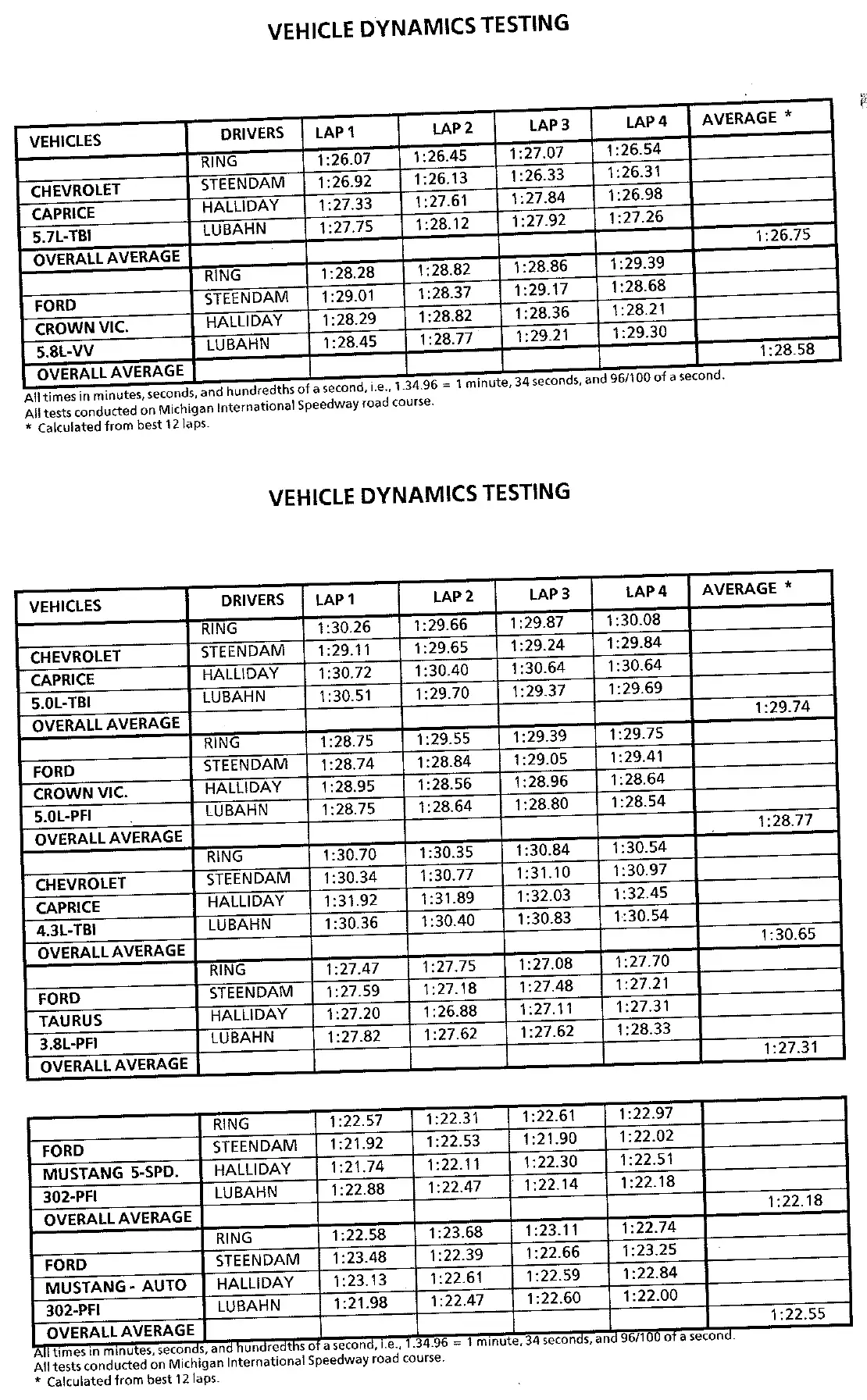
Four drivers each drove four timed laps in every car over the 1.635-mile road course. The book’s method page says each car “will be driven over the course for at least 12 timed laps, using a minimum of 3 separate drivers. The final score for each vehicle will be the average of the fastest of at least 9 timed laps.” The lap tables say something narrower: “* Calculated from best 12 laps.” Every car ran 16 laps, and each printed average is the mean of its 12 fastest, with the four slowest dropped. All eight recompute from the printed laps. The 4.3 Caprice’s best 12 average exactly 1:30.645, printed 1:30.65.
| Driver | Lap 1 | Lap 2 | Lap 3 | Lap 4 | Four-lap mean (computed) |
|---|---|---|---|---|---|
| Chevrolet Caprice 5.7L-TBI — printed average 1:26.75 (best 12 of 16 laps); fastest lap 1:26.07, slowest 1:28.12 | |||||
| Ring | 1:26.07 | 1:26.45 | 1:27.07 | 1:26.54 | 1:26.53 |
| Steendam | 1:26.92 | 1:26.13 | 1:26.33 | 1:26.31 | 1:26.42 |
| Halliday | 1:27.33 | 1:27.61 | 1:27.84 | 1:26.98 | 1:27.44 |
| Lubahn | 1:27.75 | 1:28.12 | 1:27.92 | 1:27.26 | 1:27.76 |
| Ford Crown Victoria 5.8L-VV — printed average 1:28.58 (best 12 of 16 laps); fastest lap 1:28.21, slowest 1:29.39 | |||||
| Ring | 1:28.28 | 1:28.82 | 1:28.86 | 1:29.39 | 1:28.84 |
| Steendam | 1:29.01 | 1:28.37 | 1:29.17 | 1:28.68 | 1:28.81 |
| Halliday | 1:28.29 | 1:28.82 | 1:28.36 | 1:28.21 | 1:28.42 |
| Lubahn | 1:28.45 | 1:28.77 | 1:29.21 | 1:29.30 | 1:28.93 |
| Chevrolet Caprice 5.0L-TBI — printed average 1:29.74 (best 12 of 16 laps); fastest lap 1:29.11, slowest 1:30.72 | |||||
| Ring | 1:30.26 | 1:29.66 | 1:29.87 | 1:30.08 | 1:29.97 |
| Steendam | 1:29.11 | 1:29.65 | 1:29.24 | 1:29.84 | 1:29.46 |
| Halliday | 1:30.72 | 1:30.40 | 1:30.64 | 1:30.64 | 1:30.60 |
| Lubahn | 1:30.51 | 1:29.70 | 1:29.37 | 1:29.69 | 1:29.82 |
| Ford Crown Victoria 5.0L-PFI — printed average 1:28.77 (best 12 of 16 laps); fastest lap 1:28.54, slowest 1:29.75 | |||||
| Ring | 1:28.75 | 1:29.55 | 1:29.39 | 1:29.75 | 1:29.36 |
| Steendam | 1:28.74 | 1:28.84 | 1:29.05 | 1:29.41 | 1:29.01 |
| Halliday | 1:28.95 | 1:28.56 | 1:28.96 | 1:28.64 | 1:28.78 |
| Lubahn | 1:28.75 | 1:28.64 | 1:28.80 | 1:28.54 | 1:28.68 |
| Chevrolet Caprice 4.3L-TBI — printed average 1:30.65 (best 12 of 16 laps); fastest lap 1:30.34, slowest 1:32.45 | |||||
| Ring | 1:30.70 | 1:30.35 | 1:30.84 | 1:30.54 | 1:30.61 |
| Steendam | 1:30.34 | 1:30.77 | 1:31.10 | 1:30.97 | 1:30.80 |
| Halliday | 1:31.92 | 1:31.89 | 1:32.03 | 1:32.45 | 1:32.07 |
| Lubahn | 1:30.36 | 1:30.40 | 1:30.83 | 1:30.54 | 1:30.53 |
| Ford Taurus — printed average 1:27.31 (best 12 of 16 laps); fastest lap 1:26.88, slowest 1:28.33 | |||||
| Ring | 1:27.47 | 1:27.75 | 1:27.08 | 1:27.70 | 1:27.50 |
| Steendam | 1:27.59 | 1:27.18 | 1:27.48 | 1:27.21 | 1:27.37 |
| Halliday | 1:27.20 | 1:26.88 | 1:27.11 | 1:27.31 | 1:27.13 |
| Lubahn | 1:27.82 | 1:27.62 | 1:27.62 | 1:28.33 | 1:27.85 |
| Ford Mustang (5-speed) — printed average 1:22.18 (best 12 of 16 laps); fastest lap 1:21.74, slowest 1:22.97 | |||||
| Ring | 1:22.57 | 1:22.31 | 1:22.61 | 1:22.97 | 1:22.62 |
| Steendam | 1:21.92 | 1:22.53 | 1:21.90 | 1:22.02 | 1:22.09 |
| Halliday | 1:21.74 | 1:22.11 | 1:22.30 | 1:22.51 | 1:22.17 |
| Lubahn | 1:22.88 | 1:22.47 | 1:22.14 | 1:22.18 | 1:22.42 |
| Ford Mustang (automatic) — printed average 1:22.55 (best 12 of 16 laps); fastest lap 1:21.98, slowest 1:23.68 | |||||
| Ring | 1:22.58 | 1:23.68 | 1:23.11 | 1:22.74 | 1:23.03 |
| Steendam | 1:23.48 | 1:22.39 | 1:22.66 | 1:23.25 | 1:22.95 |
| Halliday | 1:23.13 | 1:22.61 | 1:22.59 | 1:22.84 | 1:22.79 |
| Lubahn | 1:21.98 | 1:22.47 | 1:22.60 | 1:22.00 | 1:22.26 |
The quickest single lap printed is Halliday’s 1:21.74 in the five-speed Mustang. In the Caprice 5.7, Steendam’s four laps averaged 1:26.42, and Lubahn’s were the slowest at 1:27.76. Halliday’s laps were the slowest of the four drivers in the 5.0 and 4.3 Caprices, and the quickest in the 5.8 Crown Victoria and the Taurus.
See the original pages: the 1990 book’s lap sheets
Brakes
| Car | Phase I speed (mph) | 60–0 Phase I (ft) | Phase I rate (ft/s²) | Phase II speed (mph) | 60–0 Phase II (ft) | Phase II rate (ft/s²) | Avg decel (ft/s²) |
|---|---|---|---|---|---|---|---|
| Ford Mustang (5-speed) | 60.9 | 149.5 | 26.68 | 60.4 | 152.7 | 25.70 | 26.19 |
| Chevrolet Caprice 5.7L-TBI | 59.9 | 158.9 | 24.29 | 59.8 | 159.2 | 24.16 | 24.23 |
| Ford Taurus | 59.9 | 158.6 | 24.33 | 60.1 | 174.5 | 22.26 | 23.30 |
| Ford Crown Victoria 5.8L-VV | 59.9 | 174.0 | 22.18 | 60.2 | 164.2 | 23.74 | 22.96 |
The five-speed Mustang stopped best, at 26.19 ft/s². Between the scored cars, the Caprice’s two stops were 0.3 feet apart. The Crown Victoria’s first stop, 174.0 feet, was 9.8 feet longer than its second. The Taurus went the other way, from 158.6 to 174.5 feet, the longest stop in the test. On the 60 mph panic stop each sheet answers “Evidence of severe fading?” NO, “Vehicle stopped in straight line?” YES and “Vehicle stopped within correct lane?” YES. The Caprice 5.0, the Crown Victoria 5.0, the Caprice 4.3 and the automatic Mustang have no brake figures.
The preface warns about these numbers: “The average deceleration rates achieved were generally lower than we have seen in the past several years. This is, we believe, due to the fact that the straightaway area we used to conduct the brake testing at the Ford Proving Grounds is somewhat shorter than we have used in past years at the Chrysler Proving Grounds. Because of the shorter distances traveled between brake applications, the brakes had less opportunity to cool. For this reason, the brake test was more severe than in previous years. Be assured that the test was equal for all cars, and the data produced is valid from a car to car comparison standpoint.”
Ergonomics, communications and fuel
| Car | Ergonomics & communications (pts) | EPA city (mpg) | EPA highway (mpg) | EPA combined (mpg) |
|---|---|---|---|---|
| Chevrolet Caprice 5.7L-TBI | 209.85 | 14.0 | 20 | 16 |
| Ford Crown Victoria 5.8L-VV | 206.13 | 13.1 | 19 | 15 |
| Chevrolet Caprice 5.0L-TBI | 209.85 | 16.4 | 25 | 20 |
| Ford Crown Victoria 5.0L-PFI | 206.13 | 17.4 | 24 | 20 |
| Chevrolet Caprice 4.3L-TBI | 209.85 | 19.0 | 27 | 22 |
| Ford Taurus | 177.45 | 18.5 | 28 | 22 |
| Ford Mustang (5-speed) | 188.35 | 16.9 | 24 | 20 |
| Ford Mustang (automatic) | 188.35 | 16.8 | 25 | 20 |
The Caprice led on the total, 209.85 against the Crown Victoria’s 206.13. The officers rated the Ford’s interior higher: its 26 ergonomics items add up to about six points more than the Caprice’s. The Caprice’s margin came from the three communications items, scored for the difficulty of fitting radios and equipment. It scored 7.75, 7.60 and 9.33 for dash, trunk and engine access, against the Ford’s 6.00, 6.80 and 2.00. The Mustang’s rear seat scored 2.83 for entry and exit, the lowest ergonomics item in the test. The fuel figures run the other way from the acceleration ones: the 4.3 Caprice was best at 19.0 mpg city, and the two scored cars were the worst, 14.0 and 13.1.
Ergonomics and communications — all 29 items
| Item | Chevrolet Caprice | Ford Crown Victoria | Ford Taurus | Ford Mustang |
|---|---|---|---|---|
| Front seat | ||||
| Padding | 7.83 | 8.50 | 7.17 | 7.00 |
| Depth of Bench | 7.00 | 8.17 | 7.50 | 7.00 |
| Adjustability-front to rear | 8.00 | 8.00 | 6.67 | 7.33 |
| Upholstery | 6.83 | 7.67 | 6.33 | 7.00 |
| Bucket Seat Design | 6.33 | 7.67 | 5.17 | 6.67 |
| Headroom | 7.50 | 8.00 | 6.83 | 7.50 |
| Seatbelts | 6.83 | 7.00 | 6.17 | 7.83 |
| Ease of Entry and Exit | 7.50 | 8.00 | 6.33 | 6.00 |
| Overall Comfort Rating | 7.50 | 8.83 | 6.83 | 6.67 |
| Rear seat | ||||
| Legroom-front seat back | 5.00 | 6.17 | 3.83 | 4.33 |
| Ease of Entry and Exit | 5.17 | 6.67 | 3.83 | 2.83 |
| Instrumentation | ||||
| Clarity | 8.00 | 7.67 | 7.17 | 7.50 |
| Placement | 7.17 | 7.17 | 7.00 | 7.83 |
| Vehicle controls | ||||
| Pedals, Size and Position | 8.00 | 7.83 | 7.50 | 6.33 |
| Position of Window/Seat Controls | 6.67 | 7.33 | 6.17 | 7.67 |
| Position of Inside Door Release | 7.50 | 6.67 | 6.50 | 6.83 |
| Position of Automatic Door Lock Switch | 7.83 | 7.67 | 7.17 | 8.17 |
| Position of Outside Rear-View Mirror Controls | 6.67 | 8.00 | 7.50 | 6.67 |
| Steering Wheel, Size/Tilt Release/Surface | 7.17 | 6.17 | 7.17 | 7.50 |
| Heater/AC Vent Placement and Adjustability | 7.67 | 7.67 | 7.17 | 7.67 |
| Auxiliary Dome/Map Light Placement/Visibility | 6.83 | 4.67 | 5.00 | 6.83 |
| Visibility | ||||
| Front | 8.00 | 8.17 | 6.67 | 7.17 |
| Rear | 6.83 | 7.33 | 6.33 | 7.17 |
| Left Rear Quarter | 7.17 | 6.67 | 6.17 | 6.67 |
| Right Rear Quarter | 7.17 | 6.67 | 6.17 | 6.67 |
| Outside Rear-View Mirrors | 7.00 | 7.00 | 6.33 | 5.67 |
| Communications | ||||
| Dash Accessibility | 7.75 | 6.00 | 4.25 | 4.25 |
| Trunk Accessibility | 7.60 | 6.80 | 5.20 | 5.60 |
| Engine Accessibility | 9.33 | 2.00 | 1.33 | 2.00 |
| Total | 209.85 | 206.13 | 177.45 | 188.35 |
Added up as printed, the Crown Victoria’s items come to 206.17, not 206.13, and the Taurus’s and Mustang’s to 0.01 more than printed. Each item is an average rounded to two places. Every ergonomics score is a whole number of sixths, as the average of six ratings would be (an inference; the book says only “a minimum of four officers”). Added as unrounded sixths, with the communications items as quarters, fifths and thirds, all four columns give the printed totals exactly. The front-seat item the 1986 bulletin calls “Split bench design” is “Bucket Seat Design” here; the 1990 specification asks for bucket seats.
Hardware: horsepower, axle ratios, test weights
| Car | HP (SAE net) | at rpm | Torque (lb-ft @ rpm) | Compression | Axle ratio | Test weight (lb) | Transmission | Tires | Wheelbase (in) | Length (in) | Brakes, front / rear |
|---|---|---|---|---|---|---|---|---|---|---|---|
| Chevrolet Caprice 5.7L-TBI | 190 | 4,400 | 290 @ 2,400 | 9.8:1 | 3.42 | 3,893 | 4-speed automatic (4L60) | P225/70HR15 | 116.0 | 212.2 | disc / drum |
| Ford Crown Victoria 5.8L-VV | 180 | 3,600 | 285 @ 2,400 | 8.3:1 | 2.73 | 4,152 | 4-speed automatic (PKA-AS) | P225/70HR15 | 114.3 | 211.0 | disc / drum |
| Chevrolet Caprice 5.0L-TBI | 170 | 4,400 | 255 @ 2,400 | 9.3:1 | 3.08 | 3,958 | 4-speed automatic (200 4R) | P225/70HR15 | 116.0 | 212.2 | disc / drum |
| Ford Crown Victoria 5.0L-PFI | 160 | 3,400 | 280 @ 2,200 | 8.9:1 | 3.08 | 3,899 | 4-speed automatic (PKA-CN) | P225/70HR15 | 114.3 | 211.0 | disc / drum |
| Chevrolet Caprice 4.3L-TBI | 140 | 4,000 | 225 @ 2,000 | 9.3:1 | 3.08 | 3,812 | 4-speed automatic (4L60) | P225/70HR15 | 116.0 | 212.2 | disc / drum |
| Ford Taurus | 140 | 3,800 | 215 @ 2,200 | 9.0:1 | 3.37 | 3,323 | 4-speed automatic transaxle (PNA-AE1) | P215/70HR14 | 106.0 | 188.4 | disc / disc |
| Ford Mustang (5-speed) | 225 | 4,200 | 300 @ 3,200 | 9.0:1 | 3.08 | 3,250 | 5-speed manual (REP-ATI) | P225/60VR15 | 100.5 | 179.6 | disc / drum |
| Ford Mustang (automatic) | 225 | 4,200 | 300 @ 3,200 | 9.0:1 | 2.73 | 3,168 | 4-speed automatic (PKA-DD) | P225/60VR15 | 100.5 | 179.6 | disc / drum |
The 5.0 Mustangs were rated at 225 horsepower, more than any sedan, and weighed 643 lb (five-speed) and 725 lb (automatic) less than the Caprice 5.7. The 5.8 Crown Victoria was the heaviest car in the test at 4,152 lb, with the tallest axle of the sedans, 2.73. The Taurus is the only car in the test with four-wheel disc brakes and front-wheel drive. The 5.7 Caprice’s 25-gallon tank held five gallons more than the 5.8 Crown Victoria’s and seven more than the 5.0’s.
How the two scored cars were ranked
The specification scores each category against its best car: “The best scoring vehicle in each test category receives a “0” as its deviation factor. The decimal equivalent of the percentage by which each of the other vehicles varies from the best scorer in that category is that vehicle’s deviation factor.” The factor is multiplied by the category weight, and the six results are added; the methodology page adds, “All mathematical computations are to be rounded to the third decimal place.” The lower total is better.
| Car | Veh. dyn. (×30) | Accel. (×20) | Braking (×10) | Speed (×20) | Ergo./comm. (×10) | Fuel (×10) | Total weighted score |
|---|---|---|---|---|---|---|---|
| Chevrolet Caprice 5.7L-TBI | 86.75 → 0 → 0 | 29.71 → 0 → 0 | 24.23 → 0 → 0 | 122.1 → 0 → 0 | 209.85 → 0 → 0 | 14.0 → 0 → 0 | 0 |
| Ford Crown Victoria 5.8L-VV | 88.58 → .021 → .630 | 34.02 → .145 → 2.900 | 22.96 → .052 → .520 | 121.0 → .009 → .180 | 206.13 → .018 → .180 | 13.1 → .064 → .640 | 5.05 |
Acceleration was most of the Crown Victoria’s deficit: 2.900 of its 5.05 points. Next came fuel economy (.640), where it was 0.9 mpg behind; dynamics (.630); and braking (.520). The scores would have been turned into money by the rule on page 7: “The bid adjustment figure will be one percent (1%) of the lowest bid price received”, multiplied by each car’s total and added to its bid. On the results page the columns “BID ADJ. FIGURE”, “ACTUAL DOLLAR ADJ.”, “ACTUAL BID PRICE” and “ADJ. BID PRICE” are empty. The only dollar figures in the book are in the worked example on page 43, which uses an illustrative lowest bid of $9,966.13 and a Car “A” scoring 6.480.
See the original page: the 1990 book’s competitive evaluation
What Michigan ordered
The specification, Mich. 3905-0010 of August 1989, asks for a four-door sedan, “Model – 1990 Current New”, and names two makes, the Chevrolet Caprice and the Ford Crown Victoria, with the engine “at manufacturer’s option, providing the car will meet or exceed the vehicle performance requirements”. Test cars were due at the Motor Transport Division in Lansing “no later than 5:00 p.m., September 11, 1989”, with “One extra set of engine belts and four (4) wheels and tires” to be provided on test day; cars were to be broken in, and with brakes “burnished prior to delivery”. “Each vehicle will be subjected to six competitive and qualification tests.”
The equipment list asks for:
- a 100-amp alternator with 45 amps at curb idle;
- a 650 cold-cranking-amp battery;
- anti-freeze to −35°F;
- a heavy-duty limited-slip differential;
- “Disc-type in front, drum-type in rear” brakes (“Four wheel disc brakes are acceptable”);
- Quartz-Halogen headlights;
- power locks “keyed alike, different key for each car”;
- paint to Dulux 93-032;
- the ⅛-inch steel roof plate “to support the overhead emergency light”;
- bucket seats, 45/45 or 40/40, with a six-way power seat for the driver only;
- a speedometer accurate to ±3 mph, reading to at least 120;
- Unity Model #225 spotlights with H7635 halogen lamps;
- a tilt wheel;
- Goodyear Eagle GT + 4 radials;
- a “3- or 4-speed, fully automatic” transmission with low-gear lockout;
- blue heavy-duty cloth or cloth-and-vinyl upholstery (“All vinyl not acceptable”);
- fifteen-inch black wheels.
It closes: “NOTE: No dealer advertising to be on vehicles.”
What else this book holds
How the cars were run. “All of the vehicles are tested with a clean roof, (that is they have no overhead light or lightbar), and without spotlights. It is our belief, and has been since we began testing in 1977, that this is the best way to assure all of the cars are testing on an equal basis.” The preface also warns readers that “the best car for your agency may be a different one than we’ve identified as best for our usage.”
Who wrote it and who paid. The preface is signed by F/Lt. Curtis L. VanDenBerg, Sgt. David B. Storer and Sgt. William F. McFall. It thanks “Aspen Systems Corporation, which operates the Technology Assessment Program, and the National Institute of Justice (NIJ) for their continued assistance and monetary support”. It also offers the programme’s 1988 video tape to anyone sending “a good quality blank video tape, (VHS format, at least T-30 in length)”.
The instruments. The book lists the equipment used:
- Labeco and Lamar fifth wheels;
- a Chronomix printing timer;
- a Micro Switch photoelectric switch;
- an Ammco Model 7350 decelerometer;
- Bell NASCAR MC-400 helmets.
Who came to watch. Two pages list 90 out-of-state participants from 54 organisations. They include state police and highway patrols from Alabama to West Virginia, city and county departments, the U.S. Capitol Police, the U.S. Department of Justice, the Federal Law Enforcement Training Center and the Canadian Security Intelligence Service. General Motors, Goodyear Tire, Aspen Systems Corporation and Warnock Fleet also sent people.
What the scan lacks. Page 21, the vehicle dynamics test facility diagram listed in the contents, is not in the file. Page 46 is scanned twice. Pages 19 and 40 are blank.
What 1990 settled
On the scoring sheet it was not close. The throttle-body Caprice 5.7 beat the variable-venturi Crown Victoria in all six categories, from the road course to fuel economy, and finished with a total of zero. What that meant in dollars the book does not say: its bid columns are blank.
Around the two scored sedans, the field was changing:
- The qualification times tightened again.
- The smaller Caprices and the 5.0 Crown Victoria were each outside at least one printed standard.
- A front-drive Taurus out-lapped every sedan but the Caprice 5.7.
- The five-speed Mustang set acceleration marks that stood in these books until the Camaros: to 60 and 100 mph until 1991, and over the quarter mile until 1992 (the 1991 bulletin prints no quarter-mile times).