
Michigan test archive
1989 Michigan State Police Patrol Vehicle Test
Fuel injection reaches the Caprice’s V8 — 9.82 seconds to 60, 122 mph — and the carbureted sedan’s clock starts running out.
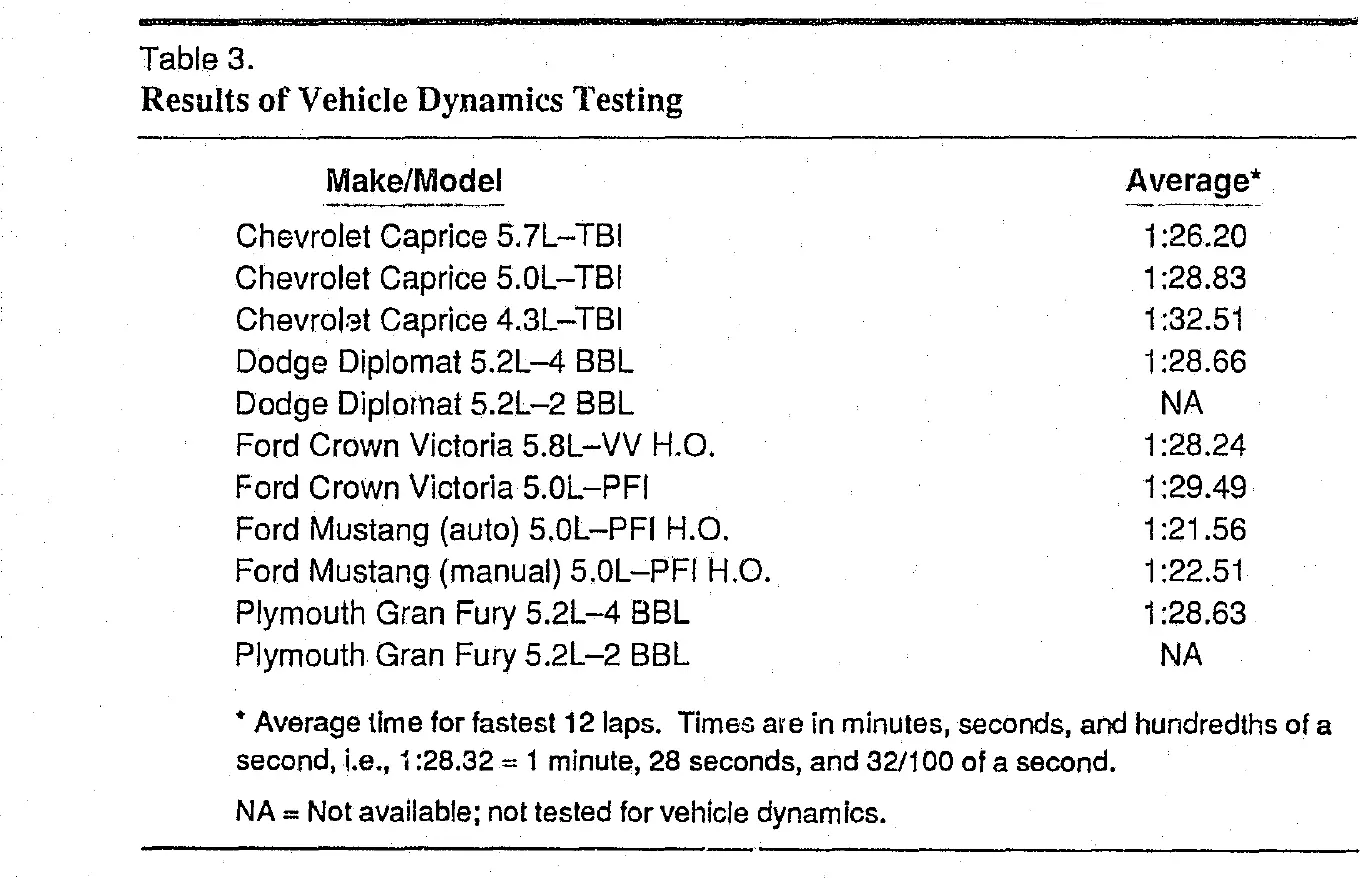
For 1989 the Chevrolet 350 traded its four-barrel carburetor for throttle-body injection, and the numbers moved like a decade had passed in one model year: 60 mph in 9.82 seconds — the quickest U.S.-specification sedan in the books held here since the 1978 Plymouth Fury (9.23) (the Canadian Caprices of 1986 and 1987 had run 9.59 and 9.49) — 100 mph in 29.35 seconds, a top speed of 122 mph, and a lap average of 1:26.20, just over two seconds a lap clear of every other sedan in the test. Eleven cars ran between 16 and 20 September 1988, and the injection map tells the story: TBI on all three Chevrolets, port injection on three Fords, and carburetors on every Chrysler product in the field.
The qualification bar tightened again — 12.7, 23.1 and 41.7 seconds — and it started claiming injected victims: the 305 Caprice and the port-injected Crown Victoria both missed the 0–100 gate. The carbureted 4-barrel M-bodies, in what was becoming an annual ritual of defiance, sailed through — and posted 119.1 mph for the Diplomat and 120.2 for the Gran Fury; the M-body Gran Fury had run 121.4 in 1984 and the Diplomat 121.5 in 1986. Meanwhile the Mustangs ran 137.2 and 138.0 mph, and for the first time the automatic out-lapped the 5-speed, 1:21.56 to 1:22.51, and the automatic’s average is the quickest in the books held here to that point.
This page is built from the NIJ’s preliminary TAP Alert bulletin (October 1988); the full November book has not been found online. The bulletin also carried a period gem: an offer of free MS-DOS software called AutoBid — built on this very test data, needing 384K of RAM — to help fleet managers rank patrol cars by performance or value. Agencies could order a copy by writing in on letterhead.
All eleven cars — dynamics, acceleration, top speed
| Car | Engine | 0–60 (s) | 0–80 (s) | 0–100 (s) | Top speed (mph) | Dynamics (s) |
|---|---|---|---|---|---|---|
| Ford Mustang (automatic) | 5.0L-PFI H.O. | 8.60 | 13.85 | 22.89 | 137.2 | 81.56 |
| Ford Mustang (5-speed) | 5.0L-PFI H.O. | 7.04 | 11.82 | 19.24 | 138.0 | 82.51 |
| Chevrolet Caprice | 5.7L-TBI | 9.82 | 17.59 | 29.35 | 122.0 | 86.20 |
| Ford Crown Victoria | 5.8L-VV H.O. | 11.98 | 20.46 | 36.55 | 119.1 | 88.24 |
| Plymouth Gran Fury | 5.2L-4BBL | 11.77 | 20.97 | 38.02 | 120.2 | 88.63 |
| Dodge Diplomat | 5.2L-4BBL | 11.84 | 21.69 | 38.95 | 119.1 | 88.66 |
| Chevrolet Caprice | 5.0L-TBI | 12.35 | 23.35 | 42.88 | 114.1 | 88.83 |
| Ford Crown Victoria | 5.0L-PFI | 12.39 | 21.88 | 42.14 | 110.0 | 89.49 |
| Chevrolet Caprice (V6) | 4.3L-TBI | 15.57 | 29.80 | 58.16 | 109.0 | 92.51 |
| Dodge Diplomat | 5.2L-2BBL | 14.38 | 25.36 | 55.58 | 113.6 | — |
| Plymouth Gran Fury | 5.2L-2BBL | 14.98 | 26.41 | 58.13 | 111.2 | — |
Measured against the year’s gates: the TBI Caprice 5.7, both 4-barrel M-bodies and the Crown Victoria 5.8 cleared everything. The 305 Caprice (42.88) and the port-injected Crown Victoria (42.14) both missed the 41.7-second 0–100 requirement, and the 5.0 Crown Victoria only just touched the required 110. The bulletin does not name the year’s winner — the scoring belongs to the full report (see below).
See the original pages: Tables 4, 5 and 3 in the bulletin
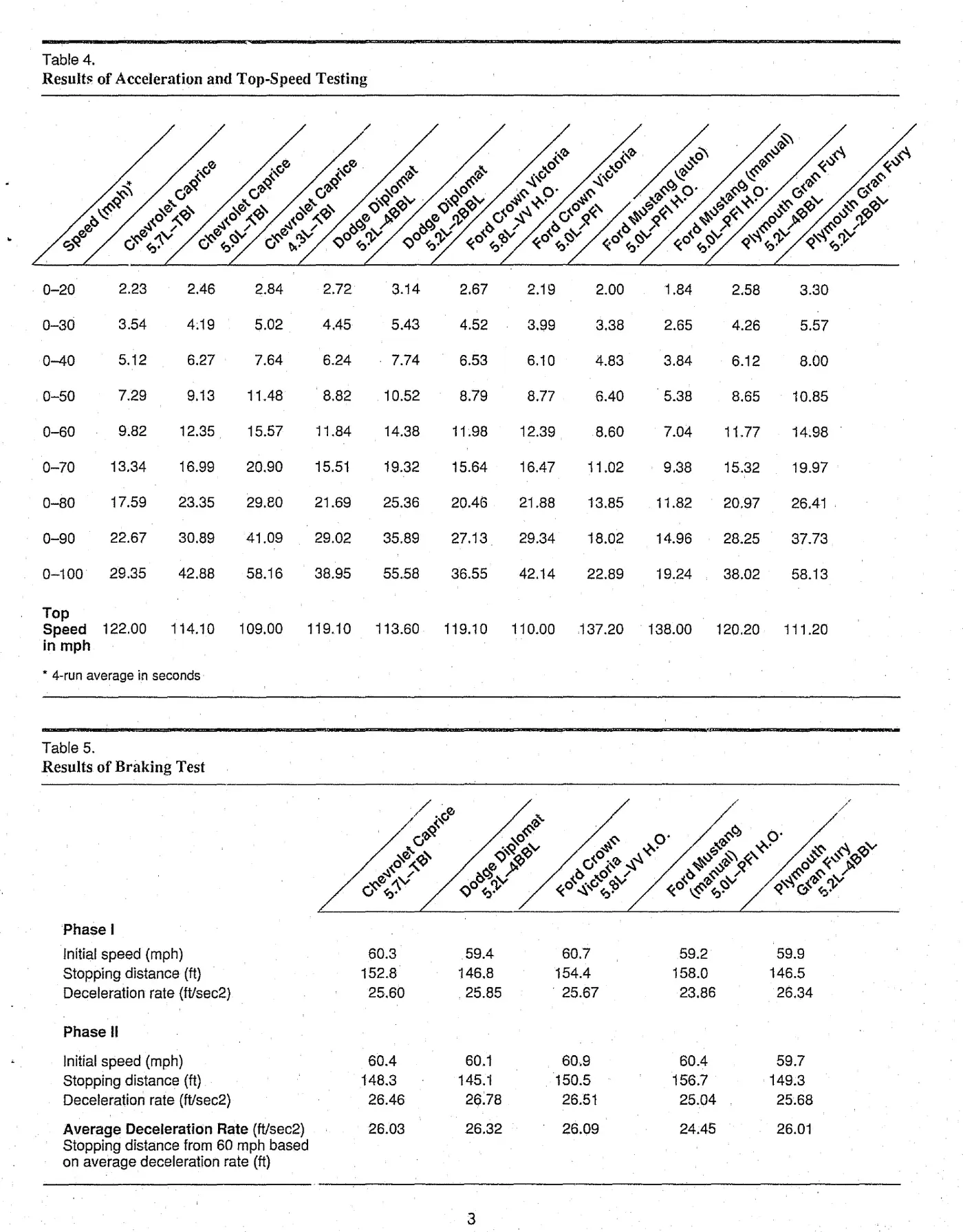
Complete acceleration data — every 10-mph increment, all eleven cars
| 0 to… | Mustang 5-spd | Mustang auto | Caprice 5.7 | Crown Vic 5.8 | Gran Fury 4BBL | Diplomat 4BBL | Caprice 5.0 | Crown Vic 5.0 | Diplomat 2BBL | Gran Fury 2BBL | Caprice 4.3 |
|---|---|---|---|---|---|---|---|---|---|---|---|
| 20 mph | 1.84 | 2.00 | 2.23 | 2.67 | 2.58 | 2.72 | 2.46 | 2.19 | 3.14 | 3.30 | 2.84 |
| 30 mph | 2.65 | 3.38 | 3.54 | 4.52 | 4.26 | 4.45 | 4.19 | 3.99 | 5.43 | 5.57 | 5.02 |
| 40 mph | 3.84 | 4.83 | 5.12 | 6.53 | 6.12 | 6.24 | 6.27 | 6.10 | 7.74 | 8.00 | 7.64 |
| 50 mph | 5.38 | 6.40 | 7.29 | 8.79 | 8.65 | 8.82 | 9.13 | 8.77 | 10.52 | 10.85 | 11.48 |
| 60 mph | 7.04 | 8.60 | 9.82 | 11.98 | 11.77 | 11.84 | 12.35 | 12.39 | 14.38 | 14.98 | 15.57 |
| 70 mph | 9.38 | 11.02 | 13.34 | 15.64 | 15.32 | 15.51 | 16.99 | 16.47 | 19.32 | 19.97 | 20.90 |
| 80 mph | 11.82 | 13.85 | 17.59 | 20.46 | 20.97 | 21.69 | 23.35 | 21.88 | 25.36 | 26.41 | 29.80 |
| 90 mph | 14.96 | 18.02 | 22.67 | 27.13 | 28.25 | 29.02 | 30.89 | 29.34 | 35.89 | 37.73 | 41.09 |
| 100 mph | 19.24 | 22.89 | 29.35 | 36.55 | 38.02 | 38.95 | 42.88 | 42.14 | 55.58 | 58.13 | 58.16 |
Brakes, ergonomics, fuel economy
| Car | 60–0 Phase I (ft) | 60–0 Phase II (ft) | Avg decel (ft/s²) |
|---|---|---|---|
| Dodge Diplomat 5.2L-4BBL | 146.8 | 145.1 | 26.32 |
| Ford Crown Victoria 5.8L-VV H.O. | 154.4 | 150.5 | 26.09 |
| Chevrolet Caprice 5.7L-TBI | 152.8 | 148.3 | 26.03 |
| Plymouth Gran Fury 5.2L-4BBL | 146.5 | 149.3 | 26.01 |
| Ford Mustang (5-speed) | 158.0 | 156.7 | 24.45 |
| Car / body | Ergonomics (pts) |
|---|---|
| Dodge Diplomat | 190.20 |
| Plymouth Gran Fury | 190.20 |
| Chevrolet Caprice | 189.60 |
| Ford Crown Victoria | 168.53 |
| Ford Mustang | 144.40 |
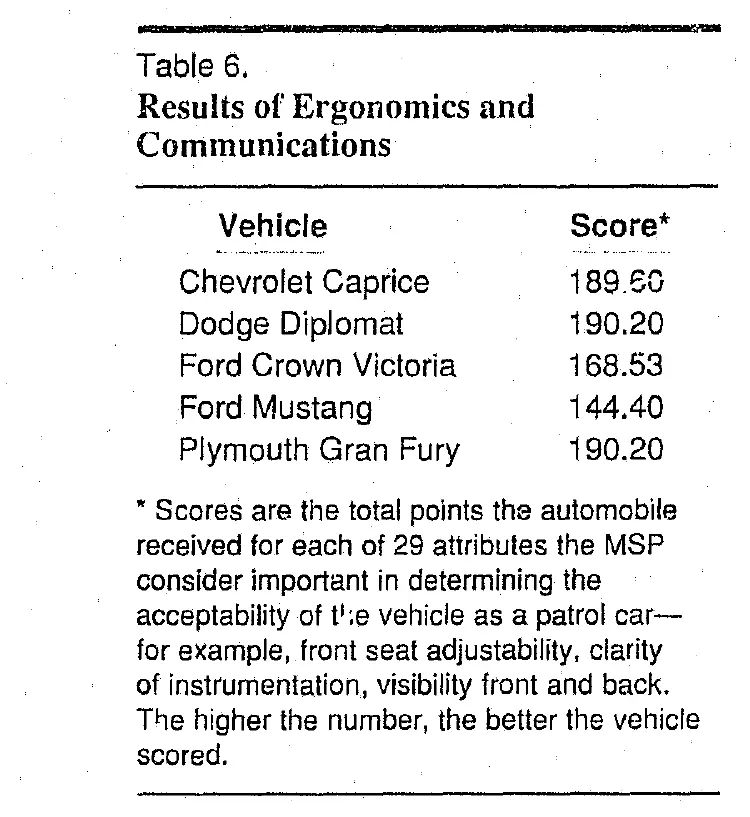
The Diplomat and Gran Fury ergonomics totals are identical as printed — shared body, as ever — and the aging M-bodies took the best ergonomics scores of the year.
See the original page: Table 6 in the bulletin
| Car | EPA combined (mpg) |
|---|---|
| Chevrolet Caprice (V6) | 19.0 |
| Ford Crown Victoria 5.0L-PFI | 17.4 |
| Chevrolet Caprice 5.0L-TBI | 17.2 |
| Ford Mustang (5-speed) | 16.9 |
| Ford Mustang (automatic) | 16.8 |
| Chevrolet Caprice 5.7L-TBI | 14.3 |
| Dodge Diplomat 5.2L-2BBL | 14.2 |
| Plymouth Gran Fury 5.2L-2BBL | 14.2 |
| Ford Crown Victoria 5.8L-VV H.O. | 13.1 |
| Dodge Diplomat 5.2L-4BBL | 12.7 |
| Plymouth Gran Fury 5.2L-4BBL | 12.7 |
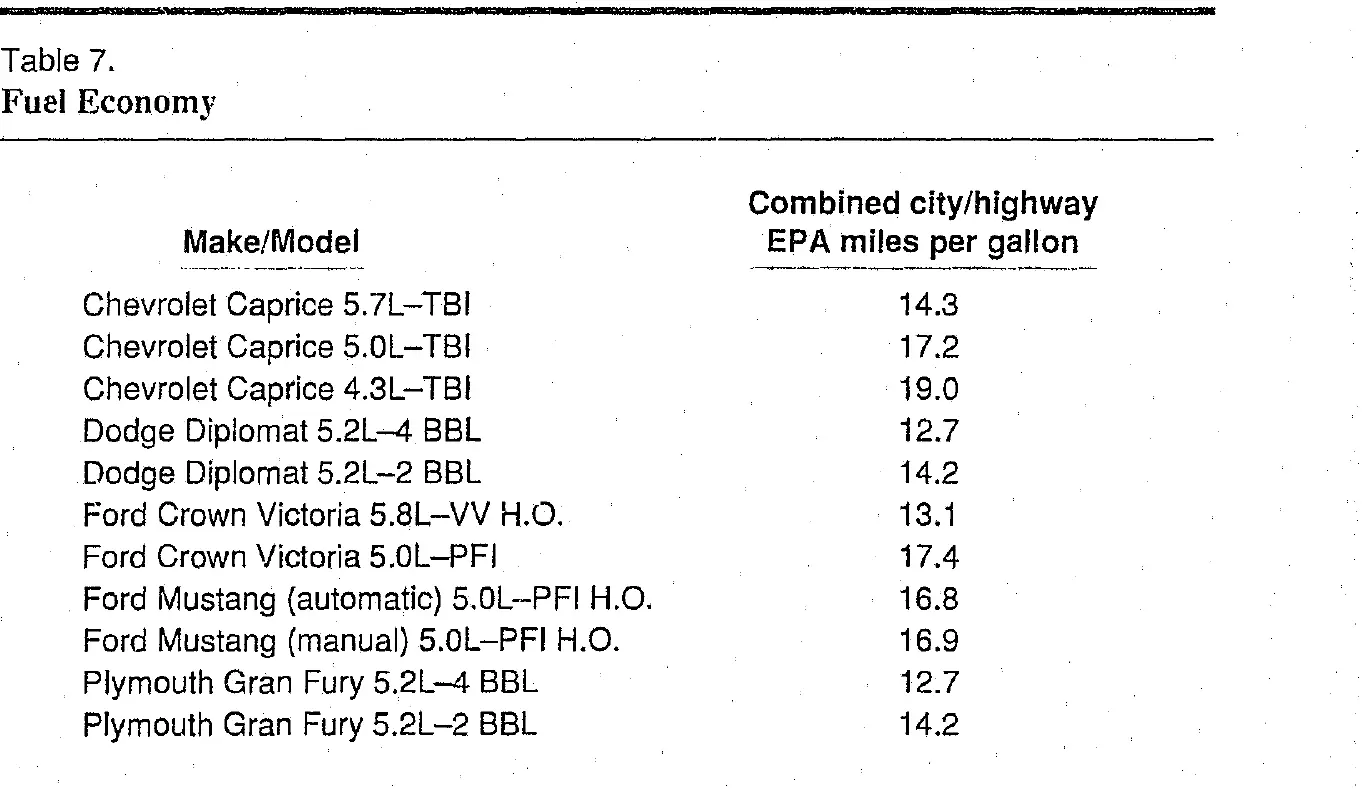
See the original page: Table 7 in the bulletin
What the bulletin doesn’t hold
This TAP Alert carried preliminary results only: the per-lap dynamics tables, the quarter-mile times, the final weighted scoring, the year’s winner, the bid prices, and the hardware specifications all belong to the full report published that November, which has not been found online. Those numbers will be added to this page from an original copy of the 1989 book; as far as I can tell, they are not available anywhere else online.
What 1989 settled
The moment GM’s fuel injection reached the 350, the sedan record book was rewritten in one September: the first U.S.-specification sedan in these books under ten seconds to 60 since 1978, and a lap average no four-door had approached. Every sedan benchmark the Caprice would carry into its legendary early-nineties form starts here.
And the M-bodies went out sprinting. In their last Michigan test in the books held here (the 1990 book has no Chrysler product), the carbureted Diplomat and Gran Fury cleared a bar that tripped two injected rivals, and ran 119.1 and 120.2 mph. The old guard didn’t fade; it was simply out-teched.