
Michigan test archive
1986 Michigan State Police Patrol Vehicle Test
A five-speed Mustang runs 137 mph, port fuel injection arrives, and three of the six sedans that ran the road course beat every sedan lap average on the earlier year pages.
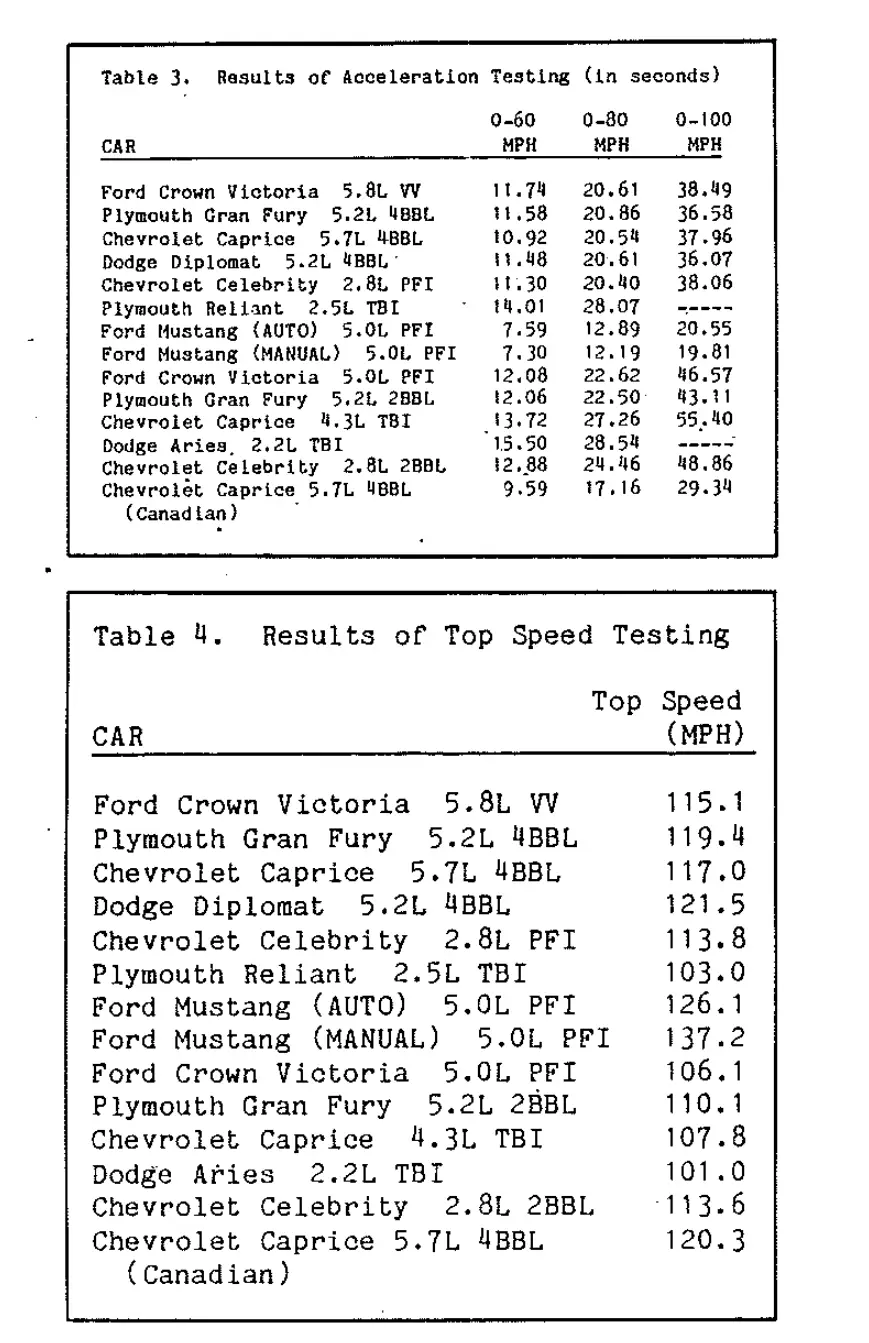
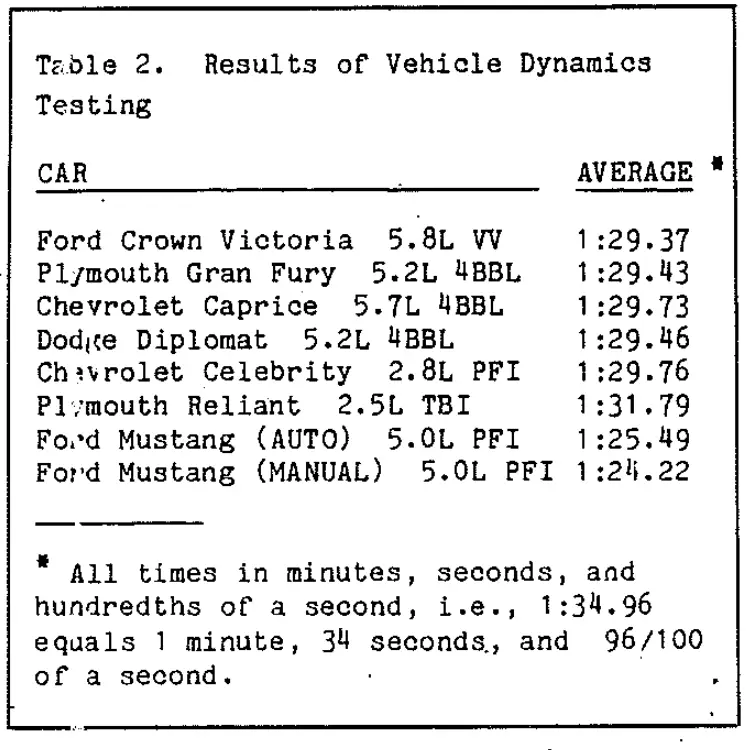
Fourteen cars ran the 1986 test, from 13 to 17 September 1985. Eight of them ran the road course, acceleration, top speed and braking, with seven ergonomics columns between them (one covers both Mustangs), and six more ran acceleration and top speed only. The quickest was the five-speed Ford Mustang: 60 mph in 7.30 seconds, 100 in 19.81, 137.2 mph and a 1:24.22 lap average. Each of those is the best on the year pages held here to that point: the 1984 five-speed Mustang had needed 7.43 and 20.77 seconds, the best lap average on those pages was the 1984 automatic Mustang’s 1:26.81, and the highest top speed the 1978 Plymouth Fury’s 132.7. The 1983 Mustang’s 1:28.31 had been the best on the 1983 page. The 1987 five-speed then ran 139.6 mph and lapped in 1:22.02; the 7.30 and 19.81 stood until the 1988 Mustang’s 6.90 and 19.07.
This is also the first test in the books held here with port fuel injection: the Mustangs, the 5.0 Crown Victoria and a 2.8-litre Chevrolet Celebrity, the first fuel-injected Celebrity in these books (the 1984 book’s was carbureted). The front-drive Celebrity reached 80 mph in 20.40 seconds, sooner than any of the V8 sedans except the Caprice listed as Canadian, and lapped within four tenths of a second of them. The Caprice 4.3, the Reliant 2.5 and the Aries 2.2 had throttle-body injection, so Chevrolet’s first fuel-injected engines in these books are both here.
The source is the National Institute of Justice’s TAPIC Alert of October 1985, which calls itself the bulletin’s “premier edition” and presents “the preliminary findings”. It prints no fuel economy and no bid adjustment, which it says the final results would include, and no scoring; that report is not held here, so this page has no winner.
All fourteen cars — acceleration, top speed and dynamics
| Car | Engine | 0–60 (s) | 0–80 (s) | 0–100 (s) | Top speed (mph) | Dynamics |
|---|---|---|---|---|---|---|
| Ford Crown Victoria 5.8L-VV | 5.8L (351) VV | 11.74 | 20.61 | 38.49 | 115.1 | 1:29.37 |
| Plymouth Gran Fury 5.2L-4BBL | 5.2L (318) 4BBL | 11.58 | 20.86 | 36.58 | 119.4 | 1:29.43 |
| Chevrolet Caprice 5.7L-4BBL | 5.7L (350) 4BBL | 10.92 | 20.54 | 37.96 | 117.0 | 1:29.73 |
| Dodge Diplomat 5.2L-4BBL | 5.2L (318) 4BBL | 11.48 | 20.61 | 36.07 | 121.5 | 1:29.46 |
| Chevrolet Celebrity 2.8L-PFI | 2.8L (173) PFI | 11.30 | 20.40 | 38.06 | 113.8 | 1:29.76 |
| Plymouth Reliant 2.5L-TBI | 2.5L (153) TBI | 14.01 | 28.07 | — | 103.0 | 1:31.79 |
| Ford Mustang (automatic) | 5.0L (302) PFI | 7.59 | 12.89 | 20.55 | 126.1 | 1:25.49 |
| Ford Mustang (5-speed) | 5.0L (302) PFI | 7.30 | 12.19 | 19.81 | 137.2 | 1:24.22 |
| Ford Crown Victoria 5.0L-PFI | 5.0L (302) PFI | 12.08 | 22.62 | 46.57 | 106.1 | — |
| Plymouth Gran Fury 5.2L-2BBL | 5.2L (318) 2BBL | 12.06 | 22.50 | 43.11 | 110.1 | — |
| Chevrolet Caprice 4.3L-TBI | 4.3L (262) TBI | 13.72 | 27.26 | 55.40 | 107.8 | — |
| Dodge Aries 2.2L-TBI | 2.2L (135) TBI | 15.50 | 28.54 | — | 101.0 | — |
| Chevrolet Celebrity 2.8L-2BBL | 2.8L (173) 2BBL | 12.88 | 24.46 | 48.86 | 113.6 | — |
| Chevrolet Caprice (Canadian) | 5.7L (350) 4BBL | 9.59 | 17.16 | 29.34 | 120.3 | — |
Among the sedans the honours split. Leaving aside the Caprice the bulletin lists as Canadian, the Caprice 5.7 was quickest to 60, the Celebrity to 80, and the Diplomat to 100 (36.07); the Diplomat’s 121.5 mph was the highest sedan top speed of all. The Canadian Caprice, also a 5.7 four-barrel, was quickest of the sedans to 60, 80 and 100: 9.59, 17.16 and 29.34 seconds; its top speed was 120.3. On the road course the five big and mid-size sedans finished within 0.39 seconds of each other, the Crown Victoria 5.8 first at 1:29.37. Three of them, the Crown Victoria 5.8, the Gran Fury and the Diplomat, beat every sedan lap average on the earlier year pages, the best of which is the 1985 Crown Victoria’s 1:29.67 (from the 1985 scoring sheet, which does not name the course); the Caprice and the Celebrity did not. All five beat the 1984 book’s best sedan average, the Impala’s 1:29.97. Four cars never reached 110 mph at all, so they could not meet the bulletin’s rule of 110 within 3 miles: the 5.0 Crown Victoria (106.1), the Caprice 4.3 (107.8), the Reliant (103.0) and the Aries (101.0). The bulletin names none of them as eliminated.
Against the September 1984 bar — the 1985 test’s, the latest held — the Caprice 4.3 would have missed all three times, the Reliant and the Aries 60 and 80 mph (neither has a 0–100 time), the carbureted Celebrity 80 and 100 (24.46 and 48.86), and the 5.0 Crown Victoria 100 (46.57 against 45.0). The 1987 bulletin explains why Michigan then tightened the times: “Last year, the MSP found that all of the test vehicles that qualified in the acceleration test exceeded the minimum requirements for the 0-60, 0-80, and 0-100 mph acceleration. Hence, the minimum requirements this year are 10 percent greater than last year’s lowest score.” The 1987 times, 12.9, 23.0 and 42.3 seconds, agree to within 0.06 seconds with 1.1 times the slowest 1986 figures among the five sedans that ran the full programme apart from the Reliant — 11.74, 20.86 and 38.49, which give 12.91, 22.95 and 42.34 — which suggests that the Reliant and the slower acceleration-only cars were not counted among those that qualified.
See the original page: Tables 2, 3 and 4 in the bulletin
Brakes and ergonomics
| Car | 60–0 Phase I (ft) | 60–0 Phase II (ft) | Avg decel (ft/s²) | Ergonomics (pts) |
|---|---|---|---|---|
| Plymouth Gran Fury 5.2L-4BBL | 146.4 | 148.5 | 26.71 | 189.20 |
| Chevrolet Celebrity 2.8L-PFI | 153.6 | 142.8 | 26.43 | 163.95 |
| Ford Mustang (5-speed) | 150.4 | 145.2 | 26.43 | 147.90 |
| Ford Mustang (automatic) | 157.3 | 161.4 | 24.31 | |
| Plymouth Reliant 2.5L-TBI | 153.6 | 144.7 | 26.42 | 164.95 |
| Dodge Diplomat 5.2L-4BBL | 150.3 | 149.7 | 25.95 | 189.20 |
| Ford Crown Victoria 5.8L-VV | 157.4 | 158.0 | 24.68 | 195.45 |
| Chevrolet Caprice 5.7L-4BBL | 169.4 | 155.5 | 24.20 | 186.10 |
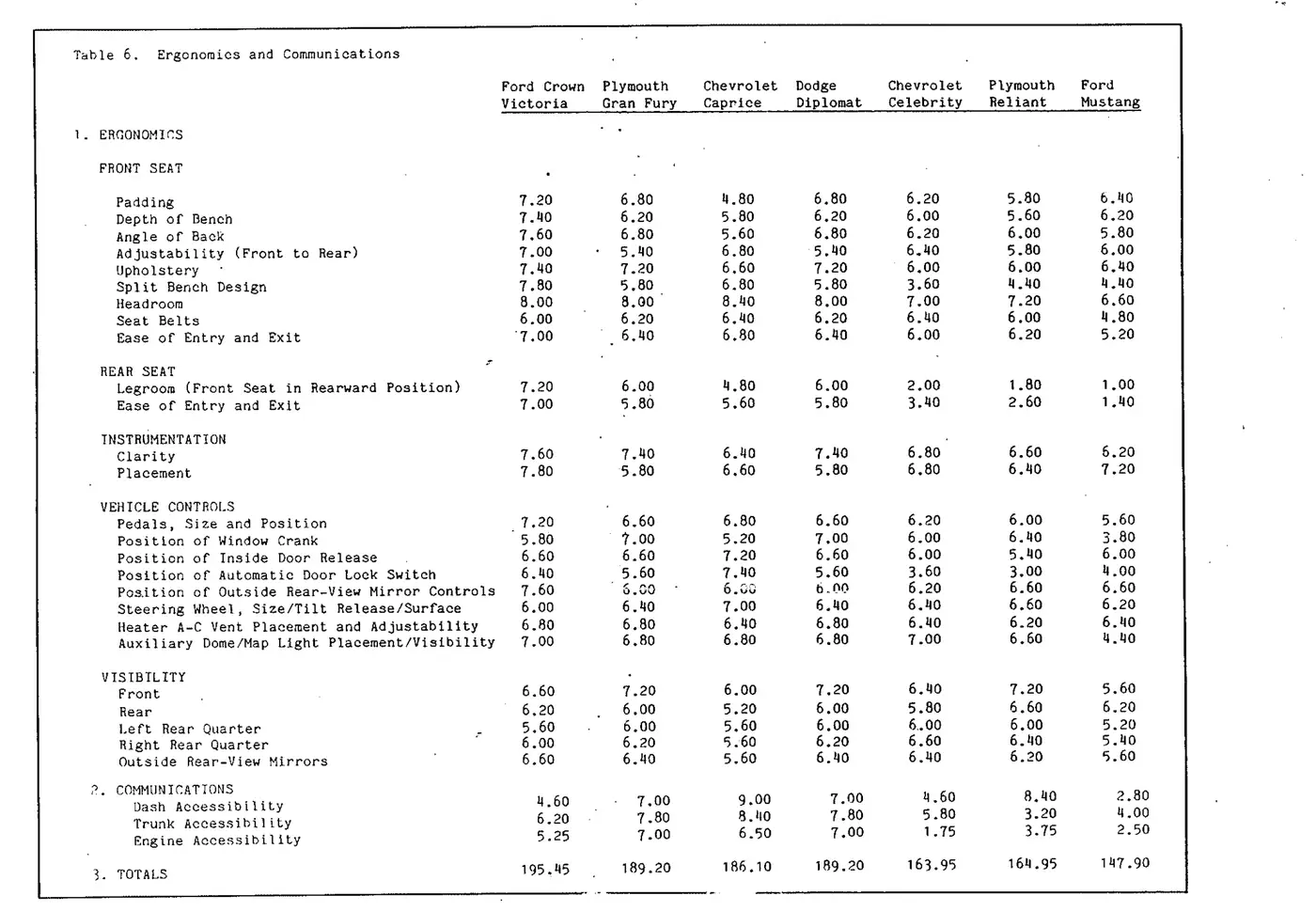
The Gran Fury’s 26.71 ft/s² is the second-best average in the books held here to that point, behind the 1985 Diplomat’s 27.11 (the 1985 scoring sheet prints one deceleration figure per car) and ahead of the 1981 Impala’s 26.62; the 1987 Gran Fury and Diplomat then reached 27.44 and 27.24. The Caprice 5.7 was last at 24.20, after a first stop of 169.4 feet, the longest in the test. On ergonomics the Crown Victoria led with 195.45 and the Mustang trailed with 147.90; its rear-seat legroom scored 1.00 out of 10.
See the original page: Table 5 in the bulletin
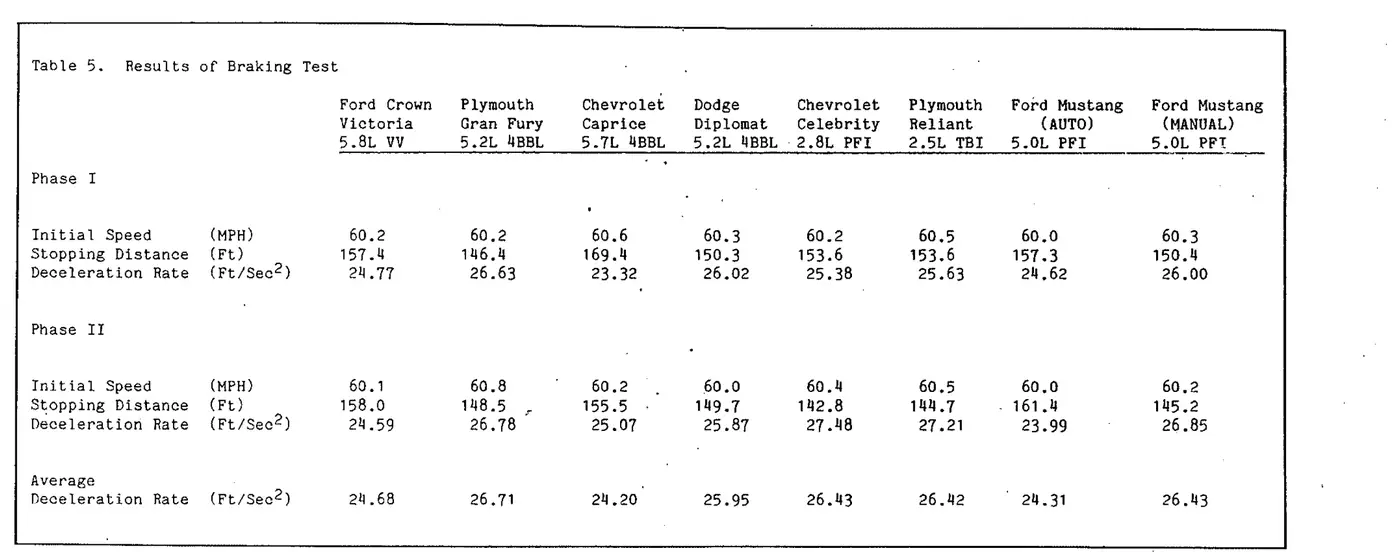
Braking — both phases, with initial speeds
| Car | Phase I mph | Phase I ft | Phase I ft/s² | Phase II mph | Phase II ft | Phase II ft/s² | Average rate |
|---|---|---|---|---|---|---|---|
| Ford Crown Victoria 5.8L-VV | 60.2 | 157.4 | 24.77 | 60.1 | 158.0 | 24.59 | 24.68 |
| Plymouth Gran Fury 5.2L-4BBL | 60.2 | 146.4 | 26.63 | 60.8 | 148.5 | 26.78 | 26.71 |
| Chevrolet Caprice 5.7L-4BBL | 60.6 | 169.4 | 23.32 | 60.2 | 155.5 | 25.07 | 24.20 |
| Dodge Diplomat 5.2L-4BBL | 60.3 | 150.3 | 26.02 | 60.0 | 149.7 | 25.87 | 25.95 |
| Chevrolet Celebrity 2.8L-PFI | 60.2 | 153.6 | 25.38 | 60.4 | 142.8 | 27.48 | 26.43 |
| Plymouth Reliant 2.5L-TBI | 60.5 | 153.6 | 25.63 | 60.5 | 144.7 | 27.21 | 26.42 |
| Ford Mustang (automatic) | 60.0 | 157.3 | 24.62 | 60.0 | 161.4 | 23.99 | 24.31 |
| Ford Mustang (5-speed) | 60.3 | 150.4 | 26.00 | 60.2 | 145.2 | 26.85 | 26.43 |
The Celebrity’s second stop, 142.8 feet from 60.4 mph at 27.48 ft/s², was the shortest single stop in the test.
Ergonomics and communications — all 29 items
| Item | Crown Victoria | Gran Fury | Caprice | Diplomat | Celebrity | Reliant | Mustang |
|---|---|---|---|---|---|---|---|
| Front seat | |||||||
| Padding | 7.20 | 6.80 | 4.80 | 6.80 | 6.20 | 5.80 | 6.40 |
| Depth of bench | 7.40 | 6.20 | 5.80 | 6.20 | 6.00 | 5.60 | 6.20 |
| Angle of back | 7.60 | 6.80 | 5.60 | 6.80 | 6.20 | 6.00 | 5.80 |
| Adjustability (front to rear) | 7.00 | 5.40 | 6.80 | 5.40 | 6.40 | 5.80 | 6.00 |
| Upholstery | 7.40 | 7.20 | 6.60 | 7.20 | 6.00 | 6.00 | 6.40 |
| Split bench design | 7.80 | 5.80 | 6.80 | 5.80 | 3.60 | 4.40 | 4.40 |
| Headroom | 8.00 | 8.00 | 8.40 | 8.00 | 7.00 | 7.20 | 6.60 |
| Seat belts | 6.00 | 6.20 | 6.40 | 6.20 | 6.40 | 6.00 | 4.80 |
| Ease of entry and exit | 7.00 | 6.40 | 6.80 | 6.40 | 6.00 | 6.20 | 5.20 |
| Rear seat | |||||||
| Legroom (front seat in rearward position) | 7.20 | 6.00 | 4.80 | 6.00 | 2.00 | 1.80 | 1.00 |
| Ease of entry and exit | 7.00 | 5.80 | 5.60 | 5.80 | 3.40 | 2.60 | 1.40 |
| Instrumentation | |||||||
| Clarity | 7.60 | 7.40 | 6.40 | 7.40 | 6.80 | 6.60 | 6.20 |
| Placement | 7.80 | 5.80 | 6.60 | 5.80 | 6.80 | 6.40 | 7.20 |
| Vehicle controls | |||||||
| Pedals, size and position | 7.20 | 6.60 | 6.80 | 6.60 | 6.20 | 6.00 | 5.60 |
| Position of window crank | 5.80 | 7.00 | 5.20 | 7.00 | 6.00 | 6.40 | 3.80 |
| Position of inside door release | 6.60 | 6.60 | 7.20 | 6.60 | 6.00 | 5.40 | 6.00 |
| Position of automatic door lock switch | 6.40 | 5.60 | 7.40 | 5.60 | 3.60 | 3.00 | 4.00 |
| Position of outside rear-view mirror controls | 7.60 | 6.00 | 6.00 | 6.00 | 6.20 | 6.60 | 6.60 |
| Steering wheel, size/tilt release/surface | 6.00 | 6.40 | 7.00 | 6.40 | 6.40 | 6.60 | 6.20 |
| Heater A-C vent placement and adjustability | 6.80 | 6.80 | 6.40 | 6.80 | 6.40 | 6.20 | 6.40 |
| Auxiliary dome/map light placement/visibility | 7.00 | 6.80 | 6.80 | 6.80 | 7.00 | 6.60 | 4.40 |
| Visibility | |||||||
| Front | 6.60 | 7.20 | 6.00 | 7.20 | 6.40 | 7.20 | 5.60 |
| Rear | 6.20 | 6.00 | 5.20 | 6.00 | 5.80 | 6.60 | 6.20 |
| Left rear quarter | 5.60 | 6.00 | 5.60 | 6.00 | 6.00 | 6.00 | 5.20 |
| Right rear quarter | 6.00 | 6.20 | 5.60 | 6.20 | 6.60 | 6.40 | 5.40 |
| Outside rear-view mirrors | 6.60 | 6.40 | 5.60 | 6.40 | 6.40 | 6.20 | 5.60 |
| Communications | |||||||
| Dash accessibility | 4.60 | 7.00 | 9.00 | 7.00 | 4.60 | 8.40 | 2.80 |
| Trunk accessibility | 6.20 | 7.80 | 8.40 | 7.80 | 5.80 | 3.20 | 4.00 |
| Engine accessibility | 5.25 | 7.00 | 6.50 | 7.00 | 1.75 | 3.75 | 2.50 |
| Total | 195.45 | 189.20 | 186.10 | 189.20 | 163.95 | 164.95 | 147.90 |
The Caprice scored best of all seven on dash and trunk accessibility for installing equipment, 9.00 and 8.40; the Celebrity’s engine bay scored 1.75. The Crown Victoria’s lead came from the seats: it was first or level first on seven of the nine front-seat items.
See the original page: Table 6 in the bulletin
What else this file holds
The makers’ letters. In March 1985 F/Lt Curtis L. VanDenBerg of the Policy Development and Evaluation Section asked Dan Bowie, Chrysler’s zone fleet manager, which 1986 cars and engines it would offer, planning delivery of test vehicles on 9 September and testing on 14 and 16 September. Chrysler’s fleet engineering office set out its 1986 offerings in an internal memo to Bowie: the Gran Fury and Diplomat were “essentially carryover from 1985”, and the Reliant and Aries had a new optional Chrysler 2.5-litre fuel-injected engine with two balance shafts, replacing the optional Mitsubishi 2.6 carbureted engine. Ford’s April 1985 letter listed the Crown Victoria with the 302 EFI and the 351 H.O. variable-venturi engine and the Mustang 302 H.O. EFI with a five-speed or an automatic, and said “1986 police packages are carryover 1985 regarding standard and optional equipment”.
The 1985 specification. The September 1984 patrol-car specification names the Chevrolet Impala, Dodge Diplomat, Ford Crown Victoria and Plymouth Gran Fury, engine at the maker’s option. It already scores the bid the way later books do: each category’s best car scores zero, the others their deviation from it, weighted 30 for dynamics, 20 for acceleration to 100, 10 for braking, 20 for top speed, 10 for ergonomics and communications and 10 for fuel economy, with 1% of the lowest bid per point added to each bid. The bulletin itself gives ergonomics 20 percent and lists no fuel economy category. The weights were already the 1984 book’s, which still summed weighted Z-scores; the 1985 scoring sheet, on the 1985 page, is the earliest held that applies the new method.
A station-wagon specification. Mich. 3958-0018, dated 1 October 1984, for a six-passenger wagon (Caprice, LTD Crown Victoria S, Custom Cruiser or Mercury), carries handwritten revisions, among them a date that appears to read June 1985 beside the struck-through printed one, a 6 apparently written over the 5 of the 1985 model year, and 100 written above the printed 80-amp alternator.
What 1986 settled
The sedans were close to one another and a long way from the Mustang: even the Canadian Caprice needed 29.34 seconds to 100 mph against the five-speed’s 19.81, and the fastest sedan, the Diplomat, topped out 15.7 mph short of it. Port injection had reached the test, on Fords and on a front-drive Chevrolet that kept up with the V8 sedans around the road course.
The bar was about to move. The 1987 bulletin says every car that qualified in 1986 had beaten the acceleration minimums, and by its own account set the 1987 ones 10 percent above the previous year’s lowest score.