
Michigan test archive
1992 Michigan State Police Patrol Vehicle Test
A Camaro runs 152 mph, the first vehicle in these books over 150, a Jeep Cherokee becomes the first four-wheel-drive vehicle tested in them, and two Caprices carry governors.
Twelve vehicles were tested, and a second, anti-lock Crown Victoria appears in the braking results only. The acceleration, top-speed and braking runs were made at the Chrysler Proving Grounds on 14 September 1991, the dynamics on the 1.635-mile Michigan International Speedway road course, and the book was published that month. Six were police patrol package cars and six special service vehicles. Michigan’s own bid specification names two models, the Chevrolet Caprice and the Ford Crown Victoria, with the engine at the maker’s option, and the book scores the Caprice 5.7 against Ford’s new 4.6-litre Crown Victoria: the Caprice led the weighted score, 4.33 against 4.93 (the lower total is better; the contract goes to the lowest bid after that score is applied, and the book prints no bids). The book scores the two automatic pursuit cars against each other as well, and prints results for the rest; its preface says the report is meant to help other agencies choose their own 1992 cars.
The fastest of them was a Chevrolet Camaro, in the second year of Camaros in the books held here: the 1991 bulletin has two. The 5.7-litre automatic ran 152.0 mph, reached 100 in 17.29 seconds and averaged 1:20.56 around the road course. Every one of those is the best in the books held to that point: the 1991 automatic Camaro had run 150.00 mph, 17.31 seconds and 1:21.08. It is the first vehicle in these books over 150 mph; the 1991 car reached exactly 150. Ed Sanow’s report on the test says the lap average “broke the MSP record set last year”. The 1991 test’s full book is not held, but its results bulletin is, and the best lap average in it, presumably the record Sanow meant, is that Camaro’s 1:21.08. Sanow also says the pursuit-car results were “exactly the opposite from last year”; the bulletin does not show what he meant. The two Special Service Mustangs ran 136.1 and 136.0.
The book also holds two firsts that later pages had placed in other years. The Jeep Cherokee, driven in full-time four-wheel drive at the manufacturer’s request, is the first sport utility and the first four-wheel-drive vehicle in the books held, a year before the 1993 one. (The 1985 file records a Jeep Wagoneer in service at the Wakefield post from 1984, but as a field evaluation, not in the test.) And two Caprices, the 5.0 with the 3.08 axle and the station wagon, had what the preface calls “governors” which “limited the top speeds to what are shown”: 114.0 and 113.0 mph. They are the first individually limited top speeds in the books held here; the next are the five vehicles the 1994 preface says have “electronic limiters”, and the 1995 bulletin is the first to mark electronic limiters in its tables (this book’s own tables already footnote its two governed Caprices).
The police patrol package cars
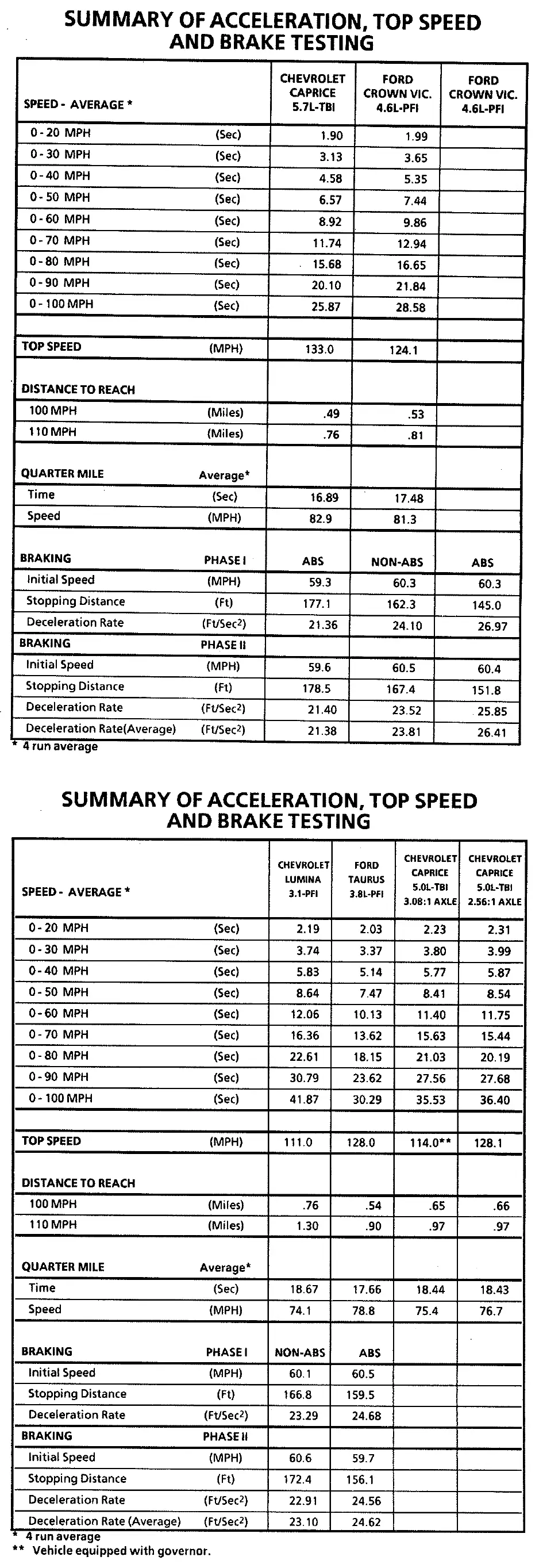
| Vehicle | Engine | 0–60 (s) | 0–100 (s) | Top speed | ¼ mile | Dynamics | Brakes (ft/s²) | 60–0 computed (ft) |
|---|---|---|---|---|---|---|---|---|
| Chevrolet Caprice | 5.7L TBI | 8.92 | 25.87 | 133.0 | 16.89 @ 82.9 | 1:26.40 | 21.38 | 181.1 |
| Ford Crown Victoria | 4.6L PFI | 9.86 | 28.58 | 124.1 | 17.48 @ 81.3 | 1:27.63 | 23.81 | 162.6 |
| Ford Taurus | 3.8L PFI | 10.13 | 30.29 | 128.0 | 17.66 @ 78.8 | 1:27.11 | 24.62 | 157.3 |
| Chevrolet Caprice (3.08:1 axle) | 5.0L TBI | 11.40 | 35.53 | 114.0 ** | 18.44 @ 75.4 | 1:29.23 | — | — |
| Chevrolet Caprice (2.56:1 axle) | 5.0L TBI | 11.75 | 36.40 | 128.1 | 18.43 @ 76.7 | — | — | — |
| Chevrolet Lumina | 3.1L PFI | 12.06 | 41.87 | 111.0 | 18.67 @ 74.1 | 1:31.78 | 23.10 | 167.6 |
| Ford Crown Victoria (ABS) | 4.6L PFI | braking results only | 26.41 | 146.6 | ||||
Gold row: the lower weighted score of the two bid sedans. The Caprice took the dynamics, acceleration, top-speed and ergonomics columns and lost only braking and fuel. Its 133.0 mph is the fastest sedan figure in the books held to that point, three tenths of a mile an hour above the 1978 Plymouth Fury’s 132.7 and three above the 1991 Caprice 5.7’s 130.0, and its 25.87 seconds to 100 is the quickest by a sedan since that 1978 Fury’s 24.78.
Its braking is the other half of the story. With anti-lock brakes, front discs and rear drums, the Caprice averaged 21.38 ft/s², a computed 181.1 feet from 60 mph, the lowest rate of any car in the test but its own station wagon. The Crown Victoria that ran everything else had conventional brakes and four-wheel discs and averaged 23.81, although the specification calls for anti-lock brakes (page 2). A second Crown Victoria, with ABS, appears only in the braking results; it averaged 26.41, and that is the figure the book scores for Ford (page 57). Ed Sanow’s report on the test in Law Enforcement Technology (February 1992) adds that Chevrolet was evaluating rear disc brakes for the Caprice.
Measured against the book’s qualification times of 11.7, 20.3 and 35.1 seconds (page 6), the Caprice 5.7, the Crown Victoria and the Taurus clear all three. The 3.08-axle Caprice misses 80 and 100 mph (21.03 and 35.53), the 2.56-axle car misses 60 and 100 (11.75 and 36.40), and the Lumina misses all three (12.06, 22.61 and 41.87). Page 6 applies the times to all vehicles submitted, and the special service Cherokee misses 80 and 100 too (20.40 and 40.39, page 31). The book names none of them as failing; Ed Sanow’s report says the Caprice 5.0, the Cherokee and the Lumina “failed to meet the MSP requirements for acceleration”. Every vehicle timed reached 110 mph inside two miles; the slowest to do it was the Cherokee, at 1.53.
The two 5.0 Caprices were entered with different axles, 3.08:1 and 2.56:1. The 3.08 car is quicker to 60 and to 100; the tall-geared 2.56 car is quicker at 70 and 80 mph and ran 128.1, but the 3.08 car’s 114.0 is a governed figure, so the comparison of top speeds is not like for like. The 2.56 car was submitted for acceleration and top speed only.
See the original pages: the 1992 book’s summary pages for these cars
The special service vehicles
| Vehicle | Engine | 0–60 (s) | 0–100 (s) | Top speed | ¼ mile | Dynamics | Brakes (ft/s²) | 60–0 computed (ft) |
|---|---|---|---|---|---|---|---|---|
| Chevrolet Camaro (automatic) | 5.7L PFI | 6.55 | 17.29 | 152.0 | 15.10 @ 93.4 | 1:20.56 | 26.74 | 144.8 |
| Chevrolet Camaro (5-speed) | 5.0L PFI | 7.24 | 18.40 | 150.0 | 15.49 @ 91.8 | 1:21.56 | 26.32 | 147.1 |
| Ford Mustang (automatic) | 5.0L PFI-H.O. | 8.08 | 21.92 | 136.1 | 16.25 @ 88.2 | 1:22.54 | 22.45 | 172.5 |
| Ford Mustang (5-speed) | 5.0L PFI-H.O. | 6.78 | 18.99 | 136.0 | 15.41 @ 91.6 | 1:22.69 | — | — |
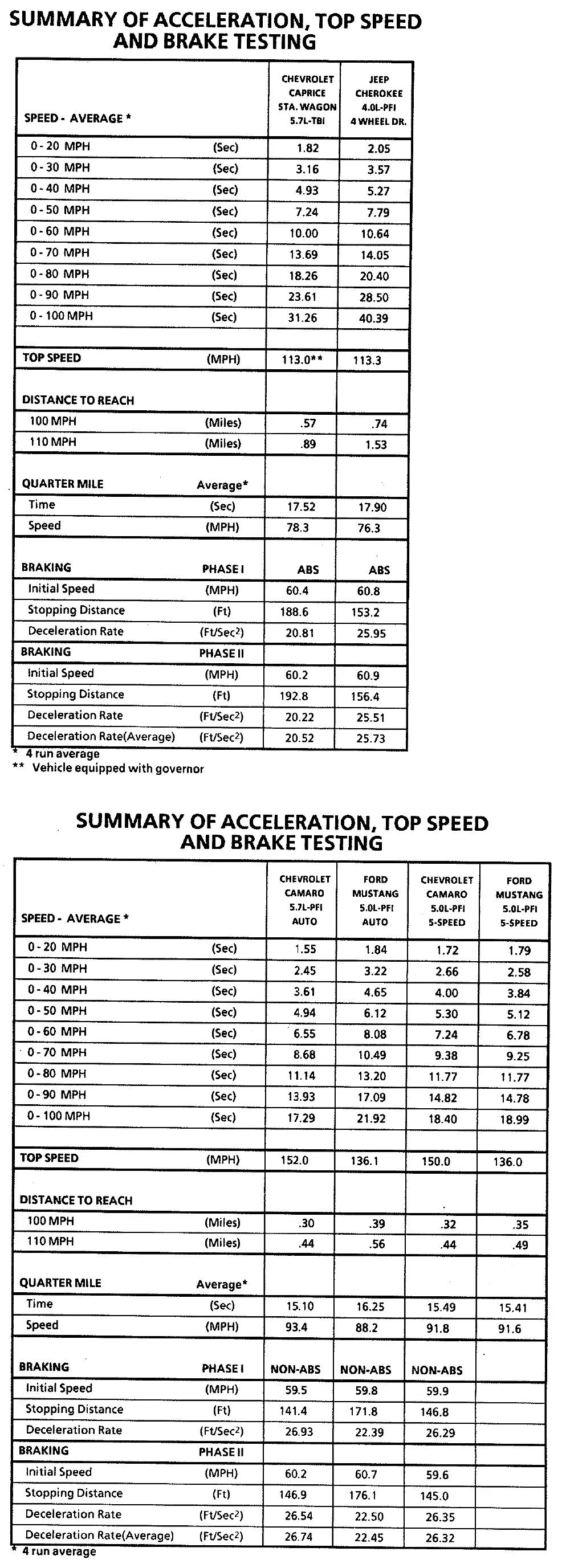
| Jeep Cherokee (4WD) | 4.0L PFI | 10.64 | 40.39 | 113.3 | 17.90 @ 76.3 | 1:27.79 | 25.73 | 150.5 |
| Chevrolet Caprice Station Wagon | 5.7L TBI | 10.00 | 31.26 | 113.0 ** | 17.52 @ 78.3 | 1:29.06 | 20.52 | 188.7 |
Gold row: the fastest and quickest vehicle in the test. Its 17.29 seconds to 100, 152.0 mph and 1:20.56 lap average are the best in the books held to that point, against the 1991 automatic Camaro’s 17.31, 150.00 and 1:21.08, and its 15.10-second quarter mile beats the 1990 five-speed Mustang’s 15.22 (the 1978, 1985, 1986, 1989 and 1991 pages have no quarter-mile times). Its 6.55 seconds to 60 is not a record: the 1991 Camaro ran 6.51. It also had the best braking rate in the test, 26.74 ft/s², without anti-lock brakes. Steendam’s 1:19.68 was the quickest single lap printed. The 5.0-litre five-speed Camaro ran 150.0. Scored against each other, the automatic Camaro beat the automatic Mustang 0.45 to 10.30; the Mustang lost on every column except fuel (page 57).
The Cherokee lapped in 1:27.79, 0.16 seconds behind the Crown Victoria and quicker than the 5.0 Caprice, the Lumina and the station wagon. Its 25.73 ft/s² was the fourth-best braking rate of the ten vehicles brake-tested. It was slow in a straight line: 40.39 seconds to 100 and 113.3 mph.
The station wagon averaged 20.52 ft/s², a computed 188.7 feet. Of the braking rates on the archive’s year pages, only the 1978 Ford LTD II’s 19.19 is lower.
See the original pages: the 1992 book’s summary pages for these vehicles
Complete acceleration ladders — every 10-mph increment
| 0 to… | Caprice 5.7 | Crown Vic | Taurus | Caprice 5.0 (3.08) | Caprice 5.0 (2.56) | Lumina | Camaro auto | Camaro 5-spd | Mustang auto | Mustang 5-spd | Cherokee | Wagon 5.7 |
|---|---|---|---|---|---|---|---|---|---|---|---|---|
| 20 mph | 1.90 | 1.99 | 2.03 | 2.23 | 2.31 | 2.19 | 1.55 | 1.72 | 1.84 | 1.79 | 2.05 | 1.82 |
| 30 mph | 3.13 | 3.65 | 3.37 | 3.80 | 3.99 | 3.74 | 2.45 | 2.66 | 3.22 | 2.58 | 3.57 | 3.16 |
| 40 mph | 4.58 | 5.35 | 5.14 | 5.77 | 5.87 | 5.83 | 3.61 | 4.00 | 4.65 | 3.84 | 5.27 | 4.93 |
| 50 mph | 6.57 | 7.44 | 7.47 | 8.41 | 8.54 | 8.64 | 4.94 | 5.30 | 6.12 | 5.12 | 7.79 | 7.24 |
| 60 mph | 8.92 | 9.86 | 10.13 | 11.40 | 11.75 | 12.06 | 6.55 | 7.24 | 8.08 | 6.78 | 10.64 | 10.00 |
| 70 mph | 11.74 | 12.94 | 13.62 | 15.63 | 15.44 | 16.36 | 8.68 | 9.38 | 10.49 | 9.25 | 14.05 | 13.69 |
| 80 mph | 15.68 | 16.65 | 18.15 | 21.03 | 20.19 | 22.61 | 11.14 | 11.77 | 13.20 | 11.77 | 20.40 | 18.26 |
| 90 mph | 20.10 | 21.84 | 23.62 | 27.56 | 27.68 | 30.79 | 13.93 | 14.82 | 17.09 | 14.78 | 28.50 | 23.61 |
| 100 mph | 25.87 | 28.58 | 30.29 | 35.53 | 36.40 | 41.87 | 17.29 | 18.40 | 21.92 | 18.99 | 40.39 | 31.26 |
| Top speed | 133.0 | 124.1 | 128.0 | 114.0 ** | 128.1 | 111.0 | 152.0 | 150.0 | 136.1 | 136.0 | 113.3 | 113.0 ** |
| Miles to 100 | 0.49 | 0.53 | 0.54 | 0.65 | 0.66 | 0.76 | 0.30 | 0.32 | 0.39 | 0.35 | 0.74 | 0.57 |
| Miles to 110 | 0.76 | 0.81 | 0.90 | 0.97 | 0.97 | 1.30 | 0.44 | 0.44 | 0.56 | 0.49 | 1.53 | 0.89 |
The Mustang five-speed is the odd ladder: quicker than the Camaro five-speed from 30 to 70 mph, level with it at 80, still four hundredths ahead at 90, and then 0.59 seconds behind at 100, 18.99 against 18.40.
Braking — both measured stops for every car
| Vehicle | Brakes | Phase I speed | Phase I distance (ft) | Phase I rate | Phase II speed | Phase II distance (ft) | Phase II rate | Average rate | 60–0 computed (ft) |
|---|---|---|---|---|---|---|---|---|---|
| Chevrolet Camaro (automatic) | conventional | 59.5 | 141.4 | 26.93 | 60.2 | 146.9 | 26.54 | 26.74 | 144.8 |
| Ford Crown Victoria (ABS) | ABS | 60.3 | 145.0 | 26.97 | 60.4 | 151.8 | 25.85 | 26.41 | 146.6 |
| Chevrolet Camaro (5-speed) | conventional | 59.9 | 146.8 | 26.29 | 59.6 | 145.0 | 26.35 | 26.32 | 147.1 |
| Jeep Cherokee (4WD) | ABS | 60.8 | 153.2 | 25.95 | 60.9 | 156.4 | 25.51 | 25.73 | 150.5 |
| Ford Taurus | ABS | 60.5 | 159.5 | 24.68 | 59.7 | 156.1 | 24.56 | 24.62 | 157.3 |
| Ford Crown Victoria | conventional | 60.3 | 162.3 | 24.10 | 60.5 | 167.4 | 23.52 | 23.81 | 162.6 |
| Chevrolet Lumina | conventional | 60.1 | 166.8 | 23.29 | 60.6 | 172.4 | 22.91 | 23.10 | 167.6 |
| Ford Mustang (automatic) | conventional | 59.8 | 171.8 | 22.39 | 60.7 | 176.1 | 22.50 | 22.45 | 172.5 |
| Chevrolet Caprice | ABS | 59.3 | 177.1 | 21.36 | 59.6 | 178.5 | 21.40 | 21.38 | 181.1 |
| Chevrolet Caprice Station Wagon | ABS | 60.4 | 188.6 | 20.81 | 60.2 | 192.8 | 20.22 | 20.52 | 188.7 |
The two Crown Victorias, the same model with and without anti-lock brakes, averaged 26.41 and 23.81 on the same day, a difference of 16.0 feet in the computed stop. The 1993 bulletin, the 1994 book, the 1995 bulletin and the 1996 book repeat the comparison. The Caprice and its wagon are the two lowest rates in the test.
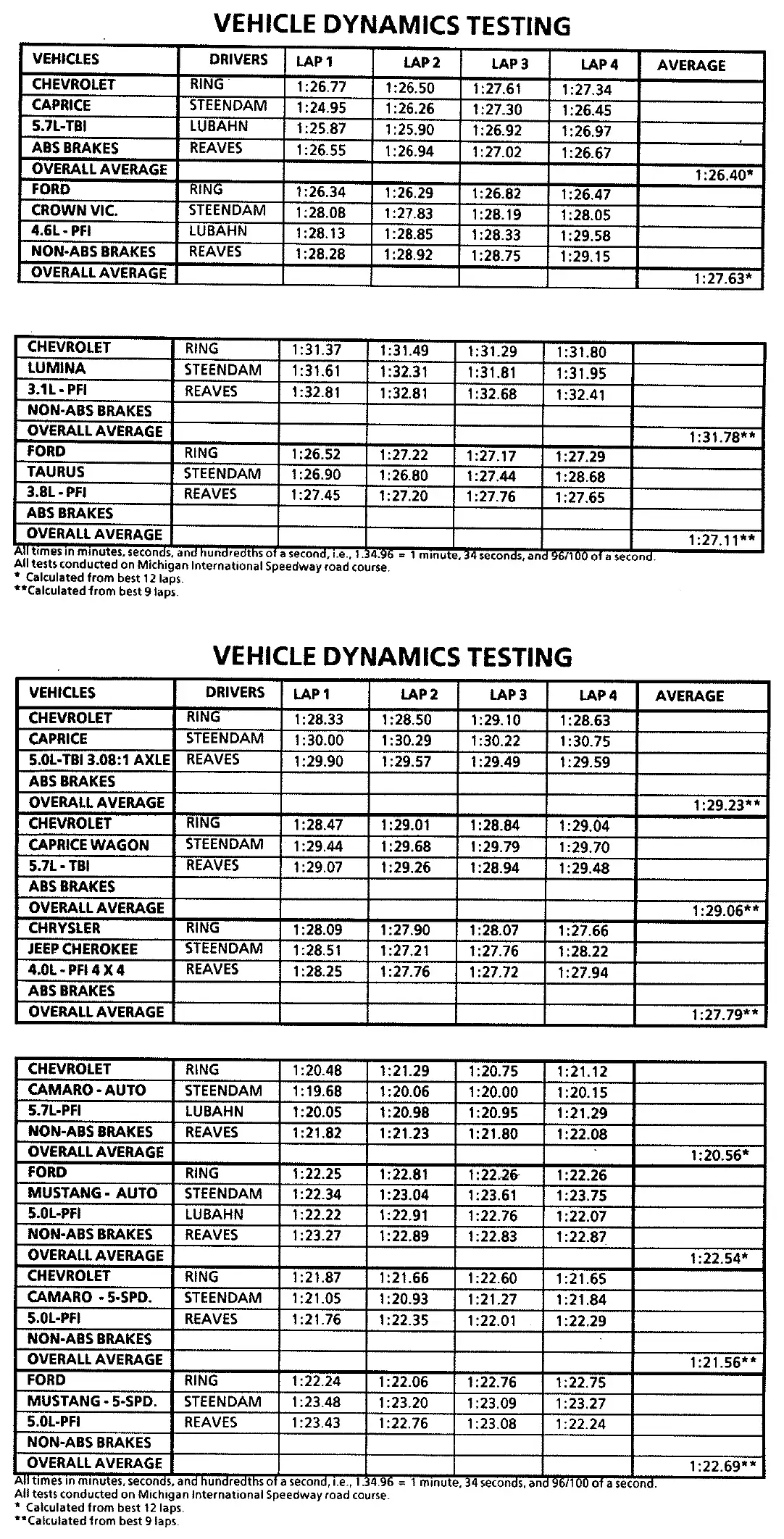
Vehicle dynamics at Michigan International Speedway — every lap, every driver
Four timed laps per driver over the 1.635-mile road course. The book’s rule is at least twelve timed laps with at least three drivers, scored on the fastest of at least nine; four cars ran with four drivers and were scored on their fastest twelve of sixteen. The 2.56-axle Caprice did not run. The preface records that the Caprice and the Taurus each had a right-front tyre changed for severe chunking, the Caprice after four timed laps and the Taurus after eight.
| Vehicle | Driver | Lap 1 | Lap 2 | Lap 3 | Lap 4 |
|---|---|---|---|---|---|
| Chevrolet Camaro (automatic) | overall average 1:20.56 | ||||
| Ring | 1:20.48 | 1:21.29 | 1:20.75 | 1:21.12 | |
| Steendam | 1:19.68 | 1:20.06 | 1:20.00 | 1:20.15 | |
| Lubahn | 1:20.05 | 1:20.98 | 1:20.95 | 1:21.29 | |
| Reaves | 1:21.82 | 1:21.23 | 1:21.80 | 1:22.08 | |
| Chevrolet Camaro (5-speed) | overall average 1:21.56 | ||||
| Ring | 1:21.87 | 1:21.66 | 1:22.60 | 1:21.65 | |
| Steendam | 1:21.05 | 1:20.93 | 1:21.27 | 1:21.84 | |
| Reaves | 1:21.76 | 1:22.35 | 1:22.01 | 1:22.29 | |
| Ford Mustang (automatic) | overall average 1:22.54 | ||||
| Ring | 1:22.25 | 1:22.81 | 1:22.26 | 1:22.26 | |
| Steendam | 1:22.34 | 1:23.04 | 1:23.61 | 1:23.75 | |
| Lubahn | 1:22.22 | 1:22.91 | 1:22.76 | 1:22.07 | |
| Reaves | 1:23.27 | 1:22.89 | 1:22.83 | 1:22.87 | |
| Ford Mustang (5-speed) | overall average 1:22.69 | ||||
| Ring | 1:22.24 | 1:22.06 | 1:22.76 | 1:22.75 | |
| Steendam | 1:23.48 | 1:23.20 | 1:23.09 | 1:23.27 | |
| Reaves | 1:23.43 | 1:22.76 | 1:23.08 | 1:22.24 | |
| Chevrolet Caprice | overall average 1:26.40 | ||||
| Ring | 1:26.77 | 1:26.50 | 1:27.61 | 1:27.34 | |
| Steendam | 1:24.95 | 1:26.26 | 1:27.30 | 1:26.45 | |
| Lubahn | 1:25.87 | 1:25.90 | 1:26.92 | 1:26.97 | |
| Reaves | 1:26.55 | 1:26.94 | 1:27.02 | 1:26.67 | |
| Ford Taurus | overall average 1:27.11 | ||||
| Ring | 1:26.52 | 1:27.22 | 1:27.17 | 1:27.29 | |
| Steendam | 1:26.90 | 1:26.80 | 1:27.44 | 1:28.68 | |
| Reaves | 1:27.45 | 1:27.20 | 1:27.76 | 1:27.65 | |
| Ford Crown Victoria | overall average 1:27.63 | ||||
| Ring | 1:26.34 | 1:26.29 | 1:26.82 | 1:26.47 | |
| Steendam | 1:28.08 | 1:27.83 | 1:28.19 | 1:28.05 | |
| Lubahn | 1:28.13 | 1:28.85 | 1:28.33 | 1:29.58 | |
| Reaves | 1:28.28 | 1:28.92 | 1:28.75 | 1:29.15 | |
| Jeep Cherokee (4WD) | overall average 1:27.79 | ||||
| Ring | 1:28.09 | 1:27.90 | 1:28.07 | 1:27.66 | |
| Steendam | 1:28.51 | 1:27.21 | 1:27.76 | 1:28.22 | |
| Reaves | 1:28.25 | 1:27.76 | 1:27.72 | 1:27.94 | |
| Chevrolet Caprice Station Wagon | overall average 1:29.06 | ||||
| Ring | 1:28.47 | 1:29.01 | 1:28.84 | 1:29.04 | |
| Steendam | 1:29.44 | 1:29.68 | 1:29.79 | 1:29.70 | |
| Reaves | 1:29.07 | 1:29.26 | 1:28.94 | 1:29.48 | |
| Chevrolet Caprice (3.08:1 axle) | overall average 1:29.23 | ||||
| Ring | 1:28.33 | 1:28.50 | 1:29.10 | 1:28.63 | |
| Steendam | 1:30.00 | 1:30.29 | 1:30.22 | 1:30.75 | |
| Reaves | 1:29.90 | 1:29.57 | 1:29.49 | 1:29.59 | |
| Chevrolet Lumina | overall average 1:31.78 | ||||
| Ring | 1:31.37 | 1:31.49 | 1:31.29 | 1:31.80 | |
| Steendam | 1:31.61 | 1:32.31 | 1:31.81 | 1:31.95 | |
| Reaves | 1:32.81 | 1:32.81 | 1:32.68 | 1:32.41 | |
In the Crown Victoria Ring was more than a second a lap quicker than any of the other three drivers. His four laps average 1:26.48, within a tenth of a second of the Caprice’s overall figure.
See the original pages: the 1992 book’s lap sheets
Ergonomics, communications and fuel
| Vehicle | Ergonomics & communications | EPA city (mpg) |
|---|---|---|
| Chevrolet Caprice | 212.12 | 14.0 (5.7) / 17.4 (5.0) |
| Chevrolet Caprice Station Wagon | 204.76 | 16.5 |
| Ford Taurus | 196.76 | 17.1 |
| Ford Crown Victoria | 189.44 | 18.5 |
| Jeep Cherokee (4WD) | 188.26 | 14.1 |
| Chevrolet Camaro | 177.98 | 16.8 (auto) / 16.5 (5-speed) |
| Chevrolet Lumina | 169.37 | 18.6 |
| Ford Mustang | 169.17 | 17.6 (auto) / 16.7 (5-speed) |
The largest part of the Caprice’s 22.68-point margin over the Crown Victoria, 9.74 points, is the front seat. The officers gave the Ford 3.57 for bucket seat design, 4.43 for depth and 5.86 for fore-and-aft adjustment, against the Caprice’s 6.86, 6.86 and 8.29, and the preparation section gave its trunk 4.75 against 7.50. The position of the Ford’s automatic door lock switch scored 1.00, the bottom of the scale, which the book defines as “totally unacceptable”. Of the nine front-seat items the Ford won only headroom, 9.14 against 7.86. The two pony cars scored lowest on the rear seat: 2.43 and 2.43 for the Camaro, 2.29 and 2.57 for the Mustang.
Fuel economy went the other way. The Caprice 5.7’s 14.0 mpg city, the lowest in the book and a tenth below the Cherokee’s 14.1, against the Crown Victoria’s estimated 18.5, cost it 2.43 weighted points, more than any other column on either car.
Hardware: horsepower, axle ratios, test weights
| Car | HP (SAE net) | Axle ratio | Test weight (lb) | Transmission (model) |
|---|---|---|---|---|
| Chevrolet Caprice | 205 | 3.42 | 4,144 | Automatic, overdrive (4L60) |
| Ford Crown Victoria | 210 | 3.27 | 4,032 | Automatic, overdrive (PKC-E) |
| Ford Taurus | 155 | 3.37 | 3,339 | Automatic, overdrive (PNA-EK) |
| Chevrolet Caprice (3.08:1 axle) | 170 | 3.08 | 4,121 | Automatic, overdrive (4L60) |
| Chevrolet Lumina | 140 | 3.33 | 3,263 | Automatic, overdrive (4T60) |
| Chevrolet Camaro (automatic) | 245 | 3.23 | 3,458 | Automatic, overdrive (4L60) |
| Chevrolet Camaro (5-speed) | 230 | 3.42 | 3,390 | 5-speed (MK6) |
| Ford Mustang (automatic) | 225 | 2.73 | 3,221 | Automatic, overdrive (PKA-FE) |
| Ford Mustang (5-speed) | 225 | 3.08 | 3,183 | 5-speed (REP-AY) |
| Jeep Cherokee (4WD) | 190 | 3.55 | 3,525 | Automatic, overdrive (AW3043LE) |
| Chevrolet Caprice Station Wagon | 180 | 3.23 | 4,335 | Automatic, overdrive (4L60) |
On paper Ford’s new 4.6 out-rated the Caprice 5.7, 210 horsepower against 205, in a car 112 lb lighter; the Caprice was still 2.71 seconds quicker to 100. The Camaro 5.7’s 245 is the highest rating in the field and the Lumina’s 140 the lowest. The Cherokee is the only vehicle on the page with four-wheel drive and, at 8.5 inches, the most ground clearance. Tyres, from the printed size and rim rows: the Caprice 5.7 on P235/70R15 102V; the Crown Victoria, the Caprice 5.0, the wagon and the Cherokee on P225/70R15 100H; the Taurus on P215/70R14 96H; the Lumina on P215/65R15 95H, the Mustangs on P215/65R15 95V and the Camaros on P245/50ZR16.
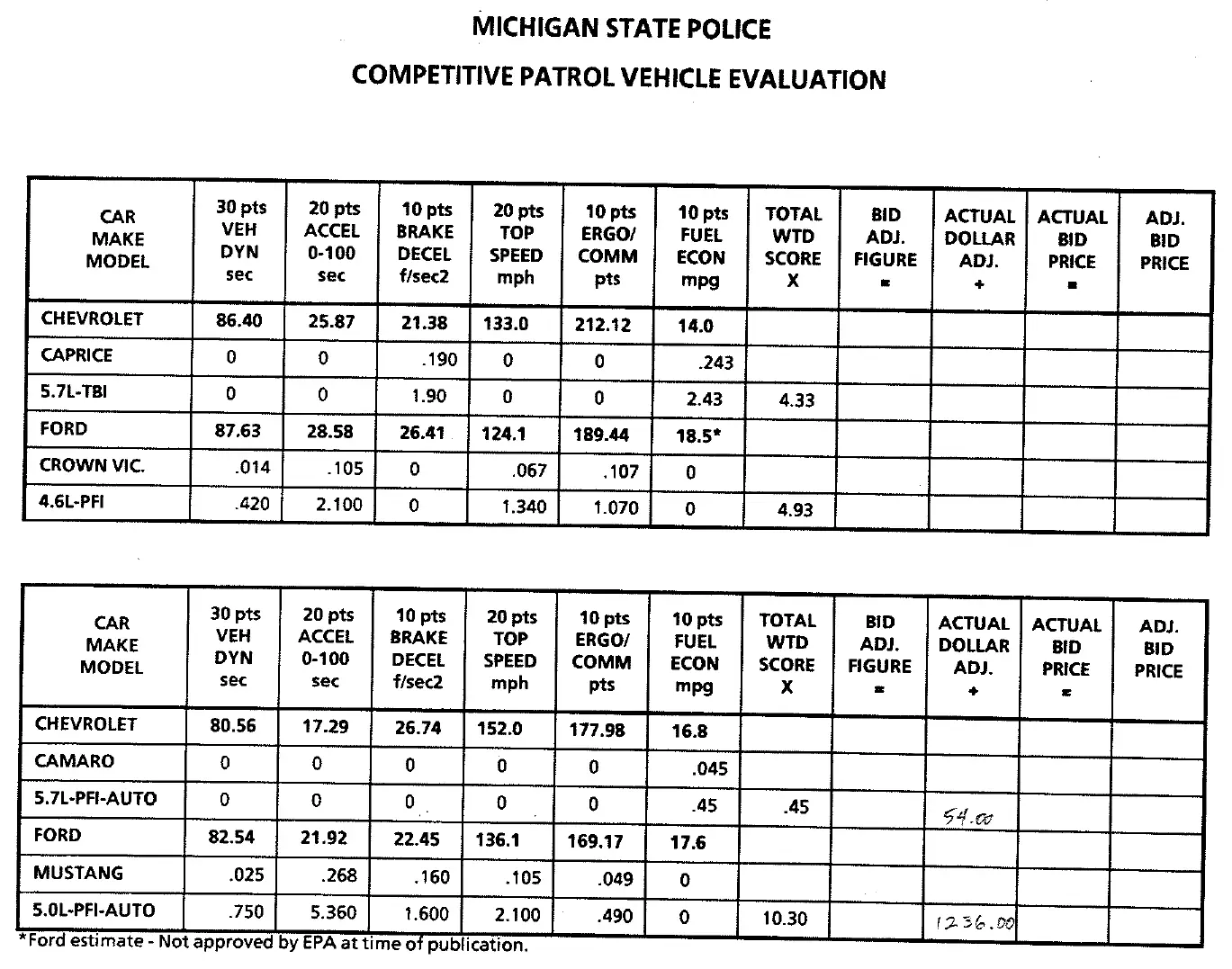
How the bid was scored
| Vehicle | Weighted dynamics | Weighted acceleration | Weighted braking | Weighted top speed | Weighted ergonomics | Weighted fuel | Total weighted score |
|---|---|---|---|---|---|---|---|
| Chevrolet Caprice | 0 | 0 | 1.90 | 0 | 0 | 2.43 | 4.33 |
| Ford Crown Victoria | 0.42 | 2.10 | 0 | 1.34 | 1.07 | 0 | 4.93 |
| Chevrolet Camaro (automatic) | 0 | 0 | 0 | 0 | 0 | 0.45 | 0.45 |
| Ford Mustang (automatic) | 0.75 | 5.36 | 1.60 | 2.10 | 0.49 | 0 | 10.30 |
The scores turn into money: 1% of the lowest bid, multiplied by the total, is added to each bid before the cheapest adjusted price wins, though the agency pays the actual bid. The book prints no bid prices. On this copy, figures are handwritten in the printed “actual dollar adj.” column: 54.00 beside the Camaro and 1236.00 beside the Mustang, each its total multiplied by 120.
See the original page: the 1992 book’s competitive evaluation
What else this book records
Who took part. Two pages list the out-of-state participants: state police and highway patrols from Alabama to West Virginia, city and county departments, the U.S. Capitol Police, the U.S. Marshals Service, the Chicago Fire Department, the Royal Canadian Mounted Police and several Ontario forces, and Supply and Services Canada.
What it cost. The title page records the printing: 1,800 copies at 95 cents, $1,710, under the authority of Public Act 59 of 1935.
When it began, by its own account. The preface says the clean-roof, no-spotlight approach has been its belief “since we began testing in 1977”. The 1996 book’s “20th annual evaluation” points to a first test of the 1977 model year, which would have been run in 1976, so the preface’s 1977 is most likely the model year. It still offers the programme’s 1988 videotape to anyone who sends a blank VHS cassette.
What 1992 settled
The bid score went to a sedan and the record book to a Camaro. The Caprice led the bid score on speed and comfort, with the poorest brakes of any sedan in the test, while a special service Camaro set new top-speed, 0–100, quarter-mile and lap marks in the books held to that point (only the 1991 Camaro’s 6.51 seconds to 60 stood): the first vehicle in them over 150 mph, and the first under 1:21 around Michigan International Speedway on average.
The rest of the list shows the field widening. A front-drive Taurus ran 128 mph and out-lapped the new Crown Victoria; a four-wheel-drive Cherokee lapped within two tenths of it; and two Caprices arrived with governors, the first limited top speeds in these books. In the 2001 and 2002 books held here, every vehicle’s top speed is marked as limited.