
Michigan test archive
1978 Michigan State Police Patrol Vehicle Test
Six sedans, a 440 Plymouth Fury at 132.7 mph, the Buick and the Ford put out on acceleration, and a scoring system that turned the Fury into the lowest adjusted bid.
This is the earliest test in the books held here: Michigan’s evaluation of the 1978 model police cars, written up in November 1977 by the State Police Executive Division’s Policy Development and Evaluation Section as the State Police Patrol Vehicle Evaluation and Purchasing Program. Six makers sent a car: Buick, Chevrolet, Dodge, Ford, Plymouth and Pontiac. On Saturday 29 October 1977 all six ran acceleration, top speed and braking at the Chrysler Proving Grounds at Chelsea, the first away at 8:36 in the morning; the brake sheets time the first measured stops between 1:10 and 3:45 in the afternoon. The road-course laps were run on the 1.82-mile course at Michigan International Speedway whose map the book prints; it does not date them.
The book says what it was for: “First, we hope to identify those vehicles which are best suited to perform the patrol function and to give the top scorers a dollars and cents advantage at bid opening. Secondly, we hope that our test data will be of use both to other law enforcement agencies in making decisions on their patrol car purchases, and to the vehicle manufacturers in their development of patrol vehicle packages which will better meet the needs of law enforcement.”
And it names the result: “In the final analysis, the top rated vehicle for our purposes is the Plymouth Fury. The Chevrolet Impala finished a very close second, followed by the Pontiac Catalina and the Dodge Monaco. Applying the final scores to the bid prices, the adjusted low bidder is the Plymouth Fury, and this is the vehicle that we will be purchasing in 1978.” The Fury, with the 440 and 255 horsepower, was quickest to every speed, fastest on top at 132.7 mph, fastest round the road course, and the thirstiest car in the test.
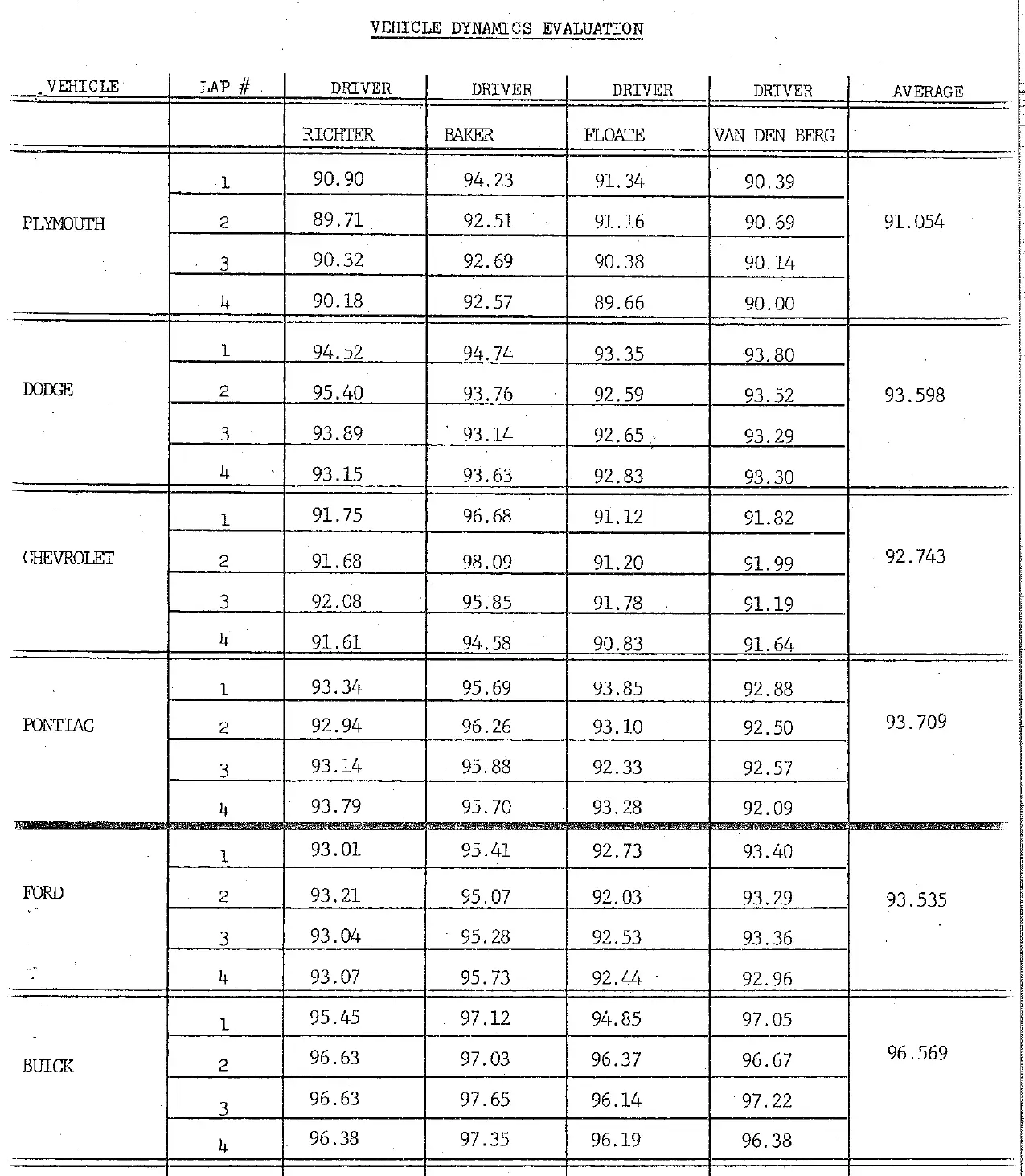
All six cars — acceleration, top speed and the road course
| Car | Engine | 0–60 (s) | 0–80 (s) | 0–100 (s) | Top speed (mph) | Dynamics (s) |
|---|---|---|---|---|---|---|
| Plymouth Fury | 440 4bbl | 9.225 | 14.930 | 24.783 | 132.7 | 91.054 |
| Chevrolet Impala | 350 4bbl | 10.780 | 19.028 | 33.695 | 115.4 | 92.743 |
| Pontiac Catalina | 400 4bbl | 9.978 | 18.123 | 34.600 | 110.2 | 93.709 |
| Dodge Monaco | 400 4bbl | 11.153 | 19.145 | 34.395 | 117.4 | 93.598 |
| Buick LeSabre † | 350 4bbl | 12.260 | 22.815 | 46.390 | 110.1 | 96.569 |
| Ford LTD II † | 400 2bbl | 12.218 | 21.988 | 41.040 | 115.0 | 93.535 |
The Fury’s margin was wide. It reached 100 mph in 24.783 seconds, 8.9 seconds ahead of the next car, the Impala (33.695), and its 132.7 mph was 15.3 mph clear of the Monaco’s 117.4. No car on this archive’s year pages went faster until the five-speed Mustang ran 137.2 in the 1986 test, and no sedan until the 1992 Caprice ran 133.0. Round the road course the Fury averaged 91.054 seconds; the Impala was next at 92.743, and the Buick last at 96.569. The 400-cubic-inch Catalina was second-quickest to 60 and 80 but, at 110.2 mph, barely cleared the 110 bar on top speed.
Acceleration — every run
| Interval | Run 1 (S) | Run 2 (N) | Run 3 (S) | Run 4 (N) | Average | Requirement |
|---|---|---|---|---|---|---|
| Plymouth Fury, started 9:16 a.m. | ||||||
| 0–60 mph | 9.05 | 9.12 | 9.46 | 9.27 | 9.225 | 12.5 |
| 0–80 mph | 14.66 | 14.74 | 15.24 | 15.08 | 14.930 | 21.0 |
| 0–100 mph | 24.40 | 24.40 | 25.12 | 25.21 | 24.783 | 38.0 |
| Chevrolet Impala, started 10:26 a.m. | ||||||
| 0–60 mph | 10.95 | 10.68 | 10.82 | 10.67 | 10.780 | 12.5 |
| 0–80 mph | 19.21 | 18.82 | 19.02 | 19.06 | 19.028 | 21.0 |
| 0–100 mph | 32.58 | 34.90 | 32.86 | 34.44 | 33.695 | 38.0 |
| Pontiac Catalina, started 8:36 a.m. | ||||||
| 0–60 mph | 9.57 | 10.11 | 9.91 | 10.32 | 9.978 | 12.5 |
| 0–80 mph | 17.34 | 18.49 | 18.15 | 18.51 | 18.123 | 21.0 |
| 0–100 mph | 32.21 | 35.64 | 32.89 | 37.66 | 34.600 | 38.0 |
| Dodge Monaco, started 9:53 a.m. | ||||||
| 0–60 mph | 10.88 | 11.16 | 11.11 | 11.46 | 11.153 | 12.5 |
| 0–80 mph | 18.78 | 19.25 | 19.15 | 19.40 | 19.145 | 21.0 |
| 0–100 mph | 33.25 | 35.39 | 33.86 | 35.08 | 34.395 | 38.0 |
| Buick LeSabre, started 11:05 a.m. | ||||||
| 0–60 mph | 12.00 | 11.94 | 12.50 | 12.60 | 12.260 | 12.5 |
| 0–80 mph | 22.04 | 22.65 | 23.17 | 23.40 | 22.815 | 21.0 |
| 0–100 mph | 42.37 | 49.75 | 44.45 | 48.99 | 46.390 | 38.0 |
| Ford LTD II, started 11:35 a.m. | ||||||
| 0–60 mph | 12.16 | 12.31 | 11.93 | 12.47 | 12.218 | 12.5 |
| 0–80 mph | 21.36 | 22.34 | 21.92 | 22.33 | 21.988 | 21.0 |
| 0–100 mph | 39.52 | 42.51 | 38.38 | 43.75 | 41.040 | 38.0 |
The Fury’s four 0–100 runs spread from 24.40 to 25.21 seconds; the Catalina’s from 32.21 to 37.66, its two northbound runs much the slower. The Buick’s four 0–100 runs ranged from 42.37 to 49.75 seconds. The Chevrolet sheet’s 0–100 requirement shows its 3 typed over another character; it reads 38.0.
Road course — every lap, by driver
| Driver | Lap 1 | Lap 2 | Lap 3 | Lap 4 | Driver average (computed) |
|---|---|---|---|---|---|
| Plymouth Fury — car average 91.054 s | |||||
| Richter | 90.90 | 89.71 | 90.32 | 90.18 | 90.278 |
| Baker | 94.23 | 92.51 | 92.69 | 92.57 | 93.000 |
| Floate | 91.34 | 91.16 | 90.38 | 89.66 | 90.635 |
| Van Den Berg | 90.39 | 90.69 | 90.14 | 90.00 | 90.305 |
| Chevrolet Impala — car average 92.743 s | |||||
| Richter | 91.75 | 91.68 | 92.08 | 91.61 | 91.780 |
| Baker | 96.68 | 98.09 | 95.85 | 94.58 | 96.300 |
| Floate | 91.12 | 91.20 | 91.78 | 90.83 | 91.233 |
| Van Den Berg | 91.82 | 91.99 | 91.19 | 91.64 | 91.660 |
| Pontiac Catalina — car average 93.709 s | |||||
| Richter | 93.34 | 92.94 | 93.14 | 93.79 | 93.303 |
| Baker | 95.69 | 96.26 | 95.88 | 95.70 | 95.883 |
| Floate | 93.85 | 93.10 | 92.33 | 93.28 | 93.140 |
| Van Den Berg | 92.88 | 92.50 | 92.57 | 92.09 | 92.510 |
| Dodge Monaco — car average 93.598 s | |||||
| Richter | 94.52 | 95.40 | 93.89 | 93.15 | 94.240 |
| Baker | 94.74 | 93.76 | 93.14 | 93.63 | 93.818 |
| Floate | 93.35 | 92.59 | 92.65 | 92.83 | 92.855 |
| Van Den Berg | 93.80 | 93.52 | 93.29 | 93.30 | 93.478 |
| Buick LeSabre — car average 96.569 s | |||||
| Richter | 95.45 | 96.63 | 96.63 | 96.38 | 96.273 |
| Baker | 97.12 | 97.03 | 97.65 | 97.35 | 97.288 |
| Floate | 94.85 | 96.37 | 96.14 | 96.19 | 95.888 |
| Van Den Berg | 97.05 | 96.67 | 97.22 | 96.38 | 96.830 |
| Ford LTD II — car average 93.535 s | |||||
| Richter | 93.01 | 93.21 | 93.04 | 93.07 | 93.083 |
| Baker | 95.41 | 95.07 | 95.28 | 95.73 | 95.373 |
| Floate | 92.73 | 92.03 | 92.53 | 92.44 | 92.433 |
| Van Den Berg | 93.40 | 93.29 | 93.36 | 92.96 | 93.253 |
The book’s method asked for “at least 12 timed laps, using at least three separate drivers”; every car got 16 laps from four. Baker was the slowest of the four drivers in every car but the Monaco, where Richter was slowest. The fastest single lap was Floate’s 89.66 in the Fury; the slowest, Baker’s 98.09 in the Impala.
See the original page: Vehicle Dynamics Evaluation
Why the Buick and the Ford went out
The book says it in one sentence: “The Buick and Ford were eliminated due to their inability to meet the established minimum acceleration requirements.” It goes on: “While the Buick and Ford were disqualified and were not permitted to bid, we did continue to evaluate the cars, primarily in order to provide the data to other law enforcement agencies whose requirements for top speed and/or acceleration differ from ours.” Both cars reached 110 mph and both completed the brake tests; the book does not say which acceleration time each missed. Set against the limits, their averages were these:
| Requirement | Limit (s) | Buick LeSabre | Ford LTD II | Slowest qualified car |
|---|---|---|---|---|
| 0–60 mph | 12.5 | 12.260 | 12.218 | 11.153 (Monaco) |
| 0–80 mph | 21.0 | 22.815 | 21.988 | 19.145 (Monaco) |
| 0–100 mph | 38.0 | 46.390 | 41.040 | 34.600 (Catalina) |
| 110 mph reached | — | Yes (110.1) | Yes (115.0) | Yes (110.2, Catalina) |
Both were inside the 0–60 limit and outside the 0–80 and 0–100 limits. The LeSabre had the least power in the test, 155 hp from a 350, and the second-tallest axle, 2.73. The LTD II had a 400 with a two-barrel carburetor, 166 hp, and the heaviest test weight in the field, 4,611 lb. The LeSabre was eliminated on acceleration again in the 1980 test.
Brakes, fuel, ergonomics and communications
| Car | 60–0 Phase I (ft) | 60–0 Phase II (ft) | Avg decel (ft/s²) | EPA city (mpg) | Ergonomics (pts) | Communications (pts) |
|---|---|---|---|---|---|---|
| Plymouth Fury | 173.5 | 168.5 | 23.293 | 10 | 286.13 | 93 |
| Chevrolet Impala | 157.8 | 168.1 | 24.338 | 15 | 311.65 | 62 |
| Pontiac Catalina | 144.8 | 163.5 | 25.056 | 14 | 311.92 | 53 |
| Dodge Monaco | 189.9 | 164.9 | 22.594 | 13 | 286.13 | 93 |
| Buick LeSabre | 187.8 | 180.2 | 21.127 | 15 | 312.75 | 58 |
| Ford LTD II | 220.8 | 189.5 | 19.192 | 13 | 281.91 | 68 |
The Catalina stopped best, 25.056 ft/s², including the shortest stop of the day, 144.8 feet from 59.2 mph. The LTD II stopped worst, 19.192 ft/s², after a first stop of 220.8 feet from 60.7; that is the lowest average deceleration rate on any of this archive’s year pages. Every car passed the panic stop: no severe fade, all wheels locked, straight and in lane. The Buick scored best on ergonomics, 312.75, ahead of the Catalina’s 311.92 and the Impala’s 311.65; the Monaco and the Fury scored an identical 286.13, item for item, and the radio installers gave both the same 93. The Catalina’s 53 was the lowest communications score. On fuel the Fury’s 10 mpg city was the lowest; the Buick and Impala were best at 15.
Braking — both stops, with initial speeds
| Brake test | Stop #4 mph | Stop #4 ft | Stop #4 ft/s² | Stop #8 mph | Stop #8 ft | Stop #8 ft/s² | Final score | Phase I ended |
|---|---|---|---|---|---|---|---|---|
| Plymouth Fury | 61.1 | 173.5 | 23.144 | 60.6 | 168.5 | 23.442 | 23.293 | 3:15 p.m. |
| Chevrolet Impala | 60.4 | 157.8 | 24.867 | 61.0 | 168.1 | 23.809 | 24.338 | 1:40 p.m. |
| Pontiac Catalina | 59.2 | 144.8 | 26.033 | 60.5 | 163.5 | 24.079 | 25.056 | 3:45 p.m. |
| Dodge Monaco | 61.0 | 189.9 | 21.076 | 60.8 | 164.9 | 24.112 | 22.594 | 2:44 p.m. |
| Buick LeSabre | 59.9 | 187.8 | 20.550 | 60.3 | 180.2 | 21.704 | 21.127 | 1:10 p.m. |
| Ford LTD II | 60.7 | 220.8 | 17.949 | 60.0 | 189.5 | 20.434 | 19.192 | 2:14 p.m. |
The stops are not corrected to exactly 60 mph. Stops #1–3 and #5–7, the heat-up stops from 90 mph, are recorded only as “COMPLETED”. Stop #9, the locked-wheel stop, is a yes/no check: every car shows no severe fading, brakes that locked, and a straight stop within its lane.
Ergonomics — all 51 items
| Item | Buick | Chevrolet | Dodge | Ford | Plymouth | Pontiac |
|---|---|---|---|---|---|---|
| Seat (front) | ||||||
| Springs | 6.75 | 6.33 | 6.50 | 5.33 | 6.50 | 6.50 |
| Padding | 7.08 | 6.83 | 6.17 | 5.17 | 6.17 | 6.50 |
| Depth of bench | 6.33 | 6.33 | 4.67 | 5.75 | 4.67 | 6.17 |
| Angle of back | 6.33 | 6.33 | 6.33 | 6.17 | 6.33 | 6.33 |
| Adjustability | 6.58 | 7.00 | 6.50 | 6.17 | 6.50 | 6.50 |
| General body support | 6.83 | 6.67 | 6.33 | 5.17 | 6.33 | 6.50 |
| Wheel-pedal-seat relationship | ||||||
| Seat | 6.00 | 6.33 | 5.50 | 5.67 | 5.50 | 6.00 |
| Backrest | 5.83 | 6.00 | 5.83 | 5.33 | 5.83 | 5.50 |
| Total distance | 6.17 | 6.33 | 5.83 | 5.83 | 5.83 | 6.33 |
| Ease of operation | 5.83 | 6.00 | 6.00 | 5.67 | 6.00 | 5.83 |
| Control accessibility | 5.67 | 5.83 | 5.83 | 5.67 | 5.83 | 5.67 |
| Controls & instrumentation | ||||||
| Shift lever position | 5.83 | 6.17 | 6.33 | 6.33 | 6.33 | 6.17 |
| Shift indicator visibility | 6.50 | 6.50 | 7.00 | 7.00 | 7.00 | 6.33 |
| Interior hood release position | — | — | — | — | — | — |
| Handbrake release position | 6.50 | 6.50 | 6.17 | 6.17 | 6.17 | 6.83 |
| Small controls (knobs & switches) | 6.33 | 6.33 | 6.00 | 5.83 | 6.00 | 6.17 |
| Cigarette lighter location | 6.17 | 6.50 | 6.17 | 6.33 | 6.17 | 6.17 |
| Adequacy | 5.50 | 5.67 | 7.00 | 6.00 | 7.00 | 8.17 |
| Clarity | 6.50 | 6.67 | 7.00 | 6.33 | 7.00 | 7.83 |
| Placement | 6.67 | 7.00 | 6.17 | 7.00 | 6.17 | 6.83 |
| Visibility | ||||||
| Front | 6.83 | 6.83 | 6.33 | 5.83 | 6.33 | 6.92 |
| Left side | 6.25 | 5.83 | 6.00 | 5.67 | 6.00 | 6.25 |
| Left rear quarter | 6.08 | 6.00 | 4.33 | 4.50 | 4.33 | 6.08 |
| Right side | 6.25 | 6.17 | 5.67 | 5.50 | 5.67 | 6.25 |
| Right rear quarter | 5.17 | 5.17 | 4.00 | 3.83 | 4.00 | 5.25 |
| Rear | 6.33 | 6.17 | 5.00 | 4.83 | 5.00 | 6.25 |
| Heater/A-C/vents & controls | ||||||
| Control positions | 7.00 | 7.17 | 3.67 | 4.17 | 3.67 | 7.00 |
| Control adjustment | 6.50 | 6.33 | 5.33 | 6.33 | 5.33 | 6.50 |
| Vent placement | 6.17 | 5.83 | 5.33 | 5.17 | 5.33 | 5.67 |
| Vent adjustability | 6.67 | 6.00 | 5.83 | 5.67 | 5.83 | 6.00 |
| Blower range | 5.83 | 5.83 | 5.83 | 5.83 | 5.83 | 5.83 |
| Temperature range | 6.33 | 6.33 | 5.67 | 6.33 | 5.67 | 6.33 |
| Noise | 5.67 | 5.67 | 5.00 | 5.67 | 5.00 | 5.50 |
| Windows and doors | ||||||
| Convenience of operation | 6.42 | 6.33 | 6.00 | 6.33 | 6.00 | 6.33 |
| Speed of operation | 6.00 | 5.67 | 5.83 | 6.17 | 5.83 | 5.67 |
| Position of crank | 5.67 | 5.50 | 6.33 | 6.83 | 6.33 | 5.67 |
| Protrusion of crank | 6.00 | 6.00 | 6.33 | 5.83 | 6.33 | 6.00 |
| Height of door opening | 6.42 | 6.50 | 4.83 | 5.67 | 4.83 | 6.42 |
| Width of door opening | 6.25 | 6.25 | 5.50 | 5.33 | 5.50 | 6.17 |
| Opening angle | 6.08 | 6.08 | 5.50 | 5.17 | 5.50 | 6.00 |
| Area | 6.08 | 6.00 | 5.33 | 5.00 | 5.33 | 6.00 |
| Rear passenger compartment | ||||||
| Springs | 6.17 | 6.00 | 5.33 | 5.00 | 5.33 | 6.00 |
| Padding | 6.67 | 6.50 | 5.33 | 5.00 | 5.33 | 6.33 |
| Depth of bench | 5.67 | 6.00 | 5.17 | 5.00 | 5.17 | 5.67 |
| Minimum distance to front seat back | 5.67 | 6.50 | 5.50 | 6.17 | 5.50 | 6.00 |
| Angle of backrest | 6.50 | 6.17 | 6.00 | 6.00 | 6.00 | 6.00 |
| Ease of entry and exit | 6.50 | 6.33 | 4.67 | 4.83 | 4.67 | 6.33 |
| Trunk | ||||||
| Configuration | 6.50 | 6.17 | 5.83 | 5.33 | 5.83 | 6.17 |
| Location of spare tire | 6.00 | 6.00 | 5.83 | 5.67 | 5.83 | 6.00 |
| Space for other equipment (First aid kit, flares, etc.) | 7.17 | 6.67 | 5.17 | 4.50 | 5.17 | 6.67 |
| Accessibility | 6.50 | 6.33 | 6.33 | 5.83 | 6.33 | 6.33 |
| Total | 312.75 | 311.65 | 286.13 | 281.91 | 286.13 | 311.92 |
The Catalina’s instruments scored highest of anything on any form: 8.17 for adequacy and 7.83 for clarity. The lowest single scores went to the heater and air-conditioning control positions in the Monaco and Fury, 3.67, and the Ford’s view over the right rear quarter, 3.83.
Communications — all 16 items
| Item | Buick | Chevrolet | Dodge | Ford | Plymouth | Pontiac |
|---|---|---|---|---|---|---|
| Dash accessibility | ||||||
| Ignition fuse terminal block (accessory positions) | 1 | 1 | 5 | 10 | 5 | 1 |
| Microphone mountings | 5 | 5 | 5 | 5 | 5 | 5 |
| Radio-Siren console mountings | 2 | 2 | 5 | 1 | 5 | 2 |
| Dual radio or scanner installation | 1 | 1 | 4 | 1 | 4 | 1 |
| Glove box position | 5 | 5 | 5 | 5 | 5 | 5 |
| Overhead/hood light switches installation (garage) | 1 | 5 | 8 | 1 | 8 | 1 |
| Trunk accessibility | ||||||
| One radio installation | 3 | 3 | 5 | 2 | 5 | 3 |
| Two radio installation | 3 | 3 | 5 | 1 | 5 | 3 |
| Antenna installation | 5 | 5 | 5 | 5 | 5 | 5 |
| Trunk equipment installation (garage) | 8 | 8 | 8 | 2 | 8 | 3 |
| Available space for rear deck lights (garage) | 6 | 6 | 8 | 6 | 8 | 6 |
| Engine accessibility | ||||||
| Battery terminal connection | 2 | 2 | 5 | 10 | 5 | 2 |
| Accommodation for power and control cables | 5 | 5 | 5 | 5 | 5 | 5 |
| Siren speaker installation (garage) | 1 | 1 | 10 | 6 | 10 | 1 |
| Level of radio frequency interference | ||||||
| Vehicle systems interference with radio equipment | 5 | 5 | 5 | 5 | 5 | 5 |
| Radio frequency interference with vehicle systems | 5 | 5 | 5 | 3 | 5 | 5 |
| Total | 58 | 62 | 93 | 68 | 93 | 53 |
The Ford’s ignition fuse block and battery terminal scored 10 each, but trunk work did not: 1 for a two-radio installation and 2 for trunk equipment. The Catalina lost most against the Impala, which it matched item for item except trunk equipment installation (3 against 8) and the overhead and hood light switches (1 against 5).
The cars as delivered
| Car | HP (as printed) | Torque (lb-ft @ rpm) | Axle ratio | Weight (lb; curb where printed) | Test weight (lb) | Wheelbase (in) | EPA mpg (city / hwy / comb) |
|---|---|---|---|---|---|---|---|
| Plymouth Fury | 255 @ 4000 | 360 @ 3200 | 2.71 | 4,412 (est.) | 4,413 | 117.4 | 10 / 14 / 11 |
| Chevrolet Impala | 170 @ 3800 | 270 @ 2400 | 3.08 | 3,722 | 3,996 | 116.0 | 15 / 21 / 17 |
| Pontiac Catalina | 180 @ 3600 | 325 @ 1600 | 3.08 | 3,613 | 4,057 | 115.9 | 14 / 21 / 17 |
| Dodge Monaco | 190 @ 3600 | 305 @ 3200 | 3.21 | 4,355 (est.) | 4,369 | 117.4 | 13 / 20 / 15 |
| Buick LeSabre | 155 @ 3400 | 280 @ 1800 | 2.73 | 3,519 | 4,077 | 115.9 | 15 / 22 / 17 |
| Ford LTD II | 166 @ 3800 | 319 @ 1800 | 3.00 | 4,160 | 4,611 | 118.0 | 13 / 18 / 15 |
The Fury and Monaco were the same 117.4-inch Chrysler sedan, with the same interior dimensions to the tenth of an inch; the Fury carried the 440 (E86) and dual exhaust, the Monaco a 400 (E68) and single exhaust. The LTD II had the longest wheelbase, 118.0 inches, and rode on HR70 tires where the others had GR70.
Hardware — everything the book prints
| Item | Buick | Chevrolet | Dodge | Ford | Plymouth | Pontiac |
|---|---|---|---|---|---|---|
| Make & model | Buick Lesabre Sedan | CHEVROLET IMPALA SEDAN | MONACO 4-DR. SEDAN – WL-41 | FORD LTD II – 4 DR. | FURY 4-DR. SEDAN – RL-41 | 1978 PONTIAC CATALINA 4-DOOR SEDAN |
| Engine | 350 CU. IN. V-8 | 350 CU. IN. V-8 | E68 – 400 CID | 6.6L (400 CID) | E86 – 440 CID | 6.6 LITRE (400 CID) V8 |
| Carburetor-exhaust | 4-Barrel Rochester Carburetor, Single Exhaust | 4-BARREL CARB., SINGLE EXHAUST | 4 BBL. – SINGLE EXHAUST | 2 BBL. – SINGLE EXHAUST | 4 BBL. – DUAL EXHAUST | 4 BBL. – SINGLE |
| Horsepower @ rpm | 155 H.P. @ 3400 RPM | 170 H.P. @ 3800 RPM | 190 @ 3600 RPM | 166 @ 3800 RPM | 255 @ 4000 RPM | 180 @ 3600 RPM |
| Torque @ rpm | 280 @ 1800 RPM | 270 @ 2400 RPM | 305 LB. FT. @ 3200 RPM | 319 @ 1800 RPM | 360 LB. FT. @ 3200 RPM | 325 @ 1600 RPM |
| Compression ratio | 8.0 to 1 | 8.2 TO 1 | 8.2 TO 1 | 8.0 TO 1 | 7.8 TO 1 | 7.6 TO 1 |
| Axle ratio | 2.73 | 3.08 | 3.21-1 | 3.00-1 (TRACTION-LOK) | 2.71-1 | 3.08-1 |
| Steering | Power-Fast Ratio 14 to 1 Gear – 15.3 to 1 Overall Ratio | POWER, HIGH EFFORT | POWER – FIRM | POWER W/AUX. COOLER – RATIO 21.76 TO 1 | POWER – FIRM | 14 TO 1 RATIO SPEC. HIGH EFFORT |
| Tire size | GR70 x 15B | GR70 – 15B | GR70-15, GOODYEAR FLEXTEN POLICE SPECIAL | HR70 x 15 POLICE SPL. (GOODYEAR) | GR70-15, GOODYEAR FLEXTEN POLICE SPECIAL | GR70 x 15 POLICE SPECIAL |
| Suspension, front | Coil springs front & rear, special police suspension with larger front & rear stabilizer bars, special springs & shocks (front and rear) | COIL SPRINGS FRONT AND REAR, SPECIAL POLICE SUSPENSION WITH LARGER FRONT AND REAR STABILIZER BARS, SPECIAL SPRINGS AND SHOCKS (front and rear) | INDEPENDENT, LATERAL NONPARALLEL CONTROL ARMS WITH TORSION BARS | H.D. SPRINGS (600 #/IN.), SHOCKS, STAB. BAR | INDEPENDENT, LATERAL NONPARALLEL CONTROL ARMS WITH TORSION BARS | 550 #/IN. SPRINGS |
| Suspension, rear | see front | see front | PARALLEL, LONGITUDINAL LEAF | H.D. SPRINGS (185 #/IN.), SHOCKS, STAB. BAR | PARALLEL, LONGITUDINAL LEAF | 350 #/IN. SPRINGS |
| Brakes | 12" x 1" front semi-metallic brake pads; 11" x 2" rear 28 lb. drum brakes | 11" x 2" 23 LB. REAR DRUM BRAKES / METALLIC – IMPREGNATED FRONT BRAKE PADS | DISC – FRONT, DRUM – REAR | POWER – FRONT (SEMI-METALLIC), REAR (ORGANIC) | DISC – FRONT, DRUM – REAR | H.D. SEMI-METALLIC DISC FRONT – 11" x 2" ORGANIC H.D. DRUM REA[R] (last letter cut off at page edge) |
| Overall length | 218.2 | 212.1 | 218.0 | 215.5 | 218.0 | 213.8 |
| Overall height | 55.7 | 56.0 LOADED | 54.3 | 52.6 | 54.3 | 53.9 |
| Weight (curb where printed) | 3519 | 3722 | 4355 (est.) | 4160 | 4412 (est.) | 3613 |
| Test weight | 4077 | 3996 | 4369 | 4611 | 4413 | 4057 |
| Wheelbase | 115.9 | 116.0 | 117.4 | 118.0 | 117.4 | 115.9 |
| Head room, front / rear | 39.4 / 38.2 | 39.0 / 38.2 | 38.7 / 37.3 | 38.3 / 37.0 | 38.7 / 37.3 | 39.0 / 38.0 |
| Leg room, front / rear | 42.4 / 39.0 | 42.2 / 39.5 | 42.6 / 34.9 | 42.6 / 37.4 | 42.6 / 34.9 | 42.2 / 39.5 |
| Shoulder room, front / rear | 60.8 / 60.8 | 60.8 / 60.8 | 58.9 / 59.3 | 58.5 / 58.2 | 58.9 / 59.3 | 61.0 / 59.4 |
| Hip room, front / rear | 55.0 / 55.3 | 55.0 / 55.3 | 59.2 / 59.2 | 59.2 / 57.0 | 59.2 / 59.2 | 55.0 / 54.1 |
| EPA city / highway / combined | 15 / 22 / 17 mpg | 15 / 21 / 17 mpg | 13 / 20 / 15 mpg | 13 / 18 / 15 mpg | 10 / 14 / 11 mpg | 14 / 21 / 17 mpg |
The Pontiac’s brake entry runs off the edge of the page (“…H.D. DRUM REA”). The bid letter of 3 November 1977 gives the Fury’s axle as “2.7-1”; its hardware page says 2.71-1.
The scoring and the money
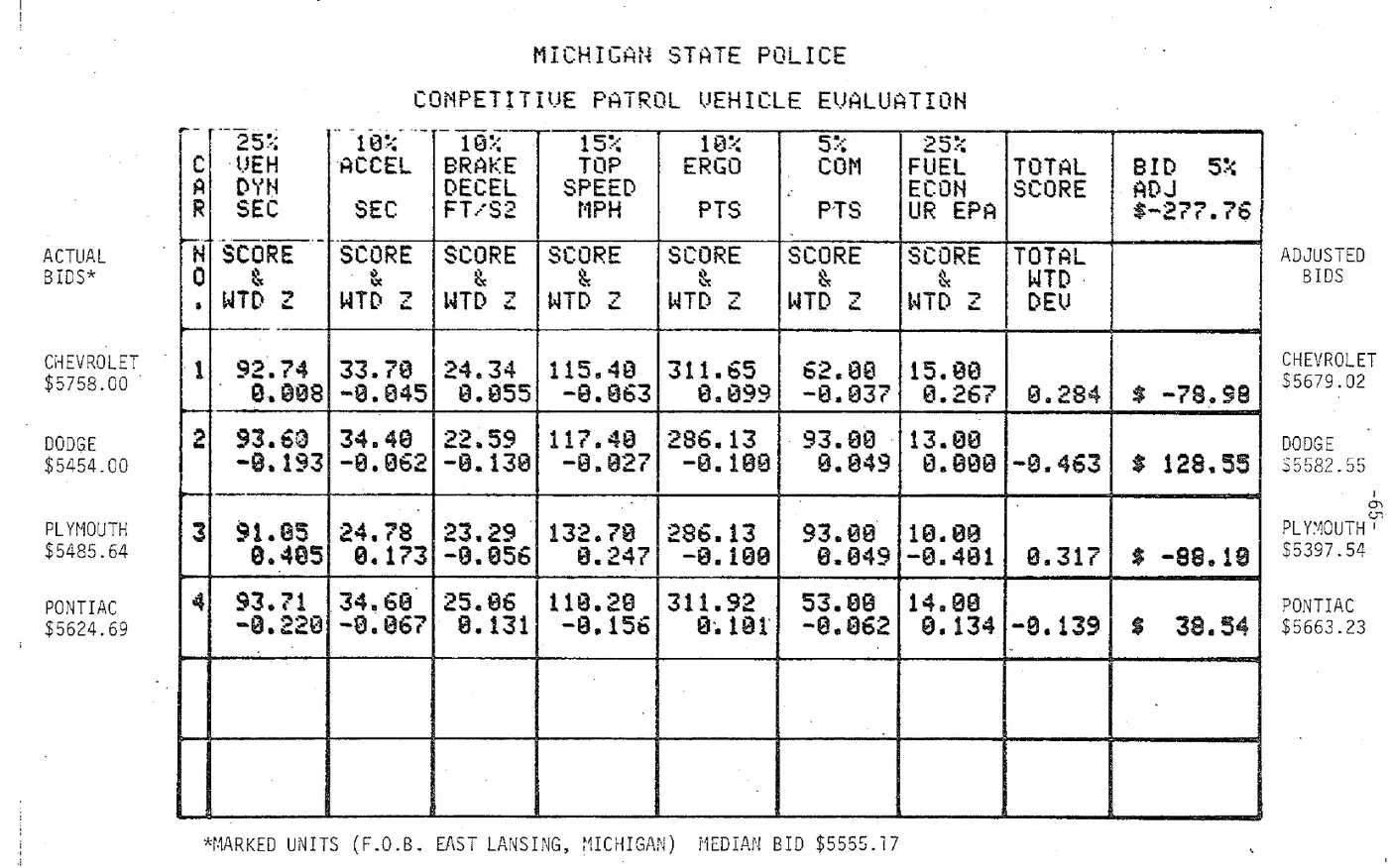
Only the four cars that qualified were scored. Each category’s raw figures were turned into Z-scores, the number of standard deviations above or below the four-car average (lower times counting as better), multiplied by the category’s weight and added up: vehicle dynamics 25%, acceleration to 100 mph 10%, braking rate 10%, top speed 15%, fuel consumption 25%, ergonomics 10% and communications 5%. The total, which the book calls “R”, was then multiplied by 5% of the median bid, $5,555.17, which gives $277.76 a point, and the result added to or taken from each actual bid. A positive score therefore lowered a bid. The book: “Applying the final scores to the bid prices, the adjusted low bidder is the Plymouth Fury”.
| Car | Total weighted score | Actual bid | Adjustment | Adjusted bid |
|---|---|---|---|---|
| Plymouth Fury | +0.317 | $5,485.64 | -$88.10 | $5,397.54 |
| Chevrolet Impala | +0.284 | $5,758.00 | -$78.98 | $5,679.02 |
| Pontiac Catalina | -0.139 | $5,624.69 | +$38.54 | $5,663.23 |
| Dodge Monaco | -0.463 | $5,454.00 | +$128.55 | $5,582.55 |
The Monaco was the lowest actual bid on this sheet, $31.64 below the Fury. Its score of −0.463, last of the four, added $128.55; the Fury’s +0.317, the best, took $88.10 off. The Fury finished $185.01 below the Monaco and $281.48 below the Impala, whose adjusted bid was the highest. The book’s preface notes that “the bid prices of two of these four vehicles were adjusted upward, and two downward based on their overall performance.”
See the original page: Competitive Patrol Vehicle Evaluation
Weighted Z-scores, category by category
| Category (weight) | Raw: Fury | Fury | Raw: Impala | Impala | Raw: Catalina | Catalina | Raw: Monaco | Monaco |
|---|---|---|---|---|---|---|---|---|
| Vehicle dynamics, s (25%) | 91.05 | +0.405 | 92.74 | +0.008 | 93.71 | -0.220 | 93.60 | -0.193 |
| Acceleration 0–100, s (10%) | 24.78 | +0.173 | 33.70 | -0.045 | 34.60 | -0.067 | 34.40 | -0.062 |
| Brake deceleration, ft/s² (10%) | 23.29 | -0.056 | 24.34 | +0.055 | 25.06 | +0.131 | 22.59 | -0.130 |
| Top speed, mph (15%) | 132.70 | +0.247 | 115.40 | -0.063 | 110.20 | -0.156 | 117.40 | -0.027 |
| Ergonomics, pts (10%) | 286.13 | -0.100 | 311.65 | +0.099 | 311.92 | +0.101 | 286.13 | -0.100 |
| Communications, pts (5%) | 93.00 | +0.049 | 62.00 | -0.037 | 53.00 | -0.062 | 93.00 | +0.049 |
| Fuel economy, EPA urban mpg (25%) | 10.00 | -0.401 | 15.00 | +0.267 | 14.00 | +0.134 | 13.00 | 0.000 |
| Total weighted score | +0.317 | +0.284 | -0.139 | -0.463 |
The Fury gained most on dynamics (+0.405), top speed (+0.247) and acceleration (+0.173), and lost most on fuel (−0.401). The Impala’s largest gains were fuel (+0.267) and ergonomics (+0.099), and its lead over the Catalina came mainly from dynamics and fuel; the Catalina’s braking (+0.131) and fuel (+0.134) were not enough to cover its dynamics (−0.220) and top speed (−0.156).
Four price sheets
The book prints the score sheet four times, once for each combination of a fully marked or a semi-marked car and delivery F.O.B. East Lansing or F.O.B. Negaunee, in the Upper Peninsula. The scores and the $277.76 a point are the same on all four; only the bids differ. Pontiac’s entry reads “NO BID” on both Negaunee sheets.
| Score sheet | Plymouth Fury | Chevrolet Impala | Pontiac Catalina | Dodge Monaco |
|---|---|---|---|---|
| Marked, F.O.B. East Lansing (p.68) | $5,485.64 → $5,397.54 | $5,758.00 → $5,679.02 | $5,624.69 → $5,663.23 | $5,454.00 → $5,582.55 |
| Marked, F.O.B. Negaunee (p.69) | $5,587.89 → $5,499.79 | $5,848.00 → $5,769.02 | NO BID | $5,600.47 → $5,729.02 |
| Semi-marked, F.O.B. East Lansing (p.70) | $5,402.89 → $5,314.79 | $5,658.00 → $5,579.02 | $5,546.81 → $5,585.35 | $5,385.00 → $5,513.55 |
| Semi-marked, F.O.B. Negaunee (p.71) | $5,503.89 → $5,415.79 | $5,748.00 → $5,669.02 | NO BID | $5,536.47 → $5,665.02 |
The Fury had the lowest adjusted bid on every sheet. On the two East Lansing sheets the Monaco was the lowest actual bid ($5,454.00 marked, $5,385.00 semi-marked) and the scoring put the Fury ahead of it; at Negaunee the Fury was already the lowest actual bid. The median of $5,555.17 is the median of the marked East Lansing bids, and the other three sheets use it unchanged. The bid letter says the adjusted low bid “will be used when making the award of items 1 and 2 of bid 78.2”; the book does not say which sheet corresponds to which item.
What Michigan ordered
The specification, Mich. 3905-0010, headed “April -, 1977” (the bid letter calls it “specification 3905-0010 dated 10/1/77”), asked for a 1978 four-door V-8 sedan on a 115.9 to 119.9-inch wheelbase, engine size “at manufacturers option providing that the car will meet or exceed the vehicle performance requirements”. Test cars were due at State Police headquarters, 714 South Harrison Road, East Lansing, by 5:00 p.m. on 25 October 1977, with an extra set of four wheels and tires and enough break-in “to permit extended periods of maximum acceleration and high speed driving”, and were to be returned by 1 December 1977.
The list is the patrol car of the day: factory air conditioning with a shut-off switch, tinted glass “not acceptable”; an 80-amp alternator “capable of surviving patrol car operation at 110 mph”; a heavy-duty limited-slip differential; power disc front brakes, “Four wheel disc brakes preferred, if available”; a split bench seat, 60-40 preferred; silicone heater and radiator hoses; a speedometer accurate to 3% with a 0–120 mph scale; Unity #225-6 spotlights with aircraft landing lamps; Goodyear Police Special Flexten radials, GR70-15B minimum, on 15 by 6.5-inch wheels; a three-speed automatic, “heaviest duty available”; seats in cloth or cloth and vinyl, blue, “All vinyl not acceptable”; paint to Dulux 93-032.
The Department of Management and Budget’s letter of 3 November 1977 approved the Fury, Monaco, Catalina and Impala for sealed bid Autos 78-2, due on 22 November 1977 at 1:30 p.m., and said the test results would be “used in the “Z” Score Formula to arrive at the adjusted low bid.”
What 1978 settled
The Fury was the quickest, fastest and best-handling car in the test and the thirstiest, and the scoring weighed those against each other in the open: its dynamics, top speed and acceleration earned more than its 10 mpg cost it, and a car that was not the cheapest bid on the East Lansing sheets became the lowest adjusted bid on all four. The margins were small in money, $185 to $281 on the main sheet, and the system was built to make them count.
The two cars that could not reach 80 and 100 mph in time were tested to the end anyway, so other agencies could see the figures, and the book says plainly why they could not bid. The fuel weighting was a quarter of every score.