
Michigan test archive
1987 Michigan State Police Patrol Vehicle Test
The year the bar went up: a ten-second Caprice, two 139-mph Mustangs — and the quarter second that ended the Diplomat’s bid.
Eleven years into the program, Michigan tightened the entry exam again. The 1983 book’s bar was 60 mph in 14.5 seconds, 80 in 26.0 and 100 in 48.5; the September 1983 specification, printed in the 1984 book, had already brought it to 13.5, 24.0 and 45.0, and the September 1984 specification for the 1985 test kept those times; the 1986 times are not held. For 1987 it went to 12.9, 23.0 and 42.3 — “10 percent greater than last year’s lowest score”, the October 1986 bulletin says — and the top-speed rule tightened to 110 mph within two miles, where three had been allowed. The first casualty was the Dodge Diplomat. Its 0–80 average came in at 23.25 seconds — a quarter second over the line — and the book records the consequence in one dry sentence: the car “failed to meet our established minimum acceleration requirements, and was consequently eliminated from our bid process.” Michigan kept testing it anyway, for the agencies whose needs differed. Two of its four runs actually beat the bar; the average didn’t.
Testing ran from 13 to 18 September 1986, with eleven cars — straight-line work at Chrysler’s proving grounds between 50 and 67 °F, dynamics on the 1.635-mile Michigan International Speedway course, at least fifteen laps per car with the fastest twelve averaged, as in the 1986 test. The preface carries its own news: Ford had promised a police-package Taurus for this test and withdrew it before testing — “we have been told it will be available for the 1988 model year.” And after the 1986 report flagged early rear-wheel lockup on all four big sedans, Chrysler and Ford arrived with the problem fixed, Chevrolet nearly so.
The scoring had changed before this book, in two steps. The 1984 book already weights dynamics at 30, acceleration and top speed at 20 each and fuel economy — worth 25% of the score in 1983 — at 10, but still sums weighted-Z statistics; the 1985 specification and scoring sheet replace those with a simpler deviation-from-best method. The 1987 book scores the same way.
The competing cars — and the one that didn’t qualify
| Car | Engine | 0–60 (s) | ¼-mile (s @ mph) | 0–100 (s) | Top speed (mph) | Miles to 100 mph | Dynamics (s) |
|---|---|---|---|---|---|---|---|
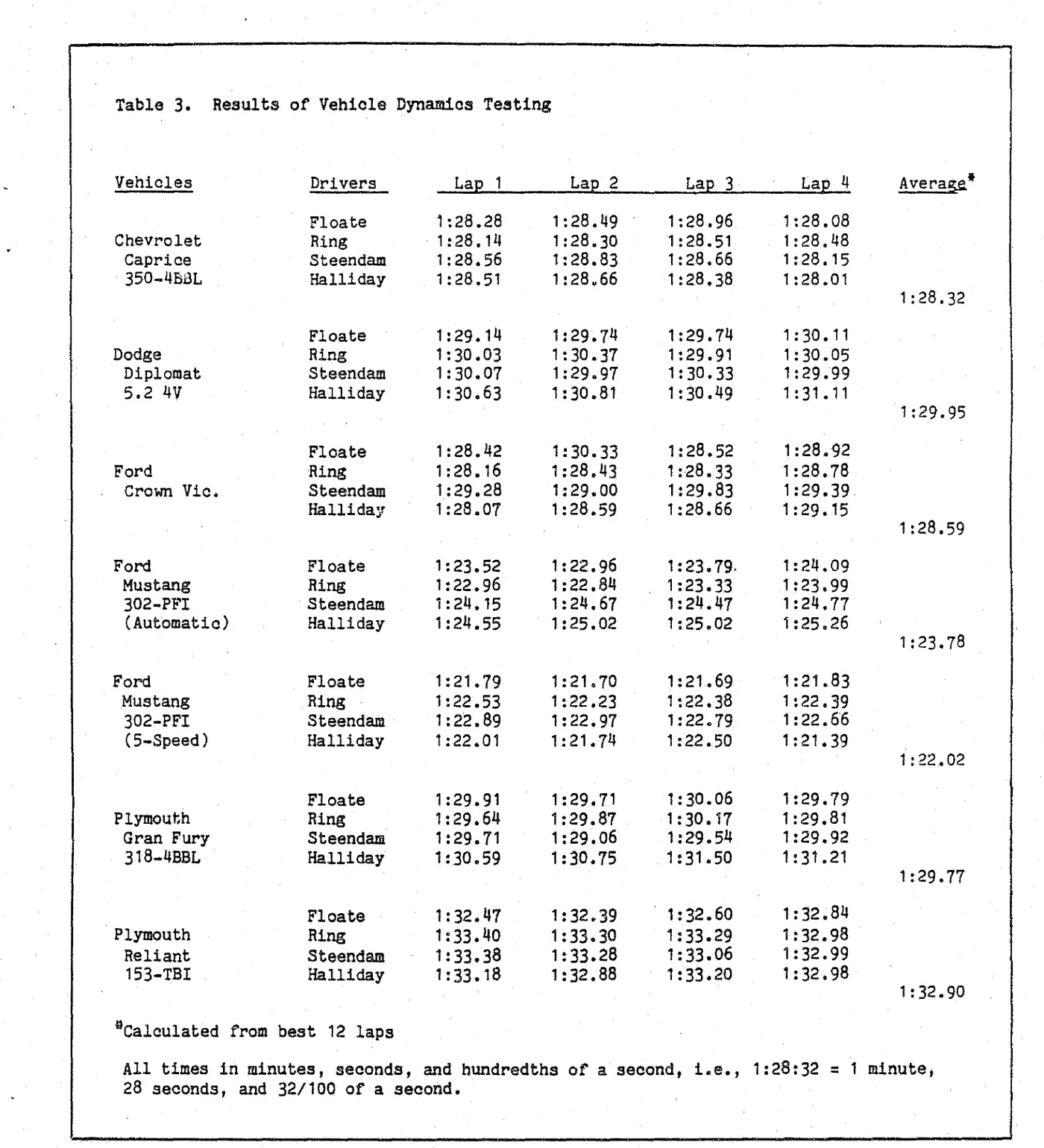
| Chevrolet Caprice | 350-4BBL | 10.32 | 17.85 @ 77.75 | 34.62 | 118.0 | 0.67 | 88.32 |
| Ford Crown Victoria | 351-VV | 12.02 | 18.93 @ 76.25 | 39.30 | 115.2 | 0.73 | 88.59 |
| Plymouth Gran Fury | 318-4BBL | 12.39 | 19.18 @ 75.0 | 38.64 | 117.5 | 0.72 | 89.77 |
| Dodge Diplomat † | 318-4BBL | 12.72 | 19.35 @ 73.5 | 40.53 | 116.9 | 0.76 | 89.95 |
Gold row: winner on total weighted score. The Caprice was the quickest and fastest of the competing sedans and fastest around the pursuit course — a 180-horsepower 350 through GM’s 700R4 overdrive — though not the quickest sedan in the books held: the 1978 Plymouth Fury (9.23 seconds to 60, 24.78 to 100) and Pontiac Catalina (9.98 and 34.60), the 1984 Ford LTD 302 (10.29 and 29.89) and the 1986 Canadian Caprice (9.59 and 29.34) had all been quicker to both. One asterisk: the Canadian-market Caprice, run for information beside it, was quicker and faster still — 9.49 to 60, 29.06 to 100, 121.7 mph.
Tested but not competing
| Car | Engine | 0–60 (s) | ¼-mile (s @ mph) | 0–100 (s) | Top speed (mph) | Dynamics (s) |
|---|---|---|---|---|---|---|
| Ford Mustang (5-speed) | 302-PFI | 7.64 | 16.00 @ 89.75 | 20.42 | 139.6 | 82.02 |
| Ford Mustang (automatic) | 302-PFI | 8.16 | 16.33 @ 86.75 | 21.73 | 139.1 | 83.78 |
| Ford Crown Victoria | 302-PFI | 11.85 | 18.55 @ 74.0 | 43.47 | 109.2 | — |
| Plymouth Gran Fury | 318-2BBL | 14.65 | 20.63 @ 71.75 | 52.44 | 113.3 | — |
| Chevrolet Caprice (V6) | 262-TBI | 13.94 | 19.90 @ 71.0 | 59.22 | 106.0 | — |
| Chevrolet Caprice (Canadian) | 350-4BBL | 9.49 | 17.40 @ 80.75 | 29.06 | 121.7 | — |
| Plymouth Reliant | 153-TBI | 15.04 | 20.38 @ 68.5 | — | 100.4 | 92.90 |
The 5-speed Mustang’s 82.02-second lap average is the fastest in the books held here to that point (1979 has no results, and 1985 survives only as a scoring sheet) — more than six seconds a lap quicker than the best sedan; its 7.64 seconds to 60 was slower than the 1986 five-speed’s 7.30. The Reliant never reached 100 mph during its timed runs; on the continued run it finally touched 100.4 after 4.44 miles.
See the original pages: Tables 4 and 3 in the October 1986 bulletin
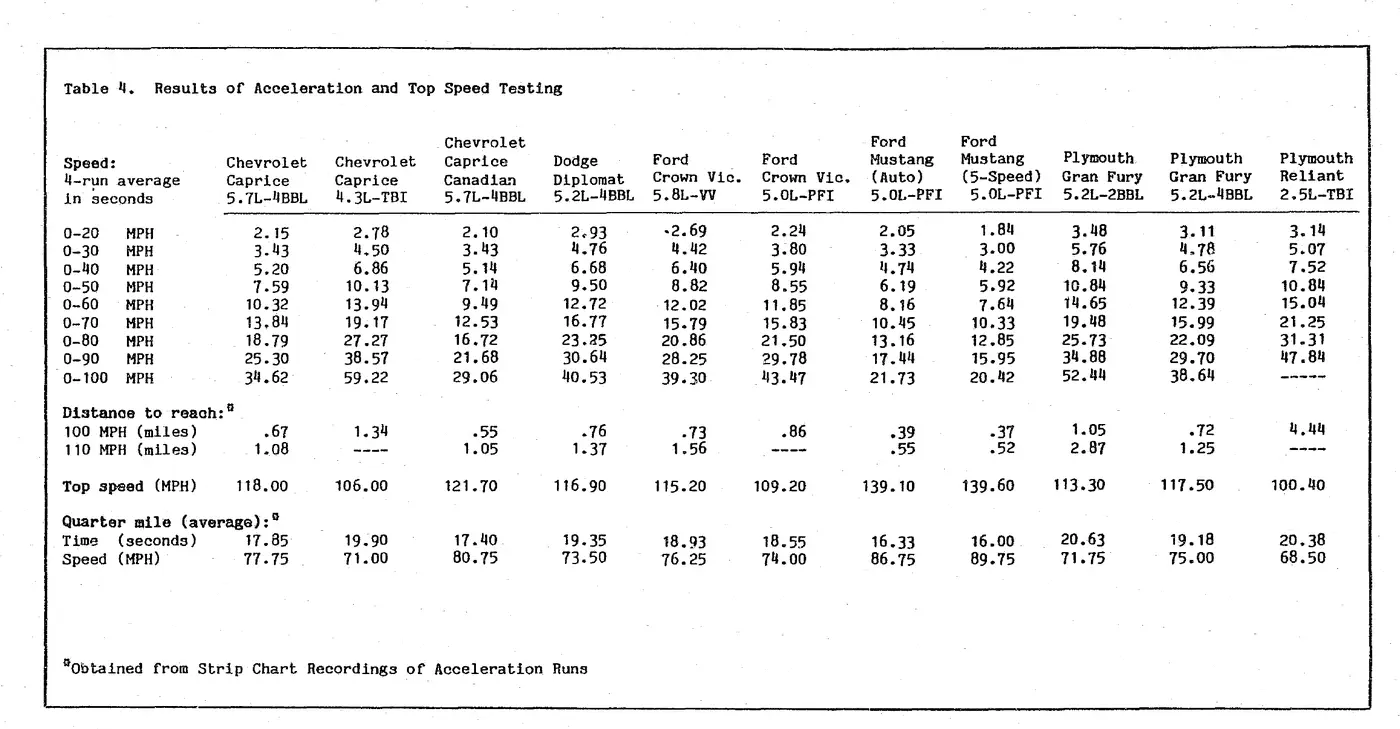
Complete acceleration data — every 10-mph increment
| 0 to… | Caprice 350 | Crown Vic 351-VV | Gran Fury 318-4 | Diplomat 318-4 |
|---|---|---|---|---|
| 20 mph | 2.15 | 2.69 | 3.11 | 2.93 |
| 30 mph | 3.43 | 4.42 | 4.78 | 4.76 |
| 40 mph | 5.20 | 6.40 | 6.56 | 6.68 |
| 50 mph | 7.59 | 8.82 | 9.33 | 9.50 |
| 60 mph | 10.32 | 12.02 | 12.39 | 12.72 |
| 70 mph | 13.84 | 15.79 | 15.99 | 16.77 |
| 80 mph | 18.79 | 20.86 | 22.09 | 23.25 |
| 90 mph | 25.30 | 28.25 | 29.70 | 30.64 |
| 100 mph | 34.62 | 39.30 | 38.64 | 40.53 |
| 0 to… | Mustang 5-spd | Mustang auto | Crown Vic 302 | Gran Fury 318-2 | Caprice 262 | Caprice 350 (Cdn) | Reliant 153 |
|---|---|---|---|---|---|---|---|
| 20 mph | 1.84 | 2.05 | 2.24 | 3.48 | 2.78 | 2.10 | 3.14 |
| 30 mph | 3.00 | 3.33 | 3.80 | 5.76 | 4.50 | 3.43 | 5.07 |
| 40 mph | 4.22 | 4.74 | 5.94 | 8.14 | 6.86 | 5.14 | 7.52 |
| 50 mph | 5.92 | 6.19 | 8.55 | 10.84 | 10.13 | 7.14 | 10.84 |
| 60 mph | 7.64 | 8.16 | 11.85 | 14.65 | 13.94 | 9.49 | 15.04 |
| 70 mph | 10.33 | 10.45 | 15.83 | 19.48 | 19.17 | 12.53 | 21.25 |
| 80 mph | 12.85 | 13.16 | 21.50 | 25.73 | 27.27 | 16.72 | 31.31 |
| 90 mph | 15.95 | 17.44 | 29.78 | 34.88 | 38.57 | 21.68 | 47.84 |
| 100 mph | 20.42 | 21.73 | 43.47 | 52.44 | 59.22 | 29.06 | — |
The 5-speed Mustang needed just 0.37 miles to reach 100 mph and 0.52 to reach 110. Its 89.75 mph quarter-mile trap speed is the highest in the books held here to that point; the 1986 bulletin prints no quarter-mile figures.
The 110 mph rule caught four of these cars. The Gran Fury two-barrel reached 110 only after 2.87 miles, against the two allowed; the 302 Crown Victoria, the V6 Caprice and the Reliant never reached it at all. None of the four was bid.
Brakes, fuel economy, ergonomics
| Car | 60–0 Phase I (ft) | 60–0 Phase II (ft) | Avg decel (ft/s²) | EPA city (mpg) | Ergonomics (pts) |
|---|---|---|---|---|---|
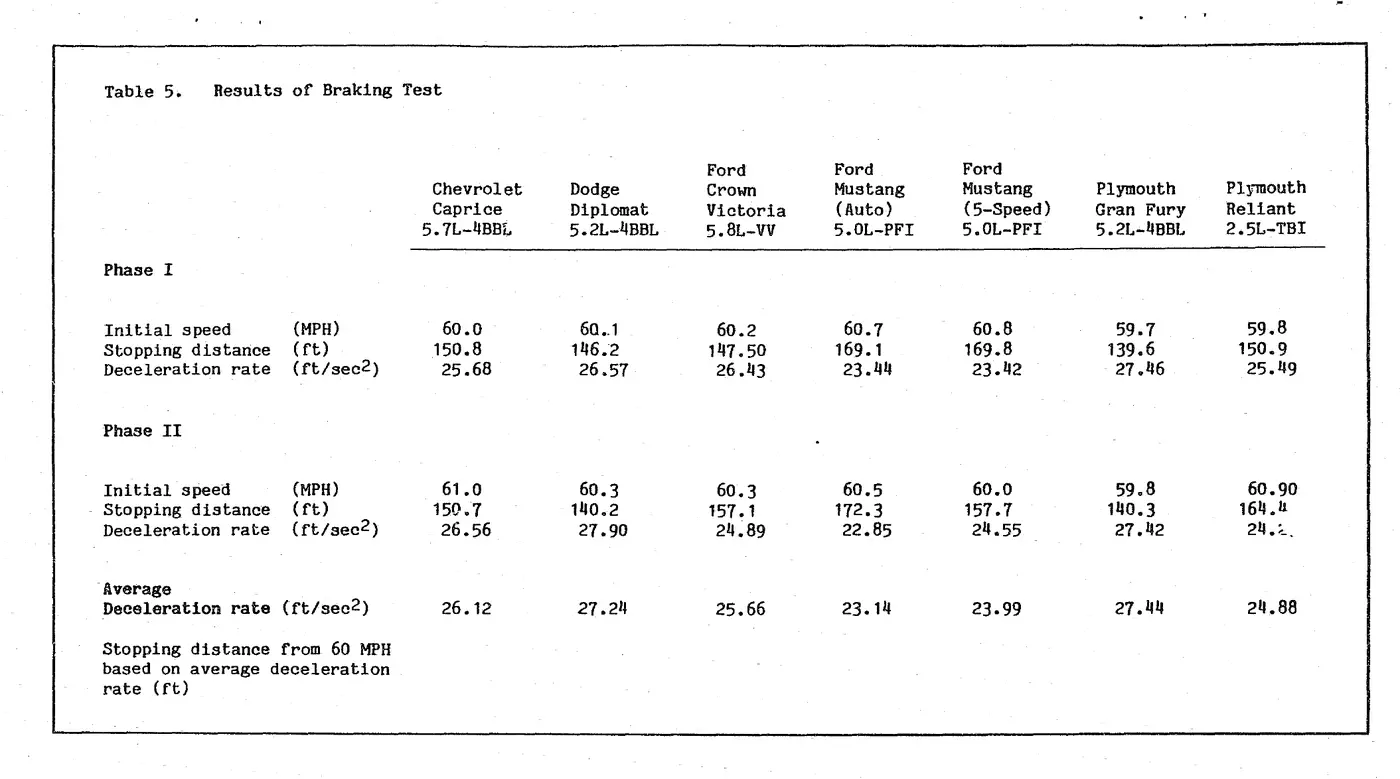
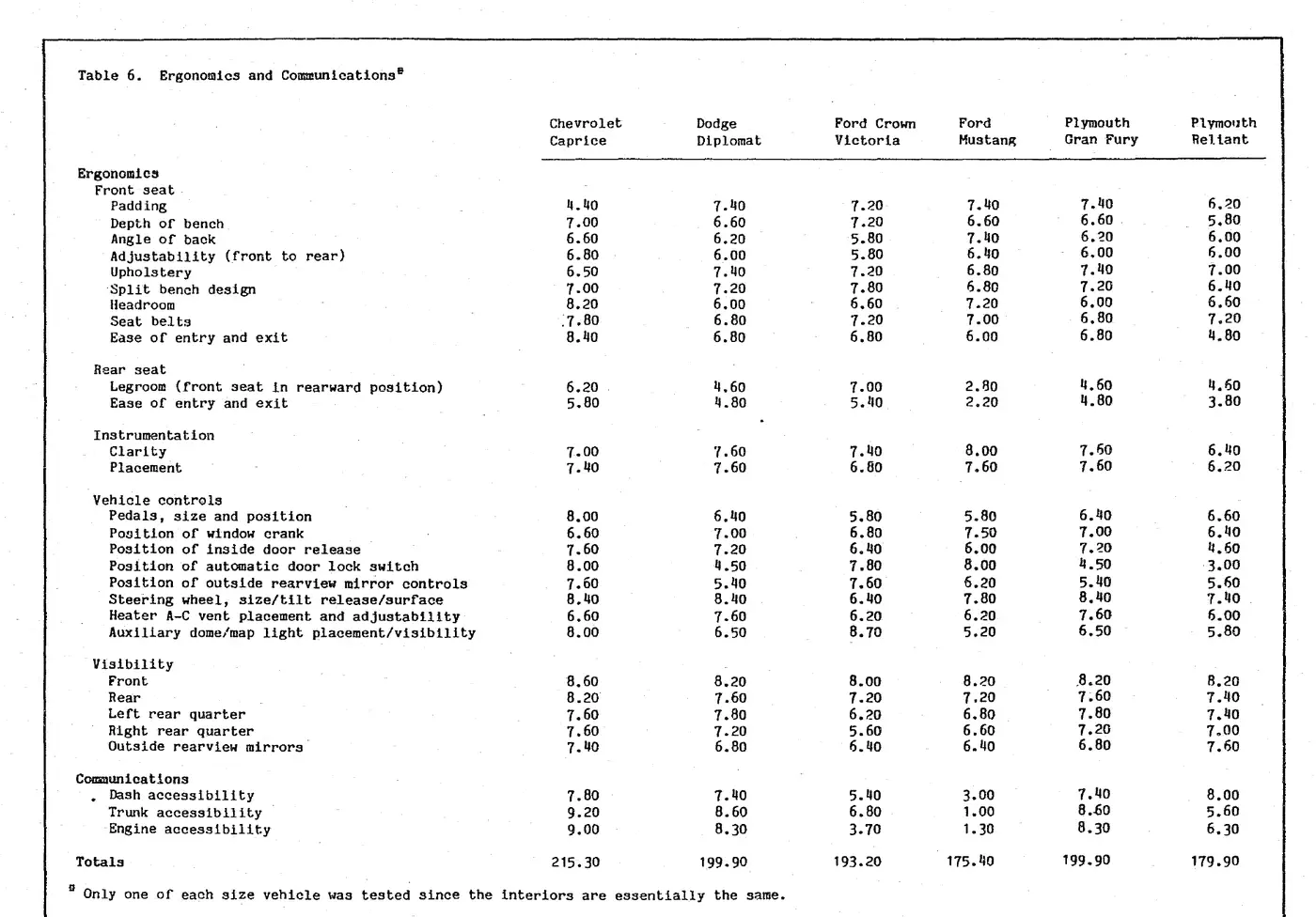
| Plymouth Gran Fury 318-4 | 139.6 | 140.3 | 27.44 | 12.7 | 199.90 |
| Dodge Diplomat 318-4 | 146.2 | 140.2 | 27.24 | 12.7 | 199.90 |
| Chevrolet Caprice 350 | 150.8 | 150.7 | 26.12 | 13.9* | 215.30 |
| Ford Crown Victoria 351 | 147.5 | 157.1 | 25.66 | 12.9* | 193.20 |
| Plymouth Reliant 153 | 150.9 | 164.4 | 24.88 | 21.2 | 179.90 |
| Ford Mustang (5-speed) | 169.8 | 157.7 | 23.99 | 16.4* | 175.40 |
| Ford Mustang (automatic) | 169.1 | 172.3 | 23.14 | 17.6 |
A quiet revolution hides in this table: deceleration rates that hovered around 24 ft/s² in 1983 now reached 27.44 — the M-bodies, of all cars, stopping shortest, on Goodyear Eagle GT/HR radials, already specified for the 1984 test. The Mustangs’ new brake package resisted fade on the track, the preface notes, but locked the rears early on the skid stops — hence the low averages. And the ergonomics sheet quantifies why radio installers dreaded the Mustang: dash accessibility 3.0, engine 1.3, trunk 1.0 out of ten.
See the original pages: Tables 5 and 6 in the October 1986 bulletin
Hardware: horsepower, axle ratios, test weights
| Car | HP (SAE net) | Axle ratio | Test weight (lb) | Transmission |
|---|---|---|---|---|
| Ford Mustang 302-PFI (5-speed) | 225 | 3.08 | 3,198 | 5-speed manual w/ OD |
| Ford Mustang 302-PFI (auto) | 225 | 2.73 | 3,270 | 4-sp auto w/ OD (AOD) |
| Chevrolet Caprice 350-4BBL | 180 | 3.08 | 3,948 | 4-sp auto w/ OD (700R4) |
| Ford Crown Victoria 351-VV | 180 | 2.73 | 4,079 | 4-sp auto w/ OD (AOD) |
| Dodge Diplomat 318-4BBL | 175 | 2.94 | 3,885 | 3-sp auto (A999) |
| Plymouth Gran Fury 318-4BBL | 175 | 2.94 | 3,924 | 3-sp auto (A999) |
| Ford Crown Victoria 302-PFI | 160 | 3.08 | 4,051 | 4-sp auto w/ OD (AOD) |
| Chevrolet Caprice 262-TBI | 140 | 3.08 | 3,803 | 4-sp auto w/ OD (700R4) |
| Plymouth Gran Fury 318-2BBL | 140 | 2.26‡ | 3,895 | 3-sp auto (A727) |
| Plymouth Reliant 153-TBI | 100 | 3.22 | 2,712 | 3-sp auto (A949) |
‡ The book disagrees with itself: the hardware summary prints 2.26:1 for the 2-barrel Gran Fury’s axle, its Appendix A sheet 2.25:1 — to be settled against a physical copy. Horsepower had climbed across the board: the Mopar 318s to 175, the Chevrolet 350 and Ford 351 to 180, and the port-injected Mustangs to 225 — up fifty from the 175 of the carbureted car Michigan published in 1983. Fuel injection now ran through half the field.
The scoring — and a rout
As in the September 1984 specification, each category’s best car scores zero, every other car is charged the fraction by which it trails the best, multiplied by the category weight — 30 points dynamics, 20 acceleration, 20 top speed, 10 brakes, 10 ergonomics, 10 fuel — and the lowest total wins. The bid adjustment is 1% of the lowest bid received, multiplied by each car’s total and added to its price. Read the totals below and the year explains itself: the Caprice scored best in five of the six categories and was charged points only for its brakes.
| Car | Dynamics (s) | 0–100 (s) | Brakes (ft/s²) | Top speed (mph) | Ergonomics (pts) | EPA city (mpg) | Total weighted score |
|---|---|---|---|---|---|---|---|
| Chevrolet Caprice 350 | 88.32 | 34.62 | 26.12 | 118.0 | 215.3 | 13.9 | 0.480 |
| Plymouth Gran Fury 318-4 | 89.77 | 38.64 | 27.44 | 117.5 | 199.9 | 12.7 | 4.460 |
| Ford Crown Victoria 351 | 88.59 | 39.30 | 25.66 | 115.2 | 193.2 | 12.9 | 5.670 |
| Dodge Diplomat 318-4 † | 89.95 | 40.53 | 27.24 | 116.9 | 199.9 | 12.7 | disqualified |
What Michigan ordered
The September 1986 specification (Mich. 3905-0010) shows the program’s electrical appetite growing: a 100-amp minimum alternator (up from 80) and a 500 cold-cranking-amp battery (up from 455). The Unity #225 spotlights with H7635 halogen spotlamps are as in the September 1984 specification. Tires are Goodyear Eagle GT/HR radials, also already specified in September 1984, and in September 1983 for the 1984 test — kept, the preface notes in answer to many inquiries, at 35 psi cold for both testing and patrol service. Fifteen-inch heavy-duty wheels, black, with hub caps. Plate brackets are asked for front and rear, where the September 1984 specification asks only for a front one.
Carried forward: the ⅛-inch welded roof plate, drilled and pre-wired for the beacon; the limited-slip differential; maximum cooling with anti-freeze protection to −35 °F; tilt steering wheel; certified ±3 mph speedometer reading to at least 120; power locks keyed alike per car; inside hood release; intermittent wipers; heavy-duty blue cloth (all-vinyl still not acceptable); paint to Dulux 93-032 — and a closing line collectors will enjoy: no dealer advertising to be on vehicles. See how to identify a genuine police package car and the police package option codes guide.
What 1987 settled
The program grew teeth. A qualification bar that had been tightening since 1983 was tightened again, and the Diplomat — 175 horsepower, three-speed automatic, the same basic car since 1977 — became its first casualty, by a quarter of a second, while stopping harder than any car in the books held here from before 1987; only the Gran Fury beside it did better. The M-body would soldier on with other agencies, but in East Lansing the verdict was in.
Meanwhile the Caprice showed what the new standard was for: 60 mph in 10.32 seconds, 100 in 34.62, best score in five categories of six. And out at the edge of the field, two port-injected Mustangs ran 139 mph and lapped the pursuit course four and a half to six seconds faster than anything with four doors — the fastest figures in any book held here to that point.