
Michigan test archive
1985 Michigan State Police Patrol Vehicle Test
The scoring sheet survives but the test book does not: four sedans, the bids, and a Dodge Diplomat with the adjusted low bid.
The 1985 file in this archive holds the result of Michigan’s 1985 patrol-car test, not the test itself. What survives is the State Police’s one-page 1985 Competitive Patrol Vehicle Evaluation, a draft of the purchasing specification the cars were tested against, and the state’s record of the bid opened on 9 November 1984. Four sedans were scored: the Chevrolet Impala 350, the Dodge Diplomat 318, the Ford Crown Victoria 351 and the Plymouth Gran Fury 318, the four makes the specification names.
On the sheet the Ford was best on the road course (89.67 seconds) and in acceleration (39.78 seconds), and it had the best total weighted score of the four, 1.400 points (zero would have been best in every category). It was also the dearest at $11,551.00 a car, and after adjustment it was still the most expensive. The Diplomat’s bid of $10,855.88 and its score of 1.720 gave the lowest adjusted price, $11,042.60. The specification’s rule is that “The vehicle to be purchased will be determined by the adjusted low bid price.” The sheet itself prints no ranks and names no winner. The order given below is worked out from its adjusted bid prices.
The four scored cars — the sheet’s raw scores
| Car | Engine | Dynamics (s) | 0–100 (s) | Avg decel (ft/s²) | Top speed (mph) | Ergonomics & communications (pts) | Fuel economy (mpg) | Total weighted score |
|---|---|---|---|---|---|---|---|---|
| Chevrolet Impala 350 | 350-4V | 90.82 | 42.24 | 25.92 | 114.3 | 206.00 | 13.3 | 2.930 |
| Dodge Diplomat 318 | 318-4V | 90.83 | 40.15 | 27.11 | 117.6 | 199.40 | 12.6 | 1.720 |
| Ford Crown Victoria 351-VV | 351-VV | 89.67 | 39.78 | 26.34 | 116.9 | 202.60 | 12.6 | 1.400 |
| Plymouth Gran Fury 318 | 318-4BBL | 90.69 | 42.00 | 26.60 | 119.4 | 198.40 | 12.6 | 2.540 |
Each car led somewhere. The Ford was quickest on the course and in acceleration, the Gran Fury fastest at 119.4 mph, the Diplomat best in braking at 27.11 ft/s², and the Impala best in ergonomics and communications (206.00) and in fuel economy (13.3 mpg). The Impala was also the slowest, at 114.3 mph, and the slowest to 100. The other three cars on the course were within 0.14 seconds of one another; the Ford was more than a second quicker. The Diplomat’s 27.11 ft/s² is the highest average deceleration on the year pages before 1987, ahead of the 1986 Gran Fury’s 26.71; the 1987 Gran Fury and Diplomat then reached 27.44 and 27.24.
See the original page: the 1985 evaluation sheet
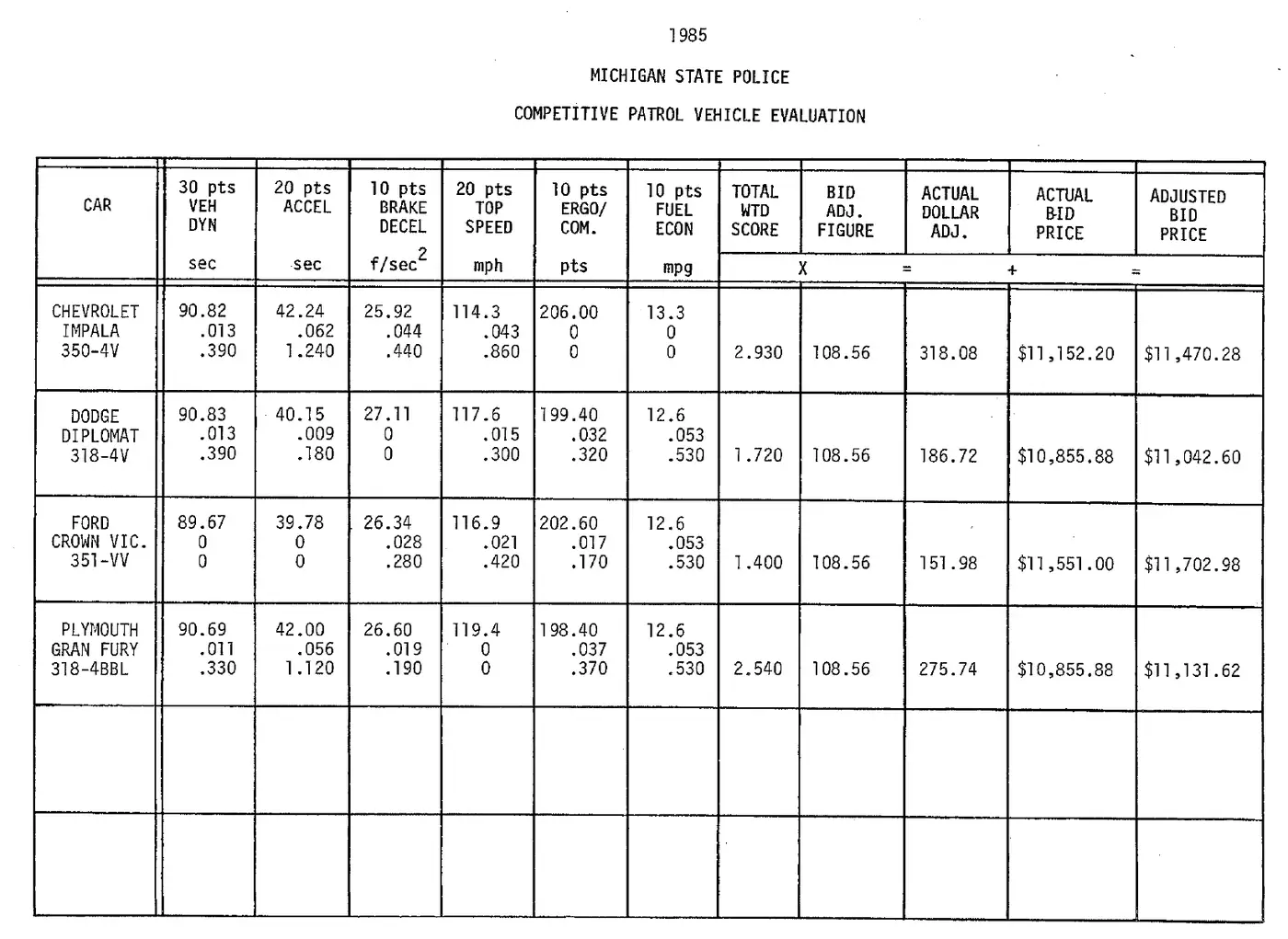
How the score was worked out
The specification gives the categories their weights: vehicle dynamics 30 points, 0–100 acceleration 20, braking 10, top speed 20, ergonomics and communications 10, and fuel economy 10. Its scoring rule reads: “The top scoring vehicle in each test category receives a “0” for that category. The percentage by which each of the other vehicles varies from the top scorer in that category is the percentage of variance.” (In the copy held, “Best” is written in by hand above “top” twice, and the second “top” is struck through.) Each car’s percentage, as a fraction, is multiplied by the category weight, and the six results are added. The sheet rounds each percentage to three decimals before weighting. Every figure below recomputes from the raw scores.
| Car | Veh. dyn. (×30) | Accel. (×20) | Braking (×10) | Speed (×20) | Ergo./comm. (×10) | Fuel (×10) | Sum |
|---|---|---|---|---|---|---|---|
| Chevrolet Impala 350 | .013 → .390 | .062 → 1.240 | .044 → .440 | .043 → .860 | 0 → 0 | 0 → 0 | 2.930 |
| Dodge Diplomat 318 | .013 → .390 | .009 → .180 | 0 → 0 | .015 → .300 | .032 → .320 | .053 → .530 | 1.720 |
| Ford Crown Victoria 351-VV | 0 → 0 | 0 → 0 | .028 → .280 | .021 → .420 | .017 → .170 | .053 → .530 | 1.400 |
| Plymouth Gran Fury 318 | .011 → .330 | .056 → 1.120 | .019 → .190 | 0 → 0 | .037 → .370 | .053 → .530 | 2.540 |
The method was new. The 1984 book scored the cars with weighted Z-statistics and converted the total at 5% of the median bid. This sheet measures each car against the best one and uses 1% of the lowest bid. The weights are the 1984 book’s.
The bids and the adjusted prices
| Car | Total weighted score | Actual bid | Adjustment | Adjusted bid |
|---|---|---|---|---|
| Chevrolet Impala 350 | 2.930 | $11,152.20 | +$318.08 | $11,470.28 |
| Dodge Diplomat 318 | 1.720 | $10,855.88 | +$186.72 | $11,042.60 |
| Ford Crown Victoria 351-VV | 1.400 | $11,551.00 | +$151.98 | $11,702.98 |
| Plymouth Gran Fury 318 | 2.540 | $10,855.88 | +$275.74 | $11,131.62 |
In order of adjusted bid: Diplomat $11,042.60, Gran Fury $11,131.62, Impala $11,470.28, Crown Victoria $11,702.98. The Diplomat and the Gran Fury were bid at the same price, so the score alone separated them, by $89.02. The Ford’s better score was worth $34.74 against the Diplomat. Its bid was $695.12 higher, and it finished $660.38 behind. All the adjustments fall between $151.98 and $318.08, a spread of $166.10, smaller than the $695.12 between the cheapest and the dearest bid.
The purchasing record
A Department of Management and Budget memo of 27 November 1984 from the buyer, Jeffrey A. White, covers the tabulation: “Attached please find your copy of the bid tabulation for bid #85-000001-S04. This bid was for Patrol Vehicles and was opened on November 9, 1984.” The sealed-bid attendance list for that day carries the signatures of State Police and Motor Transport Division staff, Ford Motor Co. and Chrysler Corp. representatives, and Chevrolet, Dodge, Plymouth and Ford dealers.
The handwritten tabulation runs to 163 line items, one per delivery point (numbered 1 to 162, with a 121a), for 873 cars in all. Item 1, East Lansing, is 320 cars; item 2, Negaunee (spelled “Neguanee”), 45; two Lansing items take 38 and 37 cars, and two more Lansing items, 9 and 91, one and two cars. Most posts take one to four. Fourteen bidders are listed, and most quote different prices for different delivery points. A note at the top reads “Deducts of Chev. Bids only reflected in items 1-9”: four Chevrolet dealers’ figures are crossed out and reduced by $15.80 to $16.00. The bids on the scoring sheet match item-1 bids by amount.
| Bidder (as written) | Item 1 bid | Note |
|---|---|---|
| Berger Chevy | $11,543.12 | deduct “-15.88 per” |
| DeNooyer | $11,212.41 | deduct “-16.00” |
| Shaheen | $11,152.20 | deduct “-15.80”; the Impala’s bid on the scoring sheet |
| Wickstrom | $11,214.11 | deduct “-15.88” |
| Colonial Dodge | $11,002.00 | |
| NorthWestern Dodge | $11,041.36 | |
| Pointe Dodge | $10,984.99 | |
| Southfield Dodge | $10,979.50 | |
| Sterling Hgts. Dodge | $10,973.51 | |
| Van Dyke | $10,961.51 | |
| Pointe Plymouth | $10,985.99 | |
| Snethkamps Ply. or Dodge | $10,855.88 | lowest; the Diplomat’s and the Gran Fury’s bid on the scoring sheet |
| Thompson | $11,047.00 | |
| Royal Oak Ford | $11,551.00 | the Crown Victoria’s bid on the scoring sheet |
What this file does not hold
The 1985 test book is not in the file. There are no test dates, no location, no drivers and no test sign-offs, and no individual acceleration runs. The 0–60 and 0–80 averages, quarter mile and distance to 110 mph are missing, as are the lap-by-lap or driver-by-driver road-course times. There are no brake stop speeds or distances, no ergonomics or communications items, and no EPA figures, engine outputs, axle ratios or test weights. Nothing names a car that failed to qualify or ran for information, and nothing says which dealer received the award. The 1986 test is on the next page.
What Michigan ordered
The specification, headed “Draft – 1984” on every page, asks for a 4-door sedan, “1985 Current New”, from Chevrolet (Impala), Dodge (Diplomat), Ford (Crown Victoria) or Plymouth (Gran Fury), engine size “at manufacturer’s option providing that the car will meet or exceed the vehicle performance requirements”. Each test car was to come with “One extra set of engine belts and four (4) wheels and tires”, already broken in and with its brakes burnished. The delivery date in this draft is left blank.
The equipment list largely repeats the September 1983 specification (four pages of which sit among the Jeep papers in this file). New or changed items include the anti-freeze to −20°F, the inside hood latch release, the roof plate’s stated purpose, spotlight fusing of 10 to 20 amps, the heavy-duty cloth upholstery and the fifteen-inch wheels; the draft also adds a predelivery-inspection entry, speaker locations and several “(Dealer installation permitted)” provisions. Among the items:
- an 80-amp alternator with 45 amps at idle;
- a 455 cold-cranking-amp battery;
- a limited-slip differential;
- Quartz-Halogen headlights;
- anti-freeze to −20°F;
- an inside hood latch release;
- power locks with “different key for each car”;
- paint to Dulux 93-032;
- the ⅛-inch steel roof plate, now “to hold roof skin in its normal position for the purpose of supporting the overhead emergency light”;
- a 60/40 split bench;
- a speedometer accurate to ±3 mph, reading to 120;
- Unity #225 spotlights with H7635 halogen lamps, fused “with 10 to 20 amp capacity”;
- a tilt wheel;
- Goodyear Eagle GT/HR radials;
- a 3- or 4-speed automatic with low-gear lockout;
- “heavy-duty cloth, or combination of heavy-duty cloth and vinyl (blue)” upholstery (“All vinyl not acceptable”);
- “Fifteen-inch heavy duty” wheels.
A closing note adds “No dealer advertising to be on vehicle.” Hand edits on the copy held replace the “Remote Control Rear Deck Lid Release” with “To be equipped with electrically operated remote control trunk release” and allow speedometer graduations of “1 or” 2 mph.
The Wakefield Jeep
Most of the 1985 file is not about sedans at all. It is the Uniform Services Division’s correspondence on a four-wheel-drive experiment, and it records no performance testing. In November 1983 Major Michael J. Anderson wrote that he had toured the Upper Peninsula posts: “I support the general concept of a utility type 4X4; however, I have concerns regarding its practicality in year-round operations and the resultant costs.” He asked for “one (1) four-wheel drive, four door, vehicle” for the Wakefield Post. The requisition is for an “AMC 4-Door Jeep Wagoneer” with a “2.8L V-6 Engine”, automatic “with Command Trac”, skid plates and a 3.73 axle. Before it arrived Anderson warned the post that “this vehicle is not designed as a pursuit type patrol vehicle; thus, sustained high speed driving shall be avoided”, and asked for a daily log.
The post commander, F/Lt Peter J. Buda, then reported almost every month on car 878 (the report of January 1986 is signed by an acting post commander). In September 1984, after a storm that “dropped up to 5 inches of slush”, the night patrol wrote: “Could not travel more than 30 MPH in patrol car because of slush. Also, on uphill grades car kept sliding sideways. Jeep was able to travel 45-50 MPH in 2 wheel drive with no sliding.” In October the Jeep went after a lost hunter. The trooper’s daily report reads: “WITHOUT 4 WHEEL VEHICLE, RESCUE WOULD HAVE BEEN NEARLY IMPOSSIBLE. 4 WHEEL DRIVE CROSSED TWO SMALL CREEKS AND TWO MUDDY HILLS. 4 WHEEL DRIVE EVEN HAD A LITTLE TROUBLE CLIMBING THE STEEPEST OF THE HILLS DUE TO WET CLAY BUT DID MAKE IT. PATROL CAR WOULD HAVE BEEN STUCK 2 MILES SHORT OF RESCUE SITE.” By November, Buda reported, “THE WORD HAS GOTTEN BACK TO THE POST THAT SEVERAL INDIVIDUALS FROM CERTAIN CIRCLES ARE VERY NERVOUS ABOUT THE TROOPS BEING ABLE TO “GET BACK IN” WHERE THEY HANG OUT, NOW THAT THERE’S A JEEP AT THE POST.” In January 1985 the temperature fell “to 40 degrees below zero” with no problems. A memo of 6 July 1985 put the Jeep at 22,465 miles with “no major mechanical problems”, and “The vehicle’s maintenance record is better than most of the Plymouth Patrol Cars at the Post.”
The district commander, Captain James Fries, was against it: “Four wheel drive vehicles are not practical for general patrol purposes”, and “paying $6,900.00 more over 60,000 miles than we do for our blue cars is significant.” Anderson asked for two more three weeks later, for Calumet and Negaunee. In May 1987 Sgt. David Storer wrote that “We now have three upper peninsula posts equipped with four-wheel drive patrol vehicles and, to date, they have performed satisfactorily.” In the same memo he noted that the patrol car “actually has more horsepower than the Jeep Wagoneer”. Major James Daust then asked the Motor Transport Division to buy one for Houghton Lake Post, to tow its 2,400-pound diving boat and trailer. Near the end of the Jeep papers come two state truck specifications for 1987 models, before three closing memos. They list the Blazer and Jimmy, Bronco and Bronco II, Ramcharger, Jeep Cherokee and a Jeep “Model 15”, but they do not say which was bought. Four-wheel-drive vehicles first appear in the Michigan test results held here in the 1992 book.
What 1985 settled
On the specification’s rule, the adjusted low bid decided it. The Crown Victoria was best on paper, quickest round the course and to 100, but the new scoring was worth little in money: 1% of the low bid per point, about $109. The whole spread of adjustments, $166, was a quarter of the price gap between the Ford and the Diplomat. The Diplomat shared the lowest bid with the Gran Fury, outscored it, braked best and finished with the adjusted low bid of $11,042.60.