
It Didn’t Lose a Race. It Lost a Seat.
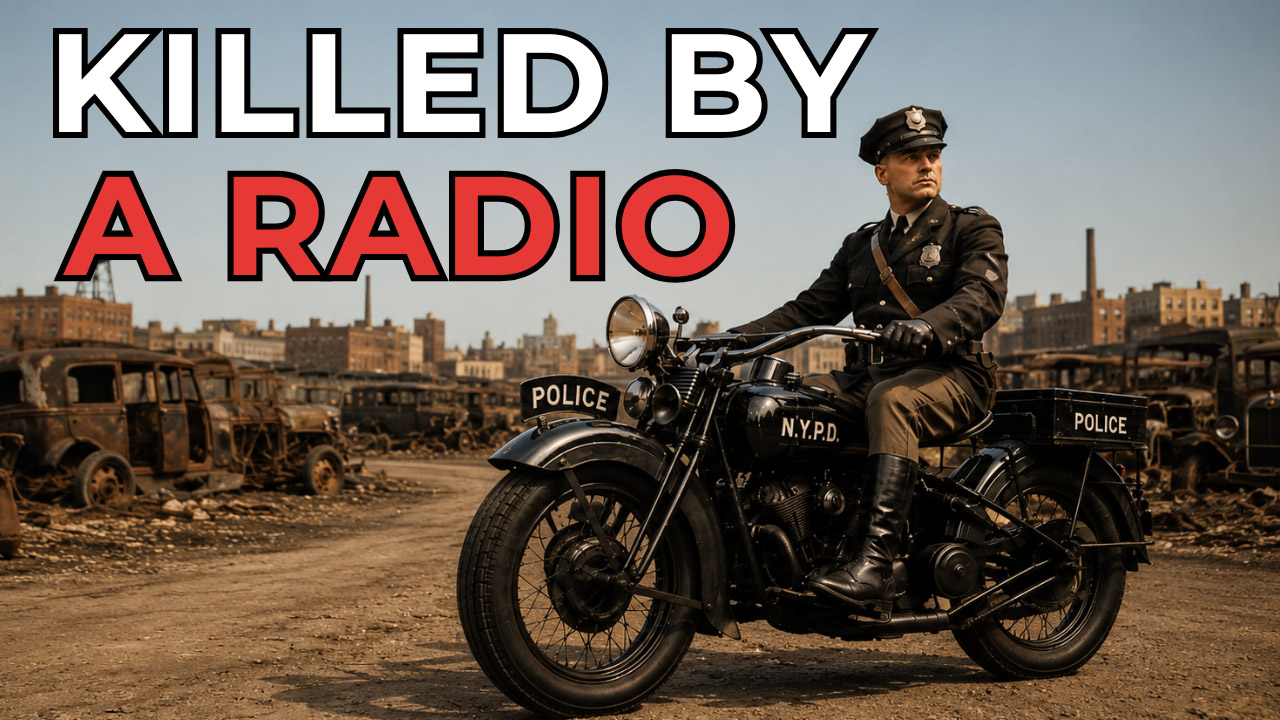
The Police Motorcycle: Killed by a Radio, Not a Faster Car
By Badges & Chrome · researched and verified from period records and primary sources · About the research →
About this VIDEO
-
The police motorcycle was pushed aside by a piece of technology it had nowhere to put.
For fifty years the motorcycle was the fastest, cheapest and most agile thing in American law enforcement. What ended its reign in general patrol was not a better vehicle but the two-way radio, and the story of why is stranger than it sounds.
-
Era
1908–1960s
-
Departments
Detroit, Berkeley, Pittsburgh, Tennessee and departments nationwide
-
Runtime
20:41
-
Published
Jul 14, 2026
1. Introduction
-
Why could only police buy the 1955 Buick Century Model 68?
Not because a faster car overtook them, and not because of cost. The motorcycle was pushed aside by the two-way radio. Early police radios were enormous, heavy, power-hungry assemblies full of fragile vacuum tubes. They needed somewhere to mount the controls, a trunk or back seat for the bulky set, and a substantial electrical system and battery to run it.
A car had all of that. A motorcycle had none of it: no space, no electrical capacity, and no practical way for a rider to operate a set while controlling a bike at speed. Once policing reorganised itself around radio dispatch and rapid response to calls, the disconnected motorcycle officer moved to the margins of the core mission. The motorcycle didn’t lose a race. It lost a seat, the seat where the radio had to go.
2. What You Will Learn
-
Why the motorcycle, not the car, was the practical answer to American policing’s mobility problem around 1908.
-
Where the term “motor officer” comes from, and why motorcycle police are still called motors.
-
Why motor officers wear boots and breeches, and which vanished branch of policing they inherited them from.
-
How the First World War handed American departments a surplus that built their motorcycle units.
-
The bitter irony of the chief who put police on motorcycles and then helped end their reign.
-
Why the motorcycle’s obvious weaknesses were never what killed it, and what it does better than a cruiser to this day.
3. Historical Background
In the first years of the twentieth century American police had a mobility problem with no good solution. Horses were slow and expensive to stable and feed, and increasingly useless against motorised criminals. The automobile existed but was unreliable, costly and hopelessly ill-suited to the roads of the era, because there essentially were no roads. In 1908 the entire United States had roughly 144 miles of paved road.
The motorcycle was the answer: cheap, fast and perfectly suited to primitive conditions. American motor policing is usually traced to 1908, when Harley-Davidson’s first police motorcycle was delivered to the Detroit Police Department. The exact “first” is genuinely disputed. Evanston, Illinois bought the first belt-driven machine the same year, and in 1909 a Portland, Oregon officer was permitted to patrol on his own Indian. But the era is clear.
The man who turned the motorcycle from novelty into system was Berkeley police chief August Vollmer, often called the father of modern American policing. Vollmer put his officers on bicycles, upgraded them to motorcycles around 1911, and moved to patrol cars by 1913 to 1914, making Berkeley one of the first fully motorised departments in the country. He modified the machines with saddlebags for police gear and wrote some of the first formal policies for how a motor unit should operate. Departments across America copied the Berkeley template.
4. The Machine Explained
The first police motorcycles were primitive by any modern measure: single-cylinder, belt-driven, and good for about the speed of a brisk modern bicycle downhill. But set them against the alternatives available in 1908, a horse or an unreliable early automobile on 144 miles of paved road, and they were transformative.
-
Delivered
1908, to the Detroit Police Department.
-
Machine
Harley-Davidson Model 4: 26 cu in single cylinder, belt drive.
-
Top speed
Around 40 mph.
-
US paved roads at the time
Roughly 144 miles in the entire country.
-
The rivals
Indian of Springfield, Massachusetts and Harley-Davidson of Milwaukee.
-
Cost advantage
A fraction of an automobile, decisive for budget-constrained departments.
-
Reliability
More dependable than early cars on bad roads.
-
Agility
Threaded congested traffic and tight urban spaces that stopped a car.
-
Presence
Flashing lights and sirens were not common on police bikes until the mid-1930s. The sight of a uniformed officer in the mirror was enough.
5. What The Records Show
The motorcycle found its perfect role with the explosion of automobile traffic in the 1920s. As Americans bought cars by the millions, speeding and reckless driving became public-safety crises, and a motor officer could hide, accelerate instantly, run down a speeding car and pull it over with an agility no patrol car could match. Through the 1930s the police motorcycle reached its peak of power and prestige, with the biggest police V-twins reaching around 100 mph.
-
The uniform nobody explains
As the motorcycle officer became the visible symbol of American mobile policing, departments dressed him in the boots, breeches and crossed-strap uniform of the horse-mounted officers he was replacing. The motor officer inherited the cavalry’s wardrobe, which is why a motor officer in tall boots and jodhpur-style breeches still looks faintly like a man who ought to be on horseback.
-
The war surplus that built the fleets
Harley-Davidson supplied roughly 20,000 motorcycles for the First World War, where they proved invaluable for dispatching messages before reliable battlefield radio existed. When the war ended the United States was left with a surplus of military motorcycles and sidecars, and police departments bought them at reduced prices, rapidly expanding their motor units. By the mid-1920s Harley-Davidson had a department dedicated to law-enforcement fleet sales, and by the end of the decade its motorcycles were reportedly in service with around 3,000 police departments.
-
When the law rode the slower bike
Prohibition complicated things. Bootleggers, flush with cash, bought the fastest machines available and knew exactly which ones. Departments typically rode Harley’s smaller-displacement models while the runners bought the bigger 74-cubic-inch versions that could simply out-accelerate them. For a few years the law was sometimes literally riding a slower motorcycle than the criminals.
-
The weaknesses that did not kill it
The motorcycle always had serious drawbacks: an officer is brutally exposed in a crash, there is no protection from weather, and a motorcycle cannot transport a prisoner. But every one of those existed from the beginning and none stopped it dominating for decades. Departments accepted them because the advantages outweighed them for the specific jobs the motorcycle did. The weaknesses were the price of admission, not a death sentence.
-
The decisive shift, and its irony
Detroit built the first practical one-way radio system in 1928, licensed as an entertainment station; Bayonne, New Jersey built the first true two-way system in 1933. A radio car became a mobile node in a citywide command network, and early sets needed space, power and a free pair of hands. And here is the irony: August Vollmer, the same Berkeley chief who had built one of America’s first motorcycle units two decades earlier, became by the 1930s one of the most influential champions of putting radio into police work. He did not invent the police radio, but as the nation’s leading voice for professionalisation he helped drive the very shift that would dethrone the machine he had done so much to put on the street.
6. Why It Mattered
The police motorcycle never actually died. It is in service with almost every major American department today. What changed was not its existence but its role.
For the first half of the twentieth century the motorcycle had been forced to be a generalist, doing all kinds of police work simply because the car was not ready and the radio did not yet exist. It was never truly suited to that: it could not carry a prisoner, shelter an officer, or, in the end, carry a radio. Its real genius had always been narrower and sharper, specialised speed and agility work, above all traffic enforcement.
So when the radio car arrived and took over general patrol, it did not destroy the motorcycle. It relieved it, lifting away a burden the machine had never been well suited to and freeing it to concentrate on the thing it had always done better than any car. Consider what a motorcycle still does that a cruiser cannot: sit unobtrusively, accelerate instantly, weave through gridlock to reach a violator, thread a jammed city to reach a crash scene. For catching a single speeding vehicle in heavy traffic it often remains the best tool there is.
The 1950s proved it. As post-war America moved to the suburbs and new freeways pushed average speeds up, traffic deaths climbed and departments turned straight back to the motor officer. Cities formed flashy specialised squads with names to match: Pittsburgh’s Hot Rod Squad chased street-racing teenagers, and the Tennessee Yellow Jackets of 1958 rode bright yellow-and-black Harleys in matching uniforms designed to be impossible to miss. The Yellow Jackets operated for only about six months but left such an impression that departments copied the look into the 1960s. That era also produced a permanent piece of Americana: the motorcycle cop parked behind a highway billboard, waiting.
What looks like the death of the police motorcycle was really the moment American policing worked out what the motorcycle was actually for. It didn’t lose. It got focused.
7. Key Takeaways
-
The motorcycle came first because in 1908 there were only about 144 miles of paved road in the entire United States.
-
1908, Detroit: the first Harley-Davidson police motorcycle, a 26 cu in single good for around 40 mph.
-
Motor officers wear cavalry clothes, boots and breeches inherited from the mounted officers they replaced.
-
20,000 Harleys went to the First World War, and the surplus built America’s police motorcycle units.
-
Its famous weaknesses never killed it. Exposure, weather and no prisoner space existed from day one.
-
The radio did. There was nowhere on a motorcycle to mount a 1930s two-way set, and no power to run it.
8. Frequently Asked Questions
9. Sources
Every claim on this page is drawn from manufacturer histories, departmental records and published policing scholarship. These are the sources behind it.
-
Harley-Davidson company history
The 1908 Detroit delivery, the Model 4 specification, and roughly 20,000 machines supplied for the First World War, together with the establishment of a dedicated law-enforcement fleet sales operation by the mid-1920s.
-
Berkeley Police Department records
Documentation of August Vollmer’s motor patrol unit, established around 1911, and the department’s full motorisation by 1913 to 1914.
-
Police1, “The evolution of motor patrol in American policing”
Survey history of early police motorcycle adoption, including the Portland and Evanston machines of 1908 and 1909.
-
Histories of the Tennessee Yellow Jackets and Pittsburgh Hot Rod Squad
Documentation of the 1958 Yellow Jackets, their yellow-and-black livery and matching uniforms, their roughly six-month operation and their subsequent imitation.
-
Detroit (1928) and Bayonne, New Jersey (1933) police radio records
The first practical one-way and two-way police radio systems, establishing the technology that displaced the motorcycle from general patrol.
10. Related VIDEOs
By Badges & Chrome — researching the history of American police vehicles from published automotive history, period records, and primary sources. Every claim is verified before publication.
About the research →