
The Most Famous Police Car Was Marketed
How the LAPD Made the Black-and-White the American Cop Car
By Badges & Chrome · researched and verified from period records and primary sources · About the research →
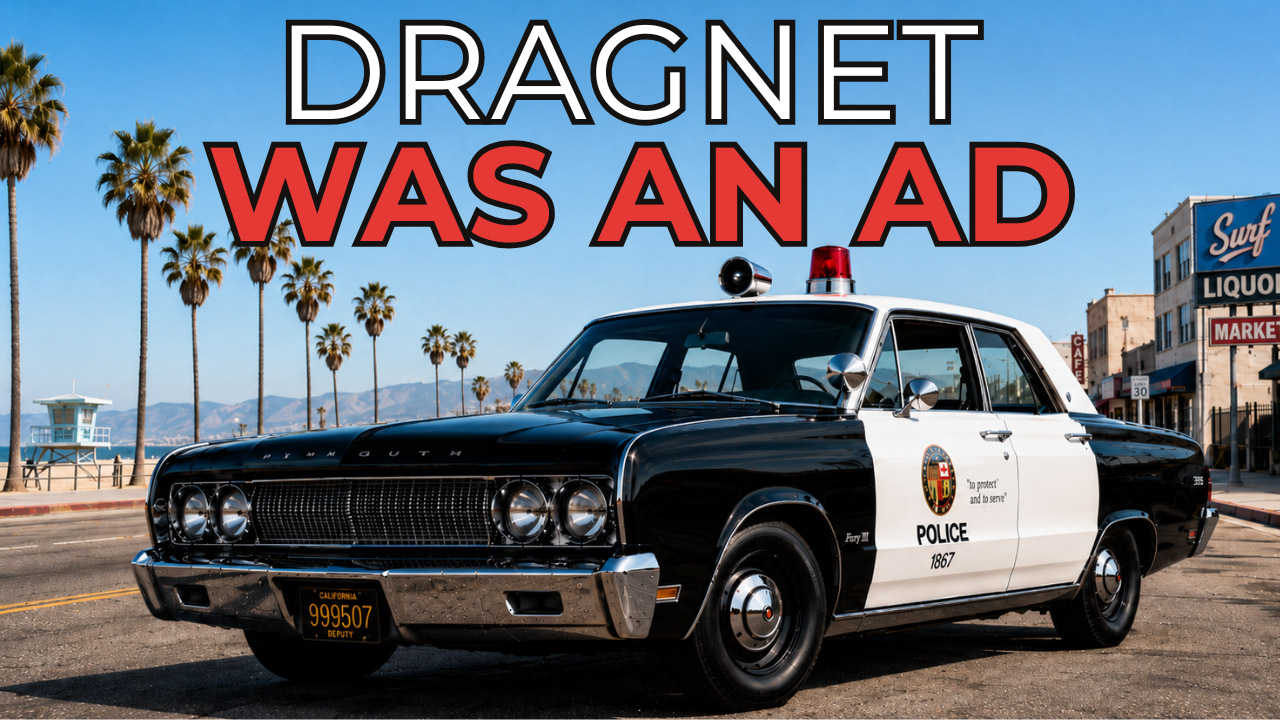
About this VIDEO
-
The image of the American police car was built deliberately, in one city, by one man.
How LAPD chief William H. Parker rebuilt a corrupt department around the patrol car between 1950 and 1970, then used two of the most popular shows on television to install that picture in the national imagination.
-
Era
1950–1970
-
Department
Los Angeles Police Department
-
Runtime
15:42
-
Published
Jul 1, 2026
1. Introduction
-
Why could only police buy the 1955 Buick Century Model 68?
The black-and-white patrol car with a roof antenna and two officers inside is not an inevitable design. It was built and marketed, largely by the Los Angeles Police Department under Chief William H. Parker between 1950 and 1970. Parker did not invent car-based policing; that belongs to earlier reformers, notably August Vollmer at Berkeley and his protégé O. W. Wilson, who codified motorised preventive patrol. The factory police package already existed at Ford by 1950.
What Parker did was execute the car-centric model at a scale and discipline nobody matched, wrap it in a phrase, “the thin blue line,” and then do the thing no earlier reformer had done: make it famous. He granted Jack Webb unprecedented access to the LAPD in exchange for the department’s Public Information Division vetting every Dragnet script.
2. What You Will Learn
-
Why Parker believed the foot beat itself was a cause of police corruption, and what he replaced it with.
-
How the LAPD standardised the black-and-white, and what the white doors were actually for.
-
Why a high-volume fleet buyer like the LAPD mattered to Detroit’s police package development.
-
The exact terms of the deal that gave Parker editorial control over the most popular police show in America.
-
What the title “Adam-12” literally decodes to, and why it was an advertisement for Parker’s patrol model.
-
The cost of the model Parker built, and why his legacy remains contested.
3. Historical Background
By the late 1940s the LAPD was a national embarrassment, riddled with vice payoffs and cosy relationships between officers and the criminals they were supposed to police. Chiefs came and went in disgrace. Meanwhile the city was exploding outward, sprawling across hundreds of square miles of new post-war neighbourhoods that the old foot-beat model could not cover.
On 9 August 1950 the city made William H. Parker chief. He was forty-five, a decorated Second World War veteran, and known for rigidity and an obsession with order. He would go on to serve sixteen years, the longest tenure in the department’s history.
Parker had a theory about corruption that shaped everything he did. He believed the foot beat was itself the problem: an officer planted in one neighbourhood week after week, building relationships with local shopkeepers and local crooks alike, was an officer who could be compromised. A car was mobile, could be anywhere, was supervised by radio, and was harder to tie into local vice. He also deliberately reduced the size of the force relative to the city’s population, on the theory that fewer but more professional officers would mean less corruption, and the car-centric model was the tool that let a smaller force cover a bigger city.
4. The Machine Explained
What Parker built was not a car but a system, and every element of it was deliberate. The two-tone scheme was not strictly his invention. The California Highway Patrol had chosen white cars from its founding in 1929 so they would stand out against mostly-black civilian traffic. Nor was the LAPD’s own black-and-white new. The department was running them by at least 1937, thirteen years before Parker took over. What he did was standardise the scheme, codify what went on the doors, and turn it into a statement. What Parker did was standardise it, codify it and give it meaning: the patrol car as advertising for police presence itself.
-
Patrol unit
Two-officer cars as the department’s signature: a driver and a partner sharing a radio and checking each other’s conduct.
-
Livery
The black-and-white. Dark body, white doors.
-
Door markings
Unit number, city seal and LAPD insignia in large characters, readable from a block away.
-
Function of the livery
Visibility and unmistakability. A patrol car that could not be confused with anything else on the road.
-
Force size
Deliberately reduced relative to population. Fewer, better-trained officers.
-
Hardware: Ford
1950, the first factory police package.
-
Hardware: Chevrolet
1955.
-
Hardware: Chrysler (Dodge)
1956. By the 1960s the LAPD was running Plymouths and Dodges in significant numbers.
5. What The Records Show
A standard civilian sedan of the early 1950s was never designed to idle for hours powering a radio, carry two large officers and a load of equipment, and accelerate hard out of stops hundreds of times a shift. A high-volume buyer constantly replacing large numbers of cars was exactly the kind of customer that pushed Detroit to keep toughening its police packages. But the more consequential thing Parker built was not mechanical.
-
The deal behind Dragnet
Jack Webb received unlimited LAPD cooperation: real case files, real procedures, and access to observe the department at work. In exchange, the department’s Public Information Division vetted the scripts. One specific condition was that the show would never use the word “cop,” which Parker regarded as derogatory. The result was officers written as ethical, efficient, terse and scientific, exactly the picture Parker wanted America to see.
-
Badge 714
Dragnet began as a radio drama in 1949 and moved to NBC television in December 1951. Its details became cultural landmarks. Joe Friday’s badge number, 714, was iconic enough that the syndicated version of the show was retitled Badge 714, and the clipped “Just the facts, ma’am” became shorthand for the entire technocratic style of policing Parker was selling.
-
The chief who produced his own television show
In 1952 Parker produced an LAPD panel show for Los Angeles NBC station KNBH called, naturally, The Thin Blue Line, on which he frequently appeared. Contemporary accounts described it as unabashedly propagandistic.
-
What “Adam-12” actually means
Webb’s 1968 series was set almost wholly inside a single LAPD black-and-white, and the title was real LAPD radio culture decoded: the “1” is the division, “Adam” is the department’s phonetic letter A designating a two-officer patrol unit, and “12” is the beat. The title of one of the most popular police shows in America was, quietly, an advertisement for the exact patrol model Parker had built.
-
6. Why It Mattered
It is tempting to say Parker invented the modern cop car. He did not, and the true story is better. The car-centric, radio-dispatched model was pioneered by Vollmer and codified by O. W. Wilson decades earlier; the factory police package came from Detroit. What Parker uniquely did was fuse three things that had never been combined: a disciplined, professionalised, car-based department; a deliberate public-relations philosophy built around the “thin blue line”; and an unprecedented partnership with the most powerful medium of the age. He took a model that already existed and made it the model, the one other cities pictured when they modernised, and the one America pictured when it imagined a police officer at all.
The model also had a cost, and the film names it. The same philosophy that made the LAPD efficient, fewer officers, mobile and detached, rolling through neighbourhoods in sealed cars rather than walking them, pulled officers away from the communities they policed. To many residents, particularly in Black neighbourhoods, the department became an occupying force that arrived by car, made arrests and left. In August 1965 that tension erupted in Watts: six days of unrest that left 34 people dead, over a thousand injured, thousands arrested and roughly $40 million in property damage. Parker’s rhetoric during and after the crisis is widely judged to have made matters worse, and his record on race has been criticised ever since.
Parker remained chief until his death from a heart attack in July 1966. How completely he had merged the real department with its televised image is best measured by what happened to Jack Webb: when Webb died in December 1982 the department retired Joe Friday’s badge number, 714, in his honour, and gave him a three-volley salute.
7. Key Takeaways
-
Parker did not invent the police car. Vollmer pioneered motorised patrol and Wilson codified it. Parker made it famous.
-
He treated corruption as a geography problem. Cars were mobile, radio-supervised and harder to compromise than a fixed foot beat.
-
The livery was advertising. White doors carried the unit number, city seal and insignia, readable from a block away.
-
He had editorial control over Dragnet: LAPD cooperation in exchange for script approval, including a ban on the word “cop.”
-
“Adam-12” decodes to Parker’s own model. The “Adam” specifically designated a two-officer unit.
-
The model’s cost was real. Watts in 1965 left 34 dead, and Parker’s record on race remains heavily criticised.
8. Frequently Asked Questions
9. Sources
Every claim on this page is drawn from departmental records, broadcast history and published scholarship. These are the sources behind it.
-
Los Angeles Police Department historical records
Documentation of Chief William H. Parker’s tenure from August 1950 to July 1966, the department’s longest, including his restructuring around radio-dispatched patrol.Documentation of Chief William H. Parker’s tenure from August 1950 to July 1966, the department’s longest, including his restructuring around radio-dispatched patrol.
-
Dragnet and The Thin Blue Line broadcast records
Dragnet’s 1949 radio origin, its December 1951 NBC television debut and its Badge 714 syndication title; and the 1952 KNBH panel show produced by Parker, as covered in TV-Radio Life, August 1952.
-
Joe Domanick, To Protect and To Serve
The LAPD’s Century of War in the City of Dreams. Scholarship on Parker’s professionalisation programme and its consequences.
-
Edward J. Escobar, Pacific Historical Review, 2003
“Bloody Christmas and the Irony of Police Professionalism,” on the tensions inside Parker’s reform model.
-
Reporting on the 1965 Watts uprising
Contemporary and retrospective accounts establishing the casualty and damage figures: 34 dead, over a thousand injured, and roughly $40 million in property damage.
10. Related VIDEOs
By Badges & Chrome — researching the history of American police vehicles from published automotive history, period records, and primary sources. Every claim is verified before publication.
About the research →