
The Six That Beat Every V8
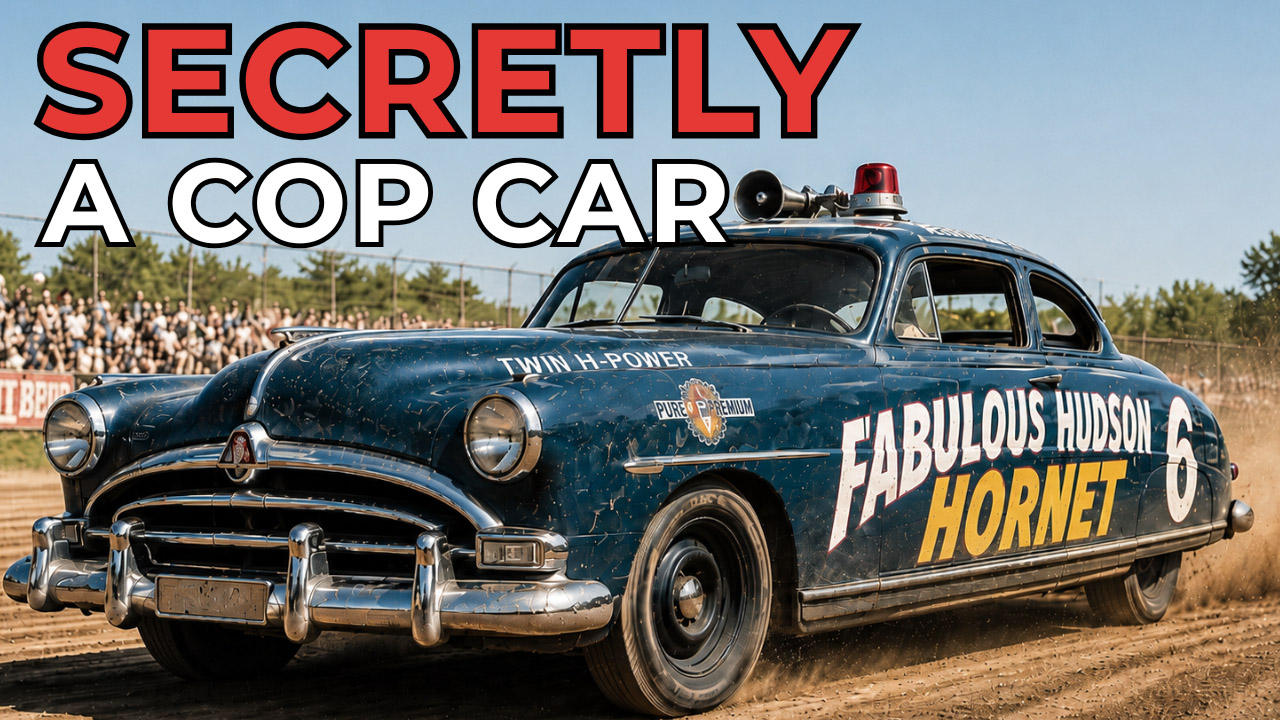
The Hudson Hornet: NASCAR Champion and Forgotten Police Car
By Badges & Chrome · researched and verified from period records and primary sources · About the research →
About this VIDEO
-
Hudson’s championship-winning race parts were officially sold as police equipment.
The six-cylinder sedan that beat every V8 in America, and quietly served as a pursuit car in the rural South. How a parts-catalogue loophole tied a race package to police work, and why the company vanished within three years of its greatest season.
-
Era
1948–1957
-
Departments
Southern county sheriffs and highway patrols
-
Runtime
26:37
-
Published
Jul 7, 2026
1. Introduction
-
Why could only police buy the 1955 Buick Century Model 68?
Yes, in a limited but genuine way, and the mechanism connecting it to police work is one of the cleverest loopholes in motorsport history. In NASCAR’s earliest years cars had to be genuinely stock, meaning only parts actually sold to the public could be raced. Hudson’s answer was to list its high-performance components in the factory catalogue as “Severe Usage” parts: heavy-duty equipment officially intended for the toughest real-world applications. The two applications Hudson named were taxis and police cars.
Because those parts were genuinely available to any department that ordered them, NASCAR had to allow them. The same catalogue that armed Herb Thomas’s championship car armed any sheriff who walked into a Hudson dealership: upgraded heads, twin exhaust manifolds, reinforced axles, racing camshafts, heavy-duty springs, eleven-inch brakes and reinforced wheels. In a handful of southern counties, the people buying it were in fact the police.
2. What You Will Learn
-
The engineering inversion that let a six-cylinder sedan out-handle every V8 in America.
-
Why Hudson’s public relations director hung up on the man who had just won the company its first NASCAR race.
-
How the “Severe Usage” catalogue loophole made a racing engine legally stock.
-
Why a small number of southern sheriffs decided a Hornet was the answer to their moonshine problem.
-
The monkey that won a NASCAR race, and how its career ended two weeks later.
-
Why the exact engineering that made the Hornet a champion is what killed the company.
3. Historical Background
The Hudson Motor Car Company was founded in Detroit in 1909, coincidentally the same year Detroit’s police commissioner bought that city’s first police automobile out of his own pocket. It was named not for an engineer but for Joseph L. Hudson, the department-store magnate who financed it. By the end of the 1920s it had grown into one of the largest automakers in the United States, and it was a genuine innovator.
By the late 1940s, though, Hudson was one of the independents, the carmakers outside the Big Three, a group including Studebaker, Packard, Nash and Kaiser, and all of them were facing an existential squeeze. In 1948 Hudson made a bold bet, built around an idea no other American manufacturer had fully committed to.
That idea was step-down design. In virtually every other American car of the period, the passenger floor sat on top of the frame rails; you stepped up and over the frame to get in. Hudson inverted it, dropping the floor down between the rails so passengers stepped down into the car, sitting lower and cradled inside a heavy steel perimeter frame at hip height. The safety benefit was obvious. The consequence that changed everything was the second one: it gave the car one of the lowest centres of gravity in the industry, and a low centre of gravity is the single most valuable thing a car can have for cornering.
4. The Machine Explained
The Hornet’s six made more torque, and nearly as much power, as the celebrated overhead-valve Oldsmobile Rocket V8. But raw output was never the point. On a winding road or a dirt oval the Hornet could carry speed through a corner that would send a taller, heavier V8 sliding toward the outside wall. That advantage came from the chassis, not the engine.
-
Engine
308 cu in L-head inline six, the largest six-cylinder in the American industry.
-
Output (standard)
Approximately 145 hp and 257 lb-ft of torque.
-
With Twin H-Power
Around 170 hp, via two single-barrel Carter carburettors on a special manifold.
-
7X racing engine
A racing crate engine rather than a police option, with bigger bore, larger valves, polished chambers, a high-compression head and a hotter cam. Hudson never published the output figure. The genuine police connection is the Severe Usage parts catalogue, not this engine.
-
Chassis
Step-down design. The floor dropped between the frame rails for an exceptionally low centre of gravity.
-
Tested top speed
97 mph, stock 1951 car, period road test.
-
Approx. list price
$2,500 to $2,800.
5. What The Records Show
Working with Hudson engineers including Vince Piggins and the legendary mechanic Smokey Yunick, racer Marshall Teague helped develop a catalogue of upgraded components. The crucial move, largely Yunick’s, was ensuring each part carried a genuine factory part number, which made it legal for NASCAR. Officially the parts were police and taxi equipment. On the track they were a championship-winning race package.
-
The “Severe Usage” catalogue
Hudson’s heavy-duty parts were listed under a category whose stated applications were taxis and police cars. It included upgraded heads, twin exhaust manifolds, reinforced axles, racing camshafts, heavy-duty springs, eleven-inch brakes and reinforced wheels. Because it was genuinely available to the public, NASCAR had to permit it. And because it was genuinely available to departments, a sheriff could order the package and receive, in effect, a detuned race car with a badge on the door.
-
Three years of NASCAR dominance
In 1952 Hudsons won 27 of 34 Grand National races, a 79.4 percent win rate. They took 22 of 37 in 1953 and 17 of 37 in 1954, winning three consecutive Manufacturers’ Championships from 1952 to 1954. That ties Hudson for third on NASCAR’s all-time manufacturers’ championship list, alongside Oldsmobile and Toyota, from roughly 80 premier-series victories in total.
-
Herb Thomas, NASCAR’s first two-time champion
A North Carolina sawmill operator who took the title in 1951 and 1953 in a Hudson, winning 39 of his 48 career races at the wheel of Hornets. He is among the real-life inspirations for Doc Hudson in the Pixar film Cars, and the 1952 Hornet he raced survives on the National Historic Vehicle Register.A North Carolina sawmill operator who took the title in 1951 and 1953 in a Hudson, winning 39 of his 48 career races at the wheel of Hornets. He is among the real-life inspirations for Doc Hudson in the Pixar film Cars, and the 1952 Hornet he raced survives on the National Historic Vehicle Register.
-
The only monkey to win a NASCAR race
Struggling for results in 1953, Tim Flock’s sponsor bought a Rhesus monkey from an Atlanta pet shop, named it Jocko Flocko, and strapped it into the passenger seat of the No. 91 Hornet in a custom helmet and racing uniform. On 16 May 1953 at Hickory Speedway they won. Two weeks later at Raleigh the monkey slipped its harness, put its head through the floor hatch drivers used to check tyre wear, and was struck by a flying pebble. It climbed onto Flock’s back mid-race and he had to pit to hand it off, dropping from a podium finish. As Flock put it, the stop cost him second place: he had to get that monkey off his back.
-
The police connection, honestly stated
There was never a nationwide factory Hudson police programme of the kind Ford launched in 1950. These were individual purchases by individual departments, and the documentation is genuinely thin: no national contracts, no marketing campaigns, no brochures. That is precisely why the story has been forgotten. What is well documented is the catalogue itself, and the logic that made it attractive: a Hornet with Twin H-Power made around 170 hp and would reach 95 to 100 mph, competitive with V8 sedans but with vastly better handling on the twisting, unpaved back roads of the southern Appalachians.
6. Why It Mattered
By the end of 1954 the Hornet had taken three straight Manufacturers’ Championships, put two drivers in the champion’s seat and served quietly in a handful of southern police departments. By every measure that should have mattered, Hudson was winning. Within roughly two years the company had ceased to exist, and the reason had nothing to do with how good the cars were.
The problem was the step-down design itself: the very thing that made the Hornet handle so brilliantly. That deeply integrated body-and-frame structure was extraordinarily expensive to retool, because changing the styling meant re-engineering the entire structure. General Motors could restyle annually and spread the tooling cost across millions of vehicles. A small independent could not. So while the Big Three rolled out fresh styling year after year, the Hornet went on looking essentially as it had in 1948, and ordinary showroom shoppers, not racers or sheriffs, were where the money was. An estimated $15 million sunk into a compact called the Jet for 1953 flopped and drained the company at the worst possible moment.
In May 1954 Hudson merged with Nash-Kelvinator to form American Motors. On paper a merger of equals; in practice Nash survived and Hudson was absorbed. The 1955 and later Hornets were Nash bodies wearing Hudson badges, derided by enthusiasts as “Hashes,” and the step-down design was gone. On 25 June 1957 Hudson production ceased and the name was retired after forty-eight years.
The Hornet’s police career vanished with it, because there was no Hudson left to remember it: no corporate archive, no successor model to carry the lineage forward. The factory police packages that would define American law enforcement for the next half-century all came from companies that survived: Ford, Chrysler and General Motors. Being first, or being best, was never enough. You also had to still exist.
7. Key Takeaways
-
The catalogue is the proof. Hudson’s high-performance parts were officially classified as police and taxi equipment, which is what made them NASCAR-legal.
-
27 of 34 races in 1952, a 79.4 percent win rate that stock car racing has almost never seen since.
-
A six beat the V8s by cornering, not by straight-line speed. The step-down chassis was the whole advantage.
-
Herb Thomas was NASCAR’s first two-time champion, winning both titles in a Hudson.
-
The police Hornets were individual purchases, never a factory programme, which is why the paper trail is so thin.
-
The engineering that won championships is what killed the company. The step-down body was too expensive to restyle.
8. Frequently Asked Questions
9. Sources
Every claim on this page is drawn from manufacturer catalogues, racing records and museum documentation. These are the sources behind it.
-
Hudson Motor Car Company parts catalogues
The “Severe Usage” listings from 1952 onward, naming taxis and police cars as the stated applications for the heavy-duty components.
-
NASCAR Hall of Fame, Curators’ Corner
Race and championship records for the Hudson Hornet, including the 1952 to 1954 Manufacturers’ Championships and Herb Thomas’s career totals.
-
Hagerty Drivers Foundation, National Historic Vehicle Register
Documentation of Herb Thomas’s surviving 1952 Hudson Hornet.
-
National Hudson Motor Car Company Museum
Marque documentation of the step-down design, Twin H-Power and the 7X racing engine, alongside the Ypsilanti Automotive Heritage Museum.
-
NASCAR Grand National season records, 1951–1954
Season-by-season results underpinning the win totals and the Jocko Flocko story, including the 16 May 1953 Hickory Speedway victory.
10. Related VIDEOs
By Badges & Chrome — researching the history of American police vehicles from published automotive history, period records, and primary sources. Every claim is verified before publication.
About the research →