
How American Policing Got On Wheels
The First Police Cars in America: 1899-1932
By Badges & Chrome · researched and verified from period records and primary sources · About the research →
About this VIDEO
-
For thirty-three years American police were almost always driving slower cars than the men they were chasing.
From Akron’s electric paddy wagon of 1899, through Prohibition’s fast bootlegger cars, to the 1932 Ford V8 that finally gave police parity and handed the same car to the criminals on exactly the same day.
-
Era
1899–1932
-
Department
Akron, Detroit, and US departments nationwide
-
Runtime
12:57
-
Published
Jun 12, 2026
1. Introduction
-
Why could only police buy the 1955 Buick Century Model 68?
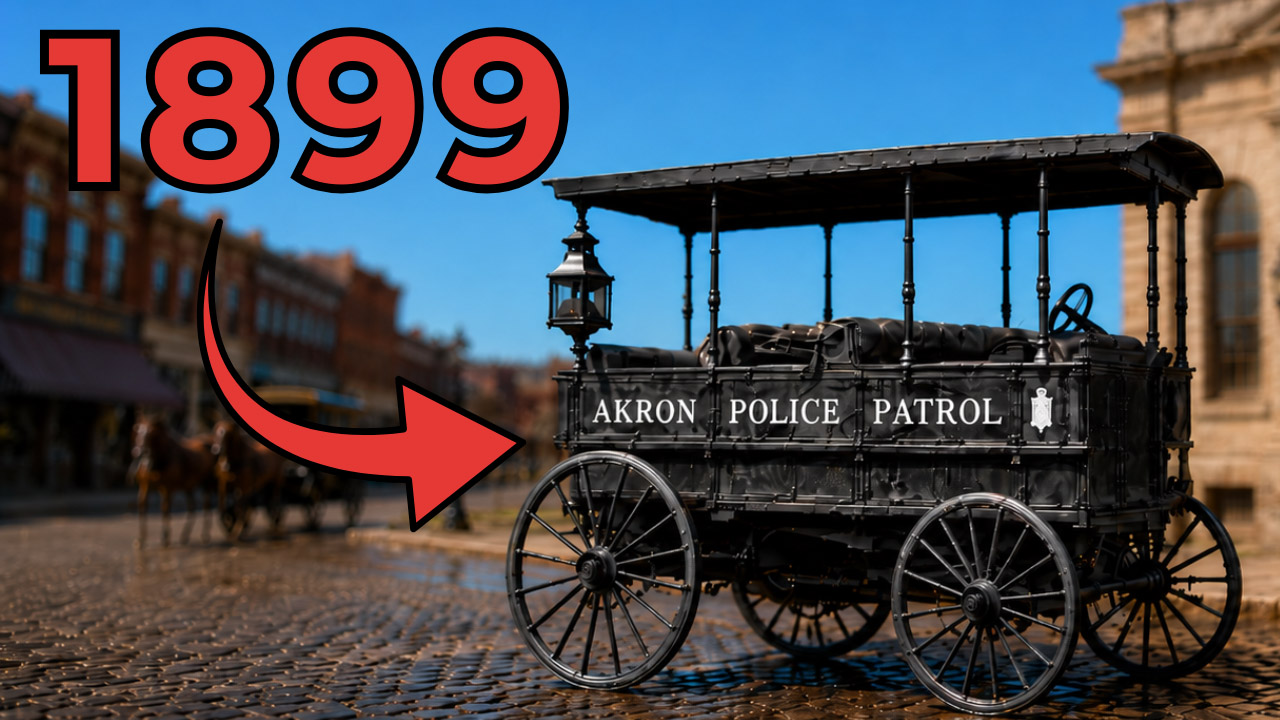
America’s first police car was an electric patrol wagon delivered to the Akron, Ohio police department in 1899. Designed by city mechanical engineer Frank Loomis and built by the Collins Buggy Company for $2,400, it was powered by two four-horsepower electric motors, could reach 18 miles per hour on level ground, and had a range of roughly 30 miles before recharging. It weighed about 5,000 pounds, seated twelve, and carried electric lights, a gong and a stretcher along with a cell for prisoners. Its first assignment was to collect an intoxicated man at the corner of Main and Exchange streets.
During the Akron riot of August 1900 the wagon was seized by a mob and pushed into the Ohio and Erie Canal, but it was recovered the following day, repaired, and returned to service. What followed was not a straight march to modernisation but three decades in which American police were almost always driving slower cars than the people they chased.
2. What You Will Learn
-
What the 1899 Akron patrol wagon actually was, its cost, its specification, and what happened to it after the riot.
-
Why Detroit’s police commissioner spent $350 of his own money on a Packard in 1909 after the city council refused to fund one.
-
How the Ford Model T made motorised policing affordable at scale, and armed the criminals at the same time.
-
Why departments ran motorcycle squads in the hundreds before they ran car fleets, and the one thing a motorcycle could never do.
-
How Prohibition created a market for cars built specifically to outrun the law, and which models the runners favoured.
-
What the 1932 Ford V8 changed, and why parity was not the same thing as an advantage.
3. Historical Background
For the first half of the twentieth century there was no such thing as a police car built for the job. Departments bought whatever was available and adapted it. The Akron experiment of 1899 was genuinely ahead of its time. Visitors travelled from across the United States to see the vehicle, and similar wagons were subsequently put into operation in Cleveland, Chicago and New York. But the economics were punishing: at $2,400, an electric patrol wagon was far beyond the reach of most city budgets.
The next landmark purchase came in Detroit in 1909, when Police Commissioner Frank Croul, frustrated by how slowly his officers could reach calls and refused funding by the city council, spent $350 of his own money on a Packard and gave it to the department to test “the fitness of such a vehicle for police work.” Between 1 December 1909 and 30 June 1910 that single car answered 2,235 police calls, and in July 1910 the same council that had refused him approved a fleet. Even so, for most cities the cost of motorisation remained prohibitive, and the police-car experiment continued to be measured in single-digit purchases.
What changed the arithmetic was the Ford Model T. By around 1913 the price of a new touring car had fallen to roughly $440, less than a tenth of what Detroit had paid for one Packard. Departments across the Midwest began buying retail Model Ts, painting them, fitting hand-cranked sirens and putting officers behind the wheel. They were neither fast nor especially reliable, but they were affordable and easy to replace, and within five years the Model T had become America’s first informal police car.
4. The Machine Explained
Two machines bracket this story. The 1899 Akron wagon was an electric vehicle built by a buggy company, closer to a horse-drawn paddy wagon with motors bolted on than to anything we would recognise as a car. The 1932 Ford Model 18 was its opposite: mass-produced, cheap, and available to anybody with $460. Between them lies the entire problem of the era, because the second machine was sold to the police and the criminals on identical terms.
-
1899 Akron wagon — Built by
Collins Buggy Company, Akron, Ohio
-
1899 Akron wagon — Designed by
Frank Loomis, city mechanical engineer
-
1899 Akron wagon — Cost
$2,400
-
1899 Akron wagon — Power
Two battery-powered electric motors, 4 hp each
-
1899 Akron wagon — Top speed
18 mph on level ground
-
1899 Akron wagon — Range
Approx. 30 miles per charge
-
1899 Akron wagon — Weight
Approx. 5,000 lb
-
1899 Akron wagon — Capacity
Seating for 12, plus a cell for prisoners
-
1899 Akron wagon — Equipment
Electric lights, gong, stretcher
-
1899 Akron wagon — Model
Ford Model 18, released March 1932
-
1932 Ford — Model
Ford Model 18, released March 1932
-
1932 Ford — Engine
221 cu in flathead V8
-
1932 Ford — Output
65 hp at 3,400 rpm; 130 lb-ft at 1,250 rpm
-
1932 Ford — Starting price
$460 (roadster)
-
1932 Ford — Significance
The first low-priced, mass-marketed American car with a V8
5. What The Records Show
For more than thirty years, no American police department of any size could claim parity with well-funded criminals over a long stretch of road. Prohibition, in force from January 1920, created a market for cars built specifically to outrun the law, and liquor running paid well enough that the men doing it could buy machines most departments could not.
-
The speed gap, in numbers
A Ford Model T managed roughly 45 mph. A typical patrol Studebaker or Buick reached 60 to 65. A stock Hudson Super Six, a bootlegger favourite from 1916, ran around 80. A modified Cadillac V8 approached 95. The cost gap was as stark: a patrol-ready Buick ran a department around $1,200, while a Cadillac cost roughly three times that.
-
Motorcycles came first
Indian began producing police-specification machines around 1908 and Harley-Davidson followed in 1909. By the late 1910s big-city departments operated motorcycle squads numbering in the hundreds. They were nimble, quick and cheap, but a motorcycle cannot carry a prisoner, so departments still needed cars.
-
The chase that founded NASCAR
The drivers running liquor across the back roads of North Carolina, Tennessee and Virginia sharpened their skills against officers who could not keep up, and became the founding generation of American stock car racing. The cars they tuned to escape the law became the cars they raced.
-
The letter to Henry Ford
The most quoted piece of evidence for what the 1932 Ford changed is a letter received by Henry Ford in April 1934, signed by Clyde Barrow, praising the V8 in the language of a man who made his living getting away. Historians continue to debate whether Barrow wrote it. What is not disputed is that the Barrow gang stole numerous Ford V8s and outran most police vehicles that pursued them, including, on occasion, other Ford V8s.
6. Why It Mattered
The American police car did not begin with the Crown Victoria, or the Charger Pursuit, or even the 1955 Buick Century. It began with a battery-powered wagon in Akron, Ohio, and the three decades that followed were not a steady march toward modernisation. They were a sequence of experiments, expenses and missed opportunities, punctuated by occasional bursts of progress that usually cost departments more than they could afford.
The 1932 Ford V8 is often treated as the happy ending of that story. It was not. Because Ford sold the car to anyone with $460, the same engine that gave the California Highway Patrol a credible pursuit vehicle gave every criminal in America exactly the same one. It delivered parity, not advantage, and parity meant a chase came down to who drove better, knew the roads better, and was willing to take more risk.
The purpose-built police car, engineered from the ground up for the job, did not yet exist. It was born out of the realisation, around the mid-1930s, that selling police departments the same car as everybody else was never going to be enough.
7. Key Takeaways
-
1899, Akron, Ohio. America’s first police vehicle was electric, cost $2,400, and weighed about 5,000 pounds.
-
It survived the riot. Pushed into the canal by a mob in August 1900, the wagon was recovered the next day, repaired and returned to service.
-
Cost, not failure, slowed adoption. Early police vehicles were prohibitively expensive; the Ford Model T solved that around 1913.
-
Motorcycles came first. Police-specification Indians and Harley-Davidsons predate widespread police car fleets.
-
Prohibition created the speed gap. Bootleggers could afford 80 to 95 mph machines while departments ran 60 to 65 mph sedans.
-
1932 brought parity, not superiority. The Ford V8 was sold to everyone, including the people the police were chasing.
8. Frequently Asked Questions
9. Sources
Every claim on this page is drawn from municipal records, period reporting and published automotive history. These are the sources behind it.
-
Akron Police Department historical records
Departmental documentation of the 1899 electric patrol wagon, its specification and its first assignment, supported by Police Magazine’s history of America’s first motorised patrol vehicle.
-
Contemporary accounts of the Akron riot, 22 August 1900
Period reporting on the seizure of the wagon, its recovery from the Ohio and Erie Canal the following day, and its return to service.
-
Detroit News historical archive and the Detroit Police Museum
Records of Commissioner Frank Croul’s $350 Packard purchase, the 2,235 calls it answered between December 1909 and June 1910, and the city council’s subsequent approval of a fleet.
-
Ford Motor Company production records
Specification and pricing for the 1932 Model 18: 221 cubic inch V8, 65 horsepower, from $460, released March 1932.
-
The Clyde Barrow letter to Henry Ford, April 1934
Held in the collection of the Henry Ford Museum. Authorship remains disputed by historians.
10. Related VIDEOs
By Badges & Chrome — researching the history of American police vehicles from published automotive history, period records, and primary sources. Every claim is verified before publication.
About the research →