
The Bureau’s First Real Weapon
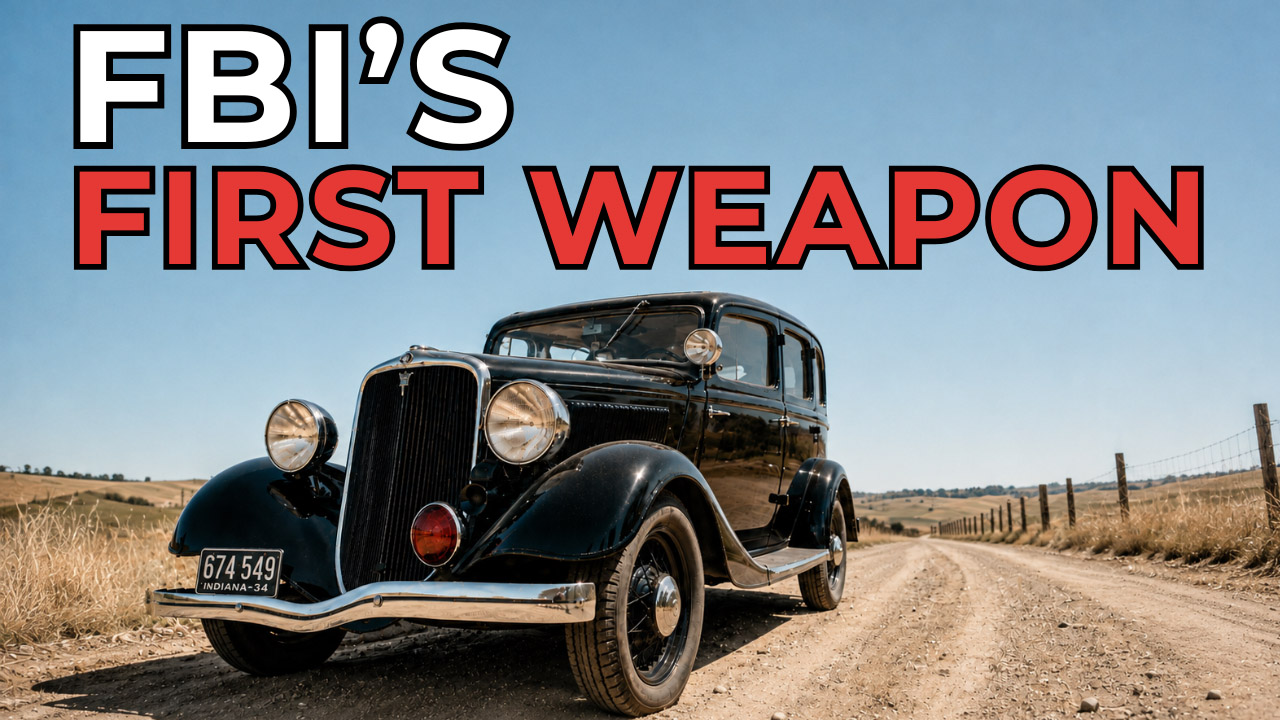
The Stolen Car That Built The FBI
By Badges & Chrome · researched and verified from period records and primary sources · About the research →
About this VIDEO
-
The FBI was not built to fight gangsters. For fifteen years it barely had the power to cross a state line.
What transformed it was the automobile and one unglamorous 1919 law about stolen cars, which became the legal key that unlocked the most famous manhunt in American history.
-
Era
1908–1935
-
Agency
Bureau of Investigation, later the FBI
-
Runtime
21:45
-
Published
Jul 22, 2026
1. Introduction
-
Why could only police buy the 1955 Buick Century Model 68?
The Dyer Act, formally the National Motor Vehicle Theft Act, passed by Congress on 28 October 1919 and introduced by Missouri congressman Leonidas C. Dyer. On its surface it was narrow and unglamorous: it simply made it a federal crime to transport a stolen motor vehicle across a state line.
But the Bureau of Investigation’s power came entirely from federal jurisdiction. It could act only where a federal law had been broken, and before 1919 the fast-moving, state-line-hopping criminals of the automobile age rarely broke any federal law at all. The Dyer Act gave the Bureau a legal hook into cases that had always been locked away in local hands. The car had given criminals the power to escape across state lines; the Dyer Act gave the Bureau the power to follow them.
2. What You Will Learn
-
Why the early Bureau of Investigation could not chase murderers or bank robbers, and what its agents were actually allowed to do.
-
How the mass-produced automobile created a new kind of criminal that no local force could stop.
-
The specific legal mechanism that made a car-theft statute the most important law in the Bureau’s early history.
-
Why so many men caught under the Dyer Act turned out to be wanted for far worse.
-
The first Bureau agent ever killed in the line of duty, and the car-theft case that killed him.
-
The single mistake John Dillinger made that handed the federal government the authority to hunt him.
3. Historical Background
When the Bureau of Investigation was created in 1908 it was a tiny outfit with a narrow mission and very little power. This is the detail that surprises people most: the early FBI was not a national police force, and could not be. In the American system, police power belonged to the states and cities. Murder was a local crime. Robbery was a local crime. The Bureau’s agents handled a narrow band of federal matters, banking violations, antitrust cases, some fraud, and in the beginning they could not even carry guns or make arrests on their own authority.
The defining limitation was jurisdiction. A criminal who committed a crime in one state and crossed the line into another was effectively beyond reach: the police in the first state had no authority in the second, and there was often no federal charge to bring. The state line was a wall, and any criminal fast enough to reach it could climb over and vanish.
For most of history that had not mattered much, because fleeing was slow. Then came the cheap, mass-produced automobile, and the Bureau and the mass-market car were born within weeks of each other in the summer of 1908.
4. The Machine Explained
The machine at the centre of this story is the ordinary early automobile, and what made it so useful to criminals was not speed but vulnerability. Early cars were almost absurdly easy to steal, and a stolen car was uniquely valuable to a criminal because it was both the prize and the means of escape. That combination is what eventually forced Congress to act.
-
Locks
Few early cars had any kind of lock at all.
-
Ignition
Primitive and simple to hotwire.
-
Identification
No vehicle identification numbers, so a stolen car was very hard to trace once moved.
-
Opportunity
People routinely left cars parked in the open for hours at a time.
-
Why it mattered to a thief
A valuable, portable, sellable object that also provided its own instant getaway.
-
The law that followed: formal name
National Motor Vehicle Theft Act.
-
Passed
28 October 1919.
-
Introduced by
Congressman Leonidas C. Dyer of Missouri.
-
What it did
Made it a federal crime to transport a stolen motor vehicle across a state line, authorising the Bureau to investigate interstate auto theft.
5. What The Records Show
The automobile did not only create car thieves; it supercharged every other kind of criminal. A bank robber could be twenty miles away before police had organised a response. A kidnapper could cross a state line in an afternoon. A killer could commit his crime in one jurisdiction and sleep that night in another. The car dissolved the old geography of crime and turned the state line, the very thing that had always protected fleeing criminals, into a weapon they could use at will.
-
A law that caught worse men than car thieves
Through the 1920s the Bureau used the Dyer Act against professional car-theft rings, and it quickly proved far more useful than a simple anti-theft measure, because of who the car thieves turned out to be. Many were military deserters, fugitives wanted for other crimes, or members of organised gangs. The Act became a way to arrest a man for the stolen car and then uncover the robberies, murders and rackets sitting behind it.
-
The first agent killed in the line of duty
On 11 October 1925, Special Agent Edwin C. Shanahan attempted to arrest professional automobile thief Martin James Durkin alone at a Chicago garage, pursuing a violation of the National Motor Vehicle Theft Act. Durkin shot him in the chest. Shanahan was the first Bureau agent ever killed in the line of duty, and it happened in a car-theft case, over the very crime that had given the Bureau its national reach. Durkin fled by car across several states before his capture the following year.
-
The mistake that doomed Dillinger
By early 1934 John Dillinger was the most notorious criminal in the United States, and yet for most of his spree the Bureau had no clear authority to chase him: bank robbery was generally not a federal crime, and murder was a state matter. Then, in March 1934, he escaped the county jail at Crown Point, Indiana, stole the car belonging to Sheriff Lillian Holley, and drove it across the state line into Illinois. The moment those wheels crossed the border he committed a federal crime, and a federal warrant followed. Less than five months later, on 22 July 1934, agents cornered and killed him outside the Biograph Theater in Chicago.
-
The agent killed on the state line itself
In 1935 agents were investigating George Barrett, who ran an elaborate stolen-car operation: buying one car legally, stealing an identical one, restamping the numbers, and selling the stolen car as clean. On 16 August 1935, Special Agent Nelson Klein moved to arrest him at College Corner, a town straddling the Ohio–Indiana border, and Barrett opened fire and killed him. Barrett fired from the Indiana side; Klein fell on the Ohio side. A criminal whose entire livelihood was built on exploiting the state line killed a federal agent straddling that very line.
6. Why It Mattered
We remember the Bureau as the agency that hunted gangsters, as though it were built to do that from the start. It wasn’t. For its first fifteen years it was a limited, hemmed-in agency that could barely cross a street, let alone a state line. What transformed it was not a dramatic crime-fighting mandate handed down from above. It was the automobile, and the almost boring little law written to deal with the automobile’s side effects.
The Dyer Act proved a powerful idea: that the federal government could reach a mobile criminal by finding the federal thread inside his crimes. That idea reshaped American law. In 1934, spurred by the Dillinger-era crime wave, Congress passed a sweeping package of new federal crime laws, making it a federal offence to rob a national bank, to flee across state lines to avoid prosecution, to transport a kidnap victim over a state line, and to assault or kill a federal agent. The Dyer Act of 1919 had been the prototype, the proof that the interstate nature of modern crime could be answered with interstate federal authority. In 1935 the agency was formally renamed the Federal Bureau of Investigation and its agents were at last given clear authority to carry weapons and make arrests nationwide.
The dependence ran even into the science. When the FBI Laboratory was established in 1932, two of the very first evidence collections it built were not fingerprints or ballistics but automobile tyre-tread patterns and automotive paint samples, reference libraries created to identify cars, because cars were so central to the crimes the Bureau now pursued.
Every time you picture a G-man of the 1930s, the fedora, the Thompson gun, the black sedan, you are looking at something the automobile made necessary and a car-theft law made possible.
7. Key Takeaways
-
The FBI’s national power began with car theft. The Dyer Act of 28 October 1919 was its first real jurisdictional key.
-
Jurisdiction, not crime-fighting mandate, was the constraint. The Bureau could act only where a federal law had been broken.
-
The law caught worse men than car thieves: deserters, fugitives and gang members reached through the vehicle charge.
-
The first agent killed in the line of duty died in a car-theft case: Edwin C. Shanahan, 11 October 1925.
-
Dillinger handed the FBI its warrant by stealing a sheriff’s car and driving it across a state line.
-
Even the FBI Laboratory started with cars. Tyre-tread and automotive paint were among its first reference collections.
8. Frequently Asked Questions
9. Sources
Every claim on this page is drawn from federal records, court documents and state archives. These are the sources behind it.
-
Federal Bureau of Investigation official timeline
The Bureau’s own published history confirming the 28 October 1919 passage of the National Motor Vehicle Theft Act and its authorisation of Bureau investigation into interstate auto theft.
-
FBI Wall of Honor and case files
Records of Special Agent Edwin C. Shanahan and the Durkin case, and of Special Agent Nelson B. Klein and the Barrett prosecution.
-
Indiana State Library and Indiana History Blog
State documentation of the Dyer Act’s application, the Dillinger warrant following the theft of Sheriff Lillian Holley’s car, and the George Barrett prosecution.
-
Greater Cincinnati Police Museum
Records of Special Agent Nelson Klein and the mechanics of Barrett’s number-swapping stolen-car operation.
-
Period press coverage of the 1918 auto-theft wave
Chicago Tribune and Indianapolis News reporting cited in the legislative history behind Representative Dyer’s bill.
10. Related VIDEOs
By Badges & Chrome — researching the history of American police vehicles from published automotive history, period records, and primary sources. Every claim is verified before publication.
About the research →