
Nobody Could Catch It
The Chrysler C-300: The Luxury Coupe That Forced Police to Get Fast
By Badges & Chrome · researched and verified from period records and primary sources · About the research →
About this VIDEO
-
A car built for the country club ended up writing the recipe for the car that patrolled the highway.
The 1955 Chrysler C-300 was the first American production car to make 300 horsepower. Within twelve months it had forced American police to invent an entirely new kind of vehicle, and the company that started the horsepower war also armed the police to fight it.
-
Era
1955–1968
-
Departments
California, Missouri and US police fleets nationwide
-
Runtime
17:03
-
Published
06 Aug, 2026
1. Introduction
-
Why could only police buy the 1955 Buick Century Model 68?
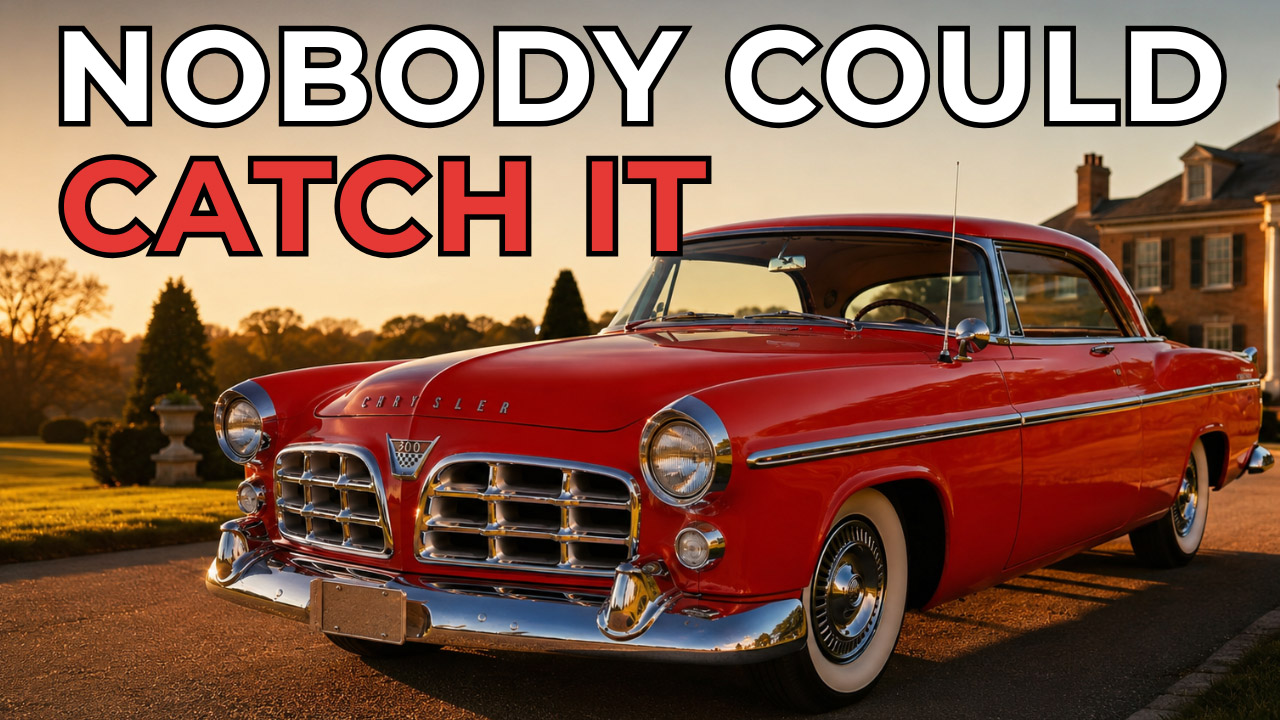
The 1955 Chrysler C-300. Its 331 cubic inch FirePower Hemi V8, fed by two Carter four-barrel carburettors and fitted with solid lifters and a full-race camshaft, produced exactly 300 horsepower and 345 pound-feet of torque. The figure was so significant that Chrysler simply named the car after it. The “300” was not a model code or a series number. It was the horsepower.
At a time when the most powerful Ford managed 193 horsepower and Chevrolet’s new small-block about 195, nothing on a dealer’s lot broke 200. The C-300 made roughly fifty percent more power than the Corvette or Thunderbird, the supposed performance cars of 1955, and it was not a mass-market machine: Chrysler built just 1,725 of them.
2. What You Will Learn
-
Why nothing on an American dealer’s lot broke 200 horsepower before 1955, and why everyone accepted that ceiling.
-
How the C-300 was assembled from three different Chryslers, almost as a parts-bin creation.
-
What happened when the same car went racing, and the team owner who professionalised NASCAR to run it.
-
Why a police car in 1955 was simply a civilian sedan with a spotlight bolted on.
-
How the company that started the horsepower war also armed the police to fight it.
-
The dynasty that followed, and why it traces back to a car no police force ever asked for.
3. Historical Background
Picture the American road in early 1955. The interstate highway system was still a year from being signed into law, but the country was already car-crazy. Yet under all those long hoods the engines were surprisingly tame. The most powerful thing Ford offered was a 292 cubic inch V8 making 193 horsepower. Chevrolet’s brand-new small-block, the engine that would become a legend, made about 195. Fast for the day, but nothing on a dealer’s lot broke two hundred horsepower.
That was the ceiling, and everyone accepted it. A family sedan was a family sedan, a luxury car was heavy and smooth and slow, and if you wanted real speed you built a hot rod in your garage or bought a small European sports car that cost a fortune. The idea that you could walk into a showroom and drive out in a full-size American car that would embarrass a sports car simply did not exist.
Then Chrysler built exactly that. On paper the C-300 made little sense. It was almost a parts-bin creation, three cars welded into one. Chrysler took the body of its upscale New Yorker, borrowed rear-quarter trim from the mid-range Windsor, and bolted on the massive “egg-crate” grille from its top-shelf Imperial line. Then it stuffed in the most powerful engine in America.
4. The Machine Explained
The C-300 was not a stripped-out special. It had leather upholstery and the top-line Chrysler dashboard, its speedometer reading to 150 miles per hour. What made it extraordinary was that a heavy luxury coupe, fully trimmed, was humiliating the sports cars of its day, and the escalation that followed was immediate: for 1956 the 300B’s Hemi grew to 354 cubic inches and 355 horsepower, rising to 375 in its hottest form.
-
Engine
331 cu in FirePower Hemi V8.
-
Induction
Twin Carter four-barrel carburettors on special intake manifolds.
-
Internals
Solid valve lifters, full-race camshaft, adjustable rocker shafts.
-
Output
300 hp and 345 lb-ft.
-
Transmission
Two-speed PowerFlite automatic, the only unit Chrysler had that could handle the torque.
-
Rear axle
3.54:1
-
Chassis
Heavy-duty suspension, lowered ride height.
-
Production
1,725 for 1955.
-
Body
New Yorker shell, Windsor rear-quarter trim, Imperial “egg-crate” grille.
-
For comparison: Cadillac V8
270 hp.
-
For comparison: Corvette and Thunderbird
Roughly 195 hp.
-
For comparison: most powerful Ford sedan
193 hp.
5. What The Records Show
Chrysler did not build the C-300 only to sell to wealthy customers. It built it to win races, and in 1955 it dominated. Every Sunday, the public watched the same car they could theoretically buy at a Chrysler dealer destroying the competition. The race car and the street car had become, suddenly, nearly the same thing.
-
Daytona Speed Week
On the sand at Daytona Beach, a C-300 recorded a two-way average of 127.58 mph in the flying mile, the fastest of the meeting by more than seven miles per hour. Period road tests recorded a top speed around 128 mph, 0 to 60 in roughly nine to ten seconds depending on the test, and a standing quarter mile in the region of 17.6 to 17.8 seconds. For comparison, the same magazine’s 250 hp New Yorker needed 10.8 seconds to 60 and topped out at 116 mph.
-
The man who professionalised NASCAR
Carl Kiekhaefer, a Wisconsin outboard-motor magnate, became NASCAR’s first true professional team owner. While rivals still drove their race cars to the track, Kiekhaefer hauled his gleaming white Chryslers in on trucks, ran a disciplined multi-car team and spared no expense.
-
Eighteen wins and a championship
Behind the wheel of a Kiekhaefer Chrysler, Tim Flock won 18 races in 1955 and took the national championship, a single-season record that stood until Richard Petty broke it in 1967.
-
What a police car actually was in 1955
It was not a special vehicle. For most departments there was no such thing as a purpose-built pursuit car. A department bought ordinary civilian sedans, the same Fords, Chevrolets and Plymouths anyone could buy, and modified them in-house: a spotlight, a two-way radio, perhaps stiffer springs, a star painted on the door. The car underneath was fundamentally the machine a grocer drove to work.
-
Chrysler’s answer, 1956
The same company that started the horsepower war also armed the police to fight back. In 1956 Chrysler introduced its first official factory police package, an engineered pursuit vehicle built on the Dodge Coronet. An honest note: this was not the first factory police car in American history. Ford had offered a police package in 1950. What made Chrysler’s 1956 effort matter is that it was the first serious, comprehensive pursuit package from the company that would dominate police work for the next thirty years, built using the exact performance lessons the C-300 had just taught.
6. Why It Mattered
That worked while everybody drove the same tame sedans. The C-300 and the horsepower war it started shattered that balance. All at once a bootlegger, a bank robber or a reckless kid with money could buy a factory car that would outrun any modified sedan a department was running.
This was not a new problem. It was the same gap the Prohibition-era moonshine runners had opened decades earlier. But the horsepower war made it worse in a fundamental way. The moonshiners had built their fast cars by hand, one at a time, in secret. Now Detroit was building them by the thousands, on the assembly line, and selling them openly. The speed advantage had gone industrial.
The result was a Mopar police dynasty. By the late 1960s Chrysler was the biggest seller of police cars in North America by a wide margin. Figures as high as eighty-five percent circulate, but they do not survive verification; Chrysler’s own claim was around sixty percent, which is itself a manufacturer’s estimate rather than an audited number. The bloodline runs from the 1956 Dodge Pursuit to the fearsome 1969 Polara, through the Diplomats and Gran Furys of the 1980s, to the Dodge Charger Pursuit patrolling American highways today. One car, born for the country club, ended up writing the recipe for the car that patrolled the highway.
7. Key Takeaways
-
The “300” is the horsepower. Chrysler named the car after the number, and it was the first American production car to reach it.
-
It was a parts-bin hybrid: New Yorker body, Windsor trim, Imperial grille, and the most powerful engine in America.
-
Just 1,725 were built for 1955. Exclusive, expensive, and aimed at wealthy buyers.
-
It won a national championship in year one, with Tim Flock taking 18 races for Carl Kiekhaefer’s professional team.
-
It industrialised the speed gap. Moonshiners had built fast cars by hand; now Detroit sold them by the thousand.
-
The same company armed both sides. Chrysler’s first factory police package followed in 1956.
8. Frequently Asked Questions
9. Sources
Every claim on this page is drawn from period road tests, racing records and manufacturer documentation. These are the sources behind it.
-
Motor Life and Motor Trend road tests, 1955
Instrumented period testing of the Chrysler C-300, establishing acceleration, quarter-mile and top-speed figures alongside the comparison New Yorker.
-
Daytona Speed Week results, 1955
Flying-mile timing records giving the C-300’s two-way average of 127.58 mph, the fastest of the meeting.
-
NASCAR Grand National season records, 1955
Race-by-race results underpinning Tim Flock’s eighteen wins and the national championship for Carl Kiekhaefer’s team.
-
Chrysler 300 letter-series production and specification records
Factory documentation of the 331 cu in FirePower Hemi, the twin Carter four-barrels, the PowerFlite transmission and total production of 1,725 units.
-
Chrysler police package literature, 1956 onward
Factory documentation of the first Chrysler police package, built on the Dodge Coronet.
10. Related VIDEOs
By Badges & Chrome — researching the history of American police vehicles from published automotive history, period records, and primary sources. Every claim is verified before publication.
About the research →