
A Corvette Engine Under A Taxi’s Skin
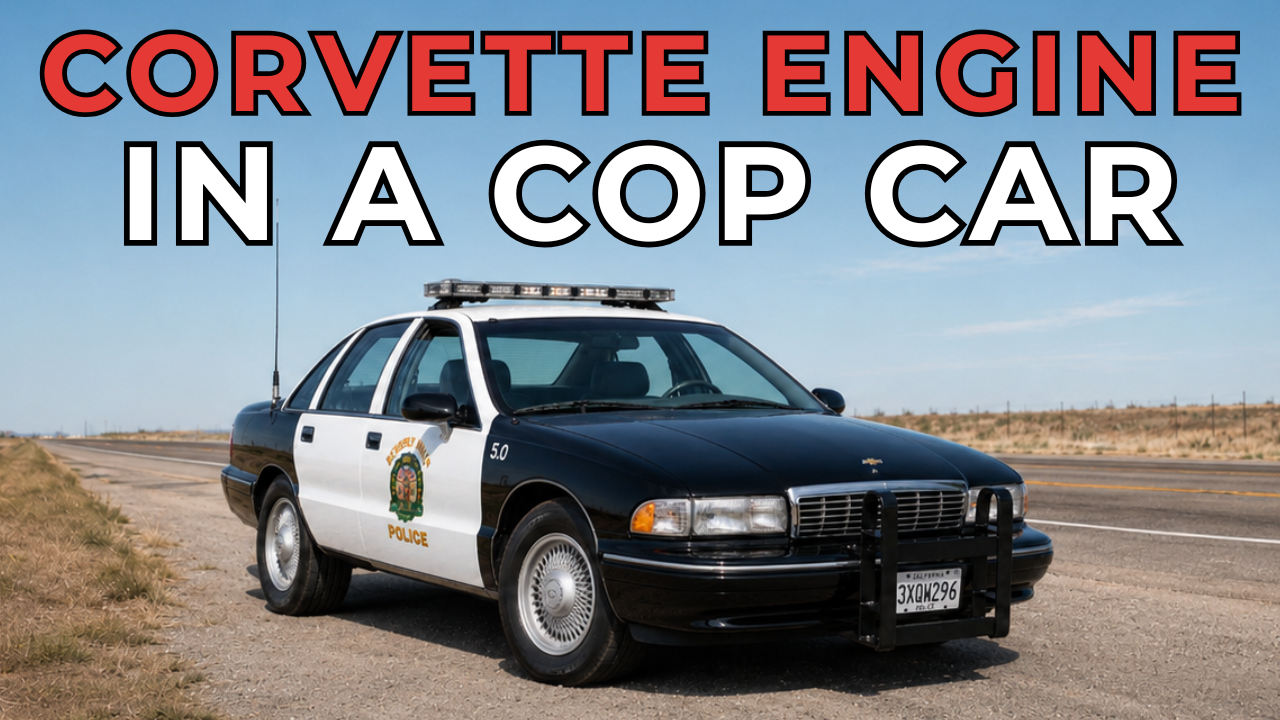
The Chevrolet Caprice 9C1: The Sleeper That Ended the Dark Age
By Badges & Chrome · researched and verified from period records and primary sources · About the research →
About this VIDEO
-
The fastest police car in America looked like the most boring car on the road, right up until its lights came on.
The ugly, bubble-shaped Chevrolet that hid a Corvette-family V8 under a taxi’s skin. Everyone says it broke the 1969 Polara’s twenty-five-year speed record, and the true story of what it actually did is more interesting than the myth.
-
Era
1991–1996
-
Departments
US police fleets nationwide
-
Runtime
18:17
-
Published
Aug 10, 2026
1. Introduction
-
Why could only police buy the 1955 Buick Century Model 68?
No, although almost everyone says it did. When the Michigan State Police ran their standardised top-speed test, the 1994 LT1 Caprice 9C1 recorded 141 mph. That is genuinely fast, faster than any police sedan had run in decades, and it beat everything else in the field that year. But the 1969 Dodge Polara had run 147, so the Caprice came up about six miles an hour short.
The “it beat the record” claim appears to trace back to a period General Motors marketing statement rather than independent test data. What the Caprice really did was reopen a question everyone thought was closed: after twenty-five years in which emissions rules and downsizing had gutted the American pursuit car, it proved a modern police car could be seriously fast again.
2. What You Will Learn
-
Why the American police car spent nearly fifteen years in the wilderness before 1994.
-
How a body shape that buyers openly mocked turned out to be the car’s secret weapon.
-
What the LT1 actually was, and why calling it “the Corvette engine” is shorthand rather than fact.
-
What the 9C1 order code changed, and one popular myth about it that isn’t true.
-
Why the same car is quoted at wildly different top speeds by people who drove them.
-
What finally broke the Polara’s record, and the symmetry in which car did it.
3. Historical Background
By the early 1990s the American police car had spent nearly fifteen years in the wilderness. The emissions crackdown, two fuel crises and desperate downsizing had gutted the pursuit car, with the low point being the infamous “dog cars” of 1980, police sedans so choked they could barely crack ninety miles an hour. The category had been climbing out of that hole ever since, but slowly.
Two cars ruled the era, the Ford Crown Victoria and the Chevrolet Caprice, fighting a quiet, low-stakes war for fleet contracts. Both were big, body-on-frame, rear-wheel-drive sedans. Neither was going to frighten anybody at a hundred miles an hour.
Then in 1991 Chevrolet completely redesigned the Caprice. Gone were the crisp, boxy lines that had defined American police cars and taxis for a generation. In their place was a smooth, rounded, aerodynamic body that people immediately mocked: the whale, the beached whale, the upside-down bathtub. With its skirted rear wheels and bulbous roofline it was one of the most awkward-looking cars Detroit had built. Underneath it was still a traditional car, the same body-on-frame, rear-wheel-drive, full-size recipe as before, riding on General Motors’ long-running B-body platform. Only the skin had changed. But that skin mattered, because the shape everyone laughed at was slippery, and aerodynamics are exactly what matter most at the top end.
4. The Machine Explained
An honest note the film makes: the police LT1 was not simply the Corvette engine with the volume turned down. Blocks, heads and cams differ. The Corvette version used aluminium heads and four-bolt mains, while the B-body car got iron heads and two-bolt mains. Same bloodline, different build. And a myth worth killing: people often say Chevrolet welded in a special reinforced frame for the 9C1. There was no separate police frame. The heavy-duty hardware was bolted to the standard full-size chassis, which was more than enough.
-
Engine
5.7-litre LT1 V8, the same engine family as the C4 Corvette and Camaro Z28.
-
Police tune
Cast-iron heads and a cam ground for low-end durability, rather than the Corvette’s aluminium heads.
-
Output
260 hp and 330 lb-ft.
-
0–60 mph
Around seven seconds.
-
Construction
Body-on-frame, rear-wheel drive, GM B-body.
-
Production
LT1-powered 9C1 built 1994 to 1996.
-
9C1 suspension
Stiffer springs, re-valved shocks, thick front and rear stabiliser bars.
-
9C1 steering
Firmer and faster.
-
9C1 brakes
Four-wheel discs with anti-lock.
-
9C1 driveline
Limited-slip rear axle.
-
9C1 cooling
Engine and transmission oil coolers.
5. What The Records Show
The Michigan State Police run the most respected standardised police vehicle test in the business, taking each car to a proving ground and clocking real top speed over multiple laps. Their 1994 result is the number this whole story turns on, and it is not the number most people repeat.
-
141, not 147
The 1994 LT1 Caprice 9C1 recorded 141 mph in MSP testing. The 1969 Dodge Polara had run 147. The gap is about six miles an hour, and the Caprice did not close it. The record was not broken until the mid-2000s, by a Hemi-powered Dodge Charger Pursuit, and the later Caprice Police Patrol Vehicle eventually reached around 155 mph in testing.
-
Where the myth came from
The record-beating claim appears to originate with General Motors itself, in a period marketing statement that the LT1 Caprice had edged past the old Dodge by a few tenths. It was a good line for selling police cars, it stuck, and it has been repeated as fact ever since. The independent test data does not support it.
-
Why the same car is quoted at different speeds
That 141 figure was frequently a governor setting, not the car straining against its own limit. Chevrolet let departments choose the ceiling and tied it to the speed rating of the tyres ordered, so one agency’s Caprice might be capped at 141, another’s at 132, and a few, thanks to a fleet manager who ticked the wrong box, at 120. Fleet records from the period show exactly that spread. The Caprice’s real ceiling depended on paperwork almost as much as horsepower.
-
The sleeper
Parked next to a civilian Caprice or a taxi, a 9C1 was almost indistinguishable: the same bland shape, the same anonymous profile. The fastest police car in America could sit at the roadside looking like the most boring car on the road, right up until its lights came on. And for proof of how good the underlying car was, Chevrolet built one more version for the public: the 1994 Impala SS was essentially the 9C1 package in a nicer suit, with the same LT1 and heavy-duty chassis dressed up with body-colour trim and alloy wheels.
6. Why It Mattered
The end came from the factory floor, not the racetrack. General Motors needed the Arlington, Texas plant that built its big rear-drive cars for something more profitable: full-size trucks and SUVs, which were exploding in popularity. So the Caprice, the Impala SS and the whole family of big rear-wheel-drive sedans were discontinued after 1996. Just as police finally had a genuinely capable full-size cruiser again, the company that built it walked away, and for the next decade the pursuit car belonged almost entirely to the Ford Crown Victoria.
Departments did not let go easily, and that is the real measure of the car. Long after 1996 an entire cottage industry grew up around keeping them alive: specialist shops buying retired Caprices, refurbishing them and selling them back into police service, because departments still wanted them and nothing new could match the combination of space, durability, top-end speed, anonymity and toughness.
And the record? The Caprice did not beat it, but it proved the record could be beaten again. For twenty-five years the 147 mph mark had looked like a relic of a lost golden age that emissions-choked modern cars could never revisit. Running 141, the LT1 Caprice dragged the pursuit car back within striking distance for the first time in a generation. The answer arrived in the following decade, and in a neat piece of symmetry it came from Dodge, the Polara’s own maker, when the Hemi Charger Pursuit finally cleared the old mark. A Dodge broke a Dodge.
7. Key Takeaways
-
141 mph, not 147. The MSP-certified figure for the 1994 LT1 Caprice fell about six mph short of the 1969 Polara.
-
The “it beat the record” claim traces to GM marketing, not independent test data.
-
The ugly shape was the point. The mocked aerodynamic body is what let the car run hard at the top end.
-
“Corvette engine” is shorthand. Same LT1 family, but police tune meant iron heads, a durability cam and two-bolt mains.
-
Top speeds varied by paperwork. Governor settings were tied to the tyre rating a department ordered: 141, 132 or even 120.
-
It proved the record was beatable, and the Hemi Charger finished the job in the mid-2000s.
8. Frequently Asked Questions
9. Sources
Every claim on this page is drawn from institutional test data, manufacturer specifications and period fleet records. These are the sources behind it.
-
Michigan State Police annual patrol vehicle evaluation
Standardised top-speed testing for the 1994 model year, the source of the certified 141 mph figure.
-
Edwin J. Sanow, Chevrolet Police Cars 1955–1996
The standard reference for Michigan State Police test figures across Chevrolet’s police fleet history.
-
General Motors LT1 engine specifications by application
Factory documentation distinguishing the Corvette, F-body and B-body variants by head material, main bearing caps and camshaft profile.
-
Chevrolet 9C1 police package option documentation
Factory specification of the suspension, steering, brake, driveline and cooling hardware included in the police package.
-
Period fleet records
Departmental documentation of governor settings and their relationship to ordered tyre speed ratings, explaining the 141, 132 and 120 mph spread.
10. Related VIDEOs
By Badges & Chrome — researching the history of American police vehicles from published automotive history, period records, and primary sources. Every claim is verified before publication.
About the research →