
The Six Feet Where The Job Happened
Eight Hours Inside An American Police Car
By Badges & Chrome · researched and verified from period records and primary sources · About the research →
About this VIDEO
-
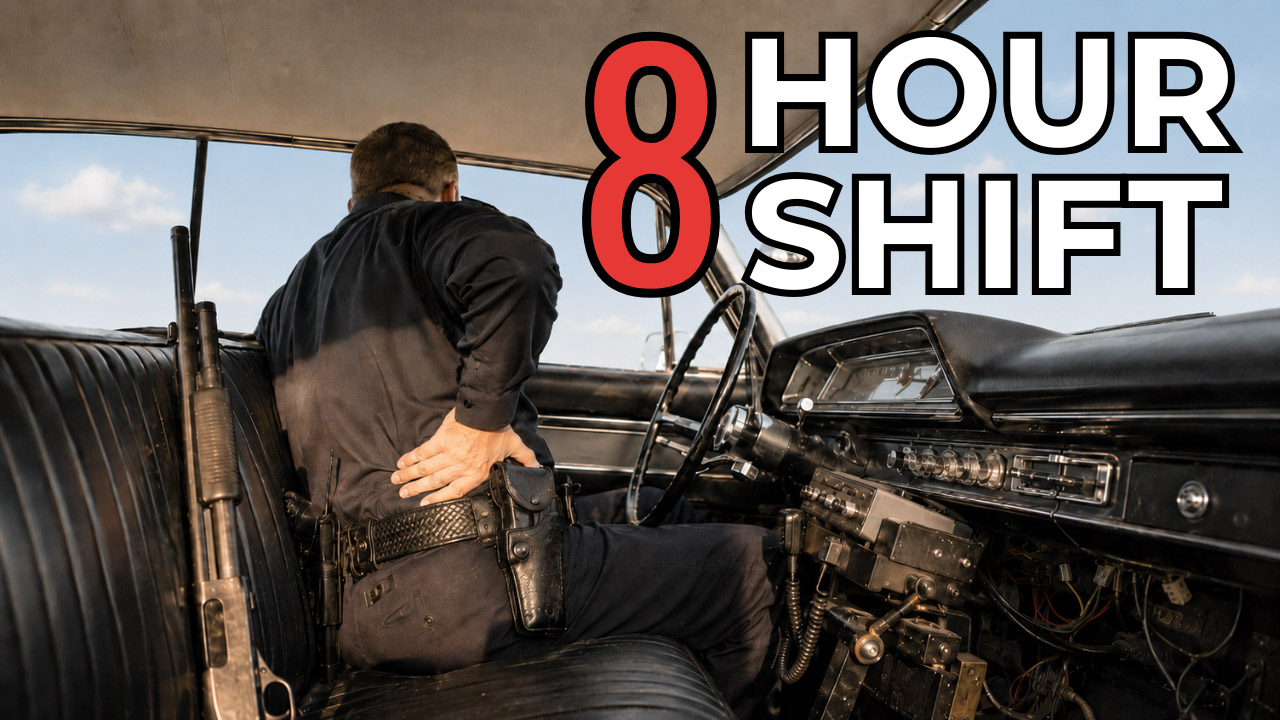
Every item in the police package was there to protect the car. Not one of them was there for the man in the seat.
This channel spends most of its time on horsepower. This film is about the six feet of space where the job actually happened, and the single line in a 1968 purchasing file that finally acknowledged there was a person in it.
-
Era
1950s–1970s
-
Departments
California Highway Patrol, San Diego, and US forces nationwide
-
Runtime
16:55
-
Published
Sep 3, 2026
1. Introduction
-
Why could only police buy the 1955 Buick Century Model 68?
Cramped, hot, and physically punishing in ways nobody designed out. A smooth vinyl bench seat with a near-vertical back. No air conditioning for most of the era in most of the country. No power steering on many cars. A radio control head bracketed under the dash that radiated heat onto the driver’s right knee through the summer. And a duty belt carrying a revolver, cartridges, cuffs and a baton, worn by a man who then sat on it for an eight-hour shift.
What makes it worth examining is not the discomfort itself but who the engineering was for. The police package specified the largest available radiator, heavy-duty fans, an engine oil cooler and a transmission cooler, because a patrol car idles for hours and then runs flat out. Every one of those items protected the machine. None of them protected the man. The film traces that imbalance to the one document that finally broke it.
2. What You Will Learn
-
Why the bench seat and the duty belt were a worse combination than either was alone.
-
Where the radio actually lived in the cabin, and what it did to the driver in summer.
-
The reach an officer learned by feel, and why the spotlight handle was the one control that had to be found without looking.
-
Which instrument on the dashboard was legal evidence rather than equipment.
-
Why there was no cage for the first half of this era, and what that meant on a night shift.
-
The single line in a 1968 California purchasing file that is the earliest evidence anyone specified for the officer’s body.
-
What actually changed the interior, and why it was not concern for the officer.
3. Historical Background
The American police car of this era was a civilian sedan with hardware added. The additions were substantial and well engineered, but they addressed a specific set of problems: a car that idles for hours powering a radio and lights, then accelerates hard, then stops from high speed repeatedly, then does it again tomorrow. Cooling, charging, suspension, brakes.
The officer inside was not part of that specification. He got the seat the factory fitted, in a cabin laid out for a family, and everything he needed was then bolted into whatever space remained. The radio control head went under the dash because that is where there was room. The shotgun went wherever it could be locked and still reached. The equipment that would not fit inside went in the boot.
For the first half of this era there was no partition between the front and rear seats. A prisoner sat directly behind the officer, and the only thing between them was the officer’s judgement about where to put his hands.
None of this was cruelty or indifference exactly. It was an absence. Nobody had asked the question, so nobody had answered it, and the men who worked in these cars adapted because adapting was the job.
4. The Machine Explained
Read the police package as a document about priorities and it becomes very clear who it was written for. Every item below exists because of something that happens to the car. The officer appears nowhere in the list.
-
Cooling
Largest available radiator, heavy-duty fans, engine oil cooler, transmission fluid cooler. For the engine, which idles hot and then runs flat out.
-
Charging
Heavy-duty alternator and battery. For the radio, lights and siren, which draw current while the car is stationary.
-
Suspension
Heavy-duty springs and shocks, thicker anti-roll bars. For control at speed and for carrying equipment over a hundred thousand hard miles.
-
Brakes
Larger drums, later discs. For repeated high-speed stops without fade.
-
Instrumentation
Calibrated, certified speedometer. Not a convenience: an officer had to swear to what it read under oath, which made it a legal instrument.
-
The seat
Whatever the factory fitted. Smooth vinyl, flat, with a near-vertical back.
-
Air conditioning
Absent for most of the era in most of the country.
-
Power steering
Frequently deleted to save money, including on cars weighing over two tons.
-
The partition
None, for the first half of the era.
5. What The Records Show
The interior of the police car eventually changed, and it is worth being honest about why. It was not a sudden recognition that officers deserved better. It was arithmetic, arriving from an unrelated argument about staffing.
-
The line in the 1968 file
A 1968 California Highway Patrol purchasing specification, preserved by the Mopar fleet historians who collect this material, is a demanding document. It required an engine of at least 420 cubic inches, running knock-free on 100-octane fuel through a single carburettor. It set a minimum 122-inch wheelbase. It required brakes that could take four hard stops from ninety miles an hour to zero at two-minute intervals, then a panic stop from sixty. And after a five-minute rest the car had to prove it still stopped in a straight line. Somebody had thought about that car in enormous detail. And in the middle of all of it, somebody wrote down a requirement that the front seats carry at least one inch of foam padding.
-
One inch of foam
That is, as far as this channel has been able to establish, the earliest hard evidence of an American police agency writing a specification for the officer’s body rather than the car’s performance. One line, in a list otherwise concerned with displacement, octane and stopping distance. It is not much. It is the first thing of its kind we have found.
-
Nobody studied these men
The serious research into police back injury does not begin until the late 1990s, roughly twenty years after everything in this film. When it arrived, a survey of around eight hundred Canadian officers found more than half reporting chronic low back pain since joining, with many pointing at the seat and the duty belt. A study of military police compared officers carrying the load on the belt against officers carrying it on the thigh: 74.2 per cent reported pain against 22.2 per cent. Same job, same shifts, same vehicles. The only difference was where the weight sat.
-
What actually changed the interior
In 1977 the San Diego Police Department published a year-long study of forty-four one and two-officer units, measuring performance, efficiency, safety and attitudes. It concluded that a single officer performed just as effectively, more efficiently, and at close to half the cost. And that is what changed the car. A two-officer car needs a bench wide enough for two men in full kit. A one-officer car has an empty passenger seat, and that empty seat is where the console went, then the radar unit, then the mobile data terminal, the laptop, the mount and the printer. The American police car became a mobile office because the second officer got out of it.
6. Why It Mattered
It is tempting to read this as a story about neglect, and it is not quite that. The engineering that went into these cars was serious and it worked. Departments got vehicles that would survive a hundred thousand miles of abuse, and the men who drove them were, by every account, proud of them.
But the imbalance is real and it is worth naming. A purchasing specification is a statement of what an organisation has decided to care about. Read the police packages of this era and you find pages on cooling, charging, braking and durability, and almost nothing on the person who would spend two thousand hours a year inside the result. That is not because anybody decided officers did not matter. It is because the question was never on the form.
Which is what makes that one line in the 1968 file worth the whole film. Somebody, somewhere in the California Highway Patrol, sat down to write a specification about displacement and octane and stopping distance, and put in a sentence about foam. It changed almost nothing on its own. But it is the first time we can find anybody asking.
And it took another thirty years before anyone studied what the job was actually doing to the men doing it.
7. Key Takeaways
-
The police package protected the machine. Cooling, charging, suspension and brakes all address what the car endures, not what the officer does.
-
The seat was whatever the factory fitted: smooth vinyl, flat, with a near-vertical back, and a duty belt underneath it for eight hours.
-
The certified speedometer was a legal instrument, because an officer had to swear to what it read under oath.
-
There was no partition for the first half of the era. A prisoner sat directly behind the officer.
-
One inch of foam, in a 1968 California purchasing specification, is the earliest evidence found of anyone specifying for the officer’s body.
-
What changed the interior was the 1977 San Diego study on one-officer patrol. The empty passenger seat became the console.
8. Frequently Asked Questions
9. Sources
Every claim on this page is drawn from purchasing specifications, published research and manufacturer documentation. These are the sources behind it.
-
California Highway Patrol purchasing specification, 1968
Preserved by Mopar fleet historians. The source of the one-inch foam requirement, the 420 cubic inch minimum, the 100-octane single-carburettor demand, the 122-inch wheelbase and the repeated-braking protocol.
-
Boydstun, Sherry and Moelter, Police Foundation, 1977
The San Diego one-officer patrol study: forty-four units measured across a full year on performance, efficiency, safety and attitudes.
-
Published research on police low back pain
A survey of approximately eight hundred Canadian officers reporting chronic low back pain since joining, and a comparative study of military police load carriage recording 74.2 per cent against 22.2 per cent depending on where the load was carried.
-
Ford Motor Company, 1950 police package press release
Contemporary documentation of the first factory police package, including the 60-ampere generator maintaining output at idling speeds.
10. Related VIDEOs
By Badges & Chrome — researching the history of American police vehicles from published automotive history, period records, and primary sources. Every claim is verified before publication.
About the research →