
Built From Soldered Coffee Cans
The Day Cops Stopped Having To Chase You
By Badges & Chrome · researched and verified from period records and primary sources · About the research →
About this VIDEO
-
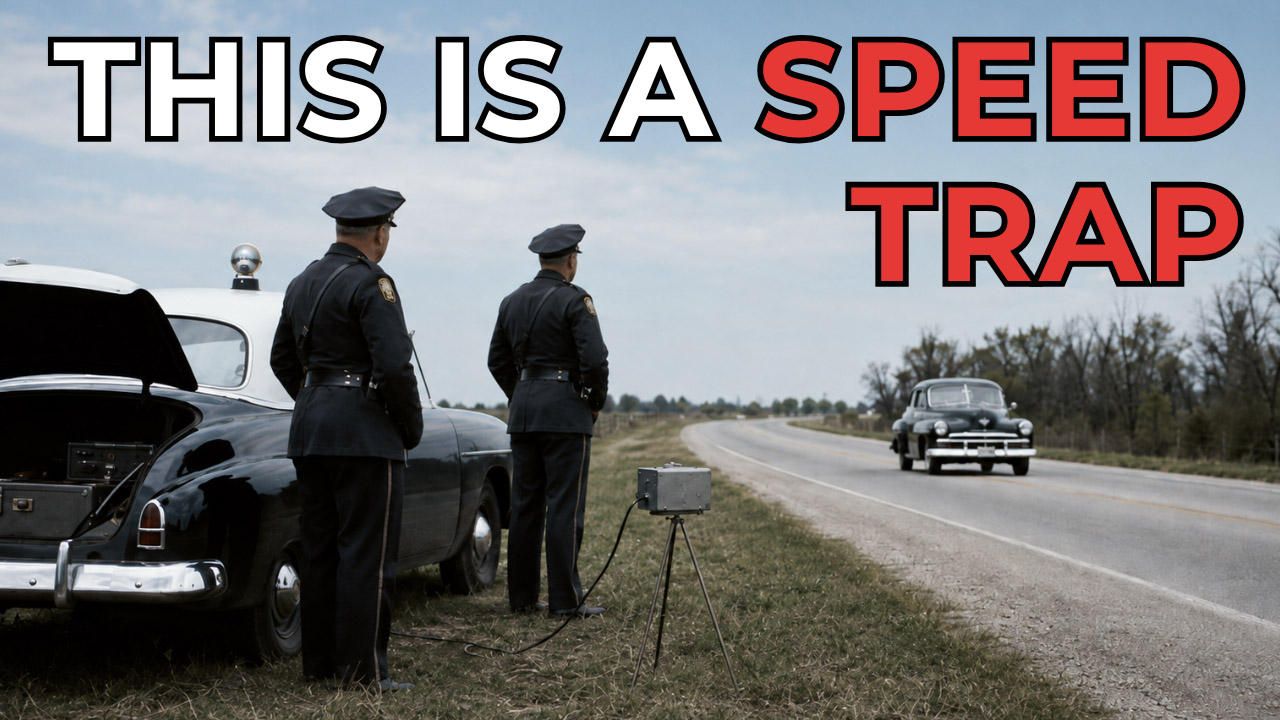
A device built to measure aircraft landing on a runway made chasing speeders optional.
How American police learned to prove speed without chasing it. From a pair of soldered-shut coffee cans on Long Island to a New Jersey courtroom that decided a machine could effectively testify.
-
Era
1947–1978
-
Agencies
Connecticut State Police, New Jersey State Police
-
Runtime
17:12
-
Published
Aug 22, 2026
1. Introduction
-
Why could only police buy the 1955 Buick Century Model 68?
The method was called pacing. An officer spotted a car he believed was speeding, pulled in behind it, matched its speed, and read his own speedometer. That reading was the evidence, which is why police packages specified a calibrated, certified speedometer as an ordered option: an officer would have to swear to what it said under oath.
But look at what pacing requires. To prove a hundred miles an hour, somebody has to drive a hundred miles an hour, usually on a road with other traffic, usually at night, in a car with drum brakes and bias-ply tyres. The officer takes on exactly the same risk as the man he is trying to stop, and he takes it on deliberately, as a matter of procedure. In 1947 two engineers pointed a machine made out of coffee cans at a highway in Connecticut and quietly ended something that had been true since the invention of the automobile.
2. What You Will Learn
-
Why proving a speed and catching a speeder used to be the same dangerous act.
-
How a wartime radar rig built to measure aircraft descending onto a runway ended up beside a Connecticut parkway.
-
Why Connecticut used radar for nearly two years without issuing a single ticket.
-
What early traffic radar actually looked like, and why every photograph you have seen of it is probably mislabelled.
-
The 1955 court decision that let a machine effectively testify, and the gap it left behind.
-
Why there is a piece of Victorian laboratory equipment in the boot of almost every patrol car in America.
3. Historical Background
John Barker and Ben Midlock worked at the Automatic Signal Company. Barker had spent the 1930s on traffic lights. During the war both men were working on military radar, and Grumman came to them with a problem that had nothing to do with cars. It concerned the PBY Catalina, an amphibious aircraft designed to land on water. Landing one on a runway was harder on the machine, and the aircraft were damaging their landing gear coming down. Nobody could measure how fast they were descending, and without that number nobody could fix it.
So Barker and Midlock built a Doppler radar unit. Because it was wartime and the parts they needed did not exist, they made the microwave resonators out of coffee cans, soldered shut. They set the thing up at the end of the runway at Grumman’s Bethpage facility on Long Island, pointed it straight up at the sky, and it worked.
Now hold that in your head. A device that can measure how fast an aircraft is coming down can measure how fast a car is coming toward you. Same principle, different direction. After the war, Barker put the equipment in the boot of his own car, drove out to the Merritt Parkway in Fairfield, Connecticut, parked on the verge, opened the boot so the gear faced the traffic, and played policeman.
4. The Machine Explained
Strip away everything you picture when you hear the word radar, because none of it exists yet. There is no gun. Nothing handheld. Nobody standing at the roadside pointing anything at anyone. If you see a photograph captioned as early police radar and it shows one officer holding something in one hand, the caption is wrong.
-
Inventors
John Barker and Ben Midlock, Automatic Signal Company, Norwalk, Connecticut.
-
Original purpose
Measuring the descent rate of aircraft landing at Grumman’s Bethpage runway, Long Island.
-
Microwave resonators
Coffee cans, soldered shut, because wartime parts did not exist.
-
Production name
The Automatic Signal Electro-Matic Speed Meter, named June 1947.
-
Form
A bulky vacuum-tube installation weighing tens of pounds, needing line power, mounted on tripods or carried in the boot of a car.
-
Operation
Stationary only. It could measure vehicles approaching and vehicles going away.
-
Output
Transmitting and receiving devices, a calibrated speedmeter needle, and in some configurations a permanent paper graph recording the speed of every car that passed through the beam.
-
Adoption
By late 1952 it was in use in thirty-one of the then forty-eight American states, and in other countries too.
5. What The Records Show
A speed measurement is worth absolutely nothing unless a judge will accept it, and the real fight over traffic radar was never technical. It was legal. The landmark case is State versus Dantonio, decided by the New Jersey Supreme Court in 1955, and the facts of it are a perfect photograph of the era.
-
Two years, no tickets
By spring 1947 the Connecticut State Police were testing the unit on the Merritt Parkway, and that year the town of Glastonbury put Barker’s machine on Route 2 in what is generally described as the world’s first speed trap. For nearly two years nobody got a ticket. Connecticut used the equipment for traffic surveys and issued warnings, courtesy cards rather than summonses. Barker noticed something and wrote it up in a 1948 journal: as soon as the state police parked their radar truck beside the highway, traffic slowed down, even though the troopers were only handing out warnings. The deterrent worked before the enforcement did.
-
“Argue with a little black box”
Enforcement proper began in February 1949, when the Connecticut State Police started issuing speeding tickets based on radar-recorded speeds. The New York Times covered it on the sixth of February, and two days later reported on a year-long trial at Garden City, New York, noting that the system worked but was expensive. A local police captain named Ralph Buckley summed up the whole shift for a reporter: this was the latest scientific method, it removed the possibility of human error, and any speeder who got caught would have to argue with a little black box.
-
Three troopers and a paper chart
On the second of February 1954, three New Jersey state troopers, Armstrong, Trainor and Trpisovsky, set up as a radar team along the New Jersey Turnpike. Trpisovsky testified that he connected the power supply, allowed the machine to warm up, tested it, and confirmed that both the meter and the graph read zero when there were no cars in range. That is a police radar operation in 1954.
-
The moment the job split in two
Here is the detail that matters most. Trpisovsky did not chase anybody. When the vehicle came through the beam he read the speed off the needle and the graph, noted the licence number, and radioed it ahead to Trooper Armstrong, stationed five or six hundred feet down the road, who made the actual stop. Two officers, in two places, doing two different jobs. The man who proved the speed and the man who caught the car were no longer the same man. That is the whole shift, sitting in the trial record.
-
What the court decided in 1955
State versus Dantonio held three things. First, that courts may take judicial notice of the general accuracy of radar speed measuring devices and of the Doppler principle, so nobody has to bring in an expert witness to establish that radar works. Second, that a few hours of training is enough to qualify an operator. Third, that the operator does not need to understand or be able to explain the machine’s internal workings. Read the last two together and you have the reason radar spread across America as fast as it did: a department did not need engineers, it needed a box, an afternoon of training and a power supply.
-
Why there’s a tuning fork in the boot
Dantonio left a gap. Judicial notice covers radar in general; it does not establish that this particular machine was working correctly on that particular day. A tuning fork cut to a given speed emits a frequency identical to the Doppler shift a vehicle would produce at that speed. Strike it, hold it in front of the antenna, and the unit should display the fork’s number. Connecticut established the fork as a reliable accuracy test in State versus Tomanelli in 1966. Then came the obvious hole: if the machine is only as good as the fork, what proves the fork? In State versus Overton, New Jersey, 1975, a sergeant tested his unit with four forks calibrated at twenty, forty, sixty and eighty, three times, and the court accepted it. In State versus Readding, 1978, an officer used a single fork cut at fifty whose own accuracy had never been established, and the court found that inadequate.
6. Why It Mattered
Every video on this channel about horsepower, about the four hundred and forty, about the hundred and forty-seven mile an hour Polara, is in some sense about a problem that a coffee can solved in 1947. The pursuit car did not stop mattering. Officers still had to stop the car, and stopping a car that does not want to be stopped is a different job from measuring it. But for the first time since the invention of the automobile, catching a speeder and proving a speeder had become two separate tasks, and only one of them needed a big engine.
By the end of the era this channel covers, an officer had three ways to establish a speed. Pace it with a certified speedometer. Measure it with radar. Or time it with VASCAR, a timing computer that emits nothing at all and therefore cannot be seen by a detector, litigated in New Jersey in 1974 as State versus Finkle. Only one of those three required the police car to be fast.
Radar left fingerprints on the car itself, too. An early unit was a vacuum-tube device drawing continuous power in a vehicle already running a tube radio, a siren and lights. It is one more reason every police package in this history specified a heavy-duty electrical system, and one more reason the specification sheets kept quoting alternator output at idle rather than at speed. Because a radar car is, by definition, a stationary car with everything switched on.
And it changed the argument in the courtroom. Before 1947, a speeding case was an officer’s word against a driver’s, decided on who the judge found more credible. After Dantonio, it was a number, produced by a machine that the court had already agreed to trust before either of them walked in.
7. Key Takeaways
-
Pacing made the evidence and the danger the same act. To prove a hundred miles an hour, an officer had to drive a hundred miles an hour.
-
The technology was an accident. It was built to measure aircraft descending onto a runway, using coffee cans as microwave resonators.
-
Connecticut used radar for nearly two years without issuing a ticket, and traffic slowed anyway. The deterrent worked before the enforcement did.
-
There was no radar gun. Early units were mains-powered vacuum-tube installations on tripods that in some configurations drew a paper graph.
-
State versus Dantonio, 1955, let courts take judicial notice of radar and required no engineering knowledge from the operator.
-
The tuning fork in every patrol car exists because of the gap Dantonio left and the standard Overton and Readding set.
8. Frequently Asked Questions
9. Sources
Every claim on this page is drawn from court decisions, period press reporting and contemporary technical journals. These are the sources behind it.
-
State v. Dantonio, 18 N.J. 570 (1955)
The New Jersey Supreme Court’s landmark judicial-notice decision, decided 20 June 1955, including the trial record of the 2 February 1954 Turnpike operation.
-
State v. Tomanelli (Conn. 1966), Overton (N.J. 1975) and Readding (N.J. 1978)
The line of decisions establishing the tuning fork as a reliable accuracy test and then setting the standard for how thoroughly it must be used.
-
State v. Finkle (N.J. 1974)
The VASCAR decision, requiring proof of the particular device’s accuracy on the same principle as the radar cases.
-
John Barker, The Traffic Quarterly, 1948
Barker’s own contemporary account of the Connecticut deployment, including his observation that traffic slowed as soon as the radar truck appeared, while officers were still issuing warnings only.
-
New York Times, February 1949
Coverage of the first radar speeding tickets in Connecticut and of the year-long Garden City trial, including Captain Ralph Buckley’s remarks.
10. Related VIDEOs
By Badges & Chrome — researching the history of American police vehicles from published automotive history, period records, and primary sources. Every claim is verified before publication.
About the research →