
The Market Chrysler Owned
The Plymouth Fury: The Fastest Police Sedan America Ever Built
By Badges & Chrome · researched and verified from period records and primary sources · About the research →
About this VIDEO
-
The most dominant police car in American history got written out of the story it created.
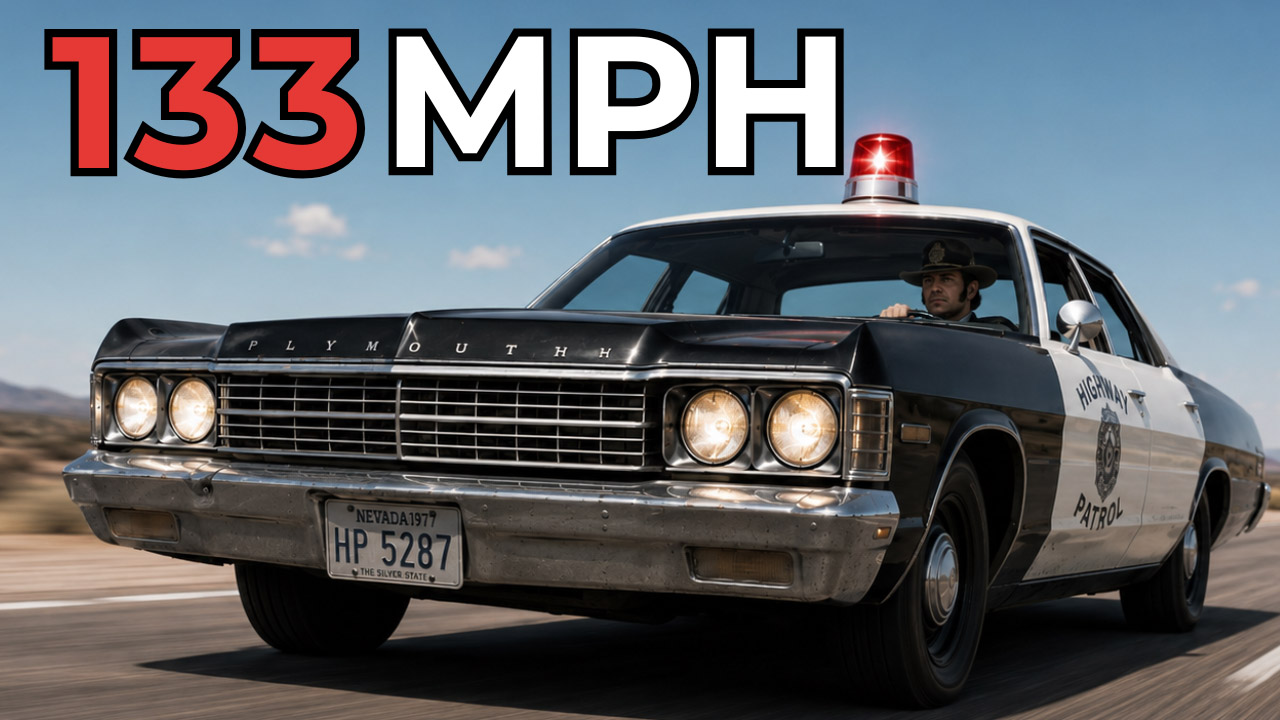
Plymouth’s pursuit cars ruled American policing for three decades and peaked with a 133 mph run in 1978, then vanished from the record while Ford took the credit for the formula Chrysler had invented.
-
Era
1956–1989
-
Department
Michigan State Police, and US police fleets nationwide
-
Runtime
17:28
-
Published
Jul 26, 2026
1. Introduction
-
Why could only police buy the 1955 Buick Century Model 68?
In 1978, a Plymouth Fury fitted with Chrysler’s E86 high-performance 440 cubic inch V8 recorded a top speed of 132.7 miles per hour at the Michigan State Police vehicle test, reaching sixty in around nine seconds and a hundred in under twenty-five. And nothing else in that year’s police field came close to it on any measure. Not the Fords, not the Chevrolets, not the other Mopar. The next quickest car in the test needed nearly thirty-four seconds to reach a hundred. The Fury did it in under twenty-five. And Chrysler had spent two decades building a position in police fleets that no rival came near.
The Fury was, by the most respected independent police vehicle test in the world, the fastest police sedan in the country at the precise moment that being the fastest was about to become impossible. Emissions rules and fuel economy standards killed the big-block 440 after 1978. The 1978 test was simultaneously the Fury’s greatest triumph and the last stand of an entire era of American cars.
2. What You Will Learn
-
Why Chrysler’s 1956 decision to sell a catalogue of police cars, rather than one police car, reshaped how American law enforcement bought vehicles.
-
The formula that made Mopar squad cars dominant, applied to police work years before the muscle-car era.
-
What was actually inside the A38 Police Pursuit Package, and why its features became standard on the police cars that followed.
-
What happened at the 1978 Michigan State Police test, and why the result marked both a peak and an ending.
-
How real, decommissioned Mopar police cars were bought cheap and destroyed by the dozen for The Blues Brothers.
-
Why the Ford Crown Victoria is remembered as the definitive American police car despite inheriting a template it did not invent.
-
What became of the breed, and the single survivor enthusiasts believe is still out there.
3. Historical Background
For the first half of the twentieth century there was no such thing as a police car built at the factory. Departments bought ordinary civilian sedans and modified them in-house, or simply accepted whatever the low bidder offered. Plymouth had been supplying vehicles to police since the early 1930s, a 1939 Plymouth coupe served with the New York Police Department in the distinctive livery of white roof, green body and black fenders, but these were everyday cars pressed into service rather than purpose-built machines.
That changed in 1950, when Ford introduced the first true factory police package. Chrysler answered in 1956 with its own official package on the Dodge Coronet, but the company did something cleverer than building a single police car. Plymouth began advertising directly to law enforcement through dedicated police and taxi sales catalogues, and Chrysler sold not one police car but a range of them, each tuned for a different job: a low-cost patroller for cities that did not need speed, and a full-bore pursuit car for the open highway. Chrysler had grasped something its rivals had not: a rural sheriff and a state highway patrol need fundamentally different machines.
In 1957 Plymouth entered the police market in force with its own Police Pursuit package, and the domination that followed lasted decades. The formula Chrysler settled on was simple and devastating: take a mid-sized, relatively light body and offer it with the largest, most powerful engines the company built. A Ford or Chevrolet police car of the period was typically a big car with a big engine. A Mopar was a smaller car with the same big engine, and physics did the rest.
4. The Machine Explained
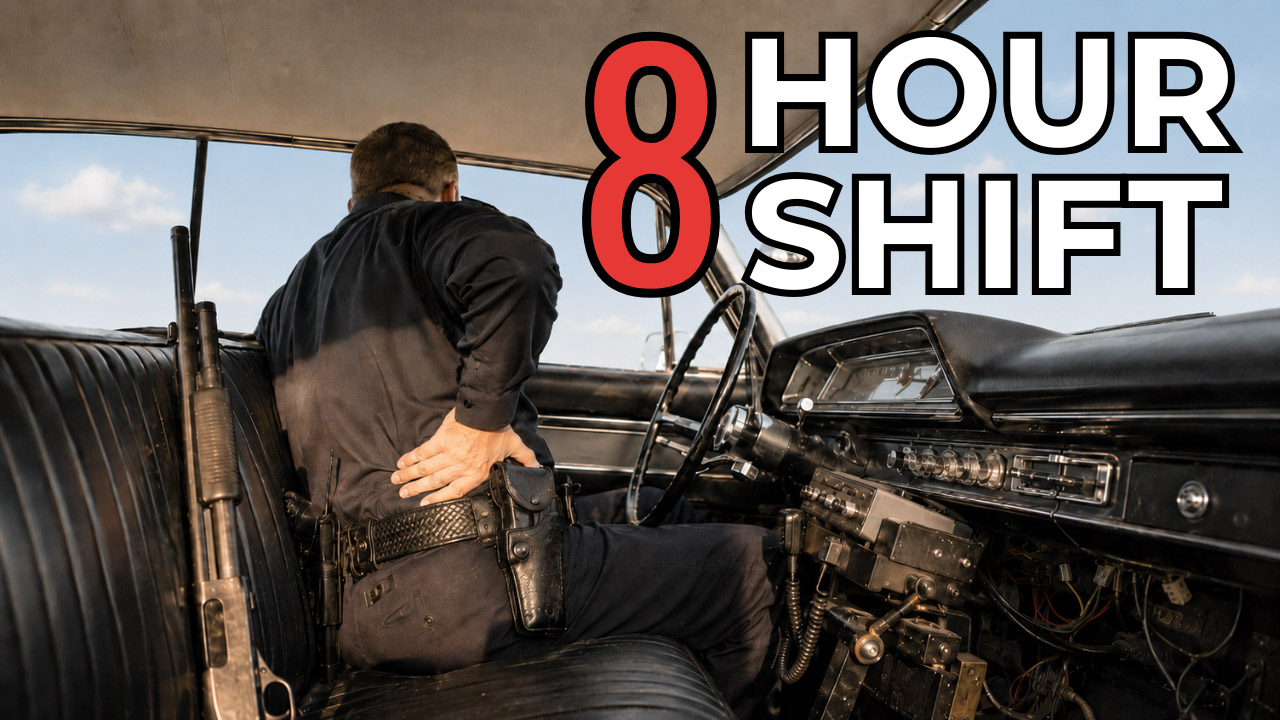
The A38 car was not a civilian sedan with a larger engine fitted. Its cooling and charging hardware existed for one specific reason: a patrol car spends most of its shift stationary with the engine running, then has to sprint to three-figure speeds without cooking itself. And there is a detail that tells you exactly who these cars were built for. The air-conditioning compressor robbed power at speed, so Chrysler dealt with it not by engineering an automatic cut-off but by printing an instruction on the dashboard telling the officer to switch the compressor off above eighty miles an hour. The car assumed a professional was driving it. Nearly every element of this specification later became standard on the police package the Crown Victoria inherited.
-
Model
Plymouth Fury, police pursuit specification.
-
Peak test year
1978.
-
Engine
440 cu in “Wedge” big-block V8, E86 high-performance specification.
-
Police package
Option code A38, Police Pursuit Package.
-
Suspension
Heavy-duty tuned, thicker front and rear sway bars, wider track.
-
Wheels and tyres
Wide slotted steel wheels with fabric-belted radial pursuit tyres rated for sustained high speed.
-
Electrical
500-amp heavy-duty battery, 100-amp alternator.
-
Cooling
High-capacity radiator, engine oil cooler, optional transmission and power-steering coolers.
-
Instrumentation
Calibrated 140 mph speedometer.
-
Engine lineage: 413 cu in V8 (1963)
360 hp, 470 lb-ft. A sixteen-second quarter mile in a fully equipped full-size sedan.
-
Engine lineage: 383 cu in V8
Capable of 0–60 mph in 7.7 seconds despite a kerb weight well over two tons.
-
Engine lineage: 440 cu in V8 (from 1966)
365 hp and 480 lb-ft from a single carburettor. America’s top police engine until 1978.
5. What The Records Show
The Michigan State Police vehicle test is the most respected police vehicle evaluation in the world. By the 1950s the agency was requesting bids from manufacturers, and rather than buy blind it began testing the low-bid cars for fitness. As the bids crept closer together, eventually just a few dollars apart, the MSP decided to test every car and choose the genuine best. When it crowned a winner, every department in America paid attention.
-
The 1978 result
Top speed 132.7 mph, against 117.4 for the next fastest car in the field. Zero to a hundred in 24.8 seconds, when the next best managed 33.7. And the quickest time round the road course as well, at 91.1 seconds. The Fury did not merely win the 1978 test. It won every performance category in it. It was also the last model year of the big-block 440 police engine, which is why the number has never been beaten by a car of its kind.
-
The honest wrinkle
The record is not one-sided, and the qualification makes the Fury more interesting rather than less. When Car and Driver ran an instrumented test on a 440-powered police Fury, the magazine came away impressed by the brutal acceleration but unimpressed by the handling: heavy oversteer, a stiffly sprung rear axle easily upset on rough roads and under braking, and only modest cornering grip. The Fury was a battering ram, not a scalpel. For the highway pursuit work that defined American policing in that era, a battering ram was precisely what the job demanded.
-
The Blues Brothers fleet
In 1980 The Blues Brothers staged one of the most spectacular automotive demolitions in film history. The pursuing squad cars that piled up, flipped and crumpled by the dozen were real decommissioned police Mopars, Dodge and Plymouth squad cars of exactly this era. The production bought them by the lot, cheap, because retired police cars were plentiful and considered worthless. As one restorer who preserves these cars has put it, police cars were never meant to live long lives; they were soldiers who lived fast and died young.
-
Almost none survive
These cars were worked hard, retired quickly, and often sold cheap or destroyed, including by film productions. Only a small number of 440-era police Furys are known to survive, and the film tells the story of the one enthusiasts believe to be the last of its kind.
-
It was also the cheapest
Michigan does not simply rank cars on performance. It calculates an adjusted bid, combining the manufacturer’s price with the test scores, and the lowest adjusted bid wins. The Fury’s was $5,397. The Dodge Monaco came in at $5,582, the Pontiac Catalina at $5,663 and the Chevrolet Impala at $5,679. So the fastest car in the 1978 test was also the cheapest way to buy a police car that year. That combination, and not speed alone, is why Chrysler took the market.
-
Two cars did not qualify at all
Michigan sets minimum acceleration standards, and a car that misses them is excluded from bidding rather than simply scored down. In 1978 two of the six cars tested were disqualified: the Buick LeSabre, which needed 46.4 seconds to reach 100 mph, and the Ford LTD II, which needed 41.0. Both appear in the results table with the word “disqualified” where a bid price should be. It is a useful reminder of how wide the spread was: in the same test, on the same day, one car did 132.7 mph and another could not qualify to compete.
6. Why It Mattered
The Ford Crown Victoria is remembered as the definitive American police car, and for its time it was. But the template that made it a legend was not Ford’s invention. The rear-wheel-drive, big-V8, full-size pursuit sedan, the durable, no-nonsense workhorse that could be beaten daily and keep running, was the Fury’s formula first. Chrysler defined what an American police car should be across the 1950s, 1960s and 1970s, and dominated the market so completely that when the Crown Victoria’s turn came, it simply carried the torch forward.
Chrysler faltered for reasons the 1978 test itself foreshadowed. The 1973 oil crisis had sent fuel prices soaring, tightening federal emissions regulations were strangling engines, and downsizing was coming for every full-size American car. The big-block 440 was gone after 1978. Chrysler soldiered into the 1980s with the smaller, 318-powered Plymouth Gran Fury and Dodge Diplomat, durable, respectable police cars, but a shadow of the fire-breathing 440s that preceded them. After the 1989 model year, Chrysler discontinued its rear-drive police platform entirely. The company that had invented and ruled the American police-car market for over three decades walked away from it.
Into that vacuum stepped Ford. The Crown Victoria took over the exact role the Fury had pioneered and rode it to a police-market dominance that lasted until 2011. The Crown Vic is remembered as king for one simple reason: it was the last one standing. It did not invent the American cop car. It outlived the company that did.
7. Key Takeaways
-
132.7 miles per hour. The 440-powered 1978 Plymouth Fury’s top speed at the Michigan State Police test, recorded in the last year it was possible.
-
Two decades of dominance. Chrysler held the American police market so completely that when it withdrew, the whole category changed hands.
-
The formula came first. Chrysler’s light-body, big-engine pursuit recipe predated the muscle car and became the template every later American police sedan followed.
-
A38 was a re-engineering, not an option pack. Suspension, brakes, wheels, tyres, cooling, charging and instrumentation were all changed for the job.
-
The Crown Victoria inherited rather than invented. Chrysler left the rear-drive police market after 1989; Ford filled the vacuum and got the credit.
-
Almost none survive. These cars were worked hard, retired fast, and destroyed cheaply, including on camera.
8. Frequently Asked Questions
9. Sources
Every claim on this page is drawn from institutional test data, manufacturer documentation and period press. These are the sources behind it.
-
Michigan State Police vehicle evaluation data
Annual patrol vehicle test results for the 1978 model year, conducted at the Chelsea Proving Grounds, establishing the 133 mph top speed and the sub-25-second 0–100 figure.
-
-
Chrysler Corporation police and taxi fleet catalogues, 1956–1978
Factory documentation of the A38 Police Pursuit Package specification and the range of police models offered for different duties.
-
Car and Driver instrumented road test
Period testing of the 440-powered police Plymouth Fury, 1977 to 1978 cars, recording the handling limitations alongside the acceleration.
-
Edwin J. Sanow, police vehicle histories
The standard reference series for Michigan State Police test data and factory police packages.
-
The Blues Brothers (1980) production history
Documentation of the decommissioned police Mopar fleet purchased and destroyed for the film’s chase sequences.
-
Michigan State Police 1978 Patrol Vehicle Test Results
The published results table for the 1978 evaluation, giving engine, horsepower, axle ratio, weight, wheelbase, road course time, 0-100 mph, top speed, braking, ergonomics, communications, fuel economy and adjusted bid price for all six vehicles tested.
10. Related VIDEOs
By Badges & Chrome — researching the history of American police vehicles from published automotive history, period records, and primary sources. Every claim is verified before publication.
About the research →