
Built for the Grind, Not the Chase
The NYPD Fleet: The Biggest Police Fleet Never Built for the Chase
By Badges & Chrome · researched and verified from period records and primary sources · About the research →
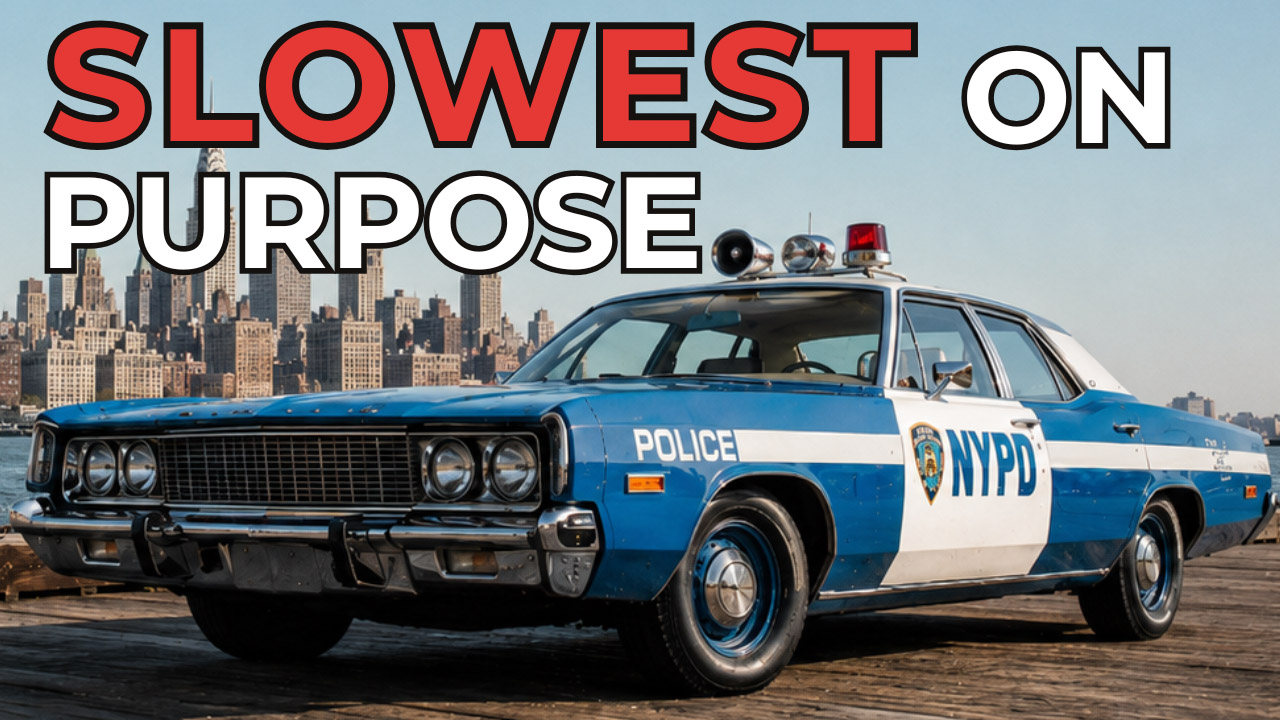
About this VIDEO
-
The everyday American police car owes more to Manhattan traffic than to the open highway.
How New York’s gridlock produced a completely different set of priorities from the speed-obsessed western departments, and why the durability features in every modern police package are a city-patrol inheritance rather than a pursuit one.
-
Era
1910–1970s
-
Department
New York City Police Department
-
Runtime
21:36
-
Published
Jul 10, 2026
1. Introduction
-
Why could only police buy the 1955 Buick Century Model 68?
Because in New York the high-speed chase was largely a fiction. Manhattan is a permanently congested grid with traffic lights every block and pedestrians everywhere. A car capable of 130 miles per hour was useless because there was nowhere in the city it could ever reach that speed.
So while the California Highway Patrol and departments like it specified the fastest cars they could buy, the NYPD specified something far less glamorous: a car that would not break. A New York patrol car idled for hours powering its radio, made hundreds of stops and starts, ran hot at low speed without the cooling airflow highway driving provides, and pounded over potholes and curbs. Toughness, not speed, became the organising principle of the largest police fleet in America, and because the department bought in such enormous volume, what it demanded is what Detroit built.
2. What You Will Learn
-
Why New York’s first police cars were convertibles, and the standing order about the roof.
-
The exact date in 1932 that radio changed American policing, and where it was broadcast from.
-
How every new radio car quietly erased two foot patrolmen from the streets.
-
Why a fleet buying in thousands could bend Detroit’s supply chain to its needs.
-
What eight hours of Manhattan stop-and-go actually does to a car.
-
Why the durability features in every modern police package are a city-patrol inheritance, not a pursuit one.
3. Historical Background
In 1910 New York was already the largest city in the United States by an enormous margin, with a population approaching five million, and the NYPD policed it almost entirely on foot. The beat officer walking a fixed route, knowing every block, every shopkeeper, every troublemaker, was the fundamental unit of New York policing, with mounted officers handling crowd control and the larger avenues.
That made sense in context. Manhattan was densely packed and distances between incidents were short, so the car did not offer the obvious advantage it held in a sprawling western city. But the department was already inching toward the automobile: a dedicated Motorcycle Squad formed in 1911 to deal with speeding motorists, Model T cars were photographed at police headquarters in the same period, and in 1919 the NYPD established a formal Automobile Squad.
New York’s early cars were civilian vehicles pressed into service with minimal modification, as everywhere else in America at the time. There was no police-package car yet. The department did develop its own distinctive livery well before the national black-and-white appeared: NYPD cars of the late 1920s wore green bodies, white roofs and black front fenders.
4. The Machine Explained
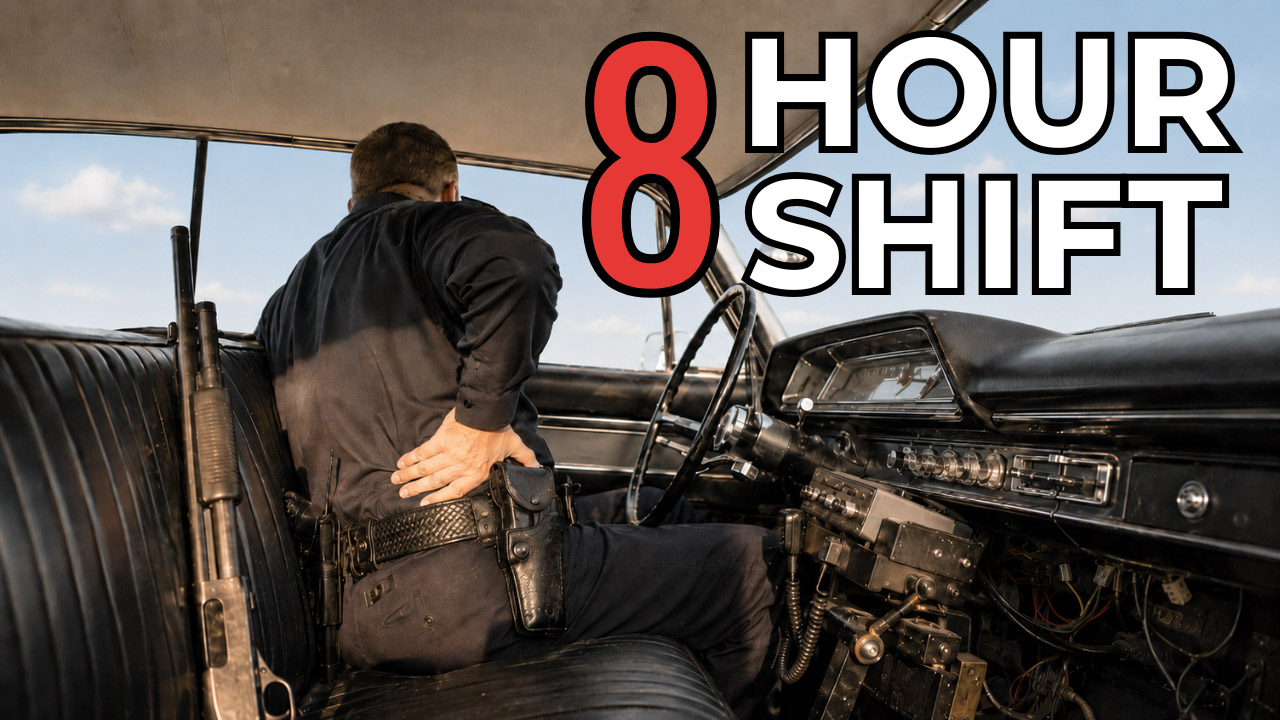
What New York specified was not a fast car but a durable one, and the reason is visible in a single eight-hour shift. A civilian car subjected to that regime wore out fast: warped brakes, burned transmissions, overheated engines, and electrical systems failing under the radio load. Everything the department asked Detroit for followed from those four conditions.
-
Idling
Hours at a time, powering radio and equipment while stationary.
-
Stop-and-start
Hundreds of cycles per shift, working brakes and transmission constantly.
-
Low-speed running
The engine runs hot without the cooling airflow that highway speed provides.
-
Road surfaces
Potholes, curbs, and a city permanently tearing itself up.
-
What the department specified
Heavy-duty cooling for constant idling, reinforced brakes for endless stop-and-go, beefed-up electrical systems to carry the radio load, and transmissions and suspensions built for abuse rather than top speed.
-
The vehicle type
The Radio Motor Patrol, or RMP, named in 1932 and still used by the department today.
-
Fleet, 1932
Roughly 800 automobiles, of which 325 were radio-equipped RMPs.
-
Fleet by April 1934
304 radio-equipped RMPs in service.
5. What The Records Show
Before radio, a patrol car was a roving unit that had to physically find a call box or telephone kiosk to receive its next assignment. After radio, it became a mobile extension of central command. For a department of NYPD’s size this was transformative: hundreds of cars could be coordinated from a single room and managed as one system rather than a scattering of independent units. The radio turned a group of cars into a network.
-
25 February 1932
The NYPD made its first official radio broadcast to a patrol car from police headquarters in Manhattan. Police Commissioner Edward P. Mulrooney called it a “wonderful success.” The department distributed 50,000 leaflets to the public under the slogan “Help yourself by helping us.” The dispatcher worked from a U-shaped table with detailed maps of every precinct and patrol post laid under glass.
-
The convertible rule
New York’s first police cars were convertibles, and officers were reportedly under standing orders to keep the top down at all times so citizens could see the officers’ uniform hats and recognise the vehicle as a police car. Rain was no excuse, and raising the top in snow is said to have required a superior’s approval. In an age before sirens were universal and flashing lights standard, the visible silhouette of an officer in his hat was the original police-car warning light.
-
Two foot posts per radio car
The department’s own historians recorded a stark piece of arithmetic. Because an RMP was crewed by two officers, every new two-man radio car put into service meant two foot posts could be eliminated. Car by car, the beat officer who walked a fixed route and knew every face on his block was replaced by a mobile, dispatchable unit that could be anywhere within minutes but knew the neighbourhood far less intimately.
-
Scale as a weapon
By the 1960s the NYPD numbered roughly 30,000 officers with a motor fleet running well into the thousands. Where a typical American city measured its fleet in dozens or low hundreds, New York measured it in thousands. When a small-town department bought ten patrol cars it took whatever the local dealer offered. When NYPD bought in the hundreds and then thousands, manufacturers paid attention, and Detroit built what it specified.
-
The cars the department actually ran
Two-door Plymouth radio cars through the 1930s and 1940s, the Ford RMP sedan in the 1950s, and the Plymouth Fury as the unmistakable mainstay by the 1970s. Across all of it ran one thread: mainstream American sedans chosen for durability, serviceability and cost. An exotic high-performance car was the wrong choice for New York not because it was too fast but because it was too hard and too expensive to keep running across a fleet of thousands.
6. Why It Mattered
The conventional history of the American police car is a story about speed, pursuit, horsepower, the chase, and it was largely written by Los Angeles and the California Highway Patrol. But that narrative has a blind spot. Speed is relevant to a tiny fraction of what a police car actually does. The vast majority of a patrol car’s life is spent idling, responding, patrolling slowly and enduring.
The features that make a modern police car a police car, heavy-duty cooling, upgraded electrical systems, reinforced brakes, durability engineering, are not pursuit features. They are endurance features, and they exist so a car can survive thousands of hours of hard, low-speed, high-abuse service. The departments that needed them most, and bought in the volume to make Detroit build them, were the big urban forces.
Consider the car that actually defined American policing for decades: the Ford Crown Victoria became legendary not because it was fast but because it was nearly indestructible, absorbing endless abuse and idling for hours with cheap, simple maintenance. Those are precisely the qualities NYPD had been demanding since the 1930s.
There is a deeper consequence too, and it reaches past the cars. The durable, radio-equipped patrol car did not only change what New York drove. By replacing foot posts two at a time, it changed the relationship between the police and the policed.
7. Key Takeaways
-
New York optimised for endurance, not speed. There was nowhere in the city to use a 130 mph car.
-
25 February 1932: the NYPD’s first official radio broadcast to a patrol car, and the birth of the RMP.
-
304 radio-equipped RMPs by April 1934, from a total fleet of roughly 800 cars in 1932.
-
Every two-man radio car eliminated two foot posts, the arithmetic that ended the beat officer’s dominance.
-
Scale gave New York leverage. Buying in thousands meant Detroit built what the department specified.
-
The police package is a city-patrol inheritance. Cooling, brakes, charging and durability are endurance features, not pursuit ones.
8. Frequently Asked Questions
9. Sources
Every claim on this page is drawn from departmental archives, published scholarship and manufacturer specifications. These are the sources behind it.
-
NYPD historical archives
“The History of Police Communications in New York City,” documenting the 25 February 1932 first broadcast, the Mulrooney quotation, the 50,000-leaflet campaign, the dispatcher’s post, the April 1934 count of 304 RMPs and the 1932 fleet figure.
-
NYPD records on the Motorcycle Squad and Automobile Squad
Departmental documentation of the 1911 Motorcycle Squad and the formal establishment of the Automobile Squad in 1919.
-
Bernard Whalen and Jon Whalen, The NYPD’s First 50 Years
Politicians, Police Commissioners, and Patrolmen. Scholarship on the department’s early motorisation and command structure.
-
Ford, Chrysler and General Motors police package specifications
Factory documentation from 1950 onward, establishing which durability features entered the standard police package and when.
10. Related VIDEOs
By Badges & Chrome — researching the history of American police vehicles from published automotive history, period records, and primary sources. Every claim is verified before publication.
About the research →