
The Getaway Car That Beat Every Cop
The Stolen Car Bonnie and Clyde Died In
By Badges & Chrome · researched and verified from period records and primary sources · About the research →
About this VIDEO
-
The fastest getaway car in America came to a complete stop of its own accord.
How a cheap, anonymous Ford V8 made two small-time Texas criminals uncatchable for two and a half years, and why the man who finally beat them did it with patience rather than horsepower.
-
Era
1932–1934
-
Pursuing agencies
Texas Rangers, Bienville Parish, Bureau of Investigation
-
Runtime
19:44
-
Published
Jul 4, 2026
1. Introduction
-
Why could only police buy the 1955 Buick Century Model 68?
Bonnie Parker and Clyde Barrow drove stolen Ford V8s almost exclusively from 1932 until their deaths in May 1934, and the car they were killed in was a 1934 Ford Model 40B DeLuxe Fordor sedan stolen from the driveway of Jesse and Ruth Warren in Topeka, Kansas on 29 April 1934.
The reason was mechanical rather than sentimental. In 1932 Henry Ford released the Model 18, the first affordable American production car with a V8 engine, 221 cubic inches, around 65 horsepower, priced from roughly $460. It was simultaneously faster than almost anything the police were driving and completely anonymous on the road. Depression-era departments were running older, cheaper civilian sedans bought on gutted budgets, and on open road they could not catch a Ford V8. For two and a half years that gap kept the most wanted fugitives in America alive.
2. What You Will Learn
-
Why the Ford V8 was the perfect criminal car, and what mattered more than its top speed.
-
How Clyde Barrow exploited a structural weakness in 1930s American law enforcement that had nothing to do with engines.
-
The letter to Henry Ford signed by Clyde Barrow, the detail that makes experts doubt it, and where it sits today.
-
Who Texas hired when everyone else had failed, and the method he used instead of chasing.
-
Why the fastest getaway car in America came to a complete stop of its own accord.
-
What became of the death car, how to tell it from the fakes, and how this chase helped create the factory police car.
3. Historical Background
Clyde Barrow left the Eastham Prison Farm in Texas in February 1932 after serving about two years for auto theft and burglary. Within months he and Bonnie Parker were committing robberies, and before long the gang had killed. In that first spring they drove whatever they could steal, a Hudson, a Chevrolet, none of it fast, and police in similar civilian sedans could mostly keep up. At that stage they were two more small-time fugitives in the Southwest.
What changed everything was a product decision in Dearborn. To Henry Ford the V8 was a strategic gamble against Chevrolet. To a criminal in Texas it was the fastest production car available to steal, and, crucially, one that looked exactly like every other car on the road. A bank robber did not want a conspicuous Cadillac. He wanted speed concealed inside an ordinary sedan.
Bonnie and Clyde acquired their first Ford V8 in 1932 and essentially never drove anything else. Over the next two years the gang stole somewhere between a dozen and a couple of dozen of them, abandoning cars that had become too well known and stealing replacements sometimes within hours. By 1933 the men hunting them could reliably predict the make and model of the next car they would be chasing.
4. The Machine Explained
Every serious account credits Barrow with exceptional driving. He had grown up running back roads in rural Texas and knew mud holes, field crossings and shortcuts no pursuing officer could anticipate. He was known for marathon drives covering enormous distances in a day, repeatedly crossing state lines to exploit a structural weakness in 1930s policing: officers generally could not pursue across jurisdictional boundaries. The V8 made the distances possible. The driving and the jurisdictional gap made them decisive.
-
The engine that started it
1932 Ford Model 18: 221 cu in flathead V8, around 65 hp, from roughly $460.
-
The death car
1934 Ford Model 40B DeLuxe Fordor sedan, flathead V8, rated at approximately 85 hp by 1934.
-
Stolen
29 April 1934, from Jesse and Ruth Warren’s driveway, Topeka, Kansas.
-
Purchase price when new
$835, bought by Ruth Warren weeks earlier.
-
Why criminals chose it
Fast, cheap, mechanically simple, and visually indistinguishable from ordinary traffic.
-
How many they stole
Somewhere between a dozen and a couple of dozen across two years, abandoned and replaced sometimes within hours.
5. What The Records Show
By spring 1934 the Bureau of Investigation, the Texas Rangers, the state police and every sheriff between Dallas and Joplin had failed. What finally worked was not a faster car but a different method entirely.
-
The man Texas hired
In February 1934 the Texas prison system hired a fifty-year-old retired Texas Ranger, Frank Hamer, as a Special Investigator on roughly $180 a month. Hamer had joined the Rangers in 1905 and spent decades on the Texas–Mexico border. Accounts credit him with an extraordinary number of gunfights, though the specific figures are disputed and almost certainly grew in the retelling.
-
Patience instead of pursuit
For three months Hamer worked through reports, witness statements and stolen-car logs across sixteen states, looking for patterns the gang did not know they had, including the way they hugged state boundaries. He focused on the people they trusted, among them gang member Henry Methvin and his family in Louisiana. He also matched the machinery: he obtained a Ford V8 for the pursuit and said plainly that, like Barrow, he used a Ford V8 and lived in the car most of the time.
-
The ambush, 23 May 1934
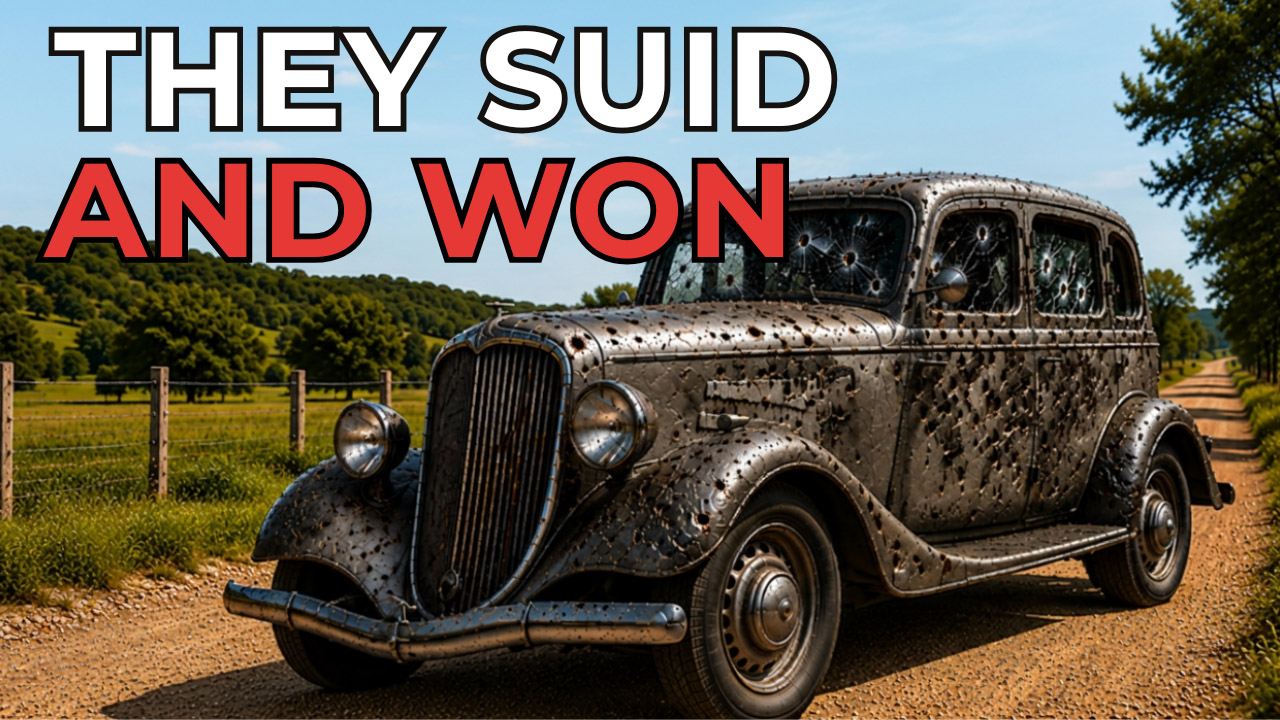
Six lawmen took part near Gibsland, Bienville Parish, Louisiana: Hamer, Maney Gault, Bob Alcorn and Ted Hinton from Texas, with Sheriff Henderson Jordan and Deputy Prentiss Oakley from Louisiana. The bait was Ivy Methvin’s logging truck, jacked up with a wheel removed and staged as a breakdown. Approximately 130 rounds were fired in a barrage lasting only seconds. Clyde was hit in the head by one of the first shots and killed almost instantly. Counts of the strikes visible on the car vary, commonly cited from around 130 up to 167.
-
The letter to Henry Ford
A letter praising the Ford V8, postmarked Tulsa on 10 April 1934 and received by Ford Motor Company on 13 April, was signed “Clyde Champion Barrow.” Barrow’s actual middle name was Chestnut, one reason handwriting experts question it. The letter is held today by the Henry Ford Museum in Dearborn, Michigan. A near-identical praise letter signed by John Dillinger was later judged a forgery.
-
The family who sued to get the car back
The car was never Bonnie and Clyde’s. Sheriff Jordan attempted to keep it, but Jesse and Ruth Warren sued and won, and the car was returned to them in August 1934, still bloodstained and shot through. It survives on public display in Primm, Nevada. Several fake death cars toured the United States over the years, so provenance matters: the authenticated car traces its ownership records back to the Warrens.
6. Why It Mattered
Strip away the folklore and this chase is a turning point in the history of the police car, which is the part that rarely gets told.
For two and a half years two criminals in a stolen Ford humiliated every level of American law enforcement, and the reason was mechanical. Departments in the early 1930s were not ordering purpose-built pursuit vehicles, because no such thing existed. A sheriff’s office bought whatever cheap civilian sedan its Depression-gutted budget allowed and sent it out exactly as it left the showroom, no heavy-duty suspension, no upgraded cooling, no performance tuning, and many were still running tired cars from the 1920s. The absurd result was that the criminal and the officer could walk into the same Ford dealership, but the criminal bought the new V8 while the officer nursed along whatever his county had bought years earlier. The outlaw, spending stolen money, was better equipped than the officer spending the taxpayer’s.
Frank Hamer’s response was the tell. He did not ask for a better gun first; he asked for a Ford V8, because he understood that in a car chase the car is the weapon. He was effectively a one-man preview of an idea American policing would take another two decades to adopt at scale: that catching fast criminals requires deliberately buying fast, properly equipped cars rather than whatever is cheapest.
That idea is what eventually produced the factory police car. When Ford introduced the first true factory police package in 1950, with heavy-duty springs, upgraded cooling and a bigger electrical system, it was answering a problem this chase had exposed sixteen years earlier. Bonnie and Clyde helped build the modern police car, not deliberately, but every time their stolen V8 left a squad car choking in the dust, it strengthened an argument inside American law enforcement that better cars were no longer optional.
7. Key Takeaways
-
The Ford V8 was the perfect criminal car because it combined real speed with total anonymity. A Cadillac was faster but conspicuous.
-
Clyde exploited jurisdiction as much as horsepower, crossing state lines that police generally could not follow across.
-
The letter to Henry Ford is genuinely disputed. The signature reads “Clyde Champion Barrow,” but his middle name was Chestnut.
-
Frank Hamer matched the machine, obtaining a Ford V8 and living in it much as Barrow did.
-
Speed never came into the ambush. Clyde slowed and stopped voluntarily for what looked like a stranded truck.
-
The death car was never theirs. It was stolen from Jesse and Ruth Warren, who sued to get it back and recovered it in August 1934.
8. Frequently Asked Questions
9. Sources
Every claim on this page is drawn from museum holdings, manufacturer records and period reporting. These are the sources behind it.
-
The Henry Ford Museum, Dearborn
Holder of the Barrow letter to Henry Ford, April 1934. Authorship remains disputed by handwriting experts.
-
Ford Motor Company records
Specification and pricing for the 1932 Model 18 and the 1934 Model 40B, including the increase in flathead output between the two model years.
-
Contemporary reporting and posse accounts, 23 May 1934
Period documentation of the ambush in Bienville Parish, Louisiana, the six lawmen involved, and the rounds fired.
-
Topeka Capital-Journal, 1984
Interview with the Warren family recalling the car’s condition when it was returned to them in August 1934, still bloodstained.
-
Ownership and provenance records for the death car
Documentation tracing the authenticated vehicle back to Jesse and Ruth Warren, which distinguishes it from the fake death cars that toured for decades.
10. Related VIDEOs
By Badges & Chrome — researching the history of American police vehicles from published automotive history, period records, and primary sources. Every claim is verified before publication.
About the research →