
The First American Arms Race
Moonshine Runners vs Revenuers: How Bootleggers Founded NASCAR
By Badges & Chrome · researched and verified from period records and primary sources · About the research →
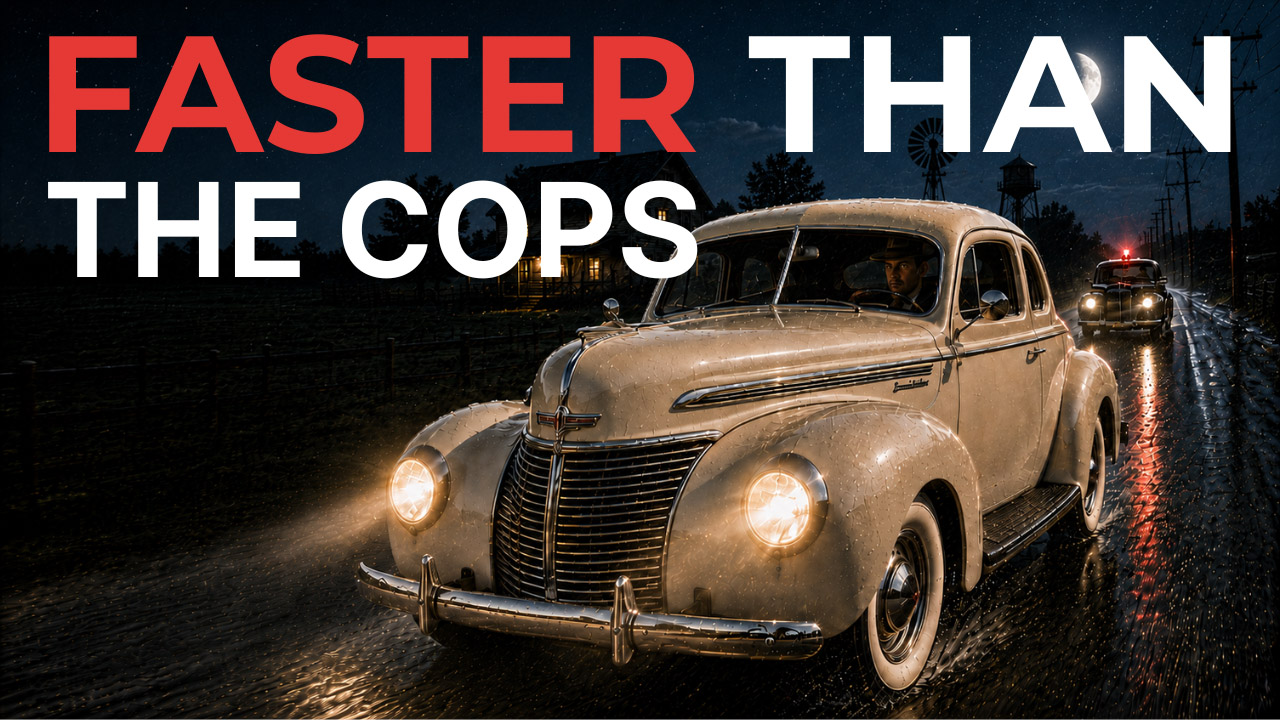
About this VIDEO
-
The men running from the law became the founding fathers of American motorsport.
The decades-long backroad chase between moonshine haulers and federal agents, told from both sides: the whiskey cars, the revenuers who hunted them, and the driving skills that eventually turned into checkered flags.
-
Era
1920–1950s
-
Agency
US Treasury revenue agents, later the ATF
-
Runtime
18:41
-
Published
Jun 28, 2026
1. Introduction
-
Why could only police buy the 1955 Buick Century Model 68?
Yes, and more completely than the sanitised version of the story suggests. NASCAR was organised in February 1948, when Florida promoter Bill France Sr. gathered drivers, mechanics and track owners at the Streamline Hotel in Daytona Beach. But the cars, the driving skills and the mechanical knowledge it was built on had been forged over the preceding two decades in a running battle between Southern whiskey haulers and the federal revenue agents trying to catch them.
Runners from one valley began racing runners from the next in cow pastures and on dirt tracks for bragging rights, using the same modified cars they ran liquor in. The sport’s first stars walked in directly off the moonshine routes, several of them still hauling whiskey during the week, and some still of active interest to federal authorities at the time of their first significant wins. The chase built the sport, and it was never really about Prohibition.
2. What You Will Learn
-
Why the chase had almost nothing to do with Prohibition, and did not stop when Prohibition was repealed in 1933.
-
What made the 1932 Ford V8 the definitive whiskey car, and the underground art form of modifications that followed.
-
How runners defeated roadblocks with hidden compartments, auxiliary tanks, and two-car relay tactics.
-
The most feared federal agent in the South, and the meticulous records he kept.
-
Why the law eventually stopped trying to win on horsepower, and what it did instead.
-
How the founding generation of American stock car racing came directly off the liquor routes.
3. Historical Background
The 18th Amendment took effect in 1920 and created a national black market overnight, but in the mountains of Appalachia families had been making untaxed corn whiskey for generations. The men pursuing them were not local police. They were federal revenue agents, “revenuers,” working for the Treasury Department, and their concern was not morality but money: the federal government wanted the tax on every gallon, and the moonshiners were not paying it.
That distinction is what most retellings miss, and it explains everything that followed. When Prohibition was repealed in 1933, the chase did not stop. Untaxed whiskey was still untaxed whiskey, and the revenuers kept coming. The lineage of that enforcement effort runs forward to the agency known today as the ATF. For these agents the backroad war ran for decades after legal liquor returned to the shelves.
The work was largely unglamorous. As one Virginia liquor agent described it, catching a moonshiner mostly meant sitting very still in the woods, sometimes for hours in the dark, waiting for a still to give itself away. Most stakeouts produced nothing. Catching whiskey on the move was harder still, which is where the cars came in.
4. The Machine Explained
A runner’s car had to do two contradictory things: look completely ordinary, and outrun anything the government could field. The philosophy fits in one line: maximum speed, minimum attention. Runners also worked in pairs, using a two-car relay with a decoy out front to draw the chase while the loaded car hung back and slipped through once the agent took the bait.
-
The definitive car
1932 Ford V8, around $460 new, and capable of over 100 mph with a few weekends of work.
-
Suspension
Heavy-duty springs and shocks, often welded from junkyard parts, so a loaded car would not sag and betray itself.
-
Engine
Larger carburettors and reworked internals, well over 100 hp.
-
Fuel
Auxiliary tanks. Stopping for fuel mid-run was a good way to get caught.
-
Concealment
False floors and hidden tanks. The best could present what looked like an empty trunk to a flashlight at a roadblock.
-
Later iron
Runners moved to faster machinery in the 1950s, including a modified 1958 Chrysler 300 and a special-ordered 1957 Ford Fairlane with the rare factory supercharged F-code V8.
5. What The Records Show
The most feared revenuer in the South was a Kentucky federal agent whose career is unusually well documented, because he kept meticulous daily records. What those records show is a war fought less on horsepower than on patience.
-
William “Big Six” Henderson
Across a 28-year career, and by his own daily record, Henderson destroyed approximately 5,000 stills and sent roughly 5,600 moonshiners to jail. Moonshiners painted “Big Six” on the sides of their barrels, and some named children after him. Kentucky girls worked him into a jump-rope chant about watching the still in case Big Six came over the hill.
-
Why the law stopped racing
Henderson understood the thing that decided the war: the car was only half the battle. You could rarely out-drive a purpose-built whiskey car in a straight chase, so the law learned to win the other way, with intelligence, surveillance, stakeouts, informants and ambush. It is the same lesson the Texas Rangers had learned pursuing Bonnie and Clyde a decade earlier. When you cannot win on horsepower, you win on patience.
-
When the hardware finally caught up
As Detroit began building genuinely fast factory cars in the 1950s, the overhead-valve V8s and the first purpose-built pursuit packages, law enforcement finally had vehicles that could run with the runners. A speed advantage that had lasted some thirty years began to close.
-
The drivers who became the sport
Atlanta police, having failed to catch Roy Hall, reportedly called him a genius at the wheel. Lloyd Seay won three races in quick succession in 1941 and was shot dead the morning after his last win, aged 21, in a dispute over moonshine. Junior Johnson, Curtis Turner and Wendell Scott were among the founding names who had run whiskey, run from the law, or both.
6. Why It Mattered
The conventional account presents NASCAR as a clean, family-friendly motorsport built from scratch in 1948. The reality is that its first stars came directly off the liquor routes, driving the same cars and using the same skills that had been developed specifically to defeat federal agents.
That matters for police history as much as for racing history. This was the first sustained arms race between American law enforcement and the people it pursued, and it established the pattern that would repeat for the next fifty years: criminals buy or build speed, the police fall behind, and the industry eventually catches up.
The blocker car that ran interference for a whiskey load became a racing tactic. The modified suspension that carried a hundred gallons without sagging became the basis of stock car preparation. And the conclusion the revenuers reached, that patience and intelligence beat horsepower, is the same conclusion police agencies would reach repeatedly in the decades that followed.
7. Key Takeaways
-
It was about tax, not Prohibition. The chase continued long after repeal in 1933, because untaxed whiskey remained untaxed whiskey.
-
The 1932 Ford V8 was the definitive whiskey car: fast, cheap at around $460, and completely anonymous.
-
The runners usually won on the road. Government cars were bought on federal budgets and chosen for cost, not speed.
-
“Big Six” Henderson broke up roughly 5,000 stills across a 28-year career and became folklore in his own lifetime.
-
The law adapted by changing the game, using surveillance, informants and ambush rather than pursuit.
-
NASCAR was organised in February 1948 at the Streamline Hotel in Daytona Beach, and its first stars came off the liquor routes.
8. Frequently Asked Questions
9. Sources
Every claim on this page is drawn from federal service records, academic folk history and period reporting. These are the sources behind it.
-
William “Big Six” Henderson’s personal daily service records
Henderson kept meticulous daily records across his 28-year federal career. His totals of roughly 5,000 stills and 5,600 arrests derive from them, as reported in Kentucky regional press including the Bowling Green Daily News and Kentucky Monthly.
-
Western Kentucky University, Department of Folk Studies
A 1976 master’s thesis on the oral folk history of “Big Six” Henderson, documenting the barrel-painting, the jump-rope chant and his reputation across the region.
-
Contemporary Atlanta press coverage
Period reporting on Lloyd Seay, Roy Hall and early Southern stock car racing, supported by Georgia Racing Hall of Fame records.
-
NASCAR founding records, February 1948
Documentation of the Streamline Hotel meetings in Daytona Beach convened by Bill France Sr.
-
History Channel documentary material
Rumrunners, Moonshiners and Bootleggers, and Modern Marvels on the origins of police pursuit technology.
10. Related VIDEOs
By Badges & Chrome — researching the history of American police vehicles from published automotive history, period records, and primary sources. Every claim is verified before publication.
About the research →