
The First Factory Police Package
The 1950 Ford: America’s First Factory-Built Police Car
By Badges & Chrome · researched and verified from period records and primary sources · About the research →
About this VIDEO
-
Ford put the police car on the assembly line, and no rival answered for five years.
The year a police chief could finally order a police car instead of building one. How Ford’s 1950 police package created an entirely new category of American automobile, and what it reveals about the carmakers that could not follow.
-
Era
1950s
-
Department
State highway patrols and US departments nationwide
-
Runtime
11:45
-
Published
June 15, 2026
1. Introduction
-
Why could only police buy the 1955 Buick Century Model 68?
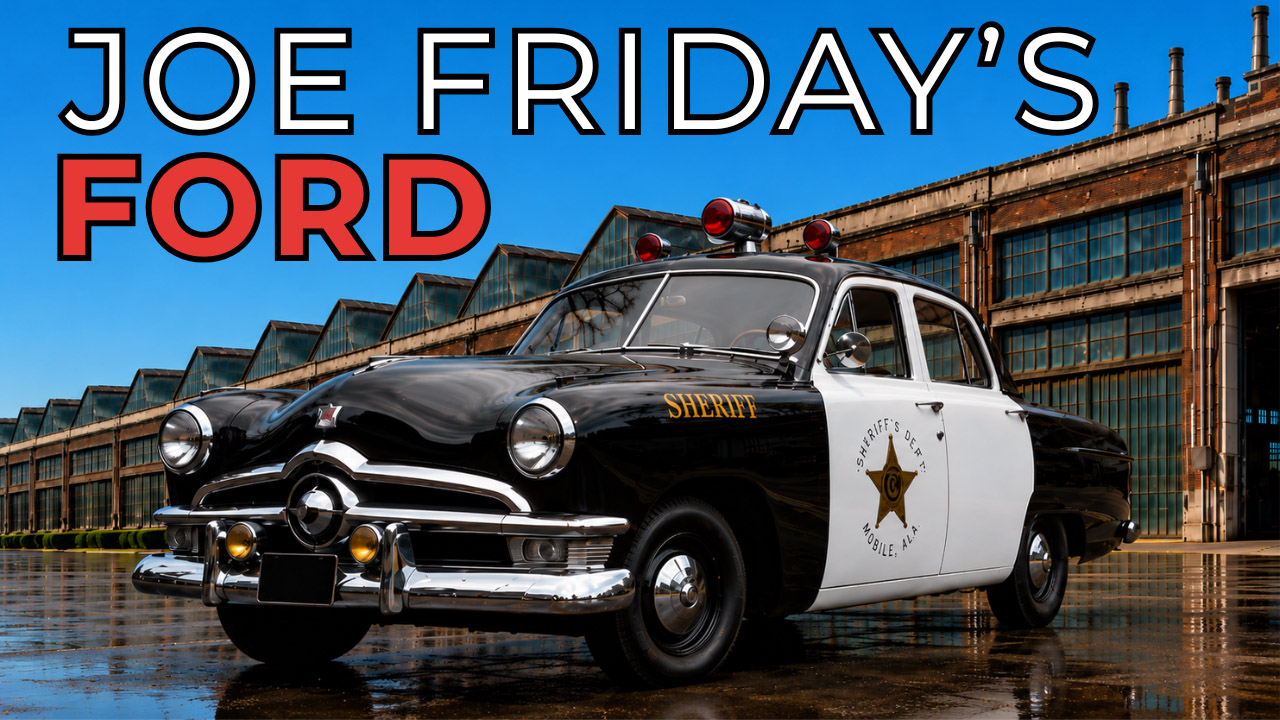
The first factory-built police car sold in America was the 1950 Ford, offered with what Ford called its police package. Before it, a department bought an ordinary civilian sedan and sent it to its own garage or a third-party upfitter to have heavier springs, a larger battery and a radio bracket fitted. Every department did it differently, and no two patrol cars in the country were identically modified.
Ford’s innovation was to perform those modifications on the assembly line, with standard parts, at a price printed on the order form. The package added heavy-duty front and rear springs, upgraded shock absorbers, a heavy-duty battery, an enlarged trunk sized for bulky AM police radios, and a 60-ampere generator that Ford advertised as maintaining maximum current even at idling speeds. That was the specific problem destroying post-war police fleets. Chevrolet did not answer until 1955, and Dodge until 1956.
2. What You Will Learn
-
Why American police fleets were collapsing between 1945 and 1950, and what it was doing to city maintenance budgets.
-
The specific engineering problem — a radio drawing more current than the rest of the car’s electrical system — that the package was built to solve.
-
What was actually in the 1950 package, and the honest wrinkle about which body it was built on.
-
Why Ford, not General Motors or Chrysler, was the company that solved it.
-
How a television detective made the Ford police car the definitive image of American law enforcement for thirty years.
-
What the police package really tells us about the collapse of the independent automakers — and why the popular version of that story is wrong.
3. Historical Background
Detroit stopped civilian car production in 1942 to build military hardware, so for the duration of the Second World War American police departments maintained whatever they already owned, mostly pre-war Fords and Chevrolets from the late 1930s. By 1945 those cars had been driven into the ground, and post-war populations were booming.
The replacements were not up to the work. A 1947 Ford was a fine family sedan, but it had not been designed to idle for hours powering a two-way radio, or to run hot pursuit on a hot day with three men aboard. Generators failed. Brake drums warped. Suspensions sagged within months. Fleet managers reported patrol cars wearing out far faster than civilian cars and costing considerably more to keep on the road.
Ford, meanwhile, was fighting to hold ground in the consumer market against Chevrolet and Plymouth. What it did have was the largest dealer network in America and a fleet sales team in daily contact with police departments, and by 1949 those salesmen were bringing back the same message from department after department. Ford’s response was to stop waiting for someone else to solve the problem and do the modifications itself, on the line.
4. The Machine Explained
The 1950 package was not a performance upgrade. It was a durability package, built around one specific failure: a two-way radio drawing more current than a civilian charging system could supply while the car sat still. An honest wrinkle the film covers is that the package was built on the carried-over 1949 body, and Ford’s own archivists say so. What made 1950 the landmark year is that it became a true factory option, the first time in America a department could order a police car rather than build one.
-
Introduced
1950 — the first factory police package in America
-
Suspension
Heavy-duty front and rear springs, upgraded shock absorbers
-
Electrical
Heavy-duty battery; 60-ampere generator and regulator assembly holding maximum current at idle
-
Body
Enlarged trunk sized for bulky AM police radio equipment
-
Transmission
Three-speed column-shift manual
-
Engines
95 hp Six; 100 hp V8; and a 110 hp “V8 H.P. Special” as the top option
-
Approx. top speed
Around 85 mph in V8 form
-
Rivals: Ford
1950 — first factory police package
-
Rivals: Chevrolet
1955 — five years later
-
Rivals: Dodge (Chrysler)
1956
5. What The Records Show
The factory cars did not merely match the garage-modified ones. Departments reported them outlasting the improvised versions and cutting maintenance costs, because the parts had been engineered to work together on an assembly line rather than assembled piecemeal from whatever a department’s mechanics could source.
An honest caveat, which the film states plainly: the durability and cost-savings figures that circulate for these cars are estimates rather than audited data. The direction of travel is well documented; the precise percentages are not.
-
The largest police order of its era
The New York Police Department ordered 430 Fords, the largest single police order recorded at that time. The early buyers were the agencies that had been modifying civilian cars for years: state highway patrols with the budgets and the mileage to care most about durability.
-
58% of America’s biggest cities
By 1961, a Ford Division survey found that 58 percent of police cars operating in the fifty largest cities in the United States were Fords. Eleven years after the package launched, Ford had more than half the market in the places that bought the most cars.
-
Where the Interceptor name begins
In 1952 Ford applied “Interceptor” to a new 125-horsepower V8 engine option sold with the police package. The first police model to carry the name arrived in 1954, and Ford has used it ever since.
-
Joe Friday’s Ford
Dragnet moved from radio to NBC in December 1951, and Sergeant Joe Friday drove a black-and-white Ford through every episode. The car was never the star, which was rather the point. Joe Friday’s Ford became the default mental image of an American police car, and it stayed that way for thirty years.
6. Why It Mattered
Most accounts of the 1950 Ford stop at “Ford invented the police package,” which is true but incomplete. The more interesting story is what the package reveals about the industry around it.
In 1950 the American car industry was not just the Big Three. It included a thriving group of independents, Hudson, Studebaker, Packard and Nash, that had sold cars to police departments for decades. None of them could easily match a factory police package, because none had the engineering depth, tooling flexibility or dealer network to make a low-volume specialty product pay.
It is tempting to conclude that the police package killed them. It did not, and the film says so plainly. The independents collapsed because they could not match the Big Three’s economies of scale, because they were crushed in the Ford-versus-GM price war of the early 1950s, and because they could not afford the constant restyling the market demanded. Police fleet sales were a rounding error on their books. The timeline makes the point on its own: for the entire window in which the independents were failing, neither Chevrolet nor Chrysler had a police package either, and both were perfectly healthy.
What the package is, instead, is a near-perfect illustration of the disadvantage that did kill them. Ford could spread the cost of engineering a niche, low-volume product across hundreds of thousands of vehicles and sell it through the largest dealer network in the country. Hudson and Packard could not. The 1950 police package is a small, vivid window into the scale gap: not the weapon that killed the independents, but a precise snapshot of why they could not compete.
7. Key Takeaways
-
1950 was the year the category was created. Before it, every police car in America was a civilian sedan modified locally; after it, you could order one.
-
The 60-ampere generator was the heart of it. Ford advertised it as holding maximum current at idling speeds, solving the exact problem that killed post-war patrol fleets.
-
Ford had a five-year head start. Chevrolet followed in 1955, Dodge in 1956.
-
The Interceptor name starts here, as a 125-horsepower engine option in 1952, becoming a model name in 1954.
-
Adoption was real and measurable. The NYPD’s 430-car order was the largest of its era, and by 1961 Fords were 58 percent of police cars in America’s fifty largest cities.
-
The package did not kill the independents, but it illustrates exactly the scale problem that did.
8. Frequently Asked Questions
9. Sources
Every claim on this page is drawn from period records, manufacturer documentation and published automotive history. These are the sources behind it.
-
Ford Motor Company, 1950 police package press release
The primary source for the 60-ampere generator specification, quoted in Police Magazine. Ford’s own wording described a generator and regulator assembly maintaining maximum current even at idling speeds.
-
Ford Division police fleet survey, 1961
The survey finding that 58 percent of police cars operating in the fifty largest US cities were Fords.
-
Police Magazine, “Ford Celebrates 75 Years of Making Patrol Vehicles”
Institutional history of Ford’s police vehicle programme, including the 1950 package launch and the origin of the Interceptor name.
-
Cleveland Police Museum
Vintage fleet documentation of period Ford police sedans in municipal service.
-
Ford Motor Company archives
Records on the 1949–51 “shoebox” body generation and the 1950 police option, confirming the package was built on the carried-over 1949 body.
10. Related VIDEOs
By Badges & Chrome — researching the history of American police vehicles from published automotive history, period records, and primary sources. Every claim is verified before publication.
About the research →