
Michigan test archive
1991 Michigan State Police Patrol Vehicle Test
The first Camaros in the books held here: the automatic reaches 150 mph and laps the road course in 1:21.08, recorded in a four-page federal bulletin that is all this file holds of the 1991 results.
No 1991 test book is held in this file. What it holds is the National Institute of Justice’s Technology Assessment Program Bulletin of November 1990, “Michigan State Police Tests 1991 Patrol Vehicles”, which opens: “Every year, the Michigan State Police (MSP) tests new patrol vehicles as part of its procurement policy. This year, from August 25 through 27, the MSP tested five special service package cars (two Mustangs, two Camaros, and one Caprice station wagon) and five police patrol package cars.” The bulletin gives no year with those dates; dated November 1990, the bulletin presumably reports a test run in August 1990. The five police patrol package cars were a Chevrolet Caprice with the 5.7 and with the 5.0, a Ford Crown Victoria with the 5.8 and with the 5.0, and a 3.8 Ford Taurus. The bulletin calls itself “a synopsis of the test results; a detailed report is also available.” That report is not held here.
The two Chevrolet Camaros are the first in the books held here. The 5.7-litre automatic ran 150.00 mph, reached 60 in 6.51 seconds and 100 in 17.31, and averaged 1:21.08 on the 1.635-mile road course. Each of those is the best in the books held here to that point. The previous best top speed was the 1987 Mustang’s 139.6. The previous quickest acceleration was the 1990 five-speed Mustang’s 6.64 and 18.66. The previous best lap average was the 1989 automatic Mustang’s 1:21.56. The 5.0-litre five-speed Camaro ran 149.10 mph, and the two 5.0 Mustangs 136.10 and 135.50.
Among the sedans, the Caprice 5.7 ran 130.00 mph and the Taurus 129.40, the highest sedan top speeds in the books held here since the 1978 Plymouth Fury’s 132.7. The 1990 Caprice 5.7 had run 122.1 mph, but it lapped quicker than the 1991 car: 1:26.75 against 1:28.07. The front-drive Taurus lapped in 1:27.05, ahead of every Caprice and Crown Victoria in the test. The Caprice station wagon, a special service car here, is the first station wagon tested in the books held here.
The bulletin prints the ergonomics scores, but no weighted or overall scores, no bids and no winner. The same file holds Chevrolet’s own engineering specification for the 1991 Caprice, including the police car, described below.
All ten cars — acceleration, top speed and the road course
| Car | Engine | 0–60 (s) | 0–80 (s) | 0–100 (s) | Top speed (mph) | Dynamics |
|---|---|---|---|---|---|---|
| Special service package cars | ||||||
| Chevrolet Camaro (automatic) | 5.7L (350 cid) PFI | 6.51 | 11.09 | 17.31 | 150.00 | 1:21.08 |
| Chevrolet Camaro (5-speed) | 5.0L (305 cid) PFI | 7.58 | 12.48 | 19.98 | 149.10 | 1:22.45 |
| Ford Mustang (5-speed) | 5.0L (302 cid) PFI-HO | 6.72 | 11.64 | 18.84 | 135.50 | 1:23.06 |
| Ford Mustang (automatic) | 5.0L (302 cid) PFI-HO | 8.41 | 13.76 | 22.80 | 136.10 | 1:23.80 |
| Chevrolet Caprice Station Wagon | 5.0L (305 cid) TBI | 12.63 | 23.94 | 42.23 | 109.00 | 1:32.11 |
| Police patrol package cars | ||||||
| Ford Taurus | 3.8L (232 cid) PFI | 9.88 | 17.76 | 29.62 | 129.40 | 1:27.05 |
| Chevrolet Caprice 5.7L-TBI | 5.7L (350 cid) TBI | 9.88 | 17.69 | 29.24 | 130.00 | 1:28.07 |
| Ford Crown Victoria 5.8L-VV | 5.8L (351 cid) VV | 11.40 | 19.27 | 34.54 | 121.30 | 1:29.20 |
| Ford Crown Victoria 5.0L-PFI | 5.0L (302 cid) PFI | 11.70 | 21.65 | 40.98 | 107.60 | 1:30.56 |
| Chevrolet Caprice 5.0L-TBI | 5.0L (305 cid) TBI | 12.86 | 22.96 | 41.84 | 124.10 | 1:30.66 |
The automatic Camaro was quickest at every step from 20 mph to 100, and lapped 1.37 seconds a lap quicker than the 5-speed Camaro and 1.98 quicker than the faster Mustang. Between the Mustangs the 5-speed was quicker to every speed and round the course (1:23.06 against 1:23.80), and the automatic 0.6 mph faster at the top. The Caprice 5.7 and the Taurus reached 60 in the same 9.88 seconds; the Caprice got to 100 0.38 seconds sooner.
Measured against the bulletin’s qualification times (60 in 12.3 seconds, 80 in 20.8, 100 in 37.4, and 110 mph within two miles), seven cars are inside all three acceleration times and above 110 mph. Three are not:
- the 5.0 Caprice sedan is outside all three times, at 12.86, 22.96 and 41.84 seconds;
- the Caprice station wagon is outside all three, at 12.63, 23.94 and 42.23, and its top speed of 109.00 is below 110;
- the 5.0 Crown Victoria is inside the 60 mph time (11.70) but outside the 80 and 100 mph times, at 21.65 and 40.98, and topped out at 107.60.
The bulletin does not say that any car failed or was disqualified, and it prints no distance to 110 mph, so whether each car reached 110 within two miles cannot be checked.
See the original pages: Tables 4 and 3 in the 1991 bulletin
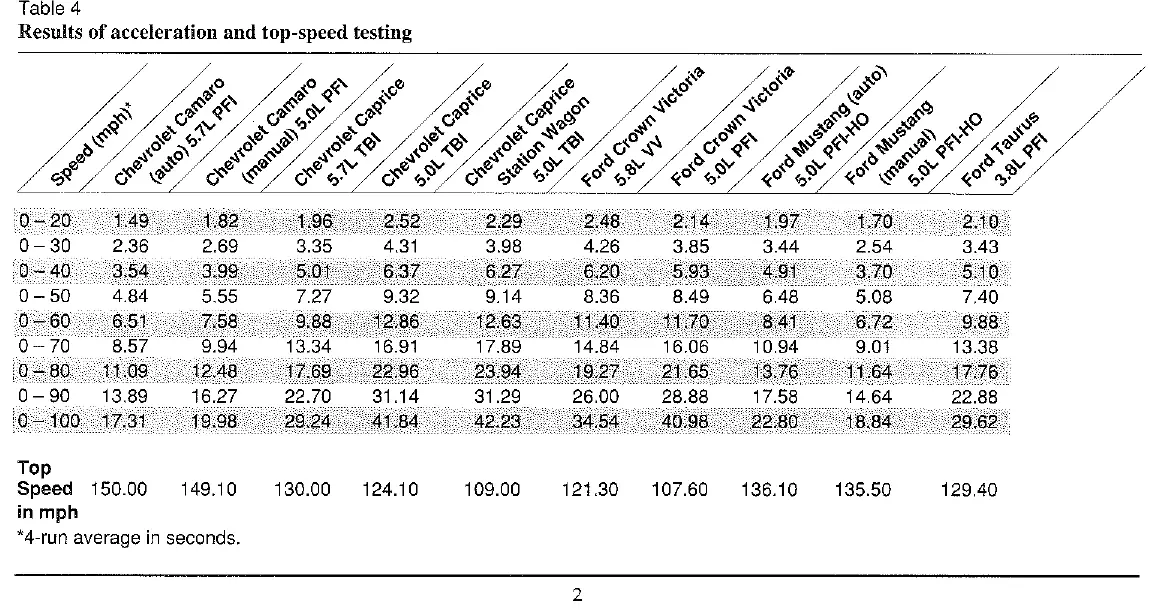
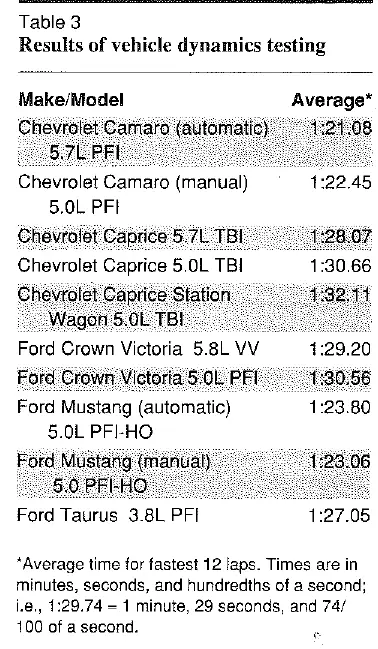
Acceleration ladders — every 10-mph step for all ten cars
| 0 to… | Chevrolet Camaro (automatic) | Chevrolet Camaro (5-speed) | Chevrolet Caprice 5.7L-TBI | Chevrolet Caprice 5.0L-TBI | Chevrolet Caprice Station Wagon | Ford Crown Victoria 5.8L-VV | Ford Crown Victoria 5.0L-PFI | Ford Mustang (automatic) | Ford Mustang (5-speed) | Ford Taurus |
|---|---|---|---|---|---|---|---|---|---|---|
| 20 mph | 1.49 | 1.82 | 1.96 | 2.52 | 2.29 | 2.48 | 2.14 | 1.97 | 1.70 | 2.10 |
| 30 mph | 2.36 | 2.69 | 3.35 | 4.31 | 3.98 | 4.26 | 3.85 | 3.44 | 2.54 | 3.43 |
| 40 mph | 3.54 | 3.99 | 5.01 | 6.37 | 6.27 | 6.20 | 5.93 | 4.91 | 3.70 | 5.10 |
| 50 mph | 4.84 | 5.55 | 7.27 | 9.32 | 9.14 | 8.36 | 8.49 | 6.48 | 5.08 | 7.40 |
| 60 mph | 6.51 | 7.58 | 9.88 | 12.86 | 12.63 | 11.40 | 11.70 | 8.41 | 6.72 | 9.88 |
| 70 mph | 8.57 | 9.94 | 13.34 | 16.91 | 17.89 | 14.84 | 16.06 | 10.94 | 9.01 | 13.38 |
| 80 mph | 11.09 | 12.48 | 17.69 | 22.96 | 23.94 | 19.27 | 21.65 | 13.76 | 11.64 | 17.76 |
| 90 mph | 13.89 | 16.27 | 22.70 | 31.14 | 31.29 | 26.00 | 28.88 | 17.58 | 14.64 | 22.88 |
| 100 mph | 17.31 | 19.98 | 29.24 | 41.84 | 42.23 | 34.54 | 40.98 | 22.80 | 18.84 | 29.62 |
The 5-speed Mustang was quicker than the 5-speed Camaro at every step to 100 (18.84 against 19.98), but the Camaro lapped 0.61 seconds quicker and ran 13.6 mph faster at the top. The station wagon and the 5.0 Caprice sedan share an engine; the wagon was quicker to 60 and the sedan to 70 and beyond. The port-injected 5.0 Crown Victoria led the 5.8 to 40 mph, then fell behind.
Brakes
| Car | Phase I speed (mph) | 60–0 Phase I (ft) | Phase I rate (ft/s²) | Phase II speed (mph) | 60–0 Phase II (ft) | Phase II rate (ft/s²) | Avg decel (ft/s²) | 60–0 at average rate (ft) |
|---|---|---|---|---|---|---|---|---|
| Chevrolet Camaro (automatic) | 60.3 | 144.7 | 27.03 | 62.0 | 157.6 | 26.23 | 26.63 | 145.41 |
| Chevrolet Camaro (5-speed) | 60.4 | 156.0 | 25.15 | 60.7 | 157.3 | 25.19 | 25.17 | 153.84 |
| Chevrolet Caprice Station Wagon | 60.4 | 159.8 | 24.56 | 59.7 | 149.7 | 25.61 | 25.09 | 154.33 |
| Chevrolet Caprice 5.7L-TBI | 59.2 | 145.3 | 25.94 | 60.8 | 166.9 | 23.82 | 24.88 | 155.63 |
| Ford Crown Victoria 5.8L-VV | 60.6 | 167.6 | 23.57 | 61.2 | 166.8 | 24.15 | 23.86 | 162.29 |
| Ford Taurus | 60.5 | 167.2 | 23.55 | 61.2 | 171.2 | 23.53 | 23.54 | 164.49 |
| Ford Mustang (automatic) | 60.8 | 185.4 | 21.45 | 59.6 | 174.4 | 21.91 | 21.68 | 178.61 |
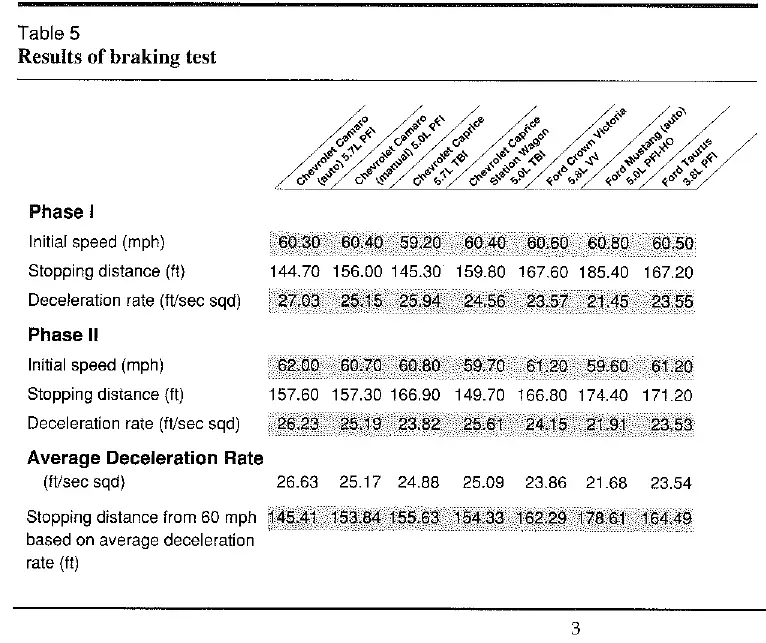
The automatic Camaro stopped best, at 26.63 ft/s² (145.41 feet from 60 at that rate), and the automatic Mustang worst, at 21.68 (178.61 feet), a 33-foot difference between them. The Caprice 5.7’s second stop was 21.6 feet longer than its first, and its rate fell from 25.94 to 23.82, the largest drop between the two phases in the test; the wagon’s second stop was the shorter of its two. The bulletin does not report the panic-stop results.
See the original page: Table 5 in the 1991 bulletin
Ergonomics, communications and fuel
| Car | Ergonomics & communications (pts) | EPA combined (mpg) |
|---|---|---|
| Chevrolet Caprice 5.7L-TBI | 204.15 | 16 |
| Chevrolet Caprice 5.0L-TBI | 204.15 | 20 |
| Ford Crown Victoria 5.8L-VV | 191.83 | 15 |
| Ford Crown Victoria 5.0L-PFI | 191.83 | 20 |
| Chevrolet Caprice Station Wagon | 191.59 | 19 |
| Ford Mustang (automatic) | 167.32 | 20 |
| Ford Mustang (5-speed) | 167.32 | 20 |
| Ford Taurus | 162.19 | — |
| Chevrolet Camaro (automatic) | 146.03 | 19 |
| Chevrolet Camaro (5-speed) | 146.03 | 20 |
The Caprice sedan scored highest, 204.15, and the Camaro lowest, 146.03, so the fastest car in the test had the lowest score. The bulletin describes the method: “A minimum of four officers independently and individually score each vehicle on comfort and instrumentation. Personnel from the Motor Transport Division, Police Car Prep Section, conduct the communications portion of the evaluation based on the relative difficulty of the necessary installations.” The 5.8 Crown Victoria’s 15 mpg is the lowest figure in the fuel table, and the Caprice 5.7’s 16 the next.
What the bulletin does not hold
The bulletin is a summary of averages. It has no individual acceleration runs and no individual laps, no drivers’ names, no quarter-mile times and no distances to 110 mph. It prints no hardware beyond the engine, no weighted or total scores, no bid prices and no winner, and it does not name where the acceleration, top-speed and braking runs were made. All of that belongs to the “detailed report” the bulletin says “is also available”, which is not in this file and has not been found. The bulletin also carried an offer of AutoBid, the Law Enforcement Standards Laboratory’s program “based on the MSP patrol vehicle performance test data”, which “runs on an MS-DOS™ microcomputer with at least 512K of RAM”; the 1989 bulletin had asked for 384K.
What else this file holds: Chevrolet’s specification for the 1991 Caprice
Fifty pages of the file are a Motor Vehicle Manufacturers Association specification form filled in by Chevrolet: “MANUFACTURERS MOTOR VEHICLE SPECIFICATIONS / METRIC (U.S. Customary) / 1991”, manufacturer “CHEVROLET MOTOR DIVISION / GENERAL MOTORS CORPORATION”, vehicle line “CHEVROLET CAPRICE SEDAN”, “Issued DECEMBER, 1989”, “Revised APRIL, 1990”. Its cover says what it is: “The information contained herein is prepared, distributed by, and is solely the responsibility of the vehicle manufacturing company to whose products it relates.” It is engineering data, not a brochure. It makes no performance claims, gives no prices, and leaves its EPA fuel economy column blank. It describes the 1991 Caprice range, not the cars Michigan tested; the bulletin does not say which axle or options those cars had.
The police car. The series table lists “CAPRICE (POLICE VEHICLES SEO 9C1) / 4-Dr. Notchback Sedan / 1BL19”, with power team A as standard and C as the option, and the police pages are headed “CAPRICE POLICE SEDAN (SEO 9C1)”. Design and development: “Chevrolet-Pontiac-GM of Canada”; where built: “U.S.A.”
| Power team | Engine code | Displacement, L (cu. in.) | Induction | Compression | Power @ rpm | Torque @ rpm | Exhaust | Transmission | Axle (std. first) |
|---|---|---|---|---|---|---|---|---|---|
| A | L03 | 5.0 (305) | Electronic Fuel Injection | 9.3:1 | 170 @ 4200 | 255 @ 2400 | Single | MD8 Auto Transmission 4-Speed | 2.56 |
| B | L03 | 5.0 (305) | Electronic Fuel Injection | 9.3:1 | 170 @ 4200 | 255 @ 2400 | Single | MD8 Auto Transmission 4-Speed | 3.08 |
| C | L05 | 5.7 (350) | Electronic Fuel Injection | 9.8:1 | 195 @ 4400 | 290 @ 2400 | Single | MD8 Auto Transmission 4-Speed | 3.42 |
- Engines. “5.0 LITER V8 (305 CID) ELECTRONIC FUEL INJECTION RPO L03”, with “Fuel Injection At Throttle Body (2)”, and “5.7 LITER V8 (350 CID) ELECTRONIC FUEL INJECTION RPO L05”, injection point “Throttle Body”, both “AC/Rochester Products” (pages 3, 3.1, 6, 6.1). The option list carries the 5.7 as “L05 Engine – Gas, V8, 5.7L, EFI … 1BL19 – Police Only” (page 26.2). The 195 bhp rating sits between the 190 the 1990 book prints for its Caprice 5.7 and the 205 in the 1992 book.
- Transmission and exhaust. “Hydra-Matic 700-R4 (4L60)”, “4-Speed Overdrive Automatic With Lock-Up Converter Clutch”, on the column; for the police 5.7, “Max. upshift speed” “1-2 [53 (33)] 2-3 [98 (61)] 3-4 [161 (100)]” km/h (mph) (page 9.1). No manual transmission is listed. Exhaust on both engines: “Single, With Cross-Over” (pages 7, 7.1).
- Axles. “2.56 (1.79)” for the police L03 and “3.42 (2.38)” for the police L05 (pages 10.1, 10.2), the figure in brackets being the overall top-gear ratio; the sedan’s optional 3.08 is printed “3.08 (2.06)” (page 10), where 3.08 × 0.70 gives 2.16. “Limited slip differential (type)”: “Cone Clutch”.
- Police and police/taxi options (pages 26.1–26.4): “GU6 Axle – Rear (3.42 Ratio) … 1BL19 – Police Only”; “G80 Axle – Rear (Limited Slip) … 1BL19 & GM8 – Police Only” (another G80 line, remark “1BA00”, carries no police restriction); “JA2 Brake System, Heavy Duty … 1BL19 – Police/Taxi Only”; “K09 Generator 120 Amp … 1BL19 – Police/Taxi Only”; and “9C1 Police Car”, listed at 19.4 kg (42.8 lb) in the optional equipment mass table.
- Police hardware elsewhere in the form. A radiator column headed “Police” with “3.0 mm” against “2.5 mm” on a line headed “Fins per inch” (page 5.1), a millimetre figure under a per-inch heading, which page 5’s footnote defines as the “Distance Between Top Of Fins”; read that way, the police core’s fins are spaced wider, so there are fewer of them; rear drums “241mm (9.5 in.)/51mm (2 in.), Sedan: 279mm (11 in.)/51mm (2 in.), Police” (page 12); power steering gear “14.1, 12.7:1 (Police) & Trailering”, overall “16.07, 15.3 (Police)” (page 14).
- Anti-lock brakes and air bag. The anti-lock device is “Standard”, “Robert Bosch Corporation”, “Electronic”, “Add-On”, with three sensors and three hydraulic circuits (page 12). The first seat’s left position has a passive restraint: “Supplemental Inflatable Restraint” (page 18).
- Weight. “1BL19 & 9C1 / Caprice W/Police Pkg.”: curb mass “1030 (2271)” front, “792 (1746)” rear, “1822 (4017)” total, against “1772 (3907)” for the plain Caprice (page 25).
- Body. “All Welded Heavy-Gage Steel Body. Full Perimeter Frame.” (page 17); “Separate Frame. Sedan: 2 Crossmembers” (page 18); wheelbase “2945 (115.9)”, length “5439 (214.1)” (page 21); EPA vehicle class “Large” (page 22).
The form lists three suspension codes, “FE2” (“Suspension System – Ride, Handling (Requires V92)”), “F41” (“Includes FE2 Suspension”) and “7B3”, without saying which is fitted to the police car. The standard tire is “P205/75R15 Base”; no police tire is listed.
What 1991 settled
The Camaro arrived a year earlier than these pages had shown, and it arrived at the top. On its first appearance the automatic Camaro was the quickest and fastest car in the books held here to that point, at 6.51 seconds to 60, 17.31 to 100, 150.00 mph and a 1:21.08 lap average. Its 1992 successor would beat the top speed, the 0–100 time and the lap, but not the 6.51.
Both Mustangs were beaten by both Camaros on top speed and on the road course. The Caprice 5.7 and the Taurus ran the highest sedan top speeds in these books since 1978, the front-drive Taurus out-lapped every Caprice and Crown Victoria, and three cars, two of them 5.0 Caprices, were outside the printed qualification times. How Michigan ranked the cars overall, and what it bought, the bulletin does not say.