
Michigan test archive
1984 Michigan State Police Patrol Vehicle Test
Thirteen cars on one Saturday at the Chrysler Proving Grounds, two Mustangs, four cars scored, and a book printed before the bids were opened.
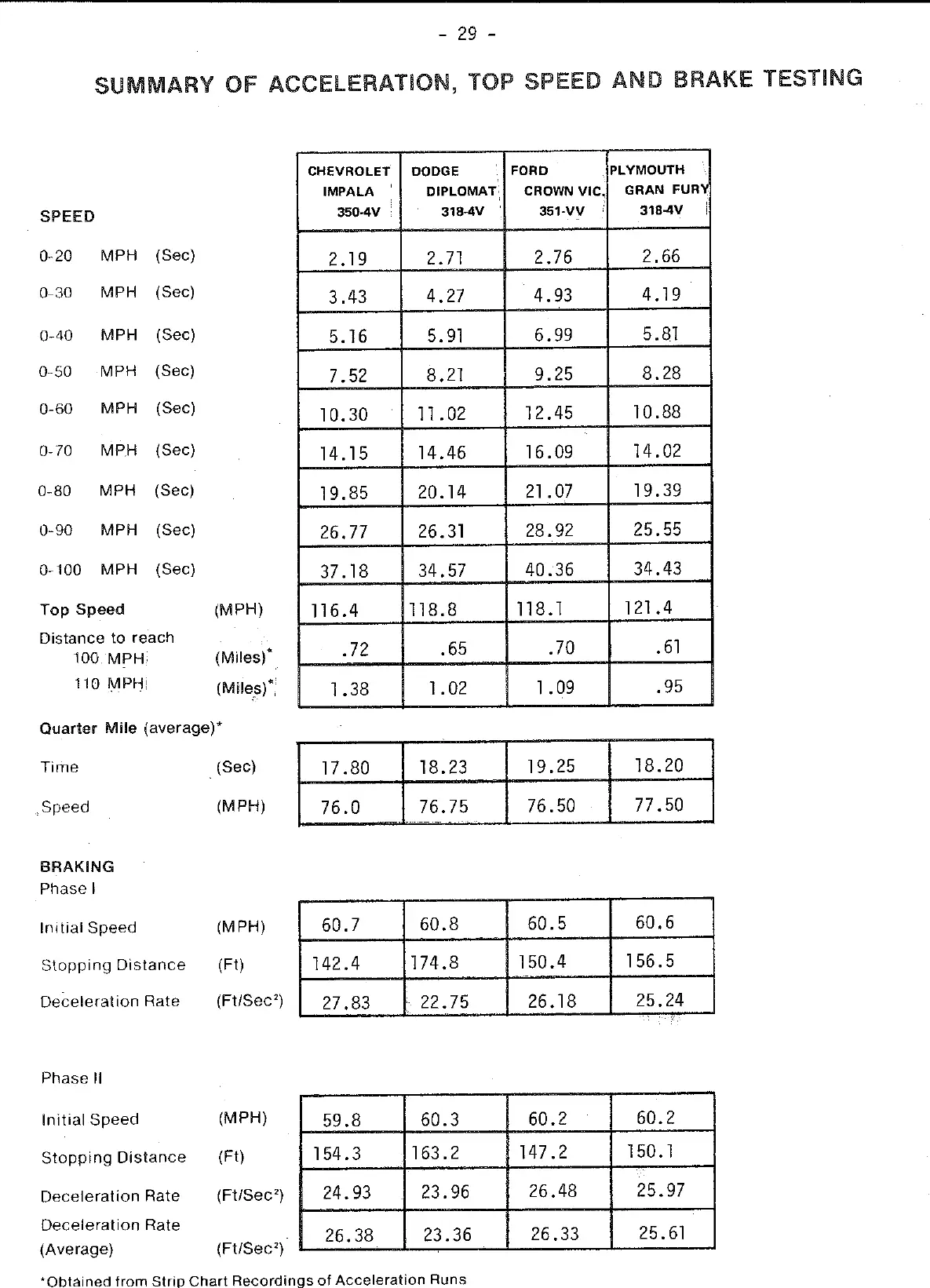
The 1984 book is the full report, dated September 1983: specification, hardware sheets, every acceleration run, every lap, the brake sheets, ergonomics, fuel economy and the scoring. Thirteen cars ran acceleration and top speed at the Chrysler Proving Grounds on 24 September 1983, the first starting at 8:25 a.m. in 34°F and the last at 3:58 p.m. in 62°F. Eight of them also ran the brake test, and eight the road course at Michigan International Speedway, where four drivers, Floate, Ring, Olson and Steendam, each drove four timed laps (the LTD only Ring, before it was withdrawn).
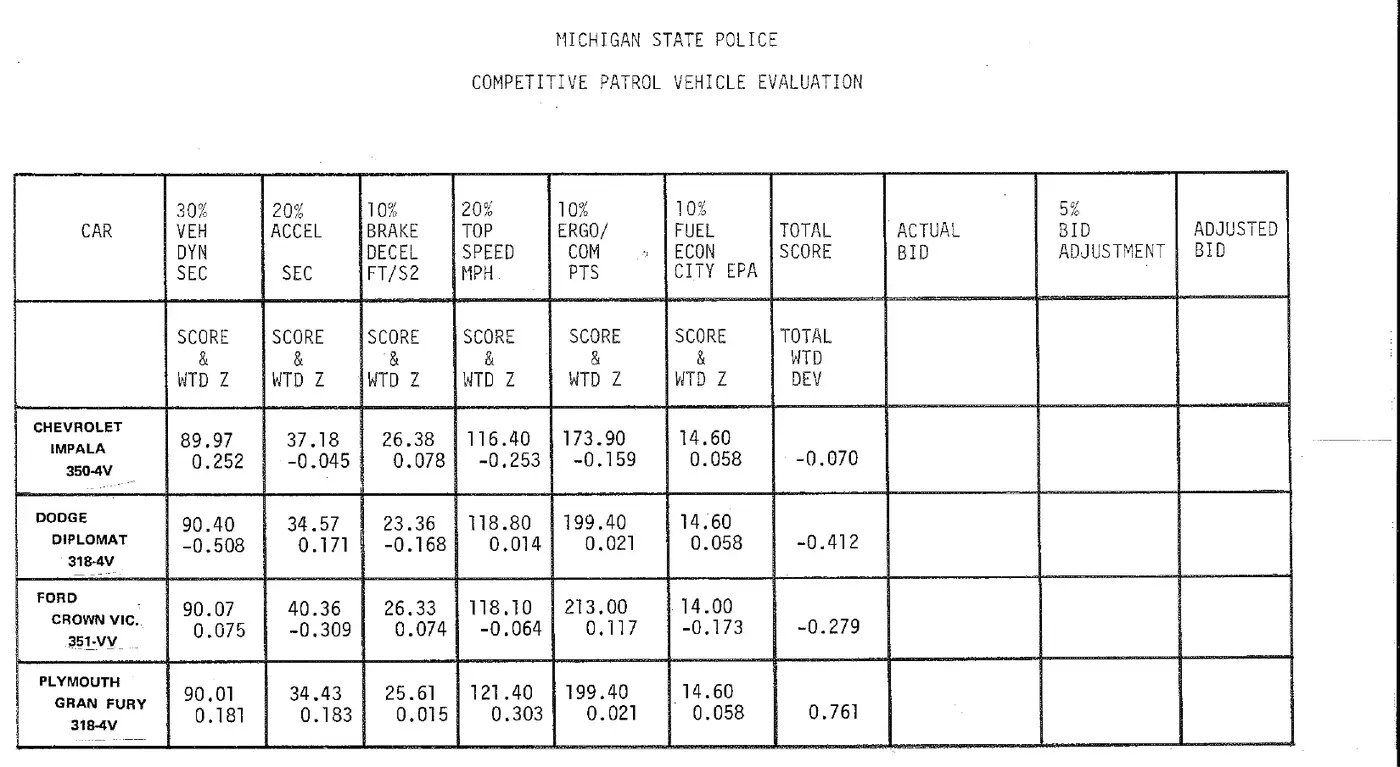
Four cars were scored: the Chevrolet Impala 350, the Dodge Diplomat 318, the Ford LTD Crown Victoria S 351 and the Plymouth Gran Fury 318, the four models the specification lists. The Gran Fury had the highest total weighted score, +0.761; the Impala was second at -0.070, the Crown Victoria third at -0.279 and the Diplomat fourth at -0.412. That is as far as the book goes. Its preface says: “At the time of this writing, our bids have not been opened, so we cannot provide our actual and adjusted bid prices at the end of this report.” The bid columns of the final table are blank, so this page names no purchase.
The other nine were tested but not scored, among them the first Chevrolet Celebrity in these books and two Mustangs: a fuel-injected automatic that lapped the road course in 1:26.81, more than three seconds a lap quicker than any of the scored sedans, and a four-barrel five-speed that reached 60 mph in 7.43 seconds and 100 in 20.77 before it overheated on its top-speed run at 129.6 mph. Michigan’s acceleration bar was already 13.5, 24.0 and 45.0 seconds to 60, 80 and 100 mph, the times the September 1984 specification kept for 1985.
The problems, in the book’s words
The preface warns that “a number of problems were encountered which do require some explanation”, and lists them.
The Crown Victoria was re-timed. “First, the acceleration and top speed figures shown for the Ford Crown Victoria 351-VV H.O. are from a second sequence of runs for the car. During the first sequence, the car did not perform to its expected potential. After a brief mechanical check, it was determined that the timing was not set to manufacturer’s specifications. Once the timing was reset, the car was retested resulting in the acceleration and top speed figures reported.” The first runs are not printed. The retest was the last run of the day, starting at 3:58 p.m.
The LTD lost its brakes. “Second, the Ford LTD 302-EFI H.O. initially passed the acceleration, top speed, and braking tests; however, was withdrawn from further testing after completing only one-fourth of the vehicle dynamics evaluation due to brake failure, later found to have been caused by a faulty master cylinder.” Its four laps, all by Ring, are printed, but “these times should not be compared against the “average” times given for the cars that did successfully complete the test, as only one driver tested the car.” Every data page calls this engine CFI, central fuel injection.
The five-speed Mustang overheated. “Third, the Ford Mustang 302-4V H.O. (manual transmission) successfully completed its four acceleration runs but experienced serious overheating on its top speed run after attaining 129.6 mph. As a result, the car was withdrawn from further testing.” The automatic Mustang, the book adds, “did successfully complete the entire test sequence. It should be noted, however, that the car was not equipped with “police package” brakes, and the rear brakes did require adjustment at one point during the vehicle dynamics testing.”
The Reliant’s brakes would not lock. “Finally, it should be noted that the brakes on the Plymouth Reliant would not lock in the final phase of the braking evaluation and consequently failed to meet our brake specification requirement. Chrysler Corporation officials, after later checking the vehicle, indicate that the failure to lock was caused by air in the brake lines.”
All thirteen cars: acceleration and top speed
| Car | Engine | 0–60 (s) | 0–80 (s) | 0–100 (s) | ¼-mile (s @ mph) | Top speed (mph) | Miles to 100 mph | Miles to 110 mph |
|---|---|---|---|---|---|---|---|---|
| Chevrolet Impala 350 | 350-4V | 10.30 | 19.85 | 37.18 | 17.80 @ 76.00 | 116.4 | 0.72 | 1.38 |
| Dodge Diplomat 318 | 318-4V | 11.02 | 20.14 | 34.57 | 18.23 @ 76.75 | 118.8 | 0.65 | 1.02 |
| Ford LTD Crown Victoria S 351-VV | 351-VV | 12.45 | 21.07 | 40.36 | 19.25 @ 76.50 | 118.1 | 0.70 | 1.09 |
| Plymouth Gran Fury 318-4V | 318-4V | 10.88 | 19.39 | 34.43 | 18.20 @ 77.50 | 121.4 | 0.61 | 0.95 |
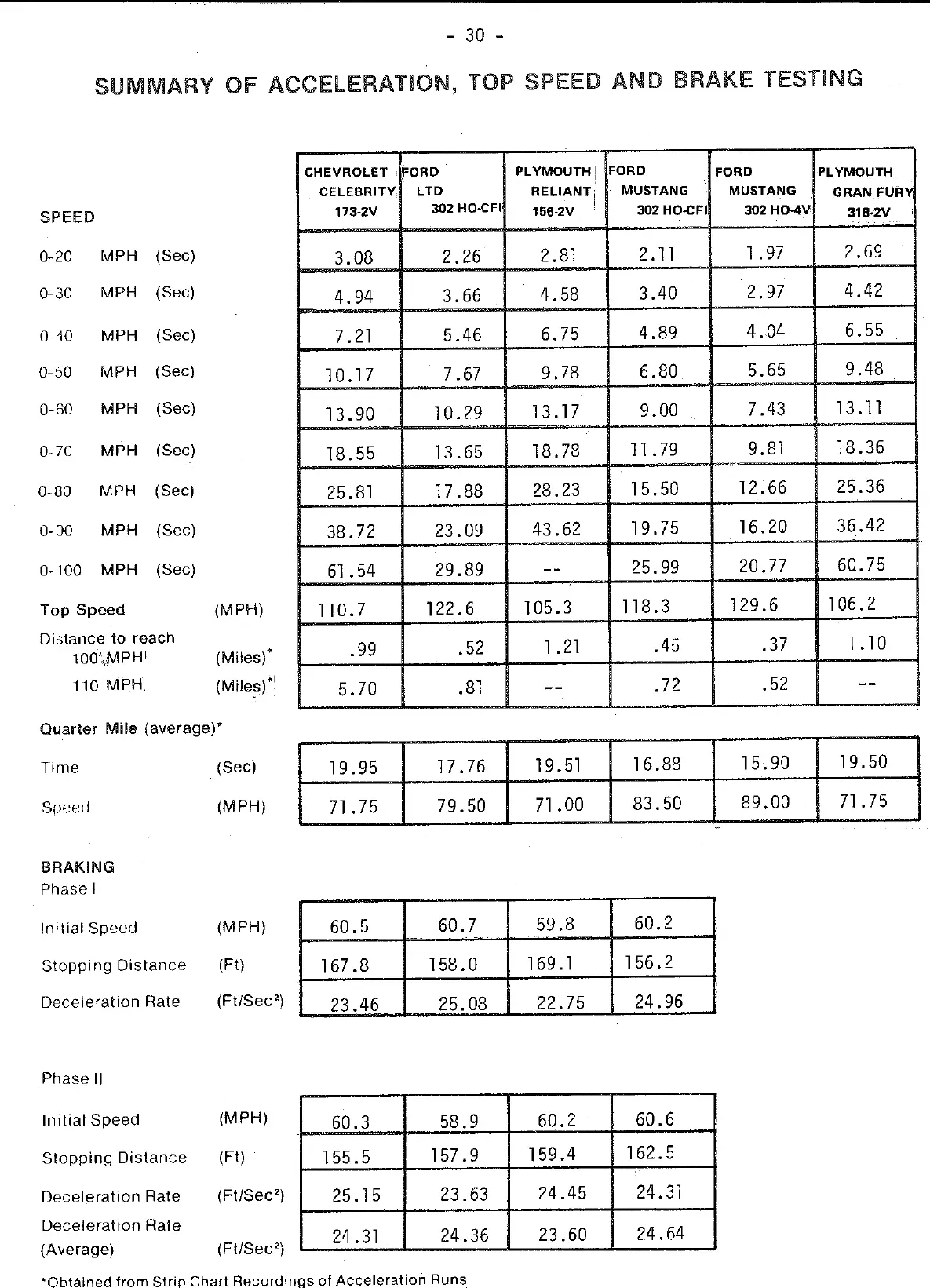
| Chevrolet Celebrity 173 | 173-2V | 13.90 | 25.81 | 61.54 | 19.95 @ 71.75 | 110.7 | 0.99 | 5.70 |
| Ford LTD 302-CFI | 302 H.O.-CFI | 10.29 | 17.88 | 29.89 | 17.76 @ 79.50 | 122.6 | 0.52 | 0.81 |
| Plymouth Reliant 2.6L | 156-2V | 13.17 | 28.23 | — | 19.51 @ 71.00 | 105.3 | 1.21 | — |
| Ford Mustang (automatic) | 302 H.O.-CFI | 9.00 | 15.50 | 25.99 | 16.88 @ 83.50 | 118.3 | 0.45 | 0.72 |
| Ford Mustang (5-speed) | 302 H.O.-4V | 7.43 | 12.66 | 20.77 | 15.90 @ 89.00 | 129.6 (overheated) | 0.37 | 0.52 |
| Plymouth Gran Fury 318-2V | 318-2V | 13.11 | 25.36 | 60.75 | 19.50 @ 71.75 | 106.2 | 1.10 | — |
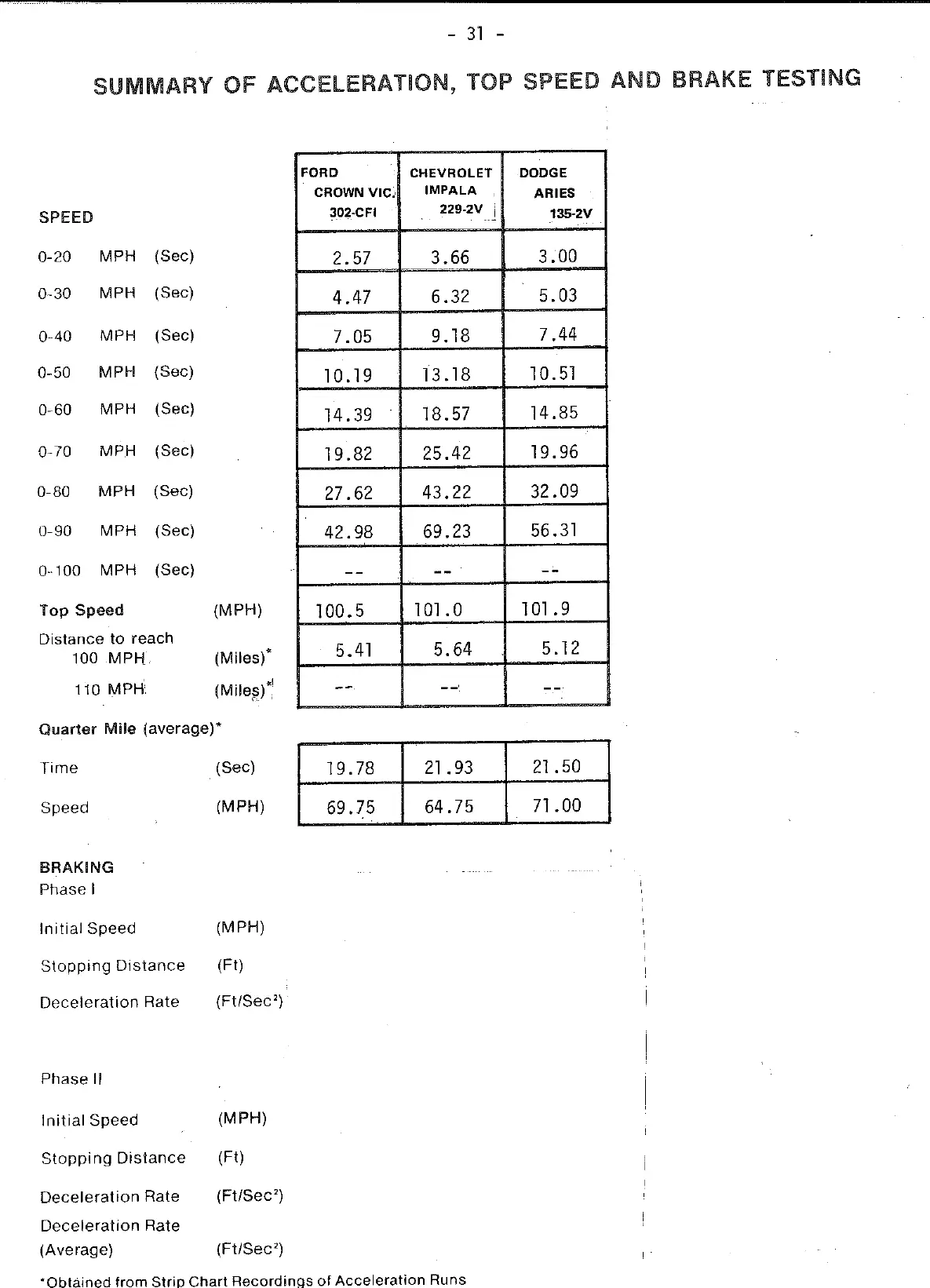
| Ford LTD Crown Victoria S 302-CFI | 302-CFI | 14.39 | 27.62 | — | 19.78 @ 69.75 | 100.5 | 5.41 | — |
| Chevrolet Impala (6-cyl) | 229-2V | 18.57 | 43.22 | — | 21.93 @ 64.75 | 101.0 | 5.64 | — |
| Dodge Aries (4-cyl) | 135-2V | 14.85 | 32.09 | — | 21.50 @ 71.00 | 101.9 | 5.12 | — |
Among the scored cars the Impala was quickest to 60 (10.30 s) and the Gran Fury to 80 and 100 (19.39 and 34.43) and fastest (121.4 mph). The mid-size Ford LTD, not scored, beat all four to 60, 80 and 100 mph and on top speed: 10.29, 17.88, 29.89 and 122.6 mph. The automatic Mustang ran 118.3; the five-speed’s 129.6 was where it overheated, short of the 1983 Mustang’s 132.0. Its 7.43 seconds to 60, 20.77 to 100 and 15.90-second quarter mile at 89.00 mph were the quickest in the books held here to that point (the 1983 Mustang’s were 8.32, 22.71 and 16.68 at 86.25); the 1986 five-speed beat the first two, the 1987 car the trap speed and the 1988 car the quarter-mile time. Against the printed bar, the Celebrity took 13.90, 25.81 and 61.54 seconds and needed 5.70 miles to reach 110; the Reliant took 28.23 to 80, has no 0–100 average because one run did not reach 100 within 2 miles, and never reached 110; the two-barrel Gran Fury was outside the 80 and 100 times and never reached 110; the 302 Crown Victoria, the six-cylinder Impala and the Aries were outside all three acceleration times and never reached 110 mph. The book names none of them as eliminated; none of them is among the four scored.
See the original pages: the three summary pages in the 1984 book
Every interval, 0–20 to 0–100 mph
| 0 to… | Chevrolet Impala 350 | Dodge Diplomat 318 | Ford LTD Crown Victoria S 351-VV | Plymouth Gran Fury 318-4V | Chevrolet Celebrity 173 | Ford LTD 302-CFI | Plymouth Reliant 2.6L |
|---|---|---|---|---|---|---|---|
| 20 mph | 2.19 | 2.71 | 2.76 | 2.66 | 3.08 | 2.26 | 2.81 |
| 30 mph | 3.43 | 4.27 | 4.93 | 4.19 | 4.94 | 3.66 | 4.58 |
| 40 mph | 5.16 | 5.91 | 6.99 | 5.81 | 7.21 | 5.46 | 6.75 |
| 50 mph | 7.52 | 8.21 | 9.25 | 8.28 | 10.17 | 7.67 | 9.78 |
| 60 mph | 10.30 | 11.02 | 12.45 | 10.88 | 13.90 | 10.29 | 13.17 |
| 70 mph | 14.15 | 14.46 | 16.09 | 14.02 | 18.55 | 13.65 | 18.78 |
| 80 mph | 19.85 | 20.14 | 21.07 | 19.39 | 25.81 | 17.88 | 28.23 |
| 90 mph | 26.77 | 26.31 | 28.92 | 25.55 | 38.72 | 23.09 | 43.62 |
| 100 mph | 37.18 | 34.57 | 40.36 | 34.43 | 61.54 | 29.89 | — |
| 0 to… | Ford Mustang (automatic) | Ford Mustang (5-speed) | Plymouth Gran Fury 318-2V | Ford LTD Crown Victoria S 302-CFI | Chevrolet Impala (6-cyl) | Dodge Aries (4-cyl) |
|---|---|---|---|---|---|---|
| 20 mph | 2.11 | 1.97 | 2.69 | 2.57 | 3.66 | 3.00 |
| 30 mph | 3.40 | 2.97 | 4.42 | 4.47 | 6.32 | 5.03 |
| 40 mph | 4.89 | 4.04 | 6.55 | 7.05 | 9.18 | 7.44 |
| 50 mph | 6.80 | 5.65 | 9.48 | 10.19 | 13.18 | 10.51 |
| 60 mph | 9.00 | 7.43 | 13.11 | 14.39 | 18.57 | 14.85 |
| 70 mph | 11.79 | 9.81 | 18.36 | 19.82 | 25.42 | 19.96 |
| 80 mph | 15.50 | 12.66 | 25.36 | 27.62 | 43.22 | 32.09 |
| 90 mph | 19.75 | 16.20 | 36.42 | 42.98 | 69.23 | 56.31 |
| 100 mph | 25.99 | 20.77 | 60.75 | — | — | — |
Every acceleration run, with start time and weather
| Run sheet | Start | Temp | Wind | 0–60, four runs | 0–80, four runs | 0–100, four runs |
|---|---|---|---|---|---|---|
| Chevrolet Impala 350 | 8:25 a.m. | 34°F | 0 mph | 10.68 / 10.30 / 10.18 / 10.03 | 20.23 / 19.66 / 19.83 / 19.67 | 37.84 / 37.19 / 36.95 / 36.73 |
| Dodge Diplomat 318 | 8:55 a.m. | 39°F | 0 mph | 10.98 / 11.04 / 10.95 / 11.12 | 20.05 / 19.86 / 20.27 / 20.36 | 34.55 / 34.58 / 34.44 / 34.71 |
| Ford LTD Crown Victoria S 351-VV | 3:58 p.m. | 62°F | 10 mph from 210° | 12.22 / 11.64 / 13.32 / 12.60 | 21.06 / 19.85 / 22.55 / 20.81 | 42.78 / 36.36 / 44.86 / 37.42 |
| Plymouth Gran Fury 318-4V | 9:48 a.m. | 48°F | 4 mph from 190° | 11.03 / 10.61 / 11.28 / 10.58 | 20.24 / 18.72 / 19.77 / 18.83 | 36.65 / 32.18 / 36.24 / 32.66 |
| Chevrolet Celebrity 173 | 10:14 a.m. | 51°F | 8 mph from 200° | 13.94 / 13.94 / 13.95 / 13.77 | 27.54 / 24.64 / 27.12 / 23.92 | 74.58 / 49.89 / 71.87 / 49.81 |
| Ford LTD 302-CFI | 10:42 a.m. | 52°F | 12 mph from 200° | 10.43 / 10.21 / 10.41 / 10.12 | 18.15 / 17.66 / 18.28 / 17.43 | 31.39 / 28.48 / 31.23 / 28.45 |
| Plymouth Reliant 2.6L | 11:10 a.m. | 54°F | 17 mph from 200° | 13.24 / 13.13 / 13.65 / 12.66 | 31.24 / 26.48 / 30.48 / 24.70 | — / 68.69 / 93.94 / 57.60 |
| Ford Mustang (automatic) | 2:20 p.m. | 59°F | 8 mph from 180° | 8.97 / 8.94 / 9.12 / 8.95 | 15.91 / 15.09 / 15.85 / 15.14 | 27.57 / 24.78 / 26.78 / 24.82 |
| Ford Mustang (5-speed) | 12:24 p.m. | 57°F | 6 mph from 250° | 7.40 / 7.50 / 7.32 / 7.49 | 12.66 / 12.58 / 12.69 / 12.69 | 21.48 / 20.34 / 20.96 / 20.28 |
| Plymouth Gran Fury 318-2V | 11:53 a.m. | 57°F | 4 mph from 200° | 12.77† / 12.59 / 13.82 / 13.26 | 24.81 / 23.54 / 27.93 / 25.16 | 65.55 / 48.09 / 75.57 / 53.77 |
| Ford LTD Crown Victoria S 302-CFI | 1:13 p.m. | 57°F | 8 mph from 250° | 14.76 / 14.38 / 14.26 / 14.17 | 29.29 / 26.84 / 28.88 / 25.45 | — / — / — / — |
| Chevrolet Impala (6-cyl) | 1:45 p.m. | 59°F | 12 mph from 190° | 19.51 / 17.61 / 18.97 / 18.19 | 51.04 / 37.28 / 46.64 / 37.92 | — / — / — / — |
| Dodge Aries (4-cyl) | 2:50 p.m. | 60°F | 10 mph from 190° | 15.54 / 14.58 / 14.95 / 14.34 | 36.31 / 29.10 / 33.84 / 29.09 | — / — / — / — |
The spread inside a car’s four runs is often wider than the gap between cars: the Crown Victoria 351 ran 0–100 in 36.36 and 44.86 seconds, and the Celebrity in 49.81 and 74.58. Every average recomputes from its four runs.
The road course
| Car | Engine | Dynamics (best 12 of 16) |
|---|---|---|
| Chevrolet Impala 350 | 350-4V | 1:29.97 |
| Dodge Diplomat 318 | 318-4V | 1:30.40 |
| Ford LTD Crown Victoria S 351-VV | 351-VV | 1:30.07 |
| Plymouth Gran Fury 318-4V | 318-4V | 1:30.01 |
| Chevrolet Celebrity 173 | 173-2V | 1:33.15 |
| Ford LTD 302-CFI | 302 H.O.-CFI | — |
| Plymouth Reliant 2.6L | 156-2V | 1:32.88 |
| Ford Mustang (automatic) | 302 H.O.-CFI | 1:26.81 |
The four scored cars finished within 0.43 seconds: Impala 1:29.97, Gran Fury 1:30.01, Crown Victoria 1:30.07, Diplomat 1:30.40. The automatic Mustang averaged 1:26.81, and Olson’s 1:25.99 in it was the fastest single lap of the test. That average is the fastest on the year pages held here to that point, where the best had been the 1983 Mustang’s 1:28.31, and the best by a sedan the 1981 Malibu’s 1:30.37; the Impala’s 1:29.97 is the first sedan average under 1:30 on them (from 1983 the average is of the best 12 of 16 laps; on all 16 the Impala averages 1:30.31, and the course length is not on the surviving pages). The 1986 Mustangs went quicker still. Olson was the slowest of the four drivers in every sedan and the fastest in the Mustang.
Every lap, by driver
| Laps | Driver | Lap 1 | Lap 2 | Lap 3 | Lap 4 | Driver mean (computed) |
|---|---|---|---|---|---|---|
| Chevrolet Impala 350 | Floate | 1:29.00 | 1:29.64 | 1:29.55 | 1:29.75 | 1:29.49 |
| Ring | 1:29.55 | 1:29.33 | 1:29.90 | 1:30.34 | 1:29.78 | |
| Olson | 1:31.58 | 1:30.82 | 1:31.26 | 1:31.68 | 1:31.34 | |
| Steendam | 1:30.84 | 1:30.65 | 1:30.39 | 1:30.72 | 1:30.65 | |
| Dodge Diplomat 318 | Floate | 1:30.45 | 1:29.92 | 1:30.07 | 1:29.16 | 1:29.90 |
| Ring | 1:29.98 | 1:29.99 | 1:30.05 | 1:30.19 | 1:30.05 | |
| Olson | 1:32.55 | 1:32.43 | 1:31.51 | 1:31.56 | 1:32.01 | |
| Steendam | 1:31.46 | 1:31.32 | 1:31.47 | 1:30.75 | 1:31.25 | |
| Ford LTD Crown Victoria S 351-VV | Floate | 1:29.58 | 1:30.00 | 1:29.28 | 1:29.69 | 1:29.64 |
| Ring | 1:29.79 | 1:29.33 | 1:29.89 | 1:29.81 | 1:29.71 | |
| Olson | 1:31.64 | 1:31.45 | 1:31.71 | 1:31.08 | 1:31.47 | |
| Steendam | 1:30.62 | 1:31.35 | 1:31.24 | 1:30.56 | 1:30.94 | |
| Plymouth Gran Fury 318-4V | Floate | 1:29.07 | 1:29.39 | 1:29.47 | 1:29.70 | 1:29.41 |
| Ring | 1:29.77 | 1:30.03 | 1:29.79 | 1:30.02 | 1:29.90 | |
| Olson | 1:30.39 | 1:31.85 | 1:31.98 | 1:32.22 | 1:31.61 | |
| Steendam | 1:31.50 | 1:30.96 | 1:30.86 | 1:30.66 | 1:31.00 | |
| Chevrolet Celebrity 173 | Floate | 1:33.49 | 1:32.98 | 1:32.31 | 1:31.92 | 1:32.68 |
| Ring | 1:32.90 | 1:32.88 | 1:33.02 | 1:32.78 | 1:32.90 | |
| Olson | 1:35.56 | 1:36.06 | 1:36.02 | 1:34.04 | 1:35.42 | |
| Steendam | 1:33.99 | 1:33.90 | 1:33.85 | 1:33.72 | 1:33.87 | |
| Ford LTD 302-CFI | Ring | 1:28.25 | 1:28.79 | 1:28.04 | 1:28.56 | 1:28.41 |
| Plymouth Reliant 2.6L | Floate | 1:32.49 | 1:32.39 | 1:32.40 | 1:32.74 | 1:32.51 |
| Ring | 1:33.09 | 1:32.68 | 1:32.61 | 1:32.75 | 1:32.78 | |
| Olson | 1:33.41 | 1:34.04 | 1:34.21 | 1:33.18 | 1:33.71 | |
| Steendam | 1:33.85 | 1:33.48 | 1:33.52 | 1:33.39 | 1:33.56 | |
| Ford Mustang (automatic) | Floate | 1:26.85 | 1:26.30 | 1:26.20 | 1:26.99 | 1:26.59 |
| Ring | 1:27.91 | 1:27.51 | 1:28.07 | 1:27.88 | 1:27.84 | |
| Olson | 1:26.17 | 1:26.53 | 1:25.99 | 1:26.19 | 1:26.22 | |
| Steendam | 1:28.43 | 1:27.94 | 1:28.26 | 1:27.15 | 1:27.95 |
Brakes
| Car | 60–0 Phase I (ft) | 60–0 Phase II (ft) | Avg decel (ft/s²) | Panic stop locked |
|---|---|---|---|---|
| Chevrolet Impala 350 | 142.4 | 154.3 | 26.38 | Yes |
| Ford LTD Crown Victoria S 351-VV | 150.4 | 147.2 | 26.33 | Yes |
| Plymouth Gran Fury 318-4V | 156.5† | 150.1 | 25.61 | Yes |
| Ford Mustang (automatic) | 156.2 | 162.5 | 24.64 | Yes |
| Ford LTD 302-CFI | 158.0 | 157.9 | 24.36 | Yes |
| Chevrolet Celebrity 173 | 167.8 | 155.5 | 24.31 | Yes |
| Plymouth Reliant 2.6L | 169.1 | 159.4 | 23.60 | No |
| Dodge Diplomat 318 | 174.8 | 163.2 | 23.36 | Yes |
† The Gran Fury’s first stop is printed twice: 156.6 feet on its brake sheet (p.42) and 156.5 in the summary (p.29). The book’s own rate, 25.24 ft/s² from 60.6 mph, is what 156.5 feet gives (25.24; 156.6 would give 25.22), so 156.5 is printed here as the figure of record.
The Impala stopped best, 26.38 ft/s² on average, and its first stop, 142.4 feet from 60.7 mph, was the shortest of the test and the shortest stop printed in the books held here until the 1987 Gran Fury’s 139.6. The Diplomat stopped worst, 23.36, after a 174.8-foot first stop. Every car showed no severe fade and stopped straight in its lane; only the Reliant’s brakes would not lock. Five cars were not brake-tested: the five-speed Mustang (withdrawn after its top-speed run), the two-barrel Gran Fury, the 302 Crown Victoria, the six-cylinder Impala and the Aries. Their braking rows in the summary are blank, and the book gives no reason.
Both stops, with initial speeds and rates
| Brake sheet | Phase I mph | Phase I ft | Phase I ft/s² | Phase II mph | Phase II ft | Phase II ft/s² | Average rate | Severe fade? | Would lock? | Straight line? | Own lane? |
|---|---|---|---|---|---|---|---|---|---|---|---|
| Chevrolet Impala 350 | 60.7 | 142.4 | 27.83 | 59.8 | 154.3 | 24.93 | 26.38 | No | Yes | Yes | Yes |
| Dodge Diplomat 318 | 60.8 | 174.8 | 22.75 | 60.3 | 163.2 | 23.96 | 23.36 | No | Yes | Yes | Yes |
| Ford LTD Crown Victoria S 351-VV | 60.5 | 150.4 | 26.18 | 60.2 | 147.2 | 26.48 | 26.33 | No | Yes | Yes | Yes |
| Plymouth Gran Fury 318-4V | 60.6 | 156.5† | 25.24 | 60.2 | 150.1 | 25.97 | 25.61 | No | Yes | Yes | Yes |
| Chevrolet Celebrity 173 | 60.5 | 167.8 | 23.46 | 60.3 | 155.5 | 25.15 | 24.31 | No | Yes | Yes | Yes |
| Ford LTD 302-CFI | 60.7 | 158.0 | 25.08 | 58.9 | 157.9 | 23.63 | 24.36 | No | Yes | Yes | Yes |
| Plymouth Reliant 2.6L | 59.8 | 169.1 | 22.75 | 60.2 | 159.4 | 24.45 | 23.60 | No | No | Yes | Yes |
| Ford Mustang (automatic) | 60.2 | 156.2 | 24.96 | 60.6 | 162.5 | 24.31 | 24.64 | No | Yes | Yes | Yes |
Ergonomics and communications
| Car | Ergonomics & communications (pts) |
|---|---|
| Chevrolet Impala 350 | 173.9 |
| Dodge Diplomat 318 | 199.4 |
| Ford LTD Crown Victoria S 351-VV | 213.0 |
| Plymouth Gran Fury 318-4V | 199.4 |
The Crown Victoria led, first or level first on every front-seat item and with a 9.0 for its dome and map light. The Diplomat and Gran Fury columns are identical item for item. The Impala’s outside mirrors scored 1.4 and their controls 1.0; the two Chrysler cars’ door-lock switch scored 0.8. For installing equipment the Crown Victoria scored lowest on dash and engine accessibility, 5.2 and 4.0.
All 29 items
| Item | Impala | Diplomat | Crown Victoria | Gran Fury |
|---|---|---|---|---|
| Front Seat | ||||
| Padding | 6.2 | 7.4 | 7.8 | 7.4 |
| Depth of Bench | 7.6 | 7.2 | 8.0 | 7.2 |
| Angle of Back | 5.6 | 7.2 | 8.0 | 7.2 |
| Adjustability (Front to Rear) | 7.0 | 7.2 | 8.4 | 7.2 |
| Upholstry | 5.8 | 6.4 | 7.8 | 6.4 |
| Split Bench Design | 5.2 | 7.8 | 8.0 | 7.8 |
| Headroom | 7.6 | 7.6 | 8.2 | 7.6 |
| Seat Belts | 6.4 | 7.2 | 7.2 | 7.2 |
| Ease of Entry and Exit | 7.8 | 7.4 | 7.8 | 7.4 |
| Rear Seat | ||||
| Legroom (Front Seat in Rearward Position) | 6.2 | 5.2 | 7.6 | 5.2 |
| Ease of Entry and Exit | 7.0 | 6.2 | 7.8 | 6.2 |
| Instrumentation | ||||
| Clarity | 6.8 | 8.6 | 8.2 | 8.6 |
| Placement | 5.4 | 8.0 | 4.8 | 8.0 |
| Vehicle Controls | ||||
| Pedals, Size and Position | 8.0 | 7.0 | 7.6 | 7.0 |
| Position of Window Crank | 4.2 | 6.6 | 5.0 | 6.6 |
| Position of Inside Door Release | 6.2 | 5.0 | 6.4 | 5.0 |
| Position of Automatic Door Lock Switch | 5.8 | 0.8 | 5.8 | 0.8 |
| Position of Outside Rear-View Mirror Controls | 1.0 | 5.2 | 7.2 | 5.2 |
| Steering Wheel, Size/Tilt Release/Surface | 6.2 | 8.0 | 7.6 | 8.0 |
| Heater A-C Vent Placement and Adjustability | 6.0 | 7.2 | 6.8 | 7.2 |
| Auxiliary Dome/Map Light Placement/Visibility | 2.0 | 3.0 | 9.0 | 3.0 |
| Visibility | ||||
| Front | 7.4 | 8.0 | 8.2 | 8.0 |
| Rear | 7.4 | 8.0 | 8.2 | 8.0 |
| Left Rear Quarter | 7.4 | 8.0 | 8.2 | 8.0 |
| Right Rear Quarter | 7.4 | 8.0 | 8.2 | 8.0 |
| Outside Rear-View Mirrors | 1.4 | 7.0 | 8.6 | 7.0 |
| Communications | ||||
| Dash Accessibility | 7.6 | 8.8 | 5.2 | 8.8 |
| Trunk Accessibility | 6.0 | 8.4 | 7.4 | 8.4 |
| Engine Accessibility | 5.3 | 7.0 | 4.0 | 7.0 |
| Ergonomics items, sum (computed) | 155.0 | 175.2 | 196.4 | 175.2 |
| Communications items, sum (computed) | 18.9 | 24.2 | 16.6 | 24.2 |
| Totals (printed) | 173.9 | 199.4 | 213.0 | 199.4 |
Fuel economy
| Car | EPA city (mpg) | City, whole mpg | EPA highway (mpg) | EPA combined (mpg) |
|---|---|---|---|---|
| Chevrolet Impala 350 | 14.6 | 15 | 24 | 18 |
| Dodge Diplomat 318 | 14.6 | 15 | 20 | 17 |
| Ford LTD Crown Victoria S 351-VV | 14.0 | 14 | 24 | 17 |
| Plymouth Gran Fury 318-4V | 14.6 | 15 | 20 | 17 |
| Chevrolet Celebrity 173 | 21.1 | 21 | 33 | 25 |
| Ford LTD 302-CFI | 18† | 18† | 28† | 21† |
| Plymouth Reliant 2.6L | 23.2 | 23 | 31 | 26 |
| Ford Mustang (automatic) | 18† | 18† | 29† | 22† |
| Ford Mustang (5-speed) | 15.9 | 16 | 29‡ | 20 |
| Plymouth Gran Fury 318-2V | 16.5 | 17 | 24 | 19 |
| Ford LTD Crown Victoria S 302-CFI | 16.5 | 17 | 27 | 20 |
| Chevrolet Impala (6-cyl) | 19.0 | 19 | 26 | 22 |
| Dodge Aries (4-cyl) | 25.6 | 26 | 36 | 29 |
Hardware
| Car | Displacement / fuel system | HP (SAE net) | Torque | Compression | Axle ratio | Transmission | Lock-up / overdrive | Test weight (lb) |
|---|---|---|---|---|---|---|---|---|
| Chevrolet Impala 350 | 350/5.7 4 BBL | 155 @ 3600 | 265 @ 1600 | 8.2:1 | 3.08 | 700R4 | Yes / Yes | 3,920 |
| Dodge Diplomat 318 | 318/5.2 4 BBL | 165 @ 4400 | 240 @ 1600 | 8.4:1 | 2.94 | A999 | Yes / No | 3,879 |
| Ford LTD Crown Victoria S 351-VV | 351/5.8W H.O. VV | 180 @ 3600 | 285 @ 2400 | 8.3:1 | 2.73 | PKA-AS24 | Yes / Yes | 4,084 |
| Plymouth Gran Fury 318-4V | 318/5.2 4 BBL | 165 @ 4400 | 240 @ 1600 | 8.4:1 | 2.94 | A999 | Yes / No | 3,888 |
| Chevrolet Celebrity 173 | 173/2.8 2 BBL | 112 @ 4800 | 145 @ 2100 | 8.5:1 | 3.06 | 125C | Yes / No | 3,056 |
| Ford LTD 302-CFI | 302/5.0 H.O. CFI | 165 @ 3800 | 245 @ 2000 | 8.4:1 | 3.08 | Automatic Overdrive (AOD) | Yes / Yes | 3,429 |
| Plymouth Reliant 2.6L | 156/2.6 2 BBL | 101 @ 4800 | 140 @ 2800 | 8.7:1 | 3.22 | A470 | No / No | 2,674 |
| Ford Mustang (automatic) | 302/5.0 H.O. CFI | 165 @ 3800 | 245 @ 2000 | 8.4:1 | 3.27 | PKA-BWI | Yes / Yes | 3,129 |
| Ford Mustang (5-speed) | 302/5.0 H.O. 4 BBL | 205 @ 4400 | 265 @ 3200 | 8.3:1 | 3.27 | REP-AC manual 5-speed | N/A / Yes | 3,015 |
| Plymouth Gran Fury 318-2V | 318/5.2 2 BBL | 130 @ 4000 | 235 @ 1600 | 8.7:1 | 2.94 | A999 | No / No | 3,853 |
| Ford LTD Crown Victoria S 302-CFI | 302/5.0 CFI | 140 @ 3200 | 250 @ 1600 | 8.4:1 | 3.55 | PKA-BB19 | Yes / Yes | 3,961 |
| Chevrolet Impala (6-cyl) | 229/3.8 2 BBL | 110 @ 4000 | 170 @ 2000 | 8.6:1 | 2.73 | 250C | Yes / No | 3,752 |
| Dodge Aries (4-cyl) | 135/2.2 2 BBL | 96 @ 5200 | 119 @ 3200 | 9.0:1 | 3.02 | A413 | No / No | 2,617 |
The Crown Victoria 351 is the “LTD Crown Victoria “S”” with the “351/5.8W H.O.” variable-venturi engine and dual exhaust; at 4,084 lb it was the heaviest car tested. The three Chrysler M-bodies, the Diplomat and both Gran Furys, used the A999 transmission, without overdrive. Three cars had Ford’s central fuel injection: the LTD, the automatic Mustang and the 302 Crown Victoria. The five-speed Mustang’s four-barrel 302, at 205 horsepower, was the most powerful engine in the test.
Dimensions, tires, brakes and capacities
| Hardware sheet | Sales code | Wheelbase | Length | Height | Tires | Turning circle | Swept area F / R | Fuel (gal/L) | Exhaust | Interior | Trunk |
|---|---|---|---|---|---|---|---|---|---|---|---|
| Chevrolet Impala 350 | 1BL69 | 116.0 | 212.2 | 56.4 | P225/70R15 | 38.7 | 273.0 / 138.2 | 25.0/94.6 | Single | 110.3 | 20.9 |
| Dodge Diplomat 318 | G-L-41 | 112.7 | 205.7 | 55.3 | P215/70R15 | 40.7 | 204.5 / 165.9 | 18/68.1 | Single | 98.7 | 15.6 |
| Ford LTD Crown Victoria S 351-VV | P43-41K | 114.3 | 211.0 | 55.3 | P225/70R15 | 39.1 | 228.7 / 157.1 | 20/75.7 | Dual | 111 | 22.4 |
| Plymouth Gran Fury 318-4V | B-L-41 | 112.7 | 205.7 | 55.3 | P215/70R15 | 40.7 | 204.5 / 165.9 | 18/68.1 | Single | 98.7 | 15.6 |
| Chevrolet Celebrity 173 | 1AW19 | 104.9 | 188.3 | 53.9 | P195/70R14 | 37.0 | 307.7 / 307.7 | 16.4/62.1 | Single | 97.8 | 16.2 |
| Ford LTD 302-CFI | P-39 | 105.6 | 196.5 | 53.6 | P205/70R14 | 39.05 | 176.6 / 110.0 | 20/75.7 | Single | 97.0 | 15.1 |
| Plymouth Reliant 2.6L | P-L-41 | 100.3 | 176.1 | 52.7 | P185/70R14 | 34.8 | 197.8 / 85.2 | 14/53.0 | Single | 95.2 | 15.0 |
| Ford Mustang (automatic) | P-26 | 100.5 | 179.1 | 51.9 | P205/70R14 | 37.36 | 176.6 / 99.0 | 15.4/58.3 | Single | 84 | N/A |
| Ford Mustang (5-speed) | P-26 | 100.5 | 179.1 | 51.9 | P205/70R14 | 37.36 | 176.6 / 99.0 | 15.4/58.3 | Dual | 84 | 10.0 |
| Plymouth Gran Fury 318-2V | B-L-41 | 112.7 | 205.7 | 55.3 | P215/70R15 | 40.7 | 204.5 / 165.9 | 18/68.1 | Single | 98.7 | 15.6 |
| Ford LTD Crown Victoria S 302-CFI | P43-41K | 114.3 | 211.0 | 55.3 | P225/70R15 | 39.1 | 228.7 / 157.1 | 18/68.1 | Single | 111 | 22.4 |
| Chevrolet Impala (6-cyl) | 1BL69 | 116.0 | 212.2 | 56.4 | P225/70R15 | 38.7 | 237.0 / 138.2 | 25.0/94.6 | Single | 110.3 | 20.9 |
| Dodge Aries (4-cyl) | D-L-41 | 100.3 | 176.1 | 52.7 | P185/70R14 | 34.8 | 197.8 / 85.2 | 14/53.0 | Single | 95.2 | 15.0 |
The scoring
The weights printed on p.50 are 30% vehicle dynamics, 20% acceleration, 10% braking rate, 20% top speed, 10% fuel consumption and 10% ergonomics and communications. The method is the weighted Z-score of the early books: each raw score is turned into a “Z”-score, “the decimal amount of standard deviations from the mean”, multiplied by the category weight, and summed into the “TOTAL WTD DEV” (Total Weighted Deviation). Higher is better. The bid adjustment was to be the total “times 5% of the median bid price of all vehicles”, added to the actual bid.
| Car | Dynamics (s) | 0–100 (s) | Brakes (ft/s²) | Top speed (mph) | Ergonomics (pts) | EPA city (mpg) | Total weighted score |
|---|---|---|---|---|---|---|---|
| Chevrolet Impala 350 | 1:29.97 | 37.18 | 26.38 | 116.4 | 173.9 | 14.6 | -0.070 |
| Dodge Diplomat 318 | 1:30.40 | 34.57 | 23.36 | 118.8 | 199.4 | 14.6 | -0.412 |
| Ford LTD Crown Victoria S 351-VV | 1:30.07 | 40.36 | 26.33 | 118.1 | 213.0 | 14.0 | -0.279 |
| Plymouth Gran Fury 318-4V | 1:30.01 | 34.43 | 25.61 | 121.4 | 199.4 | 14.6 | +0.761 |
See the original page: Competitive Patrol Vehicle Evaluation
The weighted Z-scores, category by category
| Weighted Z | Dynamics 30% | Accel. 20% | Braking 10% | Top speed 20% | Ergo/comm. 10% | Fuel 10% | Total wtd dev | Actual bid | Bid adj. | Adjusted bid |
|---|---|---|---|---|---|---|---|---|---|---|
| Chevrolet Impala 350 | +0.252 | -0.045 | +0.078 | -0.253 | -0.159 | +0.058 | -0.070 | — | — | — |
| Dodge Diplomat 318 | -0.508 | +0.171 | -0.168 | +0.014 | +0.021 | +0.058 | -0.412 | — | — | — |
| Ford LTD Crown Victoria S 351-VV | +0.075 | -0.309 | +0.074 | -0.064 | +0.117 | -0.173 | -0.279 | — | — | — |
| Plymouth Gran Fury 318-4V | +0.181 | +0.183 | +0.015 | +0.303 | +0.021 | +0.058 | +0.761 | — | — | — |
The Gran Fury was above the four-car mean in all six categories and best of the four on acceleration and top speed. The Diplomat had the second-best acceleration but lost 0.508 on the road course, where it was slowest of the four by 0.33 seconds. The Crown Victoria’s best ergonomics and second-best brakes could not make up for the slowest 0–100 time and the lowest fuel figure. The book’s caution applies: “If, however, your needs differ from ours; i.e., top speed is not important to you, or 0-60 mph acceleration is more critical than 0-100, you would be well advised to make comparisons of the various vehicles using that data which is applicable to your operation.”
What Michigan ordered
The September 1983 specification asked for a “POLICE CARS: PATROL 4-Door Sedan” from the Chevrolet Impala, Dodge Diplomat, Ford Crown Victoria and Plymouth Gran Fury, 1984 models. Its bid requirements set the terms for the test cars: delivered to State Police headquarters in East Lansing “no later than 5:00 p.m., September 19, 1983”, each with “One extra set of engine belts and four (4) wheels and tires”, and with brakes “burnished prior to delivery”. Engine size was “at manufacturer’s option providing that the car will meet or exceed the vehicle performance requirements”.
The equipment list keeps the period basics: a limited-slip differential, the largest cooling system available, an 80-amp alternator giving 45 amps at idle, a 455-cold-cranking-amp battery, quartz-halogen headlights, power door locks, a remote left mirror, a steel plate under the roof “at least 1/8″ thick”, Unity #225 spotlights on both A-pillars, a speedometer “calibrated to within ± 3 mph accuracy” with 2-mph graduations to at least 120, a “Tilt type steering wheel”, a 60/40 split bench (“preferable”), blue cloth or cloth-and-vinyl seats (“All vinyl not acceptable”), paint to Dulux 93-032 and Goodyear Eagle GT/HR radials. Transmissions were to be “3- or 4-speed fully automatic, heaviest duty available” with a low-gear lockout. Front disc and rear drum brakes were the norm; “Four wheel disc brakes acceptable.” See how to identify a genuine police package car.
The test equipment (p.22) was a Labeco fifth wheel with digital velocity and distance meters, an Astro-Med “Dash-2” strip-chart recorder, a Chronomix Compusport 721 printing timer and a Micro Switch photo-electric trigger.
What 1984 settled
On the book’s own arithmetic the Gran Fury 318 four-barrel was the car to beat, by a wide margin over the Impala, with the Crown Victoria and the Diplomat behind; what Michigan actually bought is not in the book, because the bids were still sealed.
It also settles some dates. The 13.5, 24.0 and 45.0-second bar and the rule of 110 mph within three miles were already in the September 1983 specification, and the 30/20/10/20/10/10 weights already in this book, still applied by the weighted Z-score method. And the Mustangs were already out of the sedans’ reach: 1:26.81 a lap and 20.77 seconds to 100 mph, with a 129.6-mph run that ended in overheating.