
Michigan test archive
2020 Michigan State Police Patrol Vehicle Test
A Yamaha breaks an eight-year-old record, two BMWs lift their rear wheels up to two and a half feet under braking, and Dodge brings next year’s cars.
Thirteen vehicles and six motorcycles. The field is now entirely sport utilities, Chargers, one pickup and one hybrid sedan — there is no conventional police saloon from any manufacturer except the Charger, and Chevrolet’s whole entry is two Tahoes for the third year running. Dodge brought 2021 model year Chargers alongside its 2020 cars, testing next year’s vehicles a season early, as Ford had done with the 2003 Police Interceptor in the 2002 book.
The year’s archive records belong to a motorcycle. The Yamaha FJR1300P-AB reached 60 mph in 3.67 seconds, 100 mph in 8.19, and ran 147 mph. Both acceleration times were archive bests when set, and 147 mph the best by a motorcycle — and the 8.19-second run to 100 displaced the 2012 Kawasaki’s 8.29, which had stood for eight years. The 147 mph is still the motorcycle best in the books held here; the two acceleration times were beaten by the 2026 BMW R 1300 RT-P with automatic shift, at 3.61 and 7.97 seconds.
Among the cars, the 3.0-litre EcoBoost Police Interceptor Utility was quickest again at 5.43 seconds to 60 and 13.99 to 100, running 148 mph. A sport utility has now been the quickest four-wheeled vehicle in the Michigan test two years running, though both HEMI Chargers ran a mile an hour faster on top speed.
And Michigan repeated a warning from the previous book, with a worse number attached. Both BMW GS-P machines again lost rear-tyre contact with the road on the majority of brake applications — but where 2019 recorded a lift, in general, of eight to twelve inches, this year it was twenty-four to thirty.
The police category
| Vehicle | 0–60 (s) | 0–100 (s) | Top speed | Top speed at | Dynamics | Brakes (ft/s²) | 60–0 (ft) |
|---|---|---|---|---|---|---|---|
| Ford PI Utility EcoBoost AWD 3.0L | 5.43 | 13.99 | 148 | 1.96 mi | 1:36.52 | 29.71 | 130.3 |
| Dodge Charger 5.7L AWD | 5.81 | 14.53 | 149 | 1.34 mi | 1:36.31 | 30.15 | 128.4 |
| 2021 Dodge Charger 5.7L RWD | 6.06 | 14.04 | 149 | 1.40 mi | 1:36.77 | 30.01 | 129.0 |
| Ford F-150 Police Responder EcoBoost 3.5L | 6.69 | 16.66 | 105 | 0.37 mi | 1:44.24 | 26.54 | 145.9 |
| Ford PI Utility Hybrid AWD | 7.20 | 17.62 | 136 | 1.20 mi | 1:39.34 | 29.76 | 130.1 |
| 2021 Dodge Charger 3.6L AWD | 7.23 | 18.39 | 140 | 2.21 mi | 1:37.75 | 30.43 | 127.2 |
| Dodge Durango 5.7L AWD | 7.44 | 20.36 | 118 | 0.71 mi | 1:42.57 | 29.98 | 129.2 |
| Dodge Charger 3.6L RWD | 7.70 | 19.42 | 141 | 1.50 mi | 1:37.95 | 30.42 | 127.3 |
| Chevrolet Tahoe 5.3L RWD | 7.81 | 19.29 | 134 | 1.53 mi | 1:40.13 | 27.18 | 142.5 |
| Chevrolet Tahoe 5.3L 4WD | 7.94 | 19.98 | 120 | 0.73 mi | 1:40.36 | 26.71 | 144.9 |
| Ford PI Utility AWD 3.3L | 8.10 | 19.74 | 136 | 1.68 mi | 1:39.60 | 29.45 | 131.5 |
| Dodge Durango 3.6L AWD | 8.59 | 22.68 | 117 | 1.10 mi | 1:45.14 | 29.44 | 131.5 |
| Ford Police Responder Hybrid Sedan | 9.06 | 27.91 | 117 | 1.90 mi | 1:45.72 | 29.69 | 130.4 |
See the original pages in the 2020 book: lap times and acceleration
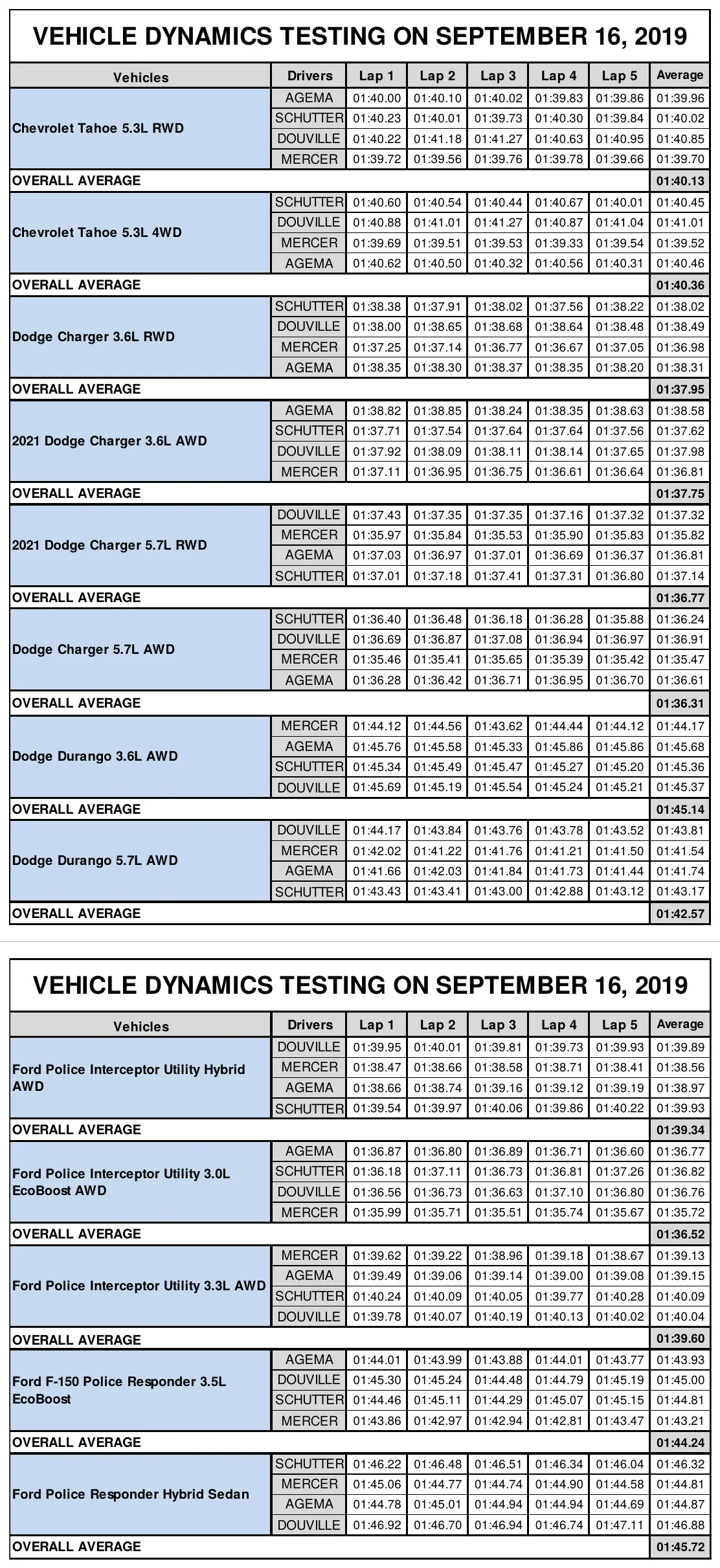
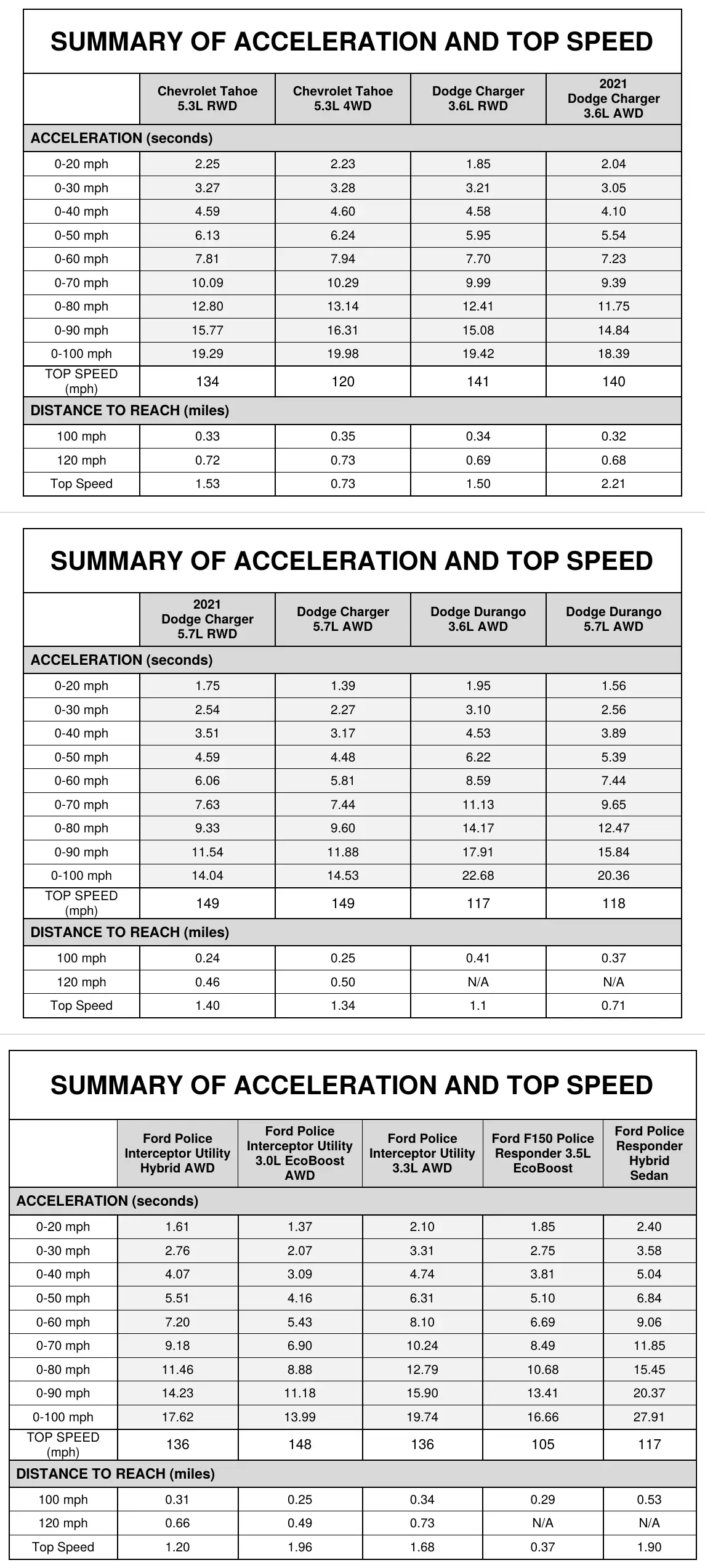
Every car and truck on this page had a speed limiter fitted, unless the book notes otherwise. The report states it for the whole field in its General Information section, printed page 2: “All vehicles listed in this report were equipped with electronic speed limiters unless otherwise noted, or with the exception of certain motorcycles.”
The caveat matters. By the 2015 book (the 2013 book has the unconditional wording; 2014 is not held) the sentence is no longer unconditional: it excepts “certain motorcycles”, so on this page the blanket statement covers the cars, and not necessarily the motorcycles. Which motorcycles, Michigan does not say. The 2021 book drops the motorcycle clause again. The car top-speed method in this book runs each car “until it reaches the manufacturer electronically limited top speed” (printed p.41), so the Chargers’ extra mile an hour may be a limiter setting.
The book prints the MSP’s purchasing criteria (printed p.4): 60 mph within 9.0 seconds, 80 within 14.9, 100 within 24.6; 110 mph within 0.92 mile and 120 mph within 1.70 miles; 25.79 ft/s² over twenty stops; and all 32 Grattan laps without major component failure. By its own figures four vehicles missed at least one: the Responder Hybrid sedan (9.06, 15.45 and 27.91 seconds, and 117 mph, so it never reached 120), the F-150 (105 mph, so never 110 or 120) and the two Durangos (117 and 118 mph). The book names none of them as out, and says meeting the criteria does not certify a vehicle as pursuit rated. Every vehicle cleared the braking minimum; the lowest rate is the F-150’s 26.54.
Gold row: quickest car or truck to 60 and to 100 for the second consecutive year, from a sport utility. The AWD HEMI Charger took the best lap average, 1:36.31, two tenths ahead of it.
The hybrid Utility keeps quietly making its case. It reached 100 mph in 17.62 seconds and lapped in 1:39.34 — quicker than the petrol 3.3-litre version of the same vehicle — while returning 23 mpg city against the 3.3’s 17. It also stopped shorter, 130.1 feet against 131.5.
Braking divides the field into two clean groups. Every Dodge and every Ford Utility sits between 127.2 and 131.5 feet. The two Tahoes and the F-150 need 142.5, 144.9 and 145.9 — an eleven-foot gap to the rest of the field, and the third consecutive year the Tahoes have been among the longest-stopping cars and trucks in the test — though the F-150 needs more still.
The motorcycles
| Machine | 0–60 (s) | 0–100 (s) | Top speed | Top speed at | Dynamics | Brakes (ft/s²) | 60–0 (ft) |
|---|---|---|---|---|---|---|---|
| Yamaha FJR1300P-AB | 3.67 | 8.19 | 147 | 3.01 mi | 1:38.06 | 26.92 | 143.8 |
| BMW R 1250 RT-P | 3.88 | 8.84 | 137 | 2.27 mi | 1:36.95 | 30.41 | 127.3 |
| BMW F 850 GS-P § | 4.56 | 13.85 | 120.1 | 1.60 mi | 1:38.14 | 29.37 | 131.8 |
| BMW F 750 GS-P § | 4.72 | 15.34 | 116.2 | 1.78 mi | 1:39.84 | 29.38 | 131.8 |
| Harley-Davidson FLHP | 5.17 | 18.04 | 109.2 | 0.67 mi | 1:49.80 | 27.74 | 139.6 |
| Harley-Davidson FLHTP | 5.30 | 20.05 | 108.3 | 0.79 mi | 1:49.82 | 28.22 | 137.2 |
Gold row: two archive records and the motorcycle top speed in one machine. 3.67 seconds to 60 mph and 147 mph both improve on the Yamaha’s own 2019 figures, and 8.19 seconds to 100 mph finally beats the 2012 Kawasaki’s 8.29 — a mark that had survived eight years and every motorcycle Michigan tested in between. The Yamaha needed three miles to find its top speed; the BMW, two and a quarter, and it had the better lap average (the quickest single lap printed was the Yamaha’s 1:35.57).
§ The braking figures for the two GS-P machines carry the same warning as in 2019, and a larger number. The rear tyre lost contact with the road on the majority of brake applications and, in general, lifted twenty-four to thirty inches, forcing the rider to modulate braking pressure rather than make a true panic stop, and on several occasions to release front brake pressure because the motorcycle was no longer stable. The book prints their figures with that warning, so read them with it in mind.
Ergonomics and communications
| Vehicle | Ergonomics (1–10) | Communications (1–10) |
|---|---|---|
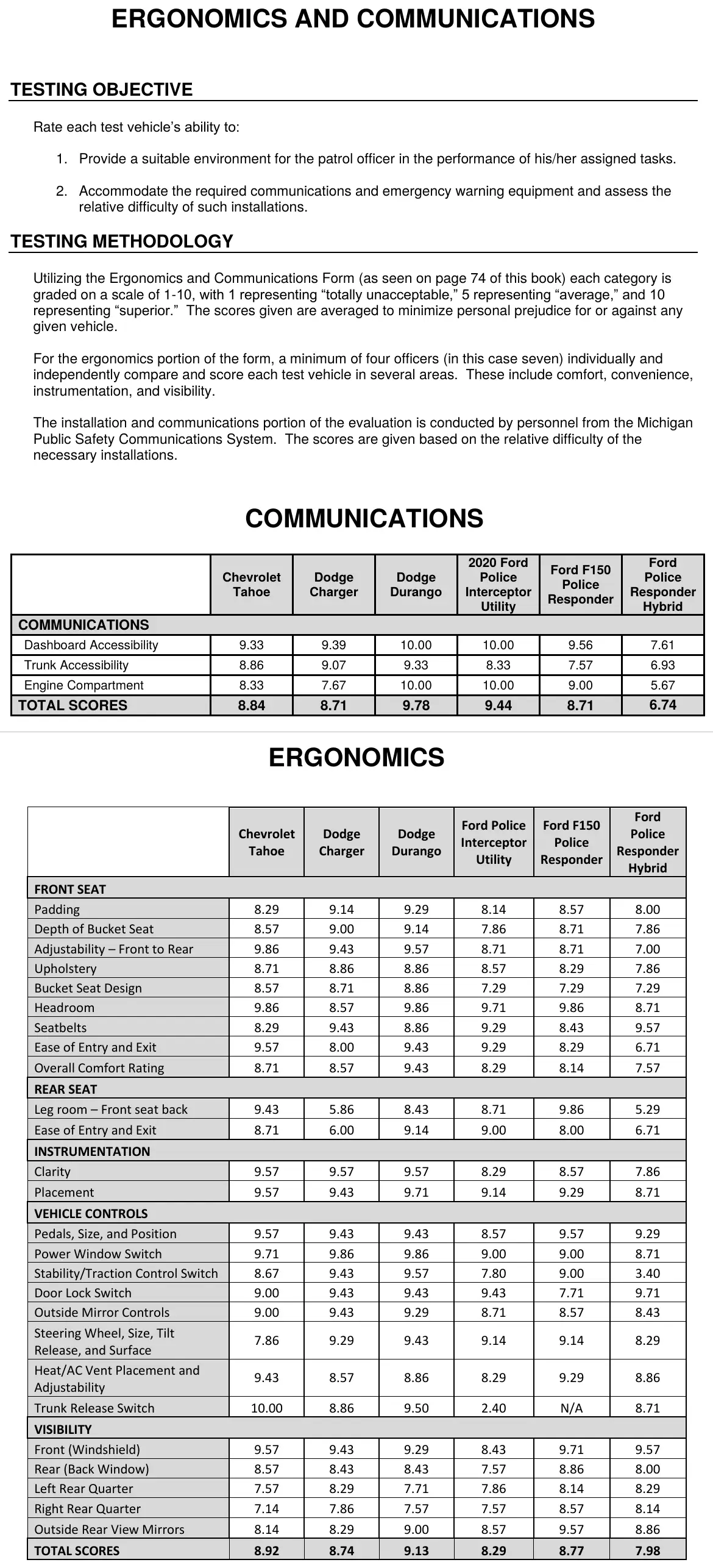
| Dodge Durango | 9.13 | 9.78 |
| Chevrolet Tahoe | 8.92 | 8.84 |
| Ford F-150 Police Responder | 8.77 | 8.71 |
| Dodge Charger | 8.74 | 8.71 |
| Ford Police Interceptor Utility | 8.29 | 9.44 |
| Ford Police Responder Hybrid Sedan | 7.98 | 6.74 |
Gold row: the Durango led both columns again; the hybrid sedan scored lowest on both.
See the original pages in the 2020 book: ergonomics
Fuel economy
| Vehicle | City | Highway | Combined |
|---|---|---|---|
| Ford Police Responder Hybrid Sedan | 40 | 36 | 38 |
| Ford PI Utility Hybrid AWD | 23 | 24 | 24 |
| 2021 Dodge Charger 3.6L AWD | 18 | 27 | 21 |
| Dodge Durango 3.6L AWD | 18 | 25 | 21 |
| Dodge Charger 3.6L RWD | 18 | 26 | 20 |
| Ford PI Utility EcoBoost AWD 3.0L | 17 | 22 | 19 |
| Ford PI Utility AWD 3.3L | 17 | 23 | 19 |
| 2021 Dodge Charger 5.7L RWD | 16 | 25 | 19 |
| Ford F-150 Police Responder 3.5L EcoBoost | 16 | 22 | 18 |
| Chevrolet Tahoe 5.3L RWD | 15 | 22 | 18 |
| Dodge Charger 5.7L AWD | 15 | 23 | 18 |
| Dodge Durango 5.7L AWD | 14 | 22 | 17 |
| Chevrolet Tahoe 5.3L 4WD | 14 | 20 | 16 |
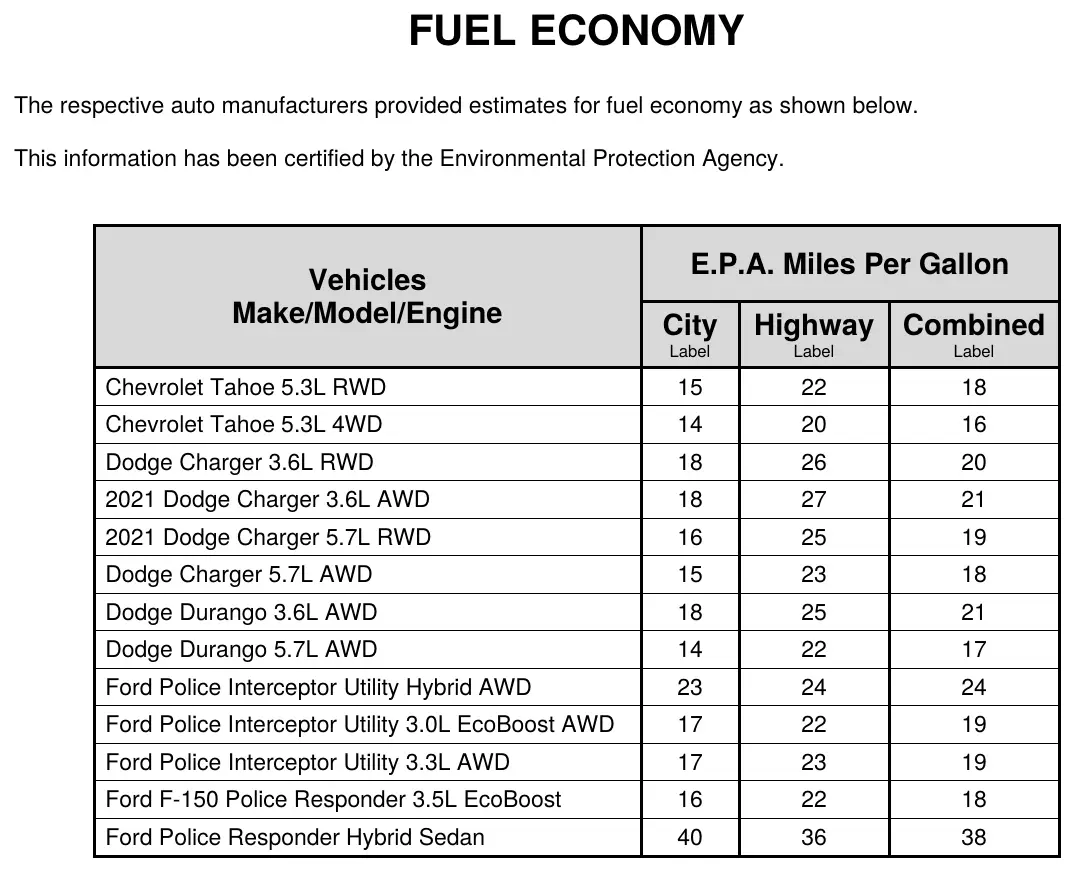
The hybrid Utility’s 23 mpg city and 24 combined is the best figure any petrol or hybrid sport utility has recorded in this archive, matched by the hybrid in every book from 2021 to 2025 — and it belongs to a vehicle that lapped Grattan quicker than its petrol equivalent and ran 136 mph. The economy argument and the performance argument had finally stopped pointing in opposite directions.
See the original page in the 2020 book: fuel economy
What 2020 settled
For two years the Police Responder Hybrid Sedan had made the fuel case alone, at the cost of being the slowest vehicle in the test to 60 and to 100; in 2020 it missed all three of the book’s acceleration times. The hybrid Utility reached 100 mph in 17.62 seconds, ran 136 mph, stopped in 130 feet, lapped quicker than the petrol 3.3 version of the same vehicle, and returned five more miles per gallon in the city than anything else on four wheels bar the sedan.
And for the second year running the quickest car or truck Michigan measured was a sport utility: the Police Interceptor Utility’s 5.43 seconds to 60 was the quickest by a car or truck in these tests to that point, from a vehicle line whose 1998 predecessors, the Ford Explorers, Ford had said were not designed or intended for pursuit. The two HEMI Chargers still ran a mile an hour faster on top.