
Michigan test archive
2021 Michigan State Police Patrol Vehicle Test
Ten vehicles and no motorcycles. A new Tahoe stops fifteen feet shorter than the one it replaced, and the EcoBoost Utility laps Grattan quicker than any sport utility before it.
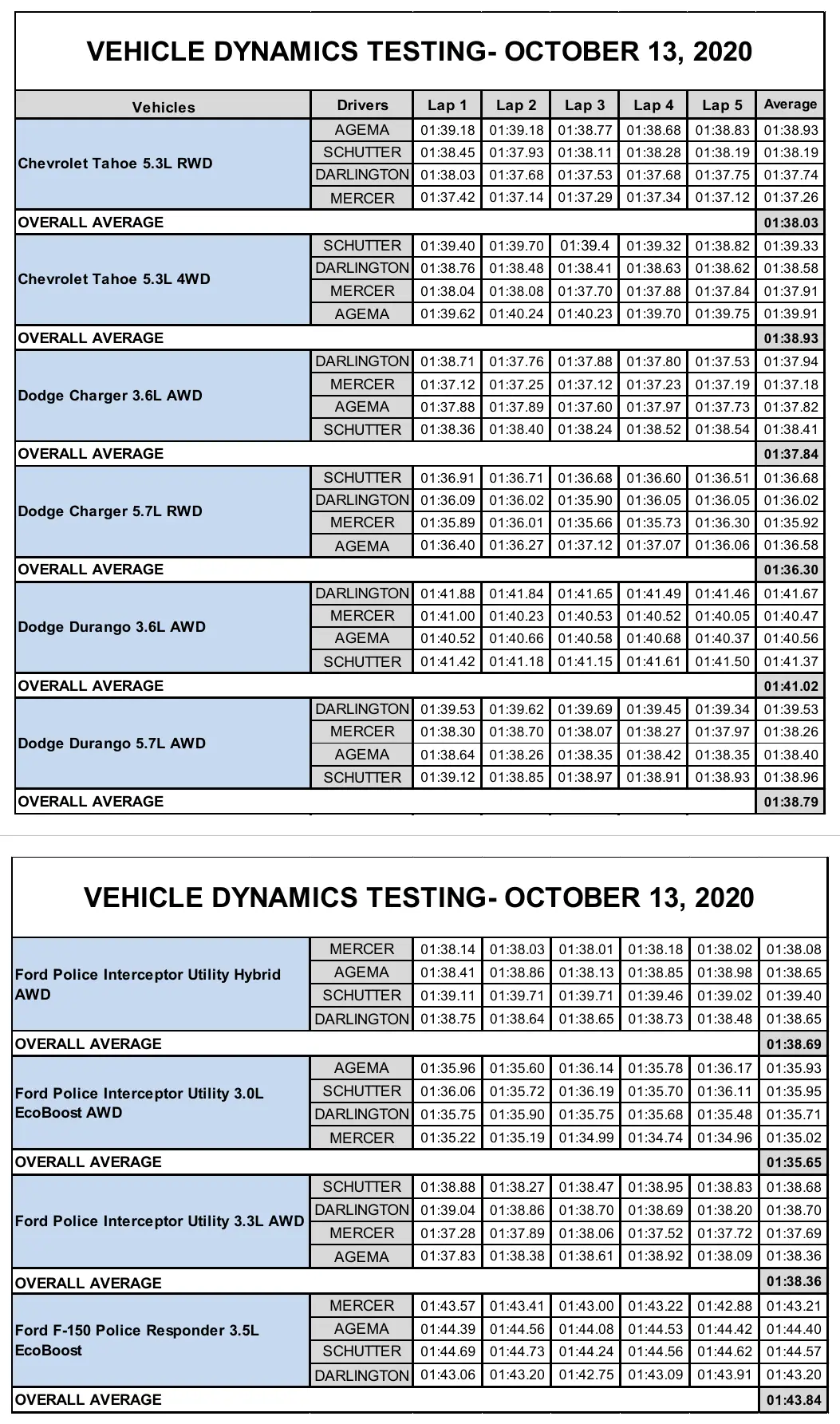
Ten vehicles, tested at the Chelsea Proving Grounds on 10 October 2020 and at Grattan Raceway three days later, and published that November. The field is two Tahoes, two Chargers, two Durangos, three Police Interceptor Utilities and an F-150. The two Chargers are the only sedans; the Ford Police Responder Hybrid Sedan of the 2020 test does not return. Nor is there a motorcycle section. Every book held here from 2009 to 2020 has one; this one does not, and it does not say why. The 2022 book compares its motorcycle braking distances with those of “the 2021 model year motorcycles”, which implies that results exist; they are not in this book.
The biggest change is Chevrolet’s. The 2021 Tahoe is a new generation — Chevrolet’s own highlights list an independent rear suspension, a wheelbase five inches longer, and Brembo six-piston front calipers on 16-inch rotors — and its figures are very different. On the 2020 page the two Tahoes needed 142.5 and 144.9 feet to stop from 60 mph. Here they need 127.4 and 127.1 feet, the fourth and second shortest stops in the field, and the rear-drive car laps Grattan 2.10 seconds quicker than its predecessor.
The 3.0-litre EcoBoost Police Interceptor Utility was quickest to 60 mph (5.75 seconds) and to 100 (13.86), fastest at 148 mph, and fastest on the road course, averaging 1:35.65 a lap. That was the best lap average any sport utility had recorded at Grattan in the books held here (the 2023 and 2024 EcoBoost Utilities later went quicker, at 1:35.42 and 1:35.17), and Trooper Jeff Mercer’s best single lap in it, 1:34.74, was the fastest of the test.
And the book tests two Chargers for the second time. Dodge brought its 2021 V6 all-wheel-drive and V8 rear-drive cars a season early, to the 2020 test, and both return here. The V6 car came back almost unchanged, decelerating at 30.43 and 30.44 ft/s² a year apart. The V8 car, recorded at 149 mph on the 2020 page, topped out at 140 mph this time. The book gives no reason.
The police vehicles
| Vehicle | 0–60 (s) | 0–100 (s) | Top speed | Top speed at | Dynamics | Brakes (ft/s²) | 60–0 (ft) | Comms | Ergo |
|---|---|---|---|---|---|---|---|---|---|
| Ford PI Utility EcoBoost AWD 3.0L | 5.75 | 13.86 | 148 | 1.24 mi | 1:35.65 | 30.02 | 129.0 | 9.44 | 8.47 |
| Dodge Charger 5.7L RWD | 5.91 | 14.14 | 140 | 1.01 mi | 1:36.30 | 30.07 | 128.8 | 8.71 | 8.81 |
| 2020 Ford F-150 Police Responder EcoBoost 3.5L | 6.61 | 16.78 | 105 | 0.36 mi | 1:43.84 | 26.52 | 146.0 | 8.71 | 9.05 |
| Dodge Durango 5.7L AWD | 7.01 | 19.00 | 130 | 1.12 mi | 1:38.79 | 29.18 | 132.7 | 9.78 | 8.89 |
| Ford PI Utility Hybrid AWD | 7.19 | 17.40 | 136 | 1.28 mi | 1:38.69 | 29.77 | 130.1 | 9.44 | 8.47 |
| Dodge Charger 3.6L AWD | 7.41 | 17.97 | 140 | 2.31 mi | 1:37.84 | 30.44 | 127.2 | 8.71 | 8.81 |
| Chevrolet Tahoe 5.3L RWD | 7.60 | 19.17 | 130 | 1.41 mi | 1:38.03 | 30.40 | 127.4 | 8.84 | 9.09 |
| Ford PI Utility AWD 3.3L | 7.84 | 19.14 | 136 | 1.78 mi | 1:38.36 | 30.59 | 126.6 | 9.44 | 8.47 |
| Chevrolet Tahoe 5.3L 4WD | 7.87 | 20.19 | 125 | 1.06 mi | 1:38.93 | 30.47 | 127.1 | 8.84 | 9.09 |
| Dodge Durango 3.6L AWD | 8.80 | 24.72 | 128 | 2.84 mi | 1:41.02 | 29.09 | 133.1 | 9.78 | 8.89 |
Gold row: the EcoBoost Utility is quickest to 60 by 0.16 seconds over the V8 Charger, quickest to 100 by 0.28, fastest at 148 mph, and 0.65 seconds a lap quicker than anything else. It does not stop shortest. That is its 3.3-litre sibling, at 126.6 feet.
The Tahoes’ brake sheets show a consistent result rather than one good stop. The rear-drive car averaged 30.16 ft/s² over its first ten stops and 30.64 over the second ten, after the cooling lap; the 4WD car 30.28 and 30.66. Against the 2020 page, under the same twenty-stop procedure, the rear-drive Tahoe stops 15.1 feet shorter and the 4WD 17.8 feet shorter. Every vehicle in the book stopped in a straight line, in its lane, with no evidence of severe fading.
The V8 Charger reached 60 mph 0.15 seconds sooner than on the 2020 page (5.91 against 6.06), but its top speed is 140 mph where the 2020 page records 149, and it got there in 1.01 miles rather than 1.40. The 2022 book prints 140 mph as both Chargers’ Manufacturer Limited Top Speed. The V6 car’s figures sit close to its 2020 ones throughout: 7.41 seconds to 60 against 7.23, 140 mph both times, laps 0.09 seconds apart. The 2020 figures are those on this site’s 2020 page, checked against the 2020 book. Dodge’s highlights describe the V6 all-wheel-drive Charger as offered “for the first time” for 2021; as a model year it is, though Michigan had already tested it in the 2020 test.
Both Durangos ran faster than on the 2020 page, 128 and 130 mph against 117 and 118, and the V8 reached 100 mph 1.36 seconds sooner (19.00 against 20.36). The V6 went the other way to 100 mph: 24.72 seconds, against 22.68 in 2020.
Ford’s highlights describe the hybrid as the Utility’s standard powertrain for 2021. Against the 3.3-litre petrol car it is 1.74 seconds quicker to 100 mph (17.40 against 19.14). This time, though, the petrol car took the lap, 1:38.36 against 1:38.69, and stopped 3.5 feet shorter.
The F-150’s specification page calls it a 2020 F-150 Police Responder: a 2020 model year in a 2021 book. Its figures repeat the 2020 page’s closely, 6.61 seconds to 60 against 6.69 and 105 mph both times, and it has the slowest lap average (1:43.84) and the longest stop (146.0 feet) in this field.
Where the book disagrees with itself, this page uses the data sheet. The V6 Charger’s distance to top speed is 2.31 miles on its data sheet (printed page 38) and 2.41 in the summary table (page 42). The rear-drive Tahoe’s projected stop is 127.4 feet on its brake sheet (page 51) and 127.5 on the bar chart (page 61); 127.4 is what the book’s own formula gives from its 30.40 ft/s².
See the original pages in the 2021 book: lap times
Acceleration in detail
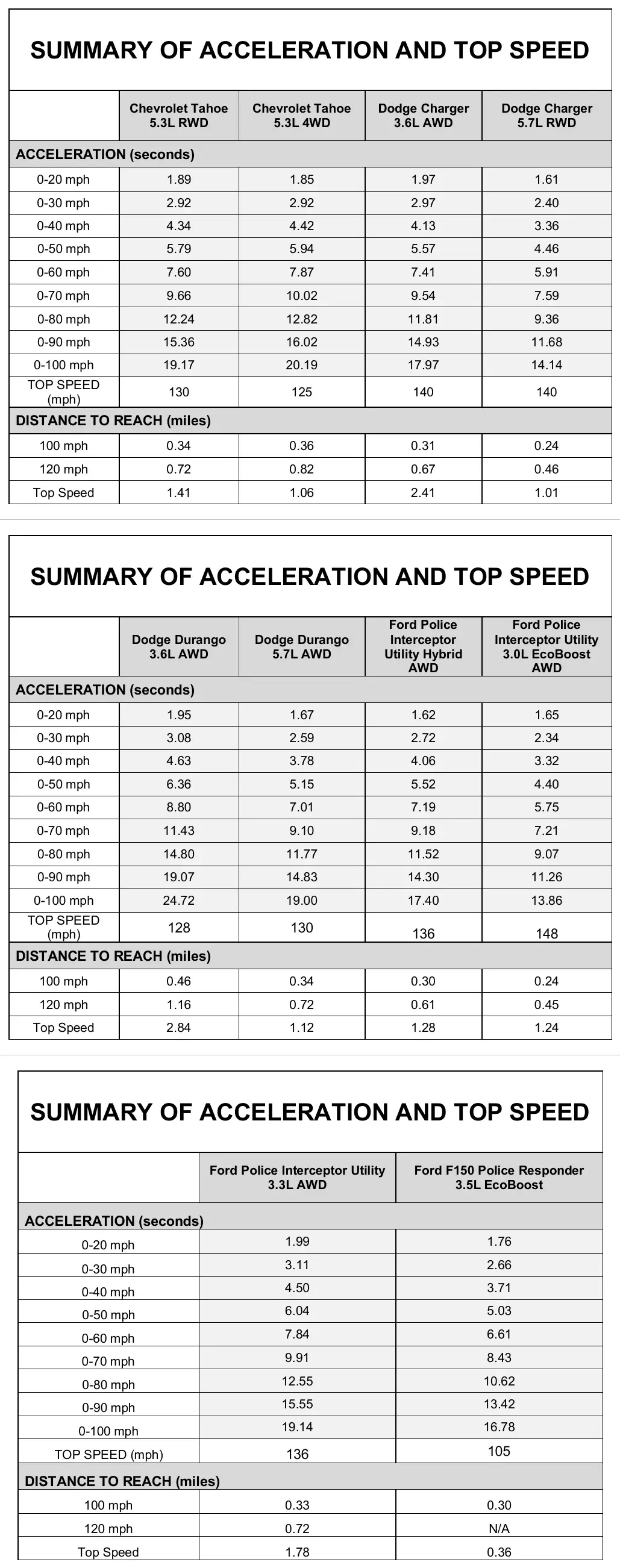
| 0 to… | Tahoe RWD | Tahoe 4WD | Charger AWD | Charger RWD | Durango 3.6L | Durango 5.7L | PI Utility Hybrid | PI Utility EcoBoost | PI Utility 3.3L | F-150 |
|---|---|---|---|---|---|---|---|---|---|---|
| 20 mph | 1.89 | 1.85 | 1.97 | 1.61 | 1.95 | 1.67 | 1.62 | 1.65 | 1.99 | 1.76 |
| 30 mph | 2.92 | 2.92 | 2.97 | 2.40 | 3.08 | 2.59 | 2.72 | 2.34 | 3.11 | 2.66 |
| 40 mph | 4.34 | 4.42 | 4.13 | 3.36 | 4.63 | 3.78 | 4.06 | 3.32 | 4.50 | 3.71 |
| 50 mph | 5.79 | 5.94 | 5.57 | 4.46 | 6.36 | 5.15 | 5.52 | 4.40 | 6.04 | 5.03 |
| 60 mph | 7.60 | 7.87 | 7.41 | 5.91 | 8.80 | 7.01 | 7.19 | 5.75 | 7.84 | 6.61 |
| 70 mph | 9.66 | 10.02 | 9.54 | 7.59 | 11.43 | 9.10 | 9.18 | 7.21 | 9.91 | 8.43 |
| 80 mph | 12.24 | 12.82 | 11.81 | 9.36 | 14.80 | 11.77 | 11.52 | 9.07 | 12.55 | 10.62 |
| 90 mph | 15.36 | 16.02 | 14.93 | 11.68 | 19.07 | 14.83 | 14.30 | 11.26 | 15.55 | 13.42 |
| 100 mph | 19.17 | 20.19 | 17.97 | 14.14 | 24.72 | 19.00 | 17.40 | 13.86 | 19.14 | 16.78 |
| Miles to 100 mph | 0.34 | 0.36 | 0.31 | 0.24 | 0.46 | 0.34 | 0.30 | 0.24 | 0.33 | 0.30 |
| Miles to 120 mph | 0.72 | 0.82 | 0.67 | 0.46 | 1.16 | 0.72 | 0.61 | 0.45 | 0.72 | N/A |
At 20 mph the order is different. The V8 Charger is quickest, in 1.61 seconds, with the Hybrid Utility second at 1.62 and the EcoBoost Utility third at 1.65. The EcoBoost leads from 30 mph on.
See the original pages in the 2021 book: acceleration
Speed limiters, and three printed settings
Every vehicle on this page had a speed limiter fitted, unless the book notes otherwise. The report states it for the whole field in its General Information section, printed page 4: “All vehicles listed in this report were equipped with electronic speed limiters unless otherwise noted.” The 2015 and 2018 to 2020 books held here add “or with the exception of certain motorcycles”; this one, which has no motorcycles, does not, and neither do the 2022 to 2026 books, although all of them except 2024 include motorcycles.
The book also describes the top-speed test in those terms. Its stated objective, printed page 35, is “to verify the electronically limited top speed reported by the manufacturer attainable by each test vehicle within 14 miles from a standing start.”
Three specification pages print the setting itself, in a field headed Manufacturer Limited Top Speed: both Tahoes and the V6 Charger. The other seven print no such field. The 2025 book prints it for ten of its fourteen entries.
| Vehicle | Manufacturer limit | Measured | Spec page |
|---|---|---|---|
| Dodge Charger 3.6L AWD | 140 | 140 | p.14 (PDF 16) |
| Chevrolet Tahoe 5.3L RWD | 130 | 130 | p.10 (PDF 12) |
| Chevrolet Tahoe 5.3L 4WD | 124 | 125 | p.12 (PDF 14) |
Two of the three topped out exactly at the printed figure. The 4WD Tahoe ran 125 mph against 124, one mile an hour over, as the BMW and the F-150 would in the 2025 book.
The purchasing criteria, and two vehicles that missed them
The book repeats the MSP’s purchasing criteria on printed page 5: 60 mph within 9.0 seconds, 80 within 14.9 and 100 within 24.6; 110 mph within 0.92 mile and 120 within 1.70 miles; an average of 25.79 ft/s² across twenty 60-to-0 stops; and all 32 Grattan laps without major component failure. Meeting them, it says, “does not certify a vehicle as being pursuit rated”, and “it is up to each agency to determine if the vehicle is suitable for the mission of their agency.”
Two vehicles miss a printed figure. The V6 Durango reached 100 mph in 24.72 seconds, 0.12 over the 24.6 allowed. The F-150 topped out at 105 mph, so it never reached the 110 and 120 mph marks. The book names neither as failing, and they are muted in the table above for that reason only. Every other vehicle clears every criterion for which the book prints a figure; the distance to 110 mph is not printed for any of them.
Ergonomics and communications
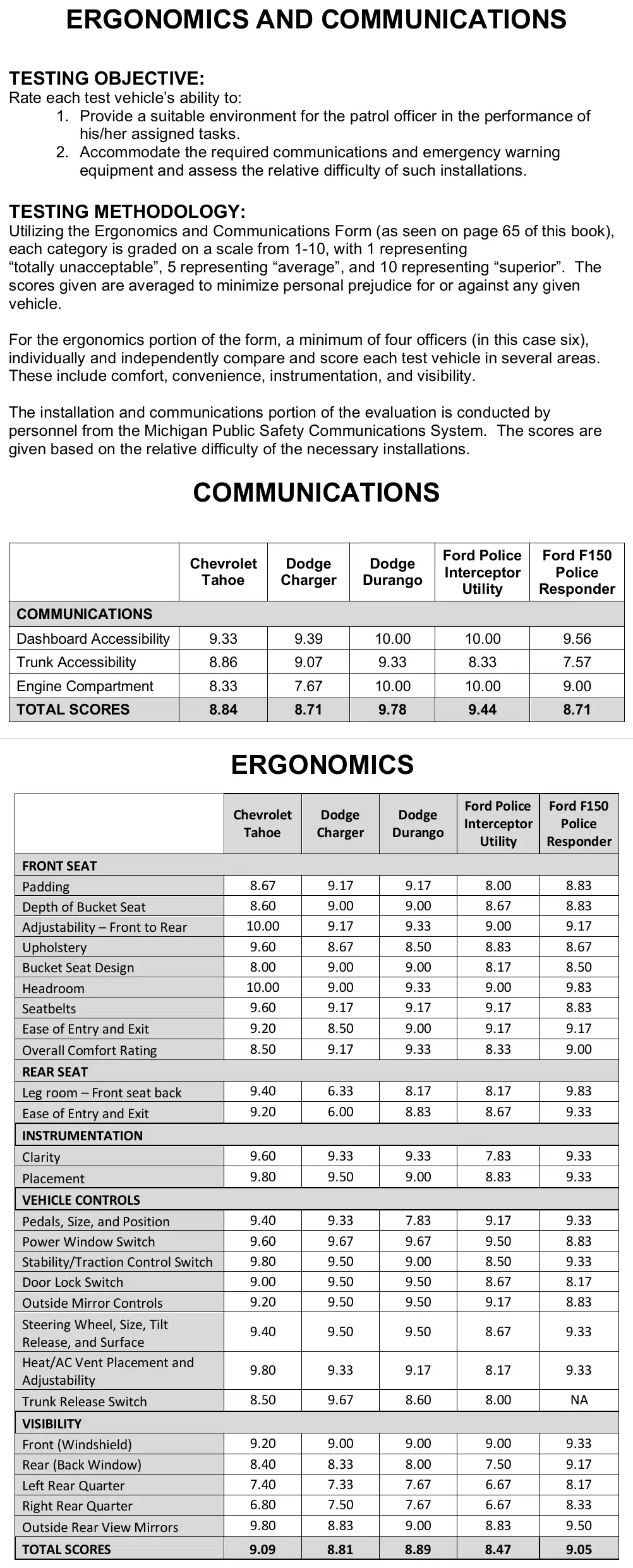
Six officers scored ergonomics this year (the method calls for at least four), grading 26 items from 1 to 10. The totals: Tahoe 9.09, F-150 9.05, Durango 8.89, Charger 8.81, Police Interceptor Utility 8.47. The lowest single marks on the sheet are the Charger’s rear seat, 6.33 for legroom and 6.00 for getting in and out, and the Utility’s rear-quarter visibility, 6.67 on each side. The Utility also had the lowest mark for instrument clarity, 7.83.
Communications installation is graded separately, by personnel from the Michigan Public Safety Communications System. The Durango led at 9.78, with full marks for dashboard and engine-compartment access; the Charger and the F-150 shared the lowest total, 8.71. All five totals are shown as printed and are the same as in the 2020 book. Every communications sub-score for the Tahoe, Durango, Police Interceptor Utility and F-150 appears again, unchanged, in every book held here from 2022 to 2026, and the Charger’s in 2022 and 2023. None of those books says whether the installations were re-assessed.
See the original pages in the 2021 book: ergonomics
Fuel economy
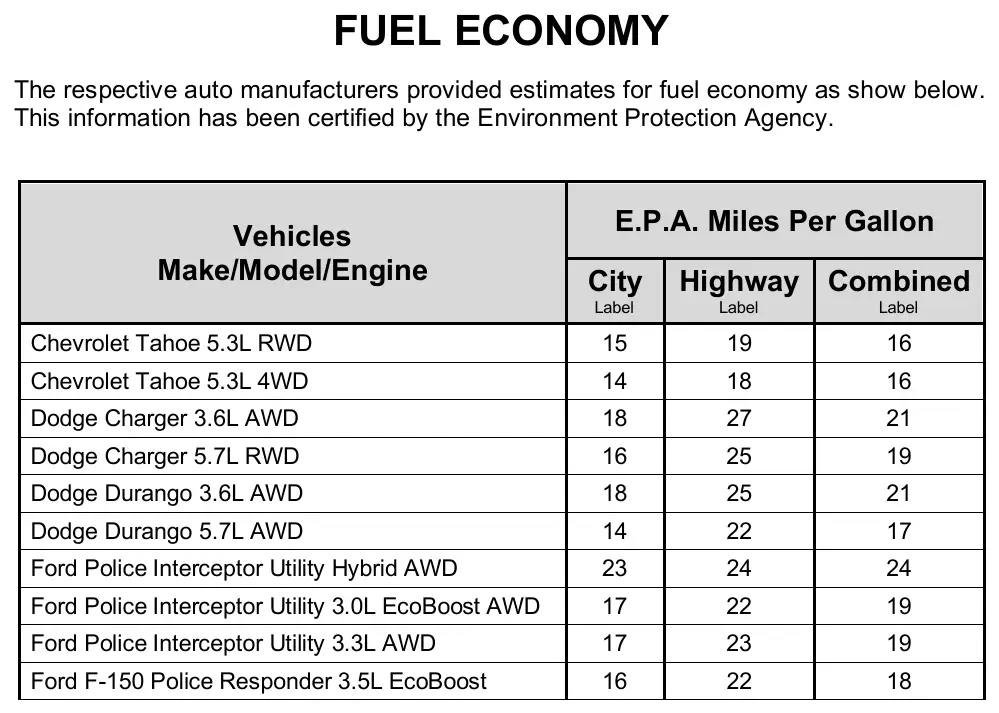
| Vehicle | City | Highway | Combined |
|---|---|---|---|
| Ford PI Utility Hybrid AWD | 23 | 24 | 24 |
| Dodge Charger 3.6L AWD | 18 | 27 | 21 |
| Dodge Durango 3.6L AWD | 18 | 25 | 21 |
| Dodge Charger 5.7L RWD | 16 | 25 | 19 |
| Ford PI Utility AWD 3.3L | 17 | 23 | 19 |
| Ford PI Utility EcoBoost AWD 3.0L | 17 | 22 | 19 |
| 2020 Ford F-150 Police Responder EcoBoost 3.5L | 16 | 22 | 18 |
| Dodge Durango 5.7L AWD | 14 | 22 | 17 |
| Chevrolet Tahoe 5.3L RWD | 15 | 19 | 16 |
| Chevrolet Tahoe 5.3L 4WD | 14 | 18 | 16 |
With no hybrid sedan in the book, the Hybrid Utility’s 24 mpg combined is the best figure here, three ahead of the V6 Charger and V6 Durango. The new Tahoes return 16 combined, as the 2025 Tahoes do.
See the original page in the 2021 book: fuel economy
What 2021 settled
The Tahoe’s braking gap closed when the new generation arrived. On the 2020 page the two Tahoes needed 142.5 and 144.9 feet, while every Dodge and every Ford Utility stopped between 127.2 and 131.5. In 2021, under the same twenty-stop procedure, the new generation needed 127.4 and 127.1, and lapped Grattan up to 2.10 seconds quicker than the car it replaced.
The book also suggests the test is repeatable. Three vehicles appear in consecutive tests in the same model year: both 2021 Chargers, tested a season early in the 2020 test, and the F-150, a 2020 model in a 2021 book. Their braking rates a year apart differ by 0.01 to 0.06 ft/s², and their laps by 0.09 to 0.47 seconds. The exception is the V8 Charger’s top speed, 149 mph on the 2020 page and 140 here, which the 2021 book does not explain.