
Michigan test archive
2019 Michigan State Police Patrol Vehicle Test
A sport utility runs 150 mph, both Tahoes overheat in the dynamics test, and Michigan accepts the LA County Sheriff’s result for one of them.
Twelve vehicles and seven motorcycles, and there is no Police Interceptor sedan. The Taurus-based Police Interceptor, which arrived in 2012 and in its EcoBoost form posted the quickest car times to 60 and to 100 in every year of this archive from 2013 to 2018, is gone. Ford’s entry is three Police Interceptor Utilities (labelled 2020 models in the book), an F-150 and the hybrid Responder sedan. Dodge brought the Durango Pursuit, new to the police category in two engines.
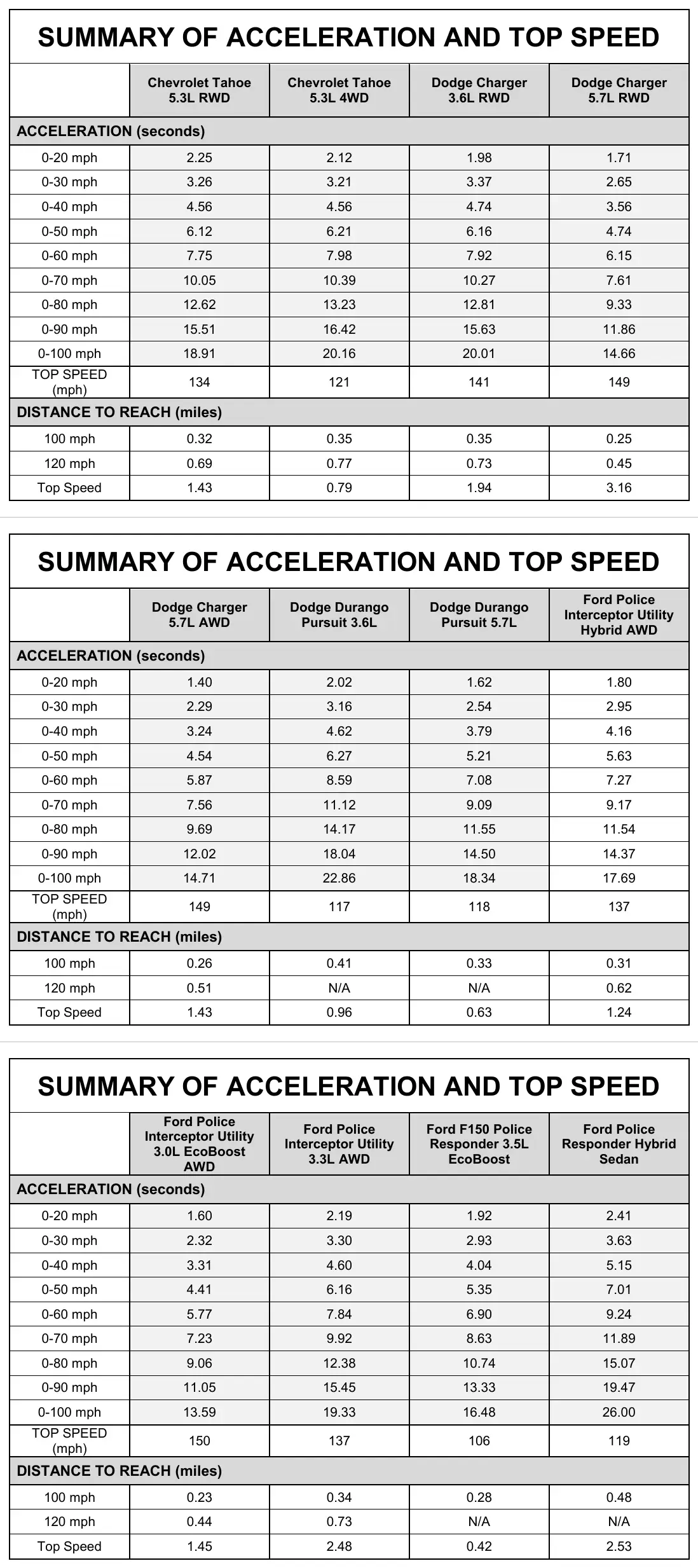
The fastest vehicle in the test, and the quickest on four wheels, is a sport utility. The Police Interceptor Utility with the 3.0-litre EcoBoost reached 60 mph in 5.77 seconds, 100 in 13.59, and ran 150 mph — the first SUV in this archive to reach 150 — and lapped Grattan in 1:36.47, faster than every Charger. Only the motorcycles were quicker to 60, the Yamaha in 3.78 seconds. In 1997 the Tahoe took 28.90 seconds to reach 100 mph, outside the bulletin’s 28.2, which may not have applied to it.
The book also prints three passages worth reading in full: the Tahoes’ overheating, a warning about the BMW GS-P brake tests, and a section on the programme’s history, “pursuit rated” and the purchasing criteria, first printed in the 2018 book.
1. Both Tahoes overheated, and Michigan accepted the LA County Sheriff’s result for one
Michigan devotes most of a page to what went wrong. During dynamics testing on 17 September 2018 — temperatures from 70°F at nine in the morning to 88°F by half past three — both the rear-drive and four-wheel-drive Tahoes went into partial power or protect mode on lap seven or eight of every run, for every driver, which limited speed and, the book says, made the final laps substantially slower. GM engineers investigated and believed the cause was malfunctioning thermal bypass valves, which control the flow of transmission fluid through the oil cooler.
Both vehicles were retested on 11 October with the valves replaced, in 46°F. The four-wheel-drive car was clean; the rear-drive car still lost power on the last lap of the third and fourth runs. The Los Angeles County Sheriff’s Department then tested both Tahoes on 25 October in 84°F, and the four-wheel-drive car overheated again in the later laps of runs three and four. GM declined further retesting until it had isolated the root cause.
The four-wheel-drive Tahoe was subsequently redeveloped and, on 24 January 2019, completed all 32 laps of the LASD dynamics course and its city pursuit course. Winter conditions at Grattan ruled out Michigan’s own confirmatory testing, and the book states that the MSP will accept LASD’s testing results as meeting its purchasing requirements. It says nothing further about the rear-drive car. The same page adds that “GM has no known incidents of the transmission over temperature issue as a result of insufficient transmission cooling capacity”.
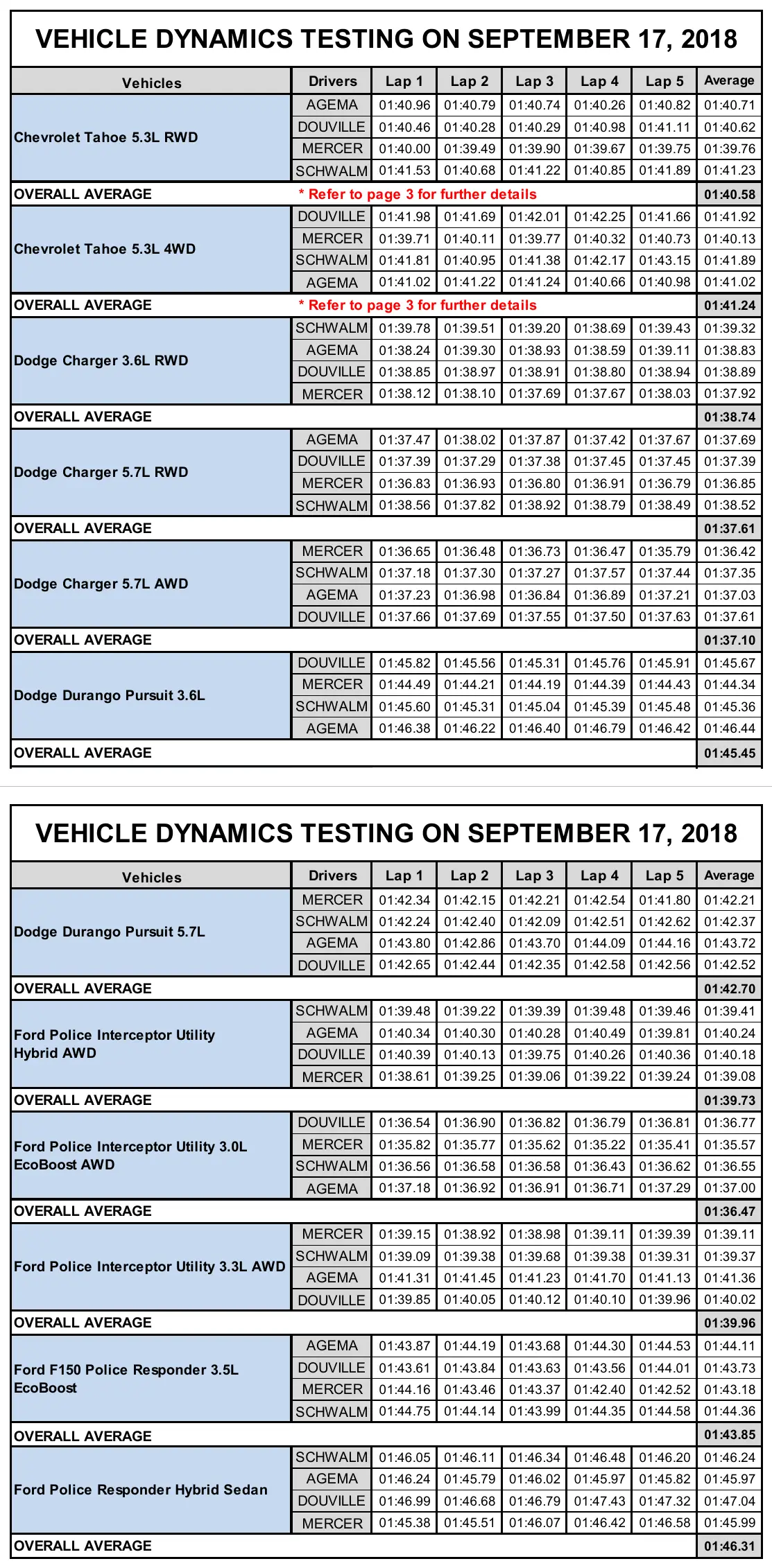
Both Tahoes do have lap averages — 1:40.58 for the rear-drive car and 1:41.24 for the four-wheel-drive — and both carry the book’s own footnote referring the reader to this passage. Each average is the mean of the four drivers’ five fastest laps out of eight; the reduced-power episodes came on lap seven or eight.
2. What the book says about “pursuit rated”
The book states that the term pursuit rated has been called into question because nobody fully understands what it represents, that pursuit capable is the more appropriate term, and that there is no sanctioning body and no specific performance criteria behind the designation. It then says that neither the MSP nor the Los Angeles County Sheriff’s Department has the authority or the credentials to award the term “pursuit rated” to any vehicle. The same passage is in the 2018 book, almost word for word.
What Michigan does have is a purchasing specification, and the book prints the performance criteria attached to it: 60 mph within 9.0 seconds, 80 within 14.9, 100 within 24.6; 110 mph within 4,838 feet and 120 mph within 8,985 feet; an average deceleration of 25.79 ft/s² across twenty 60-to-0 threshold stops; and completion of all 32 Grattan laps without major component failure. Meeting those criteria, the book says, does not certify a vehicle as pursuit rated; it justifies that a vehicle can perform the job the MSP requires.
By the book’s own figures, four of the twelve cars and trucks missed at least one of those marks: the F-150 topped out at 106 mph, so it never reached 110 or 120; the Responder Hybrid sedan took 9.24, 15.07 and 26.00 seconds to 60, 80 and 100 and topped out at 119; and the Durango Pursuits topped out at 117 and 118. The book names none of them as out. The Tahoes’ trouble is reported in prose, and the book does not say that either missed the lap criterion.
3. Testing began in the 1950s
The same section, first printed in the books held here in 2018, dates the programme’s origins: the MSP began testing patrol cars in the 1950s. At that time quotations were requested from manufacturers and only the vehicle with the lowest quotation was tested, to see whether it met the purchasing requirements. Years later, when the quotations came in four dollars apart, the department decided to test every vehicle in order to select the best one. The book gives no date for that change.
That resolves an apparent conflict rather than creating one. The 1980 report states that the Police Patrol Vehicle Evaluation and Purchasing Program was developed in 1976, and the 1996 and 2001 books count their annual evaluations back to a first one in 1976–77. Those are dates for the comparative programme — the one that tests everybody and scores them against each other. Testing itself, of a single lowest bidder against a pass or fail standard, began earlier, in the 1950s by the book’s account.
The police category
| Vehicle | 0–60 (s) | 0–100 (s) | Top speed | Top speed at | Dynamics | Brakes (ft/s²) | 60–0 (ft) |
|---|---|---|---|---|---|---|---|
| 2020 Ford PI Utility EcoBoost AWD 3.0L | 5.77 | 13.59 | 150 | 1.45 mi | 1:36.47 | 29.44 | 131.5 |
| Dodge Charger 5.7L AWD | 5.87 | 14.71 | 149 | 1.43 mi | 1:37.10 | 28.94 | 133.8 |
| Dodge Charger 5.7L RWD | 6.15 | 14.66 | 149 | 3.16 mi | 1:37.61 | 30.25 | 128.0 |
| Ford F-150 Police Responder EcoBoost 3.5L | 6.90 | 16.48 | 106 | 0.42 mi | 1:43.85 | 27.30 | 141.9 |
| Dodge Durango Pursuit 5.7L | 7.08 | 18.34 | 118 | 0.63 mi | 1:42.70 | 29.18 | 132.7 |
| 2020 Ford PI Utility Hybrid AWD | 7.27 | 17.69 | 137 | 1.24 mi | 1:39.73 | 29.24 | 132.4 |
| Chevrolet Tahoe 5.3L RWD | 7.75 | 18.91 | 134 | 1.43 mi | 1:40.58 § | 26.58 | 145.7 |
| 2020 Ford PI Utility AWD 3.3L | 7.84 | 19.33 | 137 | 2.48 mi | 1:39.96 | 29.00 | 133.5 |
| Dodge Charger 3.6L RWD | 7.92 | 20.01 | 141 | 1.94 mi | 1:38.74 | 30.51 | 126.9 |
| Chevrolet Tahoe 5.3L 4WD | 7.98 | 20.16 | 121 | 0.79 mi | 1:41.24 § | 27.17 | 142.5 |
| Dodge Durango Pursuit 3.6L | 8.59 | 22.86 | 117 | 0.96 mi | 1:45.45 | 30.07 | 128.8 |
| Ford Police Responder Hybrid Sedan | 9.24 | 26.00 | 119 | 2.53 mi | 1:46.31 | 29.93 | 129.4 |
See the original pages in the 2019 book: lap times and acceleration
Every car and truck on this page had a speed limiter fitted, unless the book notes otherwise. The report states it for the whole field in its General Information section, printed page 2: “All vehicles listed in this report were equipped with electronic speed limiters unless otherwise noted, or with the exception of certain motorcycles.”
The caveat matters. By the 2015 book (the 2013 book has the unconditional wording; 2014 is not held) the sentence is no longer unconditional: it excepts “certain motorcycles”, so on this page the blanket statement covers the cars, and not necessarily the motorcycles. Which motorcycles, Michigan does not say.
The year Michigan accepted another agency’s test
Printed page 3 carries something that happens in no other book held here. Both Tahoes “experienced partial power/protect mode issues in laps seven or eight on each run for each driver” — an overheating condition. Both were retested on 11 October 2018 after their thermal bypass valves were replaced; the four-wheel-drive car was clean, the rear-drive car “experienced partial power on the last lap of the third and fourth runs.” The Los Angeles County Sheriff’s Department then tested both Tahoes on 25 October, and the four-wheel-drive car overheated again. Then GM stopped: “GM engineers have elected not to retest the vehicles at this time until they have isolated and corrected the root cause of the overheating condition.”
By the time the fix was ready it was January, and Grattan is in Michigan:
“On January 24, 2019, the Tahoe four-wheel drive was retested and successfully completed all 32 laps of the LASD dynamic course as well as the city pursuit course. Winter conditions at the Grattan Raceway preclude the MSP from any confirmatory testing of the success of the engineering changes. The MSP will accept LASD’s testing results as meeting our purchasing requirements.“
The book says the manufacturers supply upcoming vehicles to both the MSP and the Los Angeles County Sheriff’s Department, and that successful results at both have historically validated the manufacturers’ engineering. Here winter conditions at Grattan ruled out Michigan’s own confirmatory testing, and it accepted LASD’s result for the four-wheel-drive Tahoe. In the books held here, it is the only time Michigan has let another agency’s testing stand in for its own.
Two things follow for reading the table. The Tahoe figures above are from the original September sessions (acceleration and braking at Chelsea on the 15th, dynamics at Grattan on the 17th), not from any later test. And the motorcycle brake figures come with their own warning from the same page: on both the BMW F 750 GS-P and F 850 GS-P “the rear tire lost contact with the roadway on the majority of brake applications.”
Gold row: the first sport utility in this archive to reach 150 mph, and the quickest car or truck of the year to both 60 and 100; several of the motorcycles were quicker. It also out-lapped every Dodge.
The hybrid Utility is the quiet achievement. It reached 100 mph in 17.69 seconds — quicker than the 3.3-litre petrol version of the same vehicle — ran 137 mph and lapped in 1:39.73. A hybrid sport utility was now a quicker police vehicle than a V6 Charger to 100 mph.
Every Dodge stops between 126.9 and 133.8 feet and the Fords between 129.4 and 141.9; the two Tahoes need 145.7 and 142.5, the longest stops of the cars and trucks (the Yamaha motorcycle needed 143.3). The V6 Charger’s 126.9 feet is the shortest stop of the year.
The motorcycles
| Machine | 0–60 (s) | 0–100 (s) | Top speed | Top speed at | Dynamics | Brakes (ft/s²) | 60–0 (ft) |
|---|---|---|---|---|---|---|---|
| Yamaha FJR1300P-AB | 3.78 | 8.39 | 144 | 2.56 mi | 1:38.56 | 27.02 | 143.3 |
| BMW R 1250 RT-P | 4.03 | 8.77 | 137 | 4.72 mi | 1:36.60 | 29.63 | 130.7 |
| Harley-Davidson FLHTP Stage 2 | 4.59 | 13.50 | 109 | 0.40 mi | 1:47.65 | 28.03 | 138.2 |
| BMW F 850 GS-P | 5.00 | 16.09 | 118 | 1.50 mi | 1:38.70 | 28.81 | 134.4 |
| Harley-Davidson FLHP Stage 1 | 5.03 | 16.13 | 109 | 0.63 mi | 1:50.46 | 27.95 | 138.5 |
| BMW F 750 GS-P | 5.04 | 16.00 | 113 | 1.79 mi | 1:41.07 | 29.45 | 131.5 |
| Harley-Davidson FLHTP | 5.23 | 19.49 | 109 | 0.80 mi | 1:49.53 | 28.15 | 137.5 |
Gold row: the Yamaha set two motorcycle bests for these tests at the time. Its 3.78 seconds to 60 mph was the quickest launch recorded in these tests to that point, beating the 2015 BMW R 1200 RT-P’s 3.99, and its 144 mph was the highest motorcycle top speed to that point; the 2020 Yamaha beat both (3.67 seconds, 147 mph), and the 2026 BMW the launch again (3.61). The BMW R 1250 answered with the best motorcycle lap average in the archive — 1:36.60, quicker than every car in the test bar one, though the motorcycles lapped four days before the cars.
And a warning printed in the book that deserves repeating. During brake testing, both BMW GS-P machines lifted their rear tyres eight to twelve inches off the road on the majority of stops, forcing the rider to modulate rather than make a true panic stop — and on several occasions to release front brake pressure because the motorcycle was no longer stable. The book prints their figures with that warning, so read them with it in mind.
Ergonomics and communications
| Vehicle | Ergonomics (1–10) | Communications (1–10) |
|---|---|---|
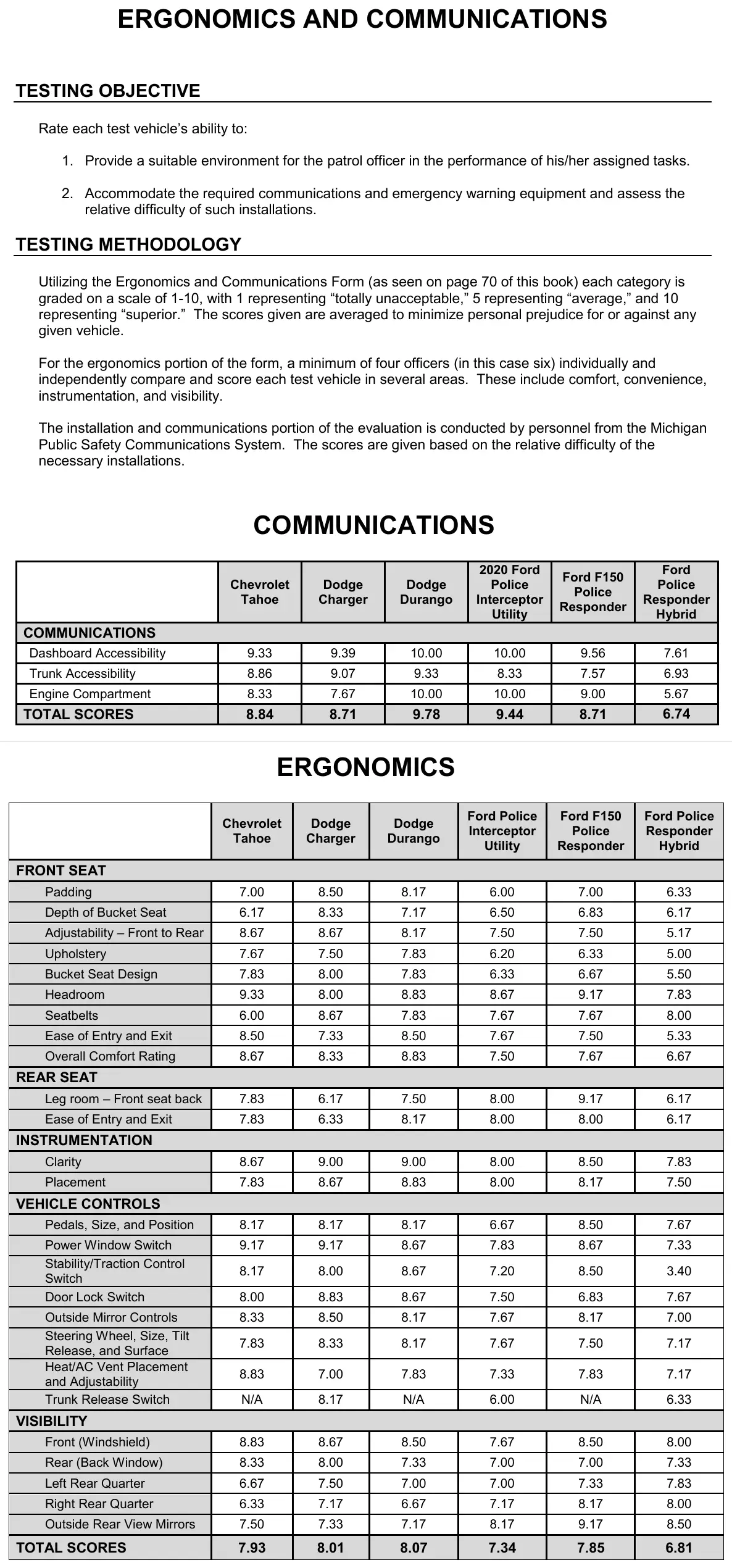
| Dodge Durango | 8.07 | 9.78 |
| Dodge Charger | 8.01 | 8.71 |
| Chevrolet Tahoe | 7.93 | 8.84 |
| Ford F-150 Police Responder | 7.85 | 8.71 |
| 2020 Ford Police Interceptor Utility | 7.34 | 9.44 |
| Ford Police Responder Hybrid Sedan | 6.81 | 6.74 |
Gold row: the Durango led both columns. The hybrid sedan scored lowest on both, with 3.40 for its stability and traction control switch and 5.67 for engine-compartment access.
See the original pages in the 2019 book: ergonomics
Fuel economy
| Vehicle | City | Highway | Combined |
|---|---|---|---|
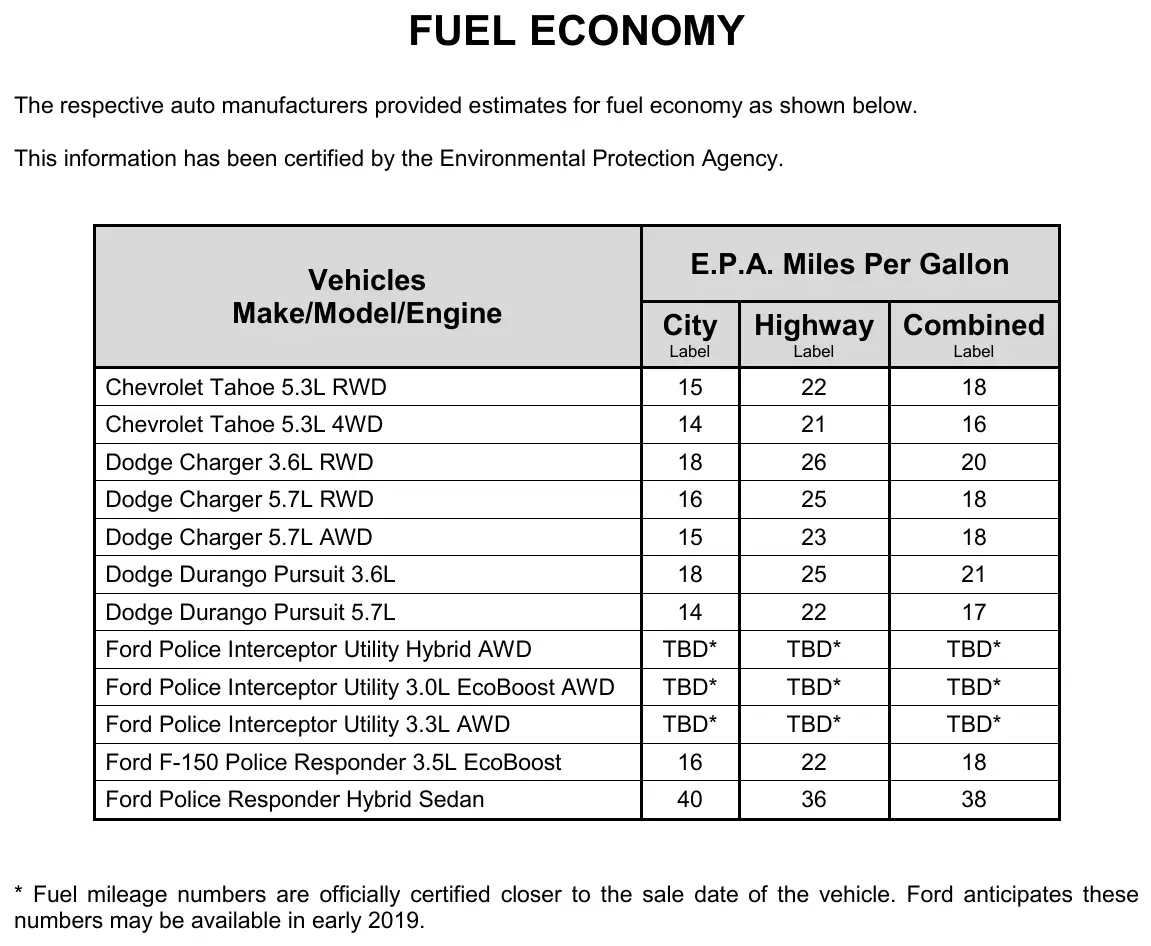
| Ford Police Responder Hybrid Sedan | 40 | 36 | 38 |
| Dodge Charger 3.6L RWD | 18 | 26 | 20 |
| Dodge Durango Pursuit 3.6L | 18 | 25 | 21 |
| Dodge Charger 5.7L RWD | 16 | 25 | 18 |
| Ford F-150 Police Responder 3.5L EcoBoost | 16 | 22 | 18 |
| Chevrolet Tahoe 5.3L RWD | 15 | 22 | 18 |
| Dodge Charger 5.7L AWD | 15 | 23 | 18 |
| Chevrolet Tahoe 5.3L 4WD | 14 | 21 | 16 |
| Dodge Durango Pursuit 5.7L | 14 | 22 | 17 |
| 2020 Ford Police Interceptor Utility (all three) | not certified at press time | ||
See the original page in the 2019 book: fuel economy
What 2019 settled
The book repeats, from the 2018 book, that “pursuit rated” has no sanctioning body and no specific criteria behind it, and that neither Michigan nor Los Angeles County has the authority to award it. What exists instead is a list: nine seconds to 60, twenty-four point six to 100, 120 mph inside 8,985 feet, 25.79 ft/s² over twenty stops, and thirty-two laps without major component failure. Four of this year’s twelve cars and trucks missed at least one line of it by the book’s own figures, and the book names none of them as out.
And both Tahoes went into partial power on lap seven or eight of every run, in temperatures that rose from 70°F to 88°F through the day. With the valves replaced, the four-wheel-drive car was clean in the cooler October retest and the rear-drive car was not; LASD’s test caught the four-wheel-drive car again, and Michigan accepted LASD’s January result for it. None of that shows in a top-speed figure or a 0–60 time; the book reports it in prose, on its third page.