
Michigan test archive
2001 Michigan State Police Patrol Vehicle Test
Vehicle dynamics moves from the speedway’s road course to Grattan Raceway, an AM General Hummer is entered as a police car, and three DaimlerChrysler prototypes are tested with their data left out of the book.
Sixteen vehicles were evaluated in September 2000, and the dynamics test had moved house. After more than two decades of lapping the Michigan International Speedway road course (1.82 miles in the 1978 book and the 1979 file, 1.635 miles on the year pages from 1981 on), vehicle dynamics ran for the first time at Grattan Raceway near Belding — a two-mile road course. The acceleration, top speed and braking work stayed at the DaimlerChrysler Proving Grounds. Every lap time on this page is therefore on a different course from every lap time before it, and the two cannot be compared.
The entry list is the reason this year is remembered. Alongside the Police Interceptor, the Impala and the two Camaros, Michigan tested an AM General Hummer with a 6.5-litre turbo-diesel — and tested it in the police category, not special service. It took 18.55 seconds to reach 60 mph, 49.27 to reach 80, never reached 90 at all, and topped out at 88 with a limiter fitted. Around Grattan it lapped in 2:00.97, twenty-four seconds a lap slower than a Camaro. Its EPA city estimate was 9 mpg. It scored 144.43 on ergonomics, the third-lowest points total in these books (the 2018 and later books print averages instead), after the 1996 Geo Tracker’s 132.16 and the 1989 Mustang’s 144.40. Its 88 mph was the lowest top speed in the books held here to that point, and the 2002 Hummer would be slower still.
And three vehicles ran that you will not find in the book. DaimlerChrysler submitted a Dodge Intrepid 3.5 and two Durangos as prototypes, not available for any police operation at the time, while the company considered whether to re-enter the law enforcement market. Their data was handed to the manufacturer at the test site and deliberately not published. Michigan says so openly in the preface — which is how we know an Intrepid was tested a model year before the 2002 book recorded the Intrepid police package’s official debut.
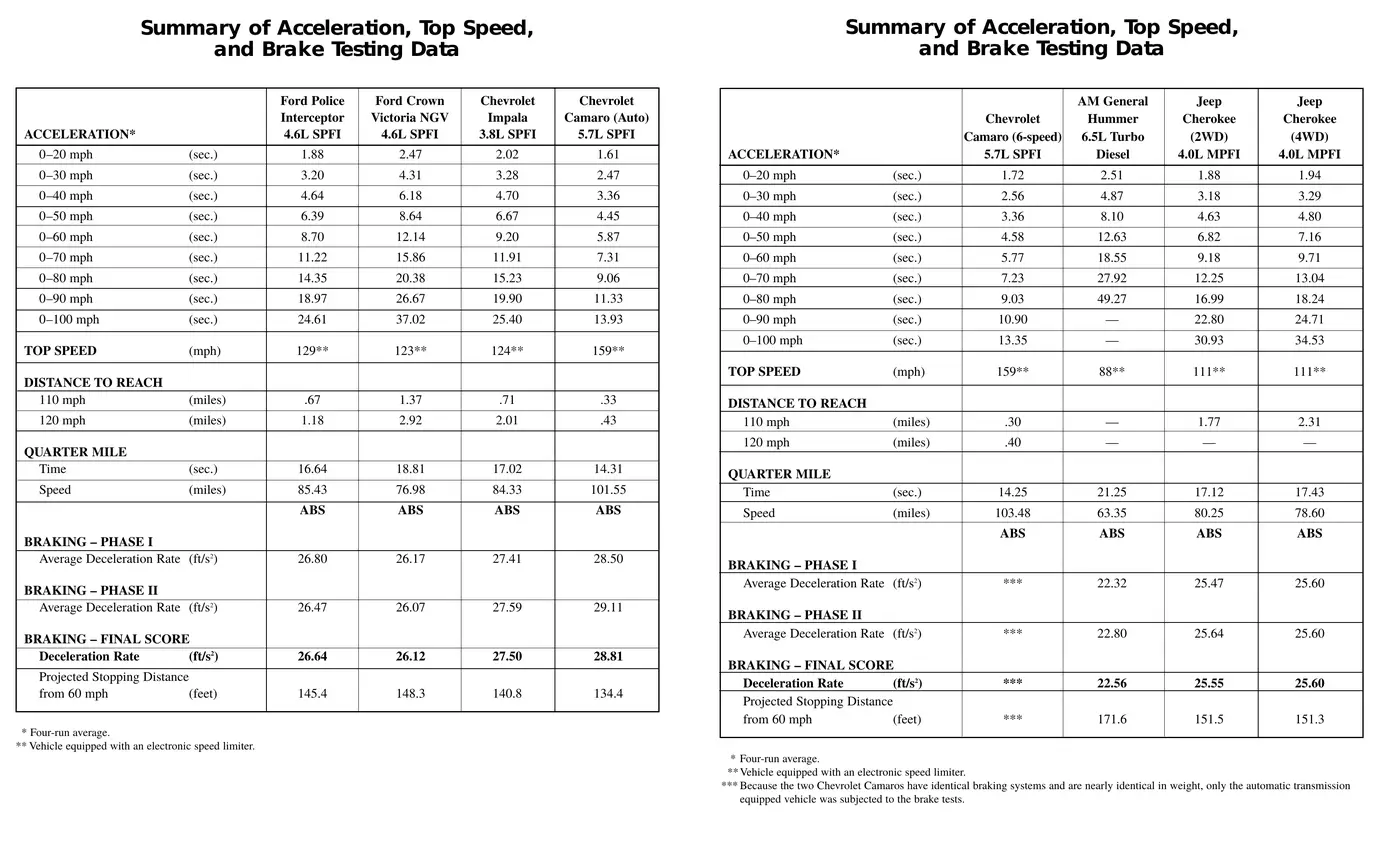
Acceleration, top speed, quarter mile and braking
| Vehicle | 0–60 (s) | 0–100 (s) | Top speed | 110 in | ¼ mile | Brakes (ft/s²) | 60–0 (ft) |
|---|---|---|---|---|---|---|---|
| Chevrolet Camaro (6-speed) | 5.77 | 13.35 | 159 ** | 0.30 mi | 14.25 @ 103.48 | ‡ | ‡ |
| Chevrolet Camaro (automatic) | 5.87 | 13.93 | 159 ** | 0.33 mi | 14.31 @ 101.55 | 28.81 | 134.4 |
| Ford Police Interceptor | 8.70 | 24.61 | 129 ** | 0.67 mi | 16.64 @ 85.43 | 26.64 | 145.4 |
| Chevrolet Impala | 9.20 | 25.40 | 124 ** | 0.71 mi | 17.02 @ 84.33 | 27.50 | 140.8 |
| Jeep Cherokee (2WD) | 9.18 | 30.93 | 111 ** | 1.77 mi | 17.12 @ 80.25 | 25.55 | 151.5 |
| Jeep Cherokee (4WD) | 9.71 | 34.53 | 111 ** | 2.31 mi | 17.43 @ 78.60 | 25.60 | 151.3 |
| Ford Crown Victoria NGV | 12.14 | 37.02 | 123 ** | 1.37 mi | 18.81 @ 76.98 | 26.12 | 148.3 |
| AM General Hummer | 18.55 | never reached | 88 ** | never reached | 21.25 @ 63.35 | 22.56 | 171.6 |
Gold row: the 6-speed Camaro’s 14.25-second quarter mile at 103.48 mph is the quickest quarter by a car in the books held here to that point (the 2002 Camaro ran 14.14), and it reached 110 mph in three tenths of a mile. Both Camaros ran 159 — and both carry the speed-limiter footnote, so 159 may be a limiter setting rather than what the car could do.
The bottom row is the Hummer, and it deserves to be read in full. It needed 18.55 seconds to reach 60 mph — more than three times the Camaro’s 5.77 — then 49.27 seconds to reach 80, and never saw 90. Its quarter mile took 21.25 seconds at 63.35 mph, and its projected stop from 60 was 171.6 feet. A vehicle that topped out at 88 mph was entered in the police category.
Elsewhere the sedans hold station. The Police Interceptor is half a second quicker to 60 than the Impala and five miles an hour faster on top; the Impala stops nearly five feet shorter. The natural-gas Crown Victoria returns after Ford skipped it in 2000 and is again the slowest sedan — 12.14 to 60 — and the petrol Interceptor out-braked it, 26.64 ft/s² to 26.12; but it reached 120 mph, which no natural-gas car in the books held here had managed before.
See the original pages: the summary of acceleration, top speed and brake testing in the 2001 book
The special-service vehicles
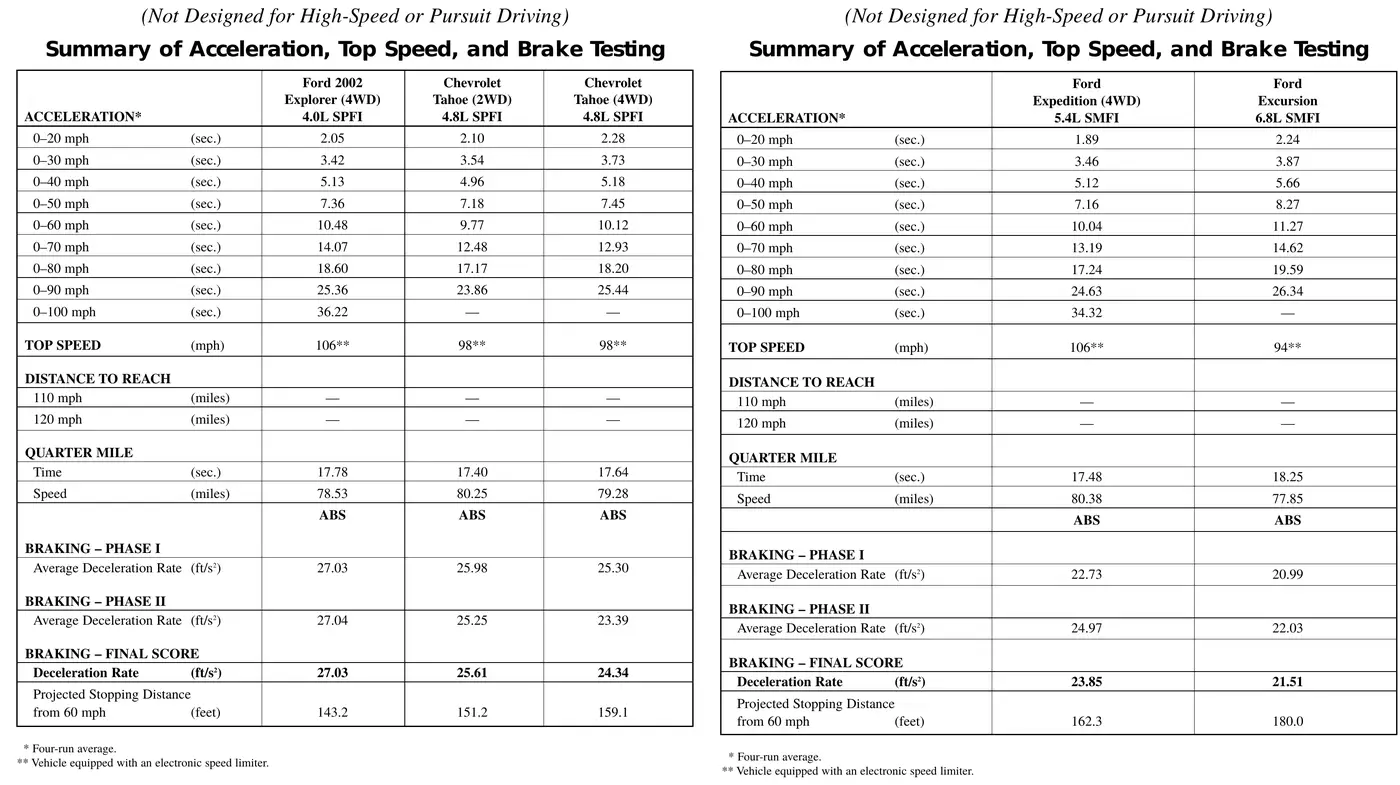
Five more vehicles ran in 2001 that the tables above do not carry. They sit in a separate section of the report behind the heading “Not Designed for High-Speed or Pursuit Driving”, on printed pages 80 and 81, and they are not driven through the vehicle dynamics test at all, so they have no lap time. The book scores their ergonomics separately; the Excursion’s 224.71 is higher than any police vehicle’s.
| Vehicle | 0–60 (s) | 0–100 (s) | Top speed | ¼ mile | Brakes (ft/s²) | 60–0 (ft) | Ergonomics & communications |
|---|---|---|---|---|---|---|---|
| Ford 2002 Explorer (4WD) 4.0L SPFI | 10.48 | 36.22 | 106 ** | 17.78 @ 78.53 | 27.03 | 143.2 | 192.72 |
| Ford Expedition (4WD) 5.4L SMFI | 10.04 | 34.32 | 106 ** | 17.48 @ 80.38 | 23.85 | 162.3 | 213.19 |
| Chevrolet Tahoe (2WD) 4.8L SPFI | 9.77 | N/A | 98 ** | 17.40 @ 80.25 | 25.61 | 151.2 | 199.31 |
| Chevrolet Tahoe (4WD) 4.8L SPFI | 10.12 | N/A | 98 ** | 17.64 @ 79.28 | 24.34 | 159.1 | 199.31 |
| Ford Excursion 6.8L SMFI | 11.27 | N/A | 94 ** | 18.25 @ 77.85 | 21.51 | 180.0 | 224.71 |
The Tahoe 2WD is the quickest of the five to 60 mph and the Excursion the slowest, but the gap that matters is braking: 27.03 ft/s² for the Explorer against 21.51 for the Excursion, which is 143 feet against 180 from the same 60 mph. The Excursion weighed 7,304 lb on the day — more than two Camaros — and needed about 37 feet more to stop.
Every one of the five carries the limiter footnote, so any of these figures may be a setting rather than a capability. The two Tahoes matter beyond their own year: with them the Tahoe’s top speed reads 98 in 2001, 98 in 2002, 98 in 2003 and 99 in 2004 — four years within a mile an hour of each other. Without them the archive appeared to show that run beginning in 2002.
See the original pages: the special-service summary in the 2001 book
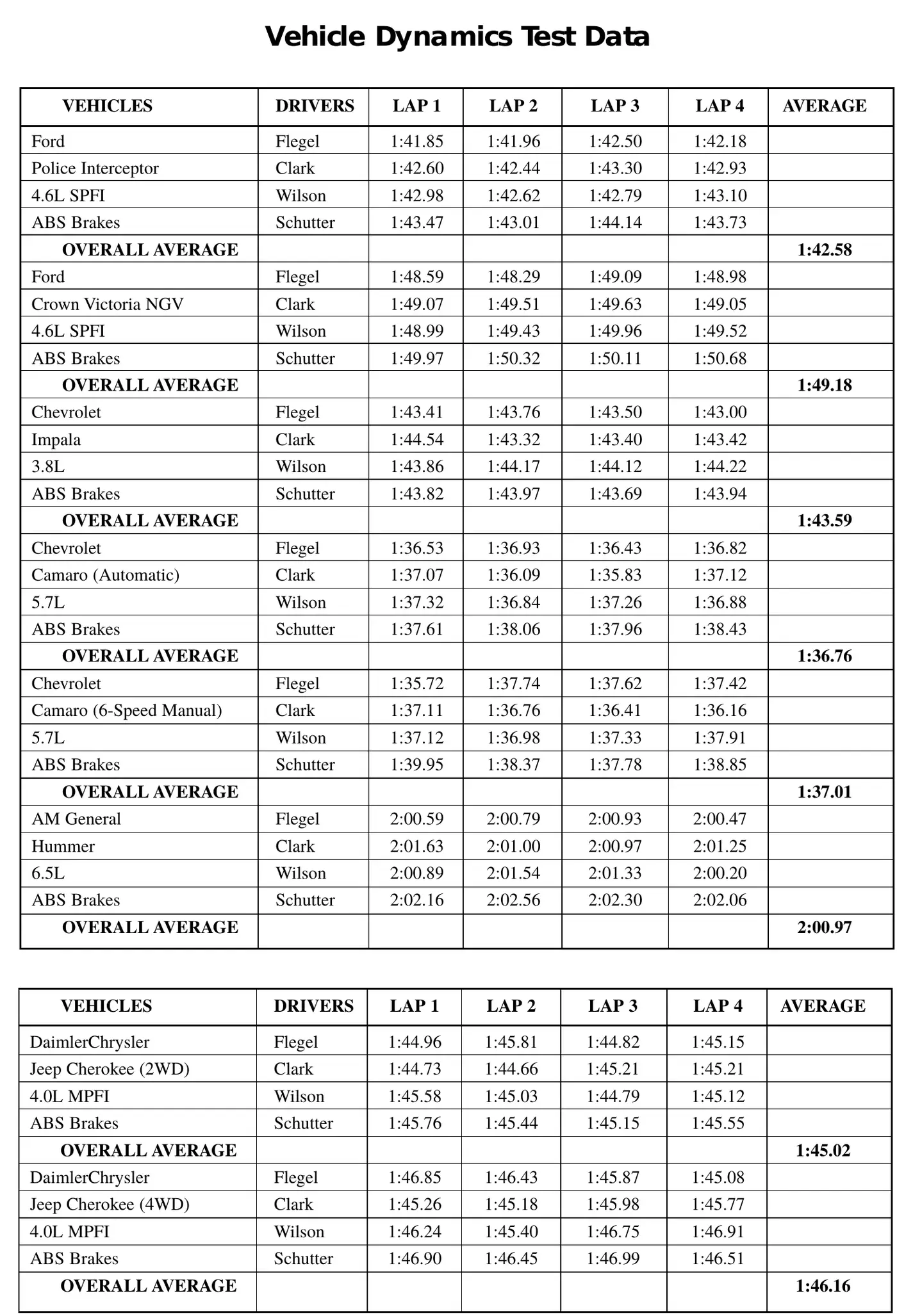
Vehicle dynamics at Grattan Raceway — every lap, every driver
Sixteen timed laps per vehicle, four drivers — Sergeants Flegel, Clark, Wilson and Schutter — with the score being the average of the fastest twelve. The four-wheel-drive Cherokee’s printed 1:46.16 is the average of all sixteen of its laps; its fastest twelve average 1:45.91. The page shows the printed figure. The course is a two-mile road-racing configuration; the speedway infield course used since the seventies is gone.
| Vehicle | Driver | Lap 1 | Lap 2 | Lap 3 | Lap 4 |
|---|---|---|---|---|---|
| Chevrolet Camaro (automatic) | overall average 1:36.76 | ||||
| Flegel | 1:36.53 | 1:36.93 | 1:36.43 | 1:36.82 | |
| Clark | 1:37.07 | 1:36.09 | 1:35.83 | 1:37.12 | |
| Wilson | 1:37.32 | 1:36.84 | 1:37.26 | 1:36.88 | |
| Schutter | 1:37.61 | 1:38.06 | 1:37.96 | 1:38.43 | |
| Chevrolet Camaro (6-speed manual) | overall average 1:37.01 | ||||
| Flegel | 1:35.72 | 1:37.74 | 1:37.62 | 1:37.42 | |
| Clark | 1:37.11 | 1:36.76 | 1:36.41 | 1:36.16 | |
| Wilson | 1:37.12 | 1:36.98 | 1:37.33 | 1:37.91 | |
| Schutter | 1:39.95 | 1:38.37 | 1:37.78 | 1:38.85 | |
| Ford Police Interceptor | overall average 1:42.58 | ||||
| Flegel | 1:41.85 | 1:41.96 | 1:42.50 | 1:42.18 | |
| Clark | 1:42.60 | 1:42.44 | 1:43.30 | 1:42.93 | |
| Wilson | 1:42.98 | 1:42.62 | 1:42.79 | 1:43.10 | |
| Schutter | 1:43.47 | 1:43.01 | 1:44.14 | 1:43.73 | |
| Chevrolet Impala | overall average 1:43.59 | ||||
| Flegel | 1:43.41 | 1:43.76 | 1:43.50 | 1:43.00 | |
| Clark | 1:44.54 | 1:43.32 | 1:43.40 | 1:43.42 | |
| Wilson | 1:43.86 | 1:44.17 | 1:44.12 | 1:44.22 | |
| Schutter | 1:43.82 | 1:43.97 | 1:43.69 | 1:43.94 | |
| Jeep Cherokee (2WD) | overall average 1:45.02 | ||||
| Flegel | 1:44.96 | 1:45.81 | 1:44.82 | 1:45.15 | |
| Clark | 1:44.73 | 1:44.66 | 1:45.21 | 1:45.21 | |
| Wilson | 1:45.58 | 1:45.03 | 1:44.79 | 1:45.12 | |
| Schutter | 1:45.76 | 1:45.44 | 1:45.15 | 1:45.55 | |
| Jeep Cherokee (4WD) | overall average 1:46.16 | ||||
| Flegel | 1:46.85 | 1:46.43 | 1:45.87 | 1:45.08 | |
| Clark | 1:45.26 | 1:45.18 | 1:45.98 | 1:45.77 | |
| Wilson | 1:46.24 | 1:45.40 | 1:46.75 | 1:46.91 | |
| Schutter | 1:46.90 | 1:46.45 | 1:46.99 | 1:46.51 | |
| Ford Crown Victoria NGV | overall average 1:49.18 | ||||
| Flegel | 1:48.59 | 1:48.29 | 1:49.09 | 1:48.98 | |
| Clark | 1:49.07 | 1:49.51 | 1:49.63 | 1:49.05 | |
| Wilson | 1:48.99 | 1:49.43 | 1:49.96 | 1:49.52 | |
| Schutter | 1:49.97 | 1:50.32 | 1:50.11 | 1:50.68 | |
| AM General Hummer | overall average 2:00.97 | ||||
| Flegel | 2:00.59 | 2:00.79 | 2:00.93 | 2:00.47 | |
| Clark | 2:01.63 | 2:01.00 | 2:00.97 | 2:01.25 | |
| Wilson | 2:00.89 | 2:01.54 | 2:01.33 | 2:00.20 | |
| Schutter | 2:02.16 | 2:02.56 | 2:02.30 | 2:02.06 | |
The Hummer’s sixteen laps fall inside a 2.36-second window, from 2:00.20 to 2:02.56, the fifth-tightest of the eight. The two-wheel-drive Cherokee’s are the tightest, at 1.15 seconds, and the 6-speed Camaro’s the widest, at 4.23.
See the original pages: the vehicle dynamics test data in the 2001 book
What went wrong during testing — the report’s own disclosures
The Impala stalled. The engine stalled during one of the test series; the preface reports it under its Grattan vehicle-dynamics heading. The driver returned to the pits; Chevrolet personnel and MSP staff between them could not determine what had caused it. The series was rerun without further problems.
Ford asked for the Police Interceptor to be tested in “drive.” The report grants the request and then notes plainly that this is contrary to the vehicle manual’s own recommendation of running in overdrive during pursuit applications.
The Jeeps were driven in “3” rather than overdrive, and the 6-speed Camaro made its top-speed run in fifth gear.
AutoBid was unavailable. The fleet-selection software built on these test results was undergoing major revisions and was not released for the 2001 model year. The 1989 bulletin and the 1996 and 1999 books held here describe it as an MS-DOS program, with limited copies free to law enforcement agencies that wrote in on letterhead. The report says a new version was expected for 2002.
Ergonomics, communications and fuel
| Vehicle | Ergonomics & communications | EPA city (mpg) |
|---|---|---|
| Chevrolet Impala | 213.58 | 19.5 |
| Ford Police Interceptor | 211.28 | 15.8 |
| Chevrolet Impala 9C3 (unmarked) | 209.55 | 19.5 |
| Ford Crown Victoria NGV | 208.37 | 15.0 |
| Jeep Cherokee | 180.47 | 15.6 (2WD) / 15.0 (4WD) |
| Chevrolet Camaro | 160.87 | 16.6 (auto) / 18.4 (6-speed) |
| AM General Hummer | 144.43 | 9.0 |
Gold row: the Impala tops the police vehicles’ ergonomics table again, by 2.30 points over the Police Interceptor, a wider margin than the 0.17 of the previous year, and it does it while returning nearly four more miles per gallon in the city. The unmarked 9C3 Impala, scored separately, lands third.
The Hummer has the lowest total, though not the lowest single marks: the Camaro took 1.80 for rear-seat entry and exit. The Hummer took 3.20 out of ten for left-rear-quarter visibility, 3.40 for the rear window, 3.60 for ease of entry and exit and 3.70 for the outside mirror controls. Its specification page gives EPA estimates of 9 mpg city and 10 highway and prints the combined figure as N/A, with the note “Class III vehicle–not tested to normal EPA requirement”.
Two things in this book’s front pages
“Doc” Halliday. The acknowledgments list the vehicle test team member by his full name and nickname — Sgt. David “Doc” Halliday — which ties the Sgt. David Halliday named as program contact in the 1999 report to the Halliday credited in the modern Michigan test books. The 1996 book lists him as a trooper test driver, Tpr. David Halliday, Brighton Post.
The program’s own start date. This preface calls 2001 the 25th year of conducting the tests; the 1999 report called that year the 23rd, and the 1996 report called itself the 20th annual evaluation. All three are consistent with a first evaluation of the 1977 models in the autumn of 1976, and the 1980 report’s preface states that the programme “was developed in 1976 by the Policy Development and Evaluation Section of the Michigan Department of State Police, in cooperation with the Purchasing Division of the Michigan Department of Management and Budget”. The 1990 preface speaks of a belief held “since we began testing in 1977”, which could be read either way, so the date of the first test is not settled.
The same sentence carries a second founding fact: the programme was built jointly with the state’s purchasing division, not by the police alone. That is consistent with the bid adjustment the books describe, and with these books being procurement documents rather than road tests.
What 2001 settled
Vehicle dynamics moved to Grattan Raceway, and in doing so drew a line under the era every earlier page in this archive belongs to. Grattan Raceway is a two-mile road course against the speedway’s 1.635 miles, and from this year the lap times measure something different. Anyone comparing a 1:36 here with a 1:20 from 1998 is comparing two different tests.
The other thing 2001 settled, it settled by accident. An AM General Hummer was entered in the police category and needed 18.55 seconds to reach 60 mph, ran out of breath before 90, lapped twenty-four seconds off the pace and scored the third-lowest ergonomics points total in these books. Nothing about the result was close. But the exercise was still worth doing, because Michigan’s whole method rests on measuring what a manufacturer claims rather than arguing about it — and the numbers on this page are the reason nobody had to.