
Michigan test archive
2002 Michigan State Police Patrol Vehicle Test
Mopar comes back, the pursuit Camaro leaves, and two new cars fall short of their braking minimums — one of them by four hundredths.
Fifteen vehicles ran in September 2001, and the preface announces an ending and two beginnings. Mopar is back in the police car business — the Dodge Intrepid police package made its official debut, a year after it was tested as an unpublished prototype. This was the last year of the pursuit Camaro. And General Motors brought a non-published prototype Tahoe, which the book’s preface calls “of particular interest because it would be a pursuit rated SUV for the future”. The Tahoe PPV entered the police category three model years later; the book does not say whether this prototype was its forerunner.
The Intrepid announced itself properly. It ran 135 mph — faster than either Police Interceptor in the test, and faster than any American police sedan in Michigan’s published results since 1996 — reached 60 in 8.72 seconds and lapped Grattan in 1:42.83, within three tenths of the Ford. Then it posted a braking score of 25.92 ft/s² against a stated minimum requirement of 25.96. It fell short on its debut by four hundredths of a foot per second squared.
It was not alone. Ford brought both the 2002 and the 2003 Police Interceptor — the following year’s car, tested twelve months early. The 2003 car scored 25.03 against a 25.87 minimum, and its story is worse than the number: its ABS failed twice during the handling test, Ford and MSP staff could not diagnose why, and on the fourth run the driver was instructed to continue with the system inactive.
The police category
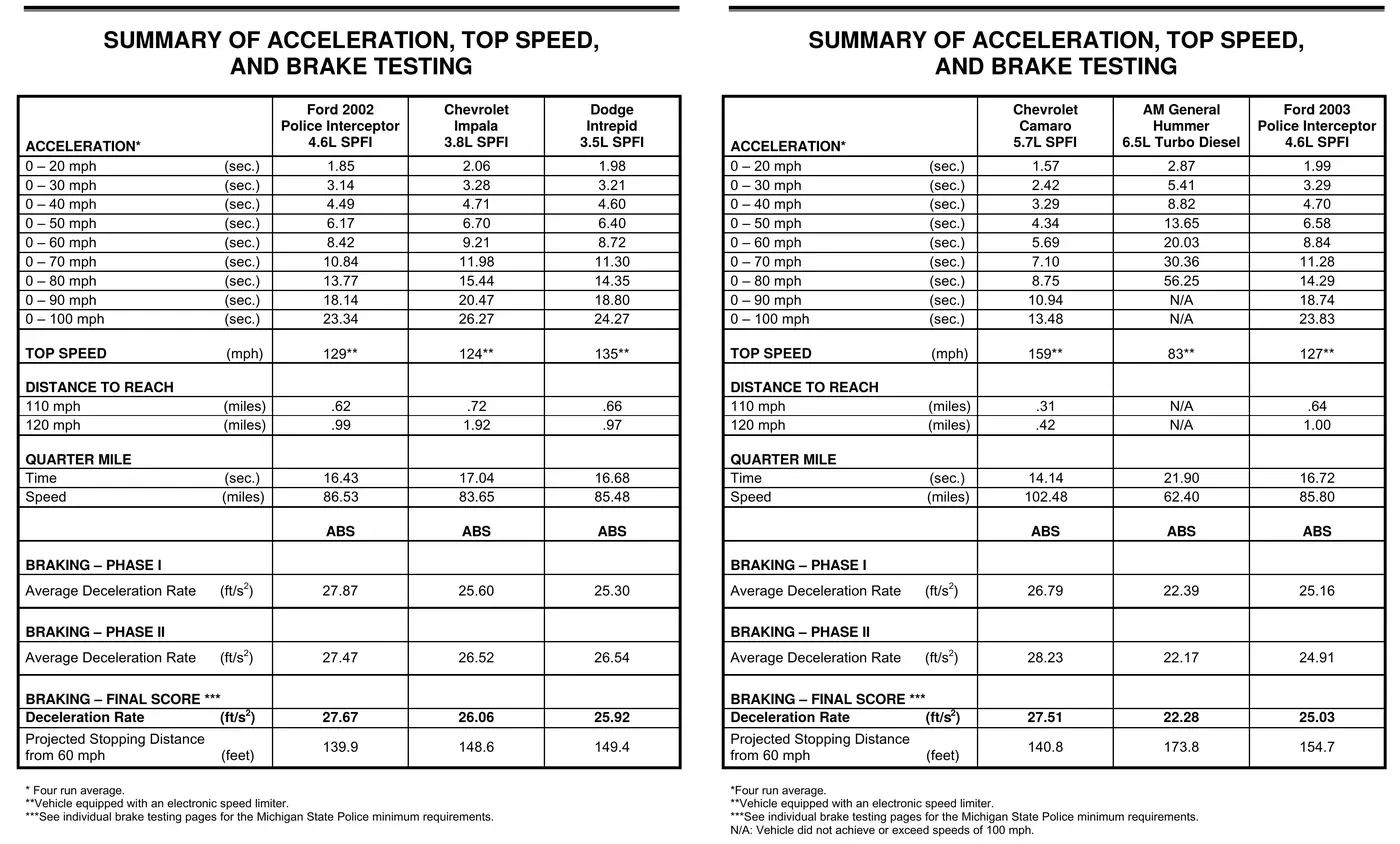
| Vehicle | 0–60 (s) | 0–100 (s) | Top speed | ¼ mile | Dynamics | Brakes (ft/s²) | Minimum | 60–0 (ft) |
|---|---|---|---|---|---|---|---|---|
| Chevrolet Camaro (automatic) | 5.69 | 13.48 | 159 ** | 14.14 @ 102.48 | 1:37.14 | 27.51 | 26.05 | 140.8 |
| Ford Police Interceptor (2002) | 8.42 | 23.34 | 129 ** | 16.43 @ 86.53 | 1:42.55 | 27.67 | 25.87 | 139.9 |
| Dodge Intrepid | 8.72 | 24.27 | 135 ** | 16.68 @ 85.48 | 1:42.83 | 25.92 | 25.96 | 149.4 |
| Ford Police Interceptor (2003) | 8.84 | 23.83 | 127 ** | 16.72 @ 85.80 | 1:42.60 | 25.03 | 25.87 | 154.7 |
| Chevrolet Impala | 9.21 | 26.27 | 124 ** | 17.04 @ 83.65 | 1:44.65 | 26.06 | 25.96 | 148.6 |
| AM General Hummer | 20.03 | never reached | 83 ** | 21.90 @ 62.40 | 2:01.55 | 22.28 | — | 173.8 |
Gold row: the last pursuit Camaro. Its quarter mile, 14.14 seconds at 102.48 mph, was the quickest by a car in the books held here to that point, 0.11 quicker than the 2001 six-speed Camaro’s 14.25, and it ran 5.69 to 60 and 159 mph. Its braking improved from 26.79 in the first phase to 28.23 in the second, for a score of 27.51, just behind the 2002 Interceptor’s 27.67.
The two braking misses are the year’s substance. The Intrepid came within 0.04 ft/s² of its requirement, which on the stopping distance is a matter of inches; the 2003 Police Interceptor missed by 0.84 and needed 154.7 feet, the longest stop of any sedan on the page. The book does not connect that result with the ABS faults recorded during the car’s dynamics runs, which came later, at Grattan.
The Hummer returned, and got worse. Where 2001 gave 18.55 seconds to 60 and 88 mph with a limiter fitted, this year it recorded 20.03 and 83, lapped 2:01.55, and needed a projected 173.8 feet to stop from 60. Its heat-up stops had to be run at 75 mph because it could not reach the standard 90.
See the original pages: the summary of acceleration, top speed and brake testing in the 2002 book
The special-service vehicles
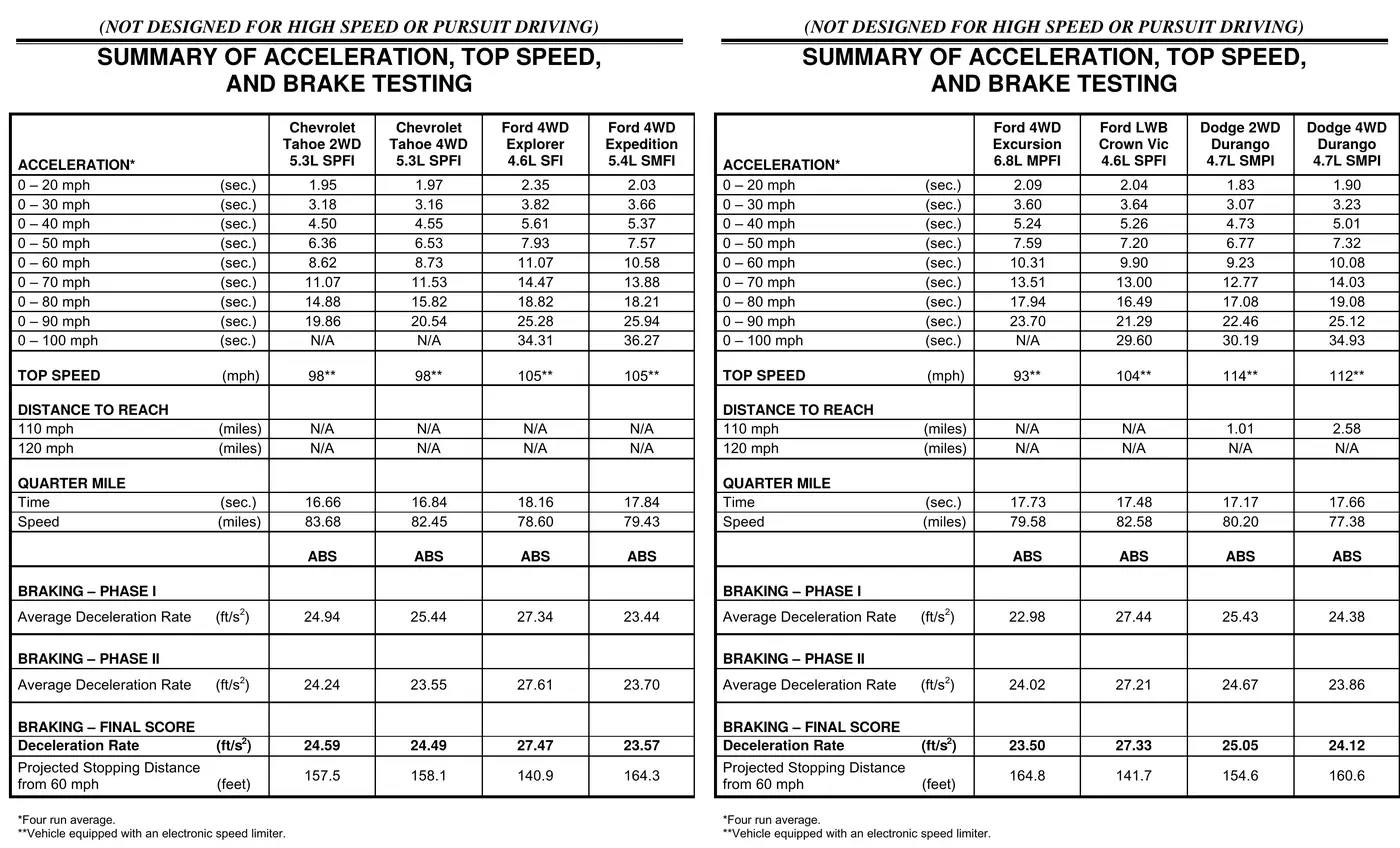
| Vehicle | 0–60 (s) | 0–100 (s) | Top speed | ¼ mile | Brakes (ft/s²) | 60–0 (ft) | Fade? |
|---|---|---|---|---|---|---|---|
| Chevrolet Tahoe (2WD) | 8.62 | N/A | 98 ** | 16.66 @ 83.68 | 24.59 | 157.5 | No |
| Chevrolet Tahoe (4WD) | 8.73 | N/A | 98 ** | 16.84 @ 82.45 | 24.49 | 158.1 | No |
| Dodge Durango (2WD) | 9.23 | 30.19 | 114 ** | 17.17 @ 80.20 | 25.05 | 154.6 | Yes |
| Ford Crown Victoria (long wheelbase) | 9.90 | 29.60 | 104 ** | 17.48 @ 82.58 | 27.33 | 141.7 | No |
| Dodge Durango (4WD) | 10.08 | 34.93 | 112 ** | 17.66 @ 77.38 | 24.12 | 160.6 | Yes |
| Ford Excursion (4WD) | 10.31 | N/A | 93 ** | 17.73 @ 79.58 | 23.50 | 164.8 | No |
| Ford Expedition (4WD) | 10.58 | 36.27 | 105 ** | 17.84 @ 79.43 | 23.57 | 164.3 | No |
| Ford Explorer (4WD) | 11.07 | 34.31 | 105 ** | 18.16 @ 78.60 | 27.47 | 140.9 | No |
The final column is the book’s fade question. Both Dodge Durangos answered yes, and the brake sheets show it: the two-wheel-drive car’s last two printed stops fell to 24.13 and 23.33 ft/s² from a first-phase best of 26.68. In the earlier books held here that print an answer for each vehicle (1978, 1980, 1984, 1990, 1992, 1994, 1996 and 2001), every answer is no; the 2005 book has two more yes answers, for the Explorer 2WD and the four-wheel-drive Tahoe.
Two other results are worth noticing. The Explorer, with the 4.6 V8, is the slowest vehicle in this table to 60 mph and has the best brakes in it, 27.47 ft/s² and 140.9 feet — better than four of the six police-category cars. And a long-wheelbase Crown Victoria appears for the first time in the books held here, stopping in 141.7 feet, classified special service.
See the original pages: the special-service summary in the 2002 book
Vehicle dynamics at Grattan — every lap, every driver
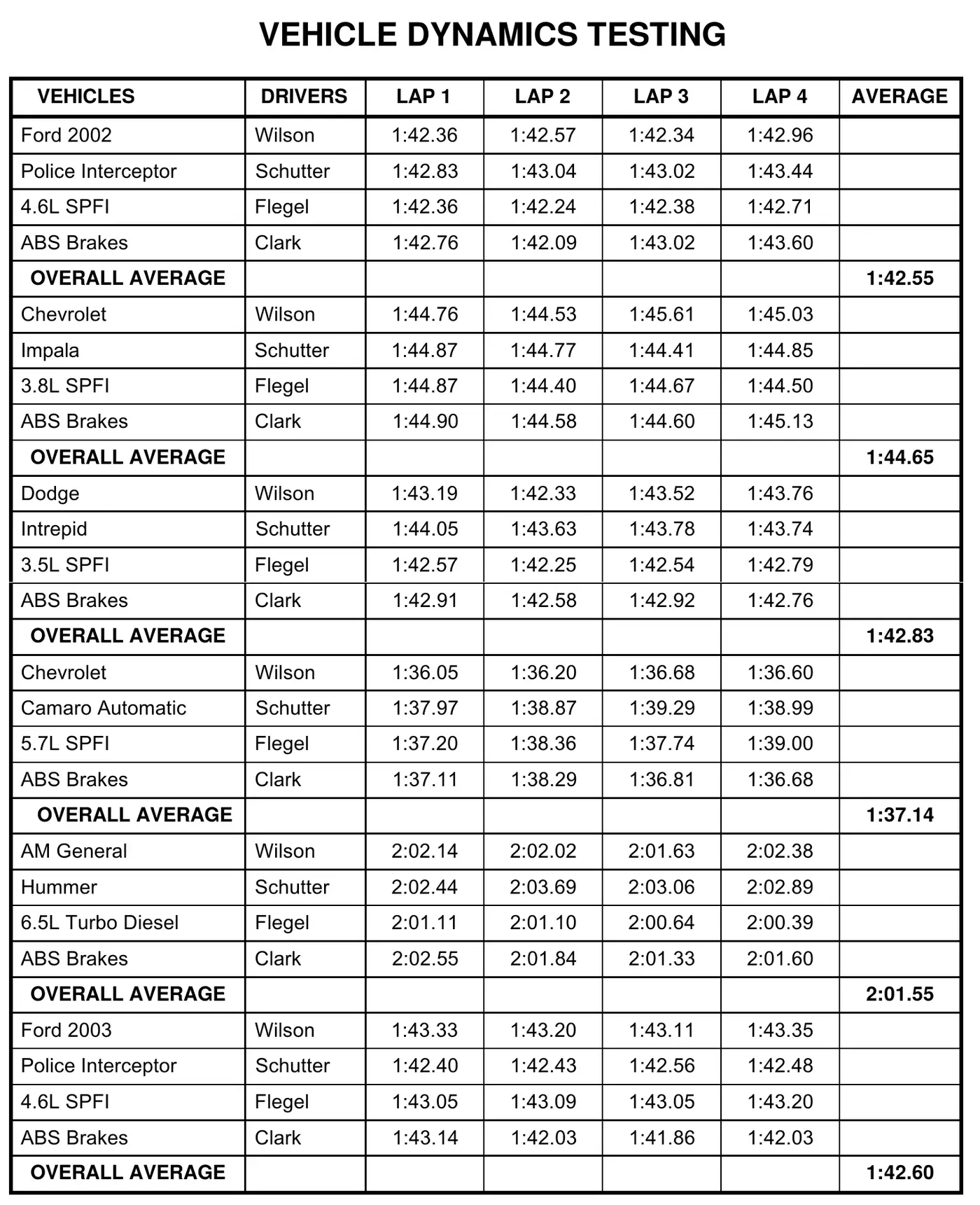
Sixteen timed laps per vehicle over the two-mile course, four drivers, score being the average of the fastest twelve. Testing began three hours late after morning rain; the track dried and the full programme was completed in the afternoon.
| Vehicle | Driver | Lap 1 | Lap 2 | Lap 3 | Lap 4 |
|---|---|---|---|---|---|
| Chevrolet Camaro (automatic) | overall average 1:37.14 | ||||
| Wilson | 1:36.05 | 1:36.20 | 1:36.68 | 1:36.60 | |
| Schutter | 1:37.97 | 1:38.87 | 1:39.29 | 1:38.99 | |
| Flegel | 1:37.20 | 1:38.36 | 1:37.74 | 1:39.00 | |
| Clark | 1:37.11 | 1:38.29 | 1:36.81 | 1:36.68 | |
| Ford Police Interceptor (2002) | overall average 1:42.55 | ||||
| Wilson | 1:42.36 | 1:42.57 | 1:42.34 | 1:42.96 | |
| Schutter | 1:42.83 | 1:43.04 | 1:43.02 | 1:43.44 | |
| Flegel | 1:42.36 | 1:42.24 | 1:42.38 | 1:42.71 | |
| Clark | 1:42.76 | 1:42.09 | 1:43.02 | 1:43.60 | |
| Ford Police Interceptor (2003) | overall average 1:42.60 | ||||
| Wilson | 1:43.33 | 1:43.20 | 1:43.11 | 1:43.35 | |
| Schutter | 1:42.40 | 1:42.43 | 1:42.56 | 1:42.48 | |
| Flegel | 1:43.05 | 1:43.09 | 1:43.05 | 1:43.20 | |
| Clark | 1:43.14 | 1:42.03 | 1:41.86 | 1:42.03 | |
| Dodge Intrepid | overall average 1:42.83 | ||||
| Wilson | 1:43.19 | 1:42.33 | 1:43.52 | 1:43.76 | |
| Schutter | 1:44.05 | 1:43.63 | 1:43.78 | 1:43.74 | |
| Flegel | 1:42.57 | 1:42.25 | 1:42.54 | 1:42.79 | |
| Clark | 1:42.91 | 1:42.58 | 1:42.92 | 1:42.76 | |
| Chevrolet Impala | overall average 1:44.65 | ||||
| Wilson | 1:44.76 | 1:44.53 | 1:45.61 | 1:45.03 | |
| Schutter | 1:44.87 | 1:44.77 | 1:44.41 | 1:44.85 | |
| Flegel | 1:44.87 | 1:44.40 | 1:44.67 | 1:44.50 | |
| Clark | 1:44.90 | 1:44.58 | 1:44.60 | 1:45.13 | |
| AM General Hummer | overall average 2:01.55 | ||||
| Wilson | 2:02.14 | 2:02.02 | 2:01.63 | 2:02.38 | |
| Schutter | 2:02.44 | 2:03.69 | 2:03.06 | 2:02.89 | |
| Flegel | 2:01.11 | 2:01.10 | 2:00.64 | 2:00.39 | |
| Clark | 2:02.55 | 2:01.84 | 2:01.33 | 2:01.60 | |
The three big sedans finish within 0.28 seconds of each other over a two-mile lap — Interceptor 1:42.55, next year’s Interceptor 1:42.60, Intrepid 1:42.83. On a course this long that is close to a dead heat. The Impala was 2.1 seconds behind the Interceptor.
See the original page: the vehicle dynamics test data in the 2002 book
What went wrong during testing — the report’s own disclosures
The Camaro broke. Under its heading for the dynamics test at Grattan, the book records that the primary test car’s transmission failed, that MSP staff and Chevrolet personnel had a back-up Camaro safety inspected, equipped and prepared, and that “The test was completed using this alternate vehicle.” The acceleration, top-speed and braking runs had been made on the Saturday at the proving grounds; the book does not say which car made them.
The 2003 Police Interceptor’s ABS failed twice. It went down during the third test driver’s run. Ford and MSP staff together could not diagnose what had happened. The system was reset, the run repeated without trouble, and then it failed again during the fourth driver’s run — at which point the driver was instructed to continue with the ABS inactive.
A three-hour rain delay. The dynamics session at Grattan was delayed all morning and run in the afternoon once the track dried, using what the report calls the team’s new testing equipment.
The Hummer couldn’t reach the heat-up speed. Its brake conditioning runs were made at 75 mph rather than the standard 90, because the vehicle is unable to attain 90.
Fuel figures for the 2003 Interceptor were not yet available. Its EPA line reads TBD, “Not available until March 2002”.
Ergonomics, communications and fuel
| Vehicle | Category | Ergonomics & communications | EPA city (mpg) |
|---|---|---|---|
| Ford Excursion (4WD) | Special service | 235.14 | N/A |
| Chevrolet Tahoe (2WD) | Special service | 229.56 | 15 |
| Chevrolet Tahoe (4WD) | Special service | 229.23 | 14 |
| Ford Expedition (4WD) | Special service | 228.63 | 12 |
| Ford Crown Victoria (LWB) | Special service | 223.35 | 17 |
| Ford Police Interceptor (2003) | Police | 223.08 | TBD |
| Chevrolet Impala | Police | 221.64 | 19.5 |
| Ford Police Interceptor (2002) | Police | 221.26 | 15.5 |
| Dodge Intrepid | Police | 218.34 | 18.0 |
| Ford Explorer (4WD) | Special service | 210.75 | 14 |
| Dodge Durango (2WD) | Special service | 206.48 | 14 |
| Dodge Durango (4WD) | Special service | 205.19 | 13 |
| Chevrolet Camaro | Police | 161.98 | 16.6 |
| AM General Hummer | Police | 154.40 | 9.0 |
Among the police-category vehicles, the 2003 Police Interceptor scores highest, at 223.08 — the highest police-category ergonomics score since the 1998 Tahoe’s 238.89, from the same car that missed its braking minimum. The Impala edges the 2002 Interceptor by 0.38 points, continuing an unbroken run since 2000, while returning four more miles per gallon in the city.
The Camaro’s departing scores include 1.50 out of ten for rear-seat entry and exit and 2.00 for rear legroom. The Hummer took 3.50 for front-seat entry and exit and 3.90 for its outside mirror controls.
What 2002 settled
Dodge came back and the pursuit Camaro went away in the same test. The Intrepid ran 135 mph, faster than both Police Interceptors, and lapped within three tenths of the Ford over two miles — and then fell short of its braking minimum by four hundredths of a foot per second squared on its first official outing. The Camaro left with a 14.14-second quarter mile at 102.48 mph, the quickest by a car in the books held here to that point.
And the year’s most consequential vehicle is one with no data at all. General Motors brought a Tahoe as an unpublished prototype and Michigan told its readers why it mattered: it was “of particular interest because it would be a pursuit rated SUV for the future”. Three model years later the Tahoe PPV was in the police category.