
Michigan test archive
2006 Michigan State Police Patrol Vehicle Test
The HEMI comes to the police category — and takes the American police sedan top-speed mark the Caprice had held in these books since 1994.
Nine vehicles ran in the police category, four in special service (the preface says five but lists four), and two more in a non-published category. The list is dominated by a manufacturer that had been absent from these tables for most of the nineties: Dodge entered four police-category cars — a Charger and a Magnum, each with the 3.5-litre V6 and each with the 5.7-litre HEMI.
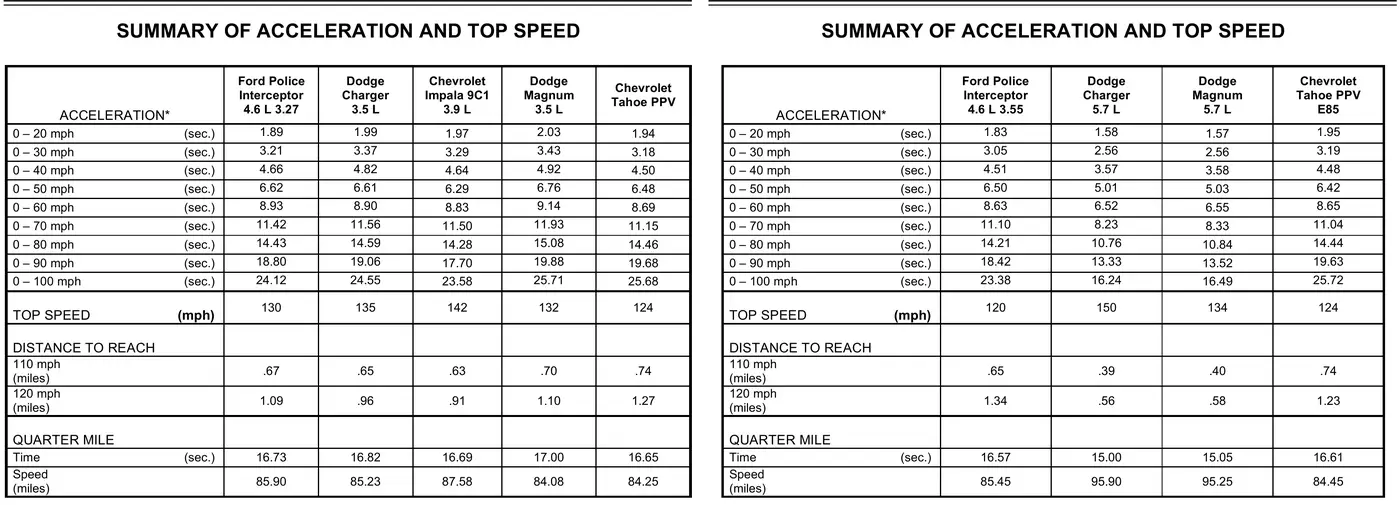
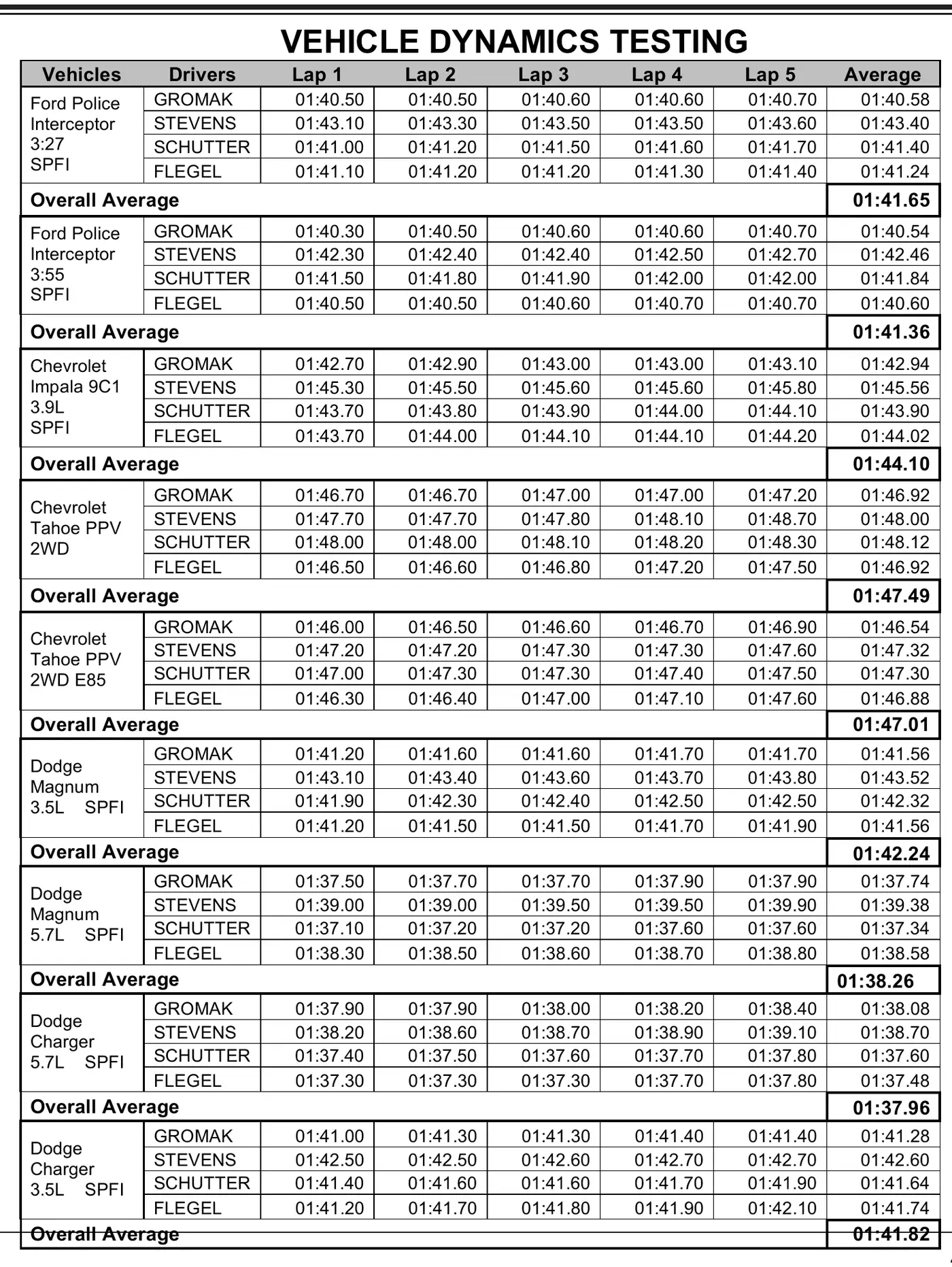
The HEMI Charger settled matters immediately. It reached 60 mph in 6.52 seconds, 100 in 16.24, crossed the quarter mile in 15.00 at 95.90 mph, and ran 150 mph. It lapped Grattan in 1:37.96. Those acceleration figures are Camaro territory — the last Camaro, in 2002, managed 5.69 to 60 and 13.48 to 100 — achieved by a four-door sedan with a usable back seat.
And 150 mph is the fastest top speed any American police sedan had recorded in this archive to that point; only the Volvo S-70 T5 sedan of 2000, at 153, had gone faster. The 1994 Caprice’s 141.2 had stood for twelve years, and the last Caprice before 2011, in 1996, had run 139. The Charger beat the 1994 car by nearly nine miles an hour, and the Impala — a front-drive Chevrolet with a 3.9-litre V6 — beat it too, at 142.
The Ford Police Interceptor, meanwhile, ran 130 mph with the 3.27 axle and 120 with the 3.55, took 8.93 and 8.63 seconds to 60 respectively, and lapped Grattan behind both HEMI Dodges but ahead of the two V6 Dodges and the Impala. It had been in every Michigan test under that name since 1999. The 3.55 car’s 120 mph was the lowest top speed in the police category.
The police category
| Vehicle | 0–60 (s) | 0–100 (s) | Top speed | ¼ mile | Dynamics | Brakes (ft/s²) | 60–0 projected (ft) |
|---|---|---|---|---|---|---|---|
| Dodge Charger 5.7L HEMI | 6.52 | 16.24 | 150 | 15.00 @ 95.90 | 1:37.96 | 29.01 | 133.5 |
| Dodge Magnum 5.7L HEMI | 6.55 | 16.49 | 134 | 15.05 @ 95.25 | 1:38.26 | 29.53 | 131.1 |
| Dodge Charger 3.5L | 8.90 | 24.55 | 135 | 16.82 @ 85.23 | 1:41.82 | 29.77 | 130.1 |
| Dodge Magnum 3.5L | 9.14 | 25.71 | 132 | 17.00 @ 84.08 | 1:42.24 | 30.19 | 128.3 |
| Ford Police Interceptor (3.55 axle) | 8.63 | 23.38 | 120 | 16.57 @ 85.45 | 1:41.36 | 27.10 | 142.9 |
| Ford Police Interceptor (3.27 axle) | 8.93 | 24.12 | 130 | 16.73 @ 85.90 | 1:41.65 | 27.05 | 143.2 |
| Chevrolet Impala 9C1 3.9L | 8.83 | 23.58 | 142 | 16.69 @ 87.58 | 1:44.10 | 27.19 | 142.4 |
| Chevrolet Tahoe PPV 2WD (E85) | 8.65 | 25.72 | 124 | 16.61 @ 84.45 | 1:47.01 | 27.11 | 142.8 |
| Chevrolet Tahoe PPV 2WD | 8.69 | 25.68 | 124 | 16.65 @ 84.25 | 1:47.49 | 26.63 | 145.4 |
Gold row: 150 mph, the fastest top speed by an American police sedan in these books to that point (the 2000 Volvo S-70 T5 sedan had run 153), and the first time since the Camaro left that anything with four doors got near the pony cars. Its 15.00-second quarter mile was the quickest by a sedan in the books held here to that point.
What the book says on printed page 2
Three facts sit in the 2006 report’s General Information section, on printed page 2, and none of them is explained in the results tables. They change how the figures on this page should be read.
Every vehicle here had a speed limiter fitted. Michigan states it for the whole field, in the sentence the 2005 report also used: “All vehicles listed in this report were equipped with electronic speed limiters.” (The 2003 to 2005 bulletins put it as “All vehicles are equipped with electronic speed limiters.”) Fitted is not the same as reached: in 1996 Michigan reported that one limited car, the Crown Victoria, never got to its preset speed.
The Impala’s braking figures are retest figures, and the reason is unusually candid. Michigan writes: “During Saturday’s Brake Testing the Chevrolet Impala did not make MSP’s minimum deceleration qualification for braking. The following week we were contacted by Chevrolet. Chevrolet found a calibration error in the ABS software on the test vehicle. This error did not effect FMVSS requirements, but was corrected to achieve MSP requirements… The test team went back to the DCX Proving Grounds on October 7th and retested the Chevrolet Impala in the braking portion only. The data published in the Brake Testing section of the book is for the retest and is accurate for the software that Chevrolet will provide for the 2006 model.”
Two things are worth drawing out of that. The car failed a minimum standard on the day and the published figure is its second attempt with corrected software — so the 27.19 ft/s² in the table is not what the submitted vehicle did. And Michigan’s standard was the stricter one: the original calibration met the federal requirement and failed Michigan’s. Only the braking was re-run; the acceleration and top speed stand from the original session.
Four vehicles never ran the dynamics test. “The Chevrolet 4WD Tahoe, Ford Explorer, Ford Expedition, and one of the Dodge Magnum’s are ‘special service’ vehicles and are not driven through the vehicle dynamics (high-speed handling) test.” Michigan’s own phrasing — one of the Magnums — confirms there are two 3.5L Magnums in 2006, a pursuit car and a special-service car, which is how this page lists them.
The braking column is the real upheaval, and it belongs entirely to Dodge. All four police-category Chargers and Magnums had projected stops under 134 feet; the Magnum 3.5 needed 128.3, the shortest twelve-stop figure in the books held here to that point (the 2000 Volvo V-70 T5 wagon had 129.5). Every Ford and Chevrolet in the police category needed at least 142 feet, almost nine more than the longest Dodge. The Impala’s figure is from its October 7 retest; the rest were braked on September 17.
Note also what the top-speed column now measures. The 3.55-axle Interceptor recorded 120 mph and the 3.27 car 130, while a front-drive V6 Impala ran 142 and a 3.5-litre Charger 135. This book does not say where any limiter was set. Two years earlier, though, Ford stated that its optional 3.55 axle “will reduce the maximum top speed of the vehicle to 119 mph”, which suggests the 3.55 car’s figure is a setting rather than what it could do. For the 3.27 car’s 130, the 2000 bulletin had said the Police Interceptor “features a 130-mph speed limiter”.
See the original pages: the acceleration and top speed summary and the vehicle dynamics data in the 2006 book
The special-service vehicles
| Vehicle | 0–60 (s) | Top speed | ¼ mile | Brakes (ft/s²) | 60–0 projected (ft) | Ergonomics & communications |
|---|---|---|---|---|---|---|
| Ford Explorer 4.6L (2WD) | 8.62 | 97 | 16.75 @ 85.58 | 25.83 | 149.9 | 177.27 |
| Dodge Magnum 3.5L (special service) | 9.07 | 117 | 16.93 @ 84.58 | 27.11 | 142.8 | 183.10 |
| Chevrolet Tahoe 5.3L (4WD) | 9.50 | 98 | 17.18 @ 82.73 | 24.79 | 156.2 | 211.48 |
| Ford Expedition 5.4L (2WD) | 9.77 | 100 | 17.32 @ 81.28 | 27.10 | 142.9 | 202.52 |
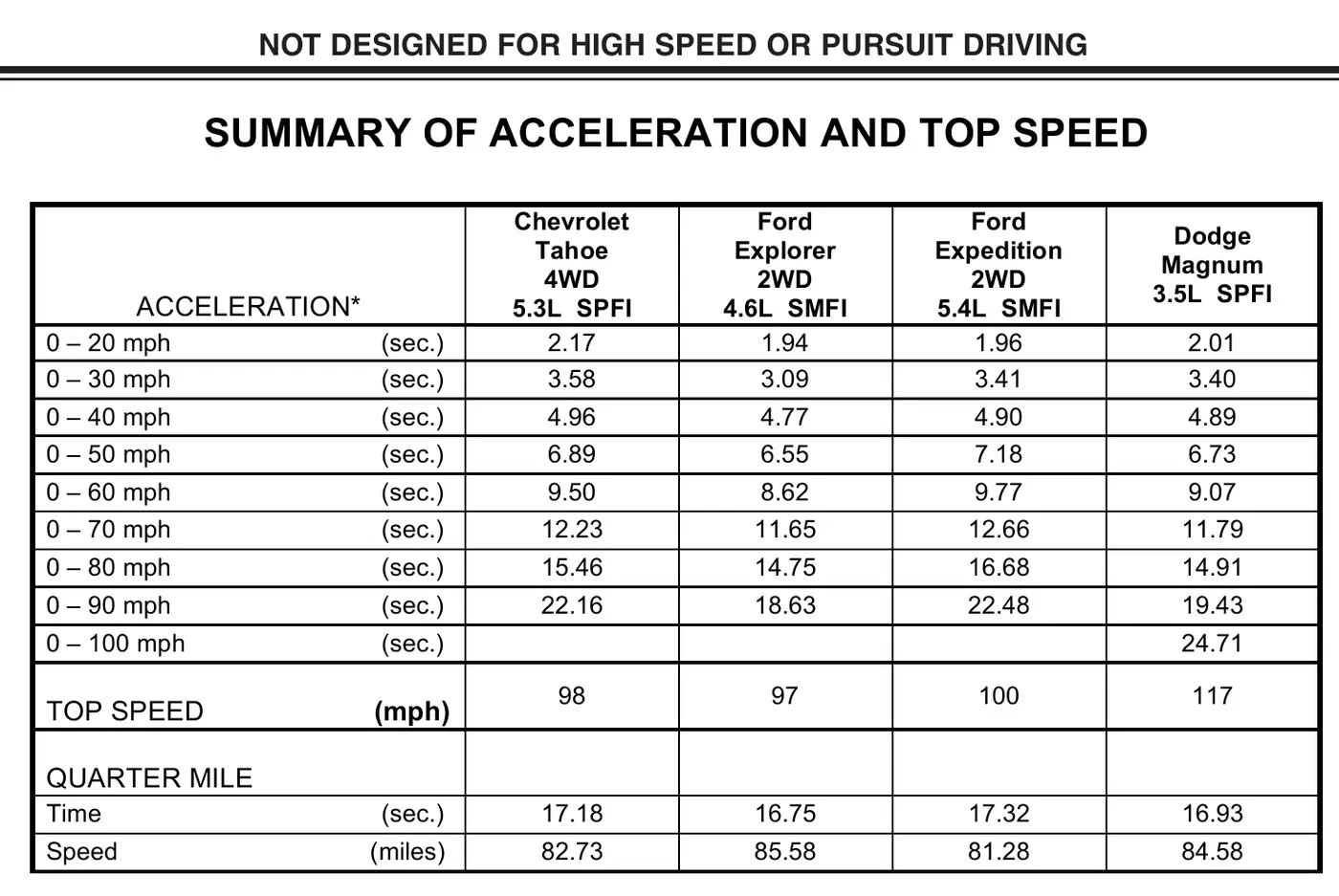
The Magnum appears in both categories this year — as a police-package car running 132 mph and stopping in 128.3 feet, and as a special-service car running 117 and stopping in 142.8. Same nameplate and engine, but a different transmission and axle (the police car’s five-speed and 2.87 against the special-service car’s four-speed and 3.64), different rear brakes and tyres, and very different results. The book does not say which difference produced which result.
See the original page: the special-service summary in the 2006 book
Ergonomics, communications and fuel
| Vehicle | Ergonomics & communications | EPA city (mpg) |
|---|---|---|
| Chevrolet Tahoe PPV | 215.36 | 14.6 (PPV 2WD) / 11.0 (E85) |
| Ford Police Interceptor | 202.65 | 15.6 |
| Chevrolet Impala 9C1 | 193.71 | 18.8 |
| Dodge Magnum | 188.73 | 18.8 (3.5) / 16.9 (5.7) |
| Dodge Charger | 188.00 | 18.8 (3.5) / 16.9 (5.7) |
The Tahoe wins this column again, and the Interceptor holds second by more than eight points — its trunk accessibility scored a perfect 10.00 from the technicians who had to fit equipment into it, the only 10.00 in this book. The Chargers finished last of the sedans, with 4.90 for the automatic door lock switch and 5.70 for rear visibility. Fast is not the same as easy to live in.
And read the E85 line carefully. The E85 Tahoe is rated 11.0 mpg city against 14.6 for the petrol Tahoe PPV, about a quarter less. In the 2005 book’s scored fuel-economy figures the E85 Tahoe gave 11.3 mpg city against 14.3, a gap of 3.0; here it is 3.6.
What 2006 settled
The performance police sedan came back, and it was a Dodge. Chrysler had returned in 2002 with an Intrepid that missed its braking requirement by four hundredths; four years later it brought a HEMI Charger that ran 150 mph, went quicker to 100 than any four-door in these books to that point, and had a projected stop of 133.5 feet, with its own V6 stablemates stopping shorter still: the Magnum 3.5’s 128.3 was the shortest twelve-stop figure in these books to that point.
What makes the year matter, though, is what it did to the Ford. In 2006 the 3.55 Police Interceptor was slower to 60 than both HEMI Dodges and the 3.27 car slower than seven other police-category vehicles; both lapped Grattan behind the two HEMIs; and each needed between 9.4 and 14.9 feet more to stop than the four police-category Dodges.