
Michigan test archive
2022 Michigan State Police Patrol Vehicle Test
A Mustang returns to these books after twenty-nine years as the first electric car in them, reaches 60 mph in 4.03 seconds, and laps slowest of the cars. Every specification page now prints its speed limit.
Eleven vehicles and four motorcycles, published in November 2021. Acceleration, top speed and braking were run at the Chelsea Proving Grounds on 18 September 2021; the motorcycles lapped Grattan Raceway on 16 September and the cars on 20 September. The field is the 2021 one again — two Tahoes, two Chargers, two Durangos, three Police Interceptor Utilities and an F-150 — plus one newcomer, a 2021 Ford Mustang Mach-E. It is the first battery-electric four-wheeled vehicle in the books held here, and the first Mustang in the books held here since 1993.
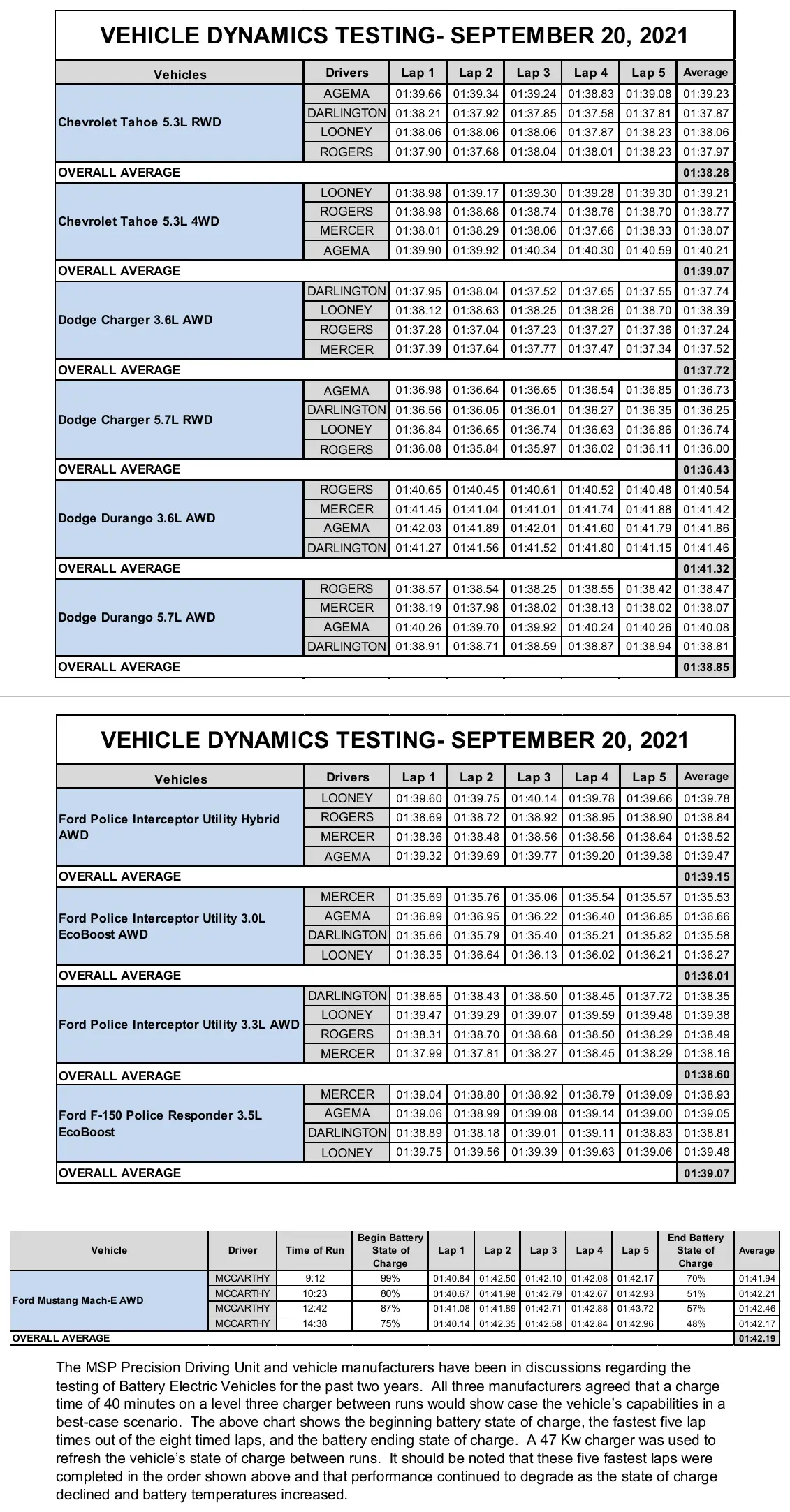
The Mach-E reached 60 mph in 4.03 seconds, 1.42 seconds quicker than any other car in the field, and 100 in 11.94. It stopped shortest, in 125.0 feet. And it lapped slowest of the cars, at 1:42.19, driven by one driver across four runs, with a 47 kW charger used between them; the manufacturers had agreed on forty minutes of charging. The book says the Precision Driving Unit and the manufacturers had been discussing how to test battery-electric vehicles for two years.
The other change is in the specification pages. All fifteen now print a Manufacturer Limited Top Speed, and eleven vehicles topped out exactly at it. For the two Chargers and two of the motorcycles the book marks the measured figure as a practical top speed, and defines it: the point at which engine power is reduced before the nominal figure is reached.
And the new F-150 is quick — 5.79 seconds to 60, 120 mph — but it stopped from 60 in 160.9 feet, at 24.07 ft/s², below the 25.79 the book sets as the braking criterion.
The police vehicles
| Vehicle | 0–60 (s) | 0–100 (s) | Top speed | Top speed at | Dynamics | Brakes (ft/s²) | 60–0 (ft) | Comms | Ergo |
|---|---|---|---|---|---|---|---|---|---|
| 2021 Ford Mustang Mach-E AWD (electric) | 4.03 | 11.94 | 124 | 2.10 mi | 1:42.19 | 30.98 | 125.0 | 5.33 | 7.66 |
| Ford PI Utility EcoBoost AWD 3.0L | 5.45 | 13.47 | 148 | 1.55 mi | 1:36.01 | 29.00 | 133.5 | 9.44 | 7.98 |
| Ford F-150 Police Responder EcoBoost 3.5L | 5.79 | 14.34 | 120 | 0.55 mi | 1:39.07 | 24.07 | 160.9 | 8.71 | 8.44 |
| Dodge Charger 5.7L RWD | 6.15 | 14.06 | 139 * | 0.93 mi | 1:36.43 | 29.40 | 131.7 | 8.71 | 8.20 |
| Dodge Durango 5.7L AWD | 6.79 | 18.10 | 130 | 1.28 mi | 1:38.85 | 28.36 | 136.6 | 9.78 | 8.22 |
| Dodge Charger 3.6L AWD | 7.17 | 17.91 | 139 * | 2.62 mi | 1:37.72 | 29.85 | 129.7 | 8.71 | 8.20 |
| Ford PI Utility Hybrid AWD | 7.25 | 17.40 | 136 | 1.25 mi | 1:39.15 | 29.07 | 133.2 | 9.44 | 7.98 |
| Chevrolet Tahoe 5.3L RWD | 7.65 | 18.81 | 130 | 1.58 mi | 1:38.28 | 29.99 | 129.1 | 8.84 | 8.74 |
| Ford PI Utility AWD 3.3L | 7.79 | 19.32 | 136 | 1.83 mi | 1:38.60 | 28.79 | 134.5 | 9.44 | 7.98 |
| Chevrolet Tahoe 5.3L 4WD | 7.95 | 19.98 | 124 | 0.98 mi | 1:39.07 | 29.46 | 131.5 | 8.84 | 8.74 |
| Dodge Durango 3.6L AWD | 8.16 | 22.80 | 127 | 2.87 mi | 1:41.32 | 28.94 | 133.8 | 9.78 | 8.22 |
Gold row: the Mach-E is quickest to 60 by 1.42 seconds and to 100 by 1.53, and stops 4.1 feet shorter than anything else here. It is also last on the road course, 0.87 seconds a lap behind the V6 Durango and 6.18 behind the EcoBoost Utility, which had the best dynamics average, 1:36.01, and the highest top speed, 148 mph.
* Practical top speed, in the book’s own words: reached when “the electronic speed limiter reduces engine power and limits acceleration gains prior to reaching 140 mph nominal top speed.” Printed page 40.
The Mach-E’s dynamics sheet records battery charge, which no earlier car sheet in these books does. One driver, Lieutenant McCarthy, ran four eight-lap series. They began at 99, 80, 87 and 75 percent charge and ended at 70, 51, 57 and 48 percent; a 47 kW charger was used between runs. In every series the first counted lap is the quickest, and the book notes that “performance continued to degrade as the state of charge declined and battery temperatures increased.” All three manufacturers, it says, had agreed that forty minutes of charging between runs would show the vehicle in a best-case scenario.
The F-150 is a 2022 model, and every performance figure moved from the 2021 book. It is 0.82 seconds quicker to 60 (5.79 against 6.61), reaches its printed limit of 120 mph where the 2021 truck topped out at 105, and laps 4.77 seconds quicker (1:39.07 against 1:43.84). It also stops 14.9 feet longer. Its specification page lists the drive system as “Front Wheel Drive”, as the 2023, 2024 and 2025 books’ do; the summary pages call it simply the F150 Police Responder 3.5L EcoBoost.
Every vehicle that also ran in 2021 needed longer to stop this year: the Tahoes by 1.7 and 4.4 feet, the Chargers by 2.5 and 2.9, the Durangos by 0.7 and 3.9, the Utilities by 3.1 to 7.9. The book does not comment on the car braking surface; it describes the same lanes on the east straightaway as the 2021 book. All eleven stopped in a straight line, in their lanes, with no evidence of severe fading.
See the original pages in the 2022 book: lap times
Acceleration in detail
| 0 to… | Mach-E | PI Utility EcoBoost | F-150 | Charger RWD | Durango 5.7L | Charger AWD | PI Utility Hybrid | Tahoe RWD | PI Utility 3.3L | Tahoe 4WD | Durango 3.6L |
|---|---|---|---|---|---|---|---|---|---|---|---|
| 20 mph | 1.28 | 1.49 | 1.63 | 1.84 | 1.54 | 1.76 | 1.76 | 2.09 | 2.09 | 2.09 | 1.84 |
| 30 mph | 1.87 | 2.19 | 2.35 | 2.63 | 2.42 | 2.72 | 2.94 | 3.07 | 3.21 | 3.14 | 2.92 |
| 40 mph | 2.45 | 3.11 | 3.36 | 3.59 | 3.61 | 3.89 | 4.22 | 4.42 | 4.55 | 4.57 | 4.28 |
| 50 mph | 3.16 | 4.15 | 4.42 | 4.67 | 5.03 | 5.35 | 5.65 | 5.84 | 6.09 | 6.07 | 5.89 |
| 60 mph | 4.03 | 5.45 | 5.79 | 6.15 | 6.79 | 7.17 | 7.25 | 7.65 | 7.79 | 7.95 | 8.16 |
| 70 mph | 5.08 | 6.88 | 7.28 | 7.73 | 8.74 | 9.33 | 9.19 | 9.64 | 9.86 | 10.08 | 10.67 |
| 80 mph | 6.46 | 8.78 | 9.17 | 9.44 | 11.25 | 11.57 | 11.45 | 12.18 | 12.42 | 12.77 | 13.85 |
| 90 mph | 8.58 | 10.92 | 11.30 | 11.70 | 14.17 | 14.60 | 14.18 | 15.12 | 15.46 | 16.01 | 17.77 |
| 100 mph | 11.94 | 13.47 | 14.34 | 14.06 | 18.10 | 17.91 | 17.40 | 18.81 | 19.32 | 19.98 | 22.80 |
| Miles to 100 mph | 0.22 | 0.23 | 0.25 | 0.24 | 0.33 | 0.31 | 0.30 | 0.33 | 0.34 | 0.35 | 0.42 |
| Miles to 120 mph | 0.68 | 0.46 | 0.55 | 0.46 | 0.72 | 0.71 | 0.61 | 0.73 | 0.75 | 0.82 | 1.14 |
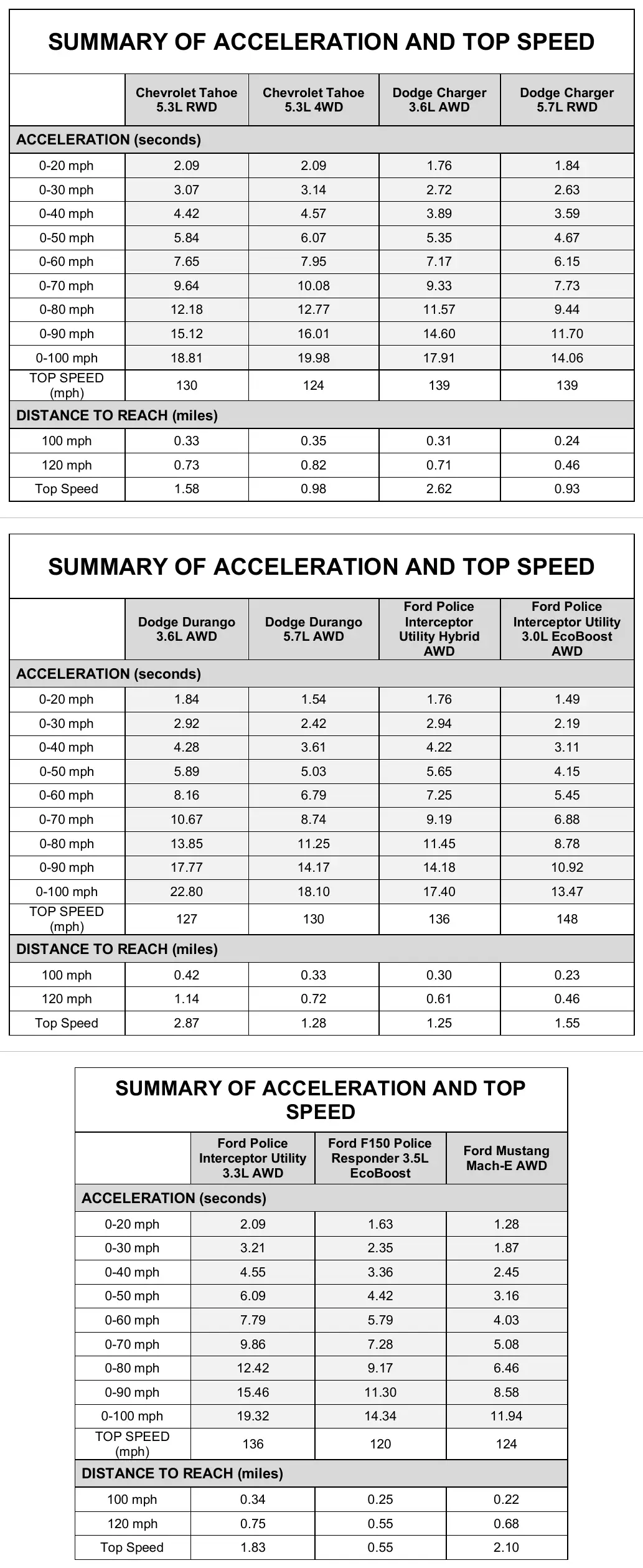
The Mach-E leads the cars at every speed up to 100 mph. Its margin over the next vehicle, the EcoBoost Utility, grows to 2.34 seconds at 90 mph and then narrows to 1.53 at 100. By 120 mph four cars are ahead of it on distance: the EcoBoost Utility and the V8 Charger at 0.46 miles, the F-150 at 0.55 and the Hybrid Utility at 0.61, against its 0.68.
See the original pages in the 2022 book: acceleration
The purchasing criteria, and one vehicle that missed them
The book repeats the MSP’s purchasing criteria on printed page 5: 60 mph within 9.0 seconds, 80 within 14.9 and 100 within 24.6; 110 mph within 0.92 mile and 120 within 1.70 miles; an average of 25.79 ft/s² across twenty 60-to-0 stops; and all 32 Grattan laps without major component failure. Meeting them, it says, “does not certify a vehicle as being pursuit rated”.
One vehicle misses a printed figure. The F-150 averaged 24.07 ft/s² across its twenty stops, against 25.79. The book does not name it as failing, and it is muted in the table above for that reason only. Every other car clears every criterion for which the book prints a figure; the distance to 110 mph is not printed for any of them. The V6 Durango, 0.12 seconds outside the 0–100 time in the 2021 book, reached 100 in 22.80 seconds this year.
The motorcycles
| Machine | 0–60 (s) | 0–100 (s) | Top speed | Top speed at | Dynamics | Brakes (ft/s²) | 60–0 (ft) |
|---|---|---|---|---|---|---|---|
| BMW R 1250 RT-P | 4.17 | 9.29 | 134 * | 2.42 mi | 1:37.46 | 28.00 | 138.3 |
| Yamaha FJR1300P-AB | 4.45 | 9.25 | 145 * | 0.94 mi | 1:38.32 | 26.19 | 147.9 |
| Harley-Davidson FLHP | 5.30 | 17.20 | 110 | 0.71 mi | 1:50.93 | 27.38 | 141.4 |
| Harley-Davidson FLHTP | 5.56 | 18.74 | 110 | 0.83 mi | 1:49.32 | 26.69 | 145.1 |
| 0 to… | BMW | Yamaha | FLHP | FLHTP |
|---|---|---|---|---|
| 20 mph | 1.42 | 1.75 | 1.26 | 1.38 |
| 30 mph | 2.08 | 2.37 | 1.89 | 2.05 |
| 40 mph | 2.67 | 2.98 | 2.68 | 2.84 |
| 50 mph | 3.37 | 3.56 | 3.96 | 4.17 |
| 60 mph | 4.17 | 4.45 | 5.30 | 5.56 |
| 70 mph | 4.95 | 5.26 | 6.85 | 7.16 |
| 80 mph | 5.98 | 6.42 | 9.04 | 9.48 |
| 90 mph | 7.16 | 7.62 | 11.81 | 12.48 |
| 100 mph | 9.29 | 9.25 | 17.20 | 18.74 |
| Miles to 100 mph | 0.15 | 0.15 | 0.33 | 0.37 |
| Miles to 120 mph | 0.35 | 0.30 | N/A | N/A |
Gold row: the BMW is quickest to 60, takes the fastest lap and stops shortest, but the Yamaha is four hundredths quicker to 100 and reaches 145 mph. The Harley-Davidsons are the Road King (FLHP) and the Electra Glide (FLHTP), both limited to 110; the Road King is quicker of the two to 60, to 100 and to its limit, and stops 3.7 feet shorter. To 20 mph it is quicker than anything in the book, the Mach-E included; to 30 it is the quickest motorcycle.
Two cautions from the book itself. The braking was done on the oval because of construction at the Precision Driving Unit, and the oval’s different coefficient of friction “may have contributed to the overall increase in braking distances when compared to the 2021 model year motorcycles” — results that are not in the 2021 book held here. And BMW tested with most of its equipment installed, while Harley-Davidson and Yamaha chose minimal equipment.
Every specification page prints the limit
Every vehicle on this page had a speed limiter fitted, unless the book notes otherwise. The report states it for the whole field in its General Information section, printed page 4: “All vehicles listed in this report were equipped with electronic speed limiters unless otherwise noted.” The top-speed test for the cars is described, on printed page 37, as a test “to verify the electronically limited top speed reported by the manufacturer”.
This year all fifteen specification pages print a Manufacturer Limited Top Speed. The 2021 book printed it for three vehicles; the 2025 book for ten of fourteen.
| Vehicle | Manufacturer limit | Measured | Spec page |
|---|---|---|---|
| Ford PI Utility EcoBoost AWD 3.0L | 148 | 148 | p.24 (PDF 25) |
| Dodge Charger 3.6L AWD | 140 | 139 * | p.14 (PDF 15) |
| Dodge Charger 5.7L RWD | 140 | 139 * | p.16 (PDF 17) |
| Ford PI Utility Hybrid AWD | 136 | 136 | p.22 (PDF 23) |
| Ford PI Utility AWD 3.3L | 136 | 136 | p.26 (PDF 27) |
| Chevrolet Tahoe 5.3L RWD | 130 | 130 | p.10 (PDF 11) |
| Dodge Durango 5.7L AWD | 130 | 130 | p.20 (PDF 21) |
| Dodge Durango 3.6L AWD | 130 | 127 | p.18 (PDF 19) |
| Chevrolet Tahoe 5.3L 4WD | 124 | 124 | p.12 (PDF 13) |
| 2021 Ford Mustang Mach-E AWD (electric) | 124 | 124 | p.30 (PDF 31) |
| Ford F-150 Police Responder EcoBoost 3.5L | 120 | 120 | p.28 (PDF 29) |
| Yamaha FJR1300P-AB | 145 | 145 * | p.75 (PDF 76) |
| BMW R 1250 RT-P | 137 | 134 * | p.69 (PDF 70) |
| Harley-Davidson FLHTP | 110 | 110 | p.70–71 (PDF 71–72) |
| Harley-Davidson FLHP | 110 | 110 | p.72–73 (PDF 73–74) |
Eleven of the fifteen topped out exactly at their printed limit. The two Chargers and the BMW stopped short of it, each at what the book calls a practical top speed, below a nominal figure it gives as 140 mph for the Chargers and 137 for the BMW. The V6 Durango reached 127 against 130, as it would again in 2025. The Yamaha’s data sheet also marks its 145 as a practical top speed, but gives the nominal figure there as 147, against the 145 its specification page prints.
Ergonomics and communications
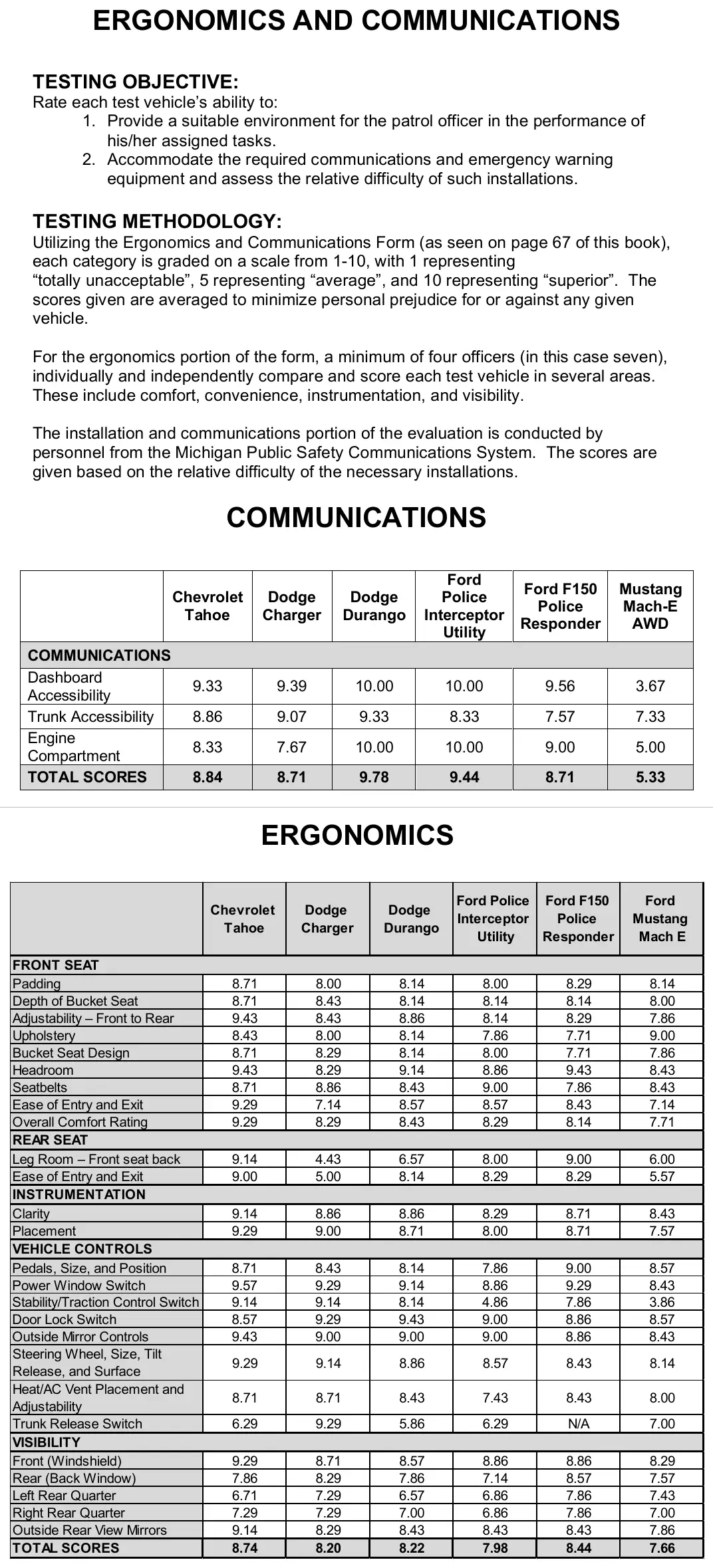
Seven officers scored ergonomics this year (the method calls for at least four). The totals: Tahoe 8.74, F-150 8.44, Durango 8.22, Charger 8.20, Police Interceptor Utility 7.98, Mach-E 7.66. Every model that also ran in 2021 scored lower than it did then. The lowest single marks on the sheet are the Mach-E’s stability and traction control switch, 3.86, and the Charger’s rear legroom, 4.43; the Utility’s traction control switch scored 4.86.
Communications installation is graded separately, by personnel from the Michigan Public Safety Communications System. The Mach-E scored 5.33, more than three points below anything else, with 3.67 for dashboard access and 5.00 for the engine compartment. The other five models repeat their 2021 scores exactly. All six sets of sub-scores appear again unchanged in the 2023 book, and five of the six, the Mach-E’s included, in the 2026 book, which has no Charger. None of these books says whether the installations were re-assessed.
See the original pages in the 2022 book: ergonomics
Fuel economy
| Vehicle | City | Highway | Combined |
|---|---|---|---|
| 2021 Ford Mustang Mach-E AWD (electric) | – | – | 84 MPGe |
| Ford PI Utility Hybrid AWD | 23 | 24 | 24 |
| Dodge Charger 3.6L AWD | 18 | 26 | 21 |
| Dodge Durango 3.6L AWD | 18 | 25 | 21 |
| Dodge Charger 5.7L RWD | 16 | 25 | 19 |
| Ford PI Utility AWD 3.3L | 17 | 23 | 19 |
| Ford PI Utility EcoBoost AWD 3.0L | 17 | 22 | 19 |
| Ford F-150 Police Responder EcoBoost 3.5L | 16 | 20 | 18 |
| Dodge Durango 5.7L AWD | 14 | 22 | 17 |
| Chevrolet Tahoe 5.3L RWD | 15 | 19 | 16 |
| Chevrolet Tahoe 5.3L 4WD | 14 | 18 | 16 |
See the original page in the 2022 book: fuel economy
| Motorcycle | City | Highway | Combined |
|---|---|---|---|
| BMW R 1250 RT-P | – | – | 50 (WMTC) |
| Harley-Davidson FLHTP | – | – | 43 |
| Harley-Davidson FLHP | – | – | 43 |
| Yamaha FJR1300P-AB | – | – | 36 |
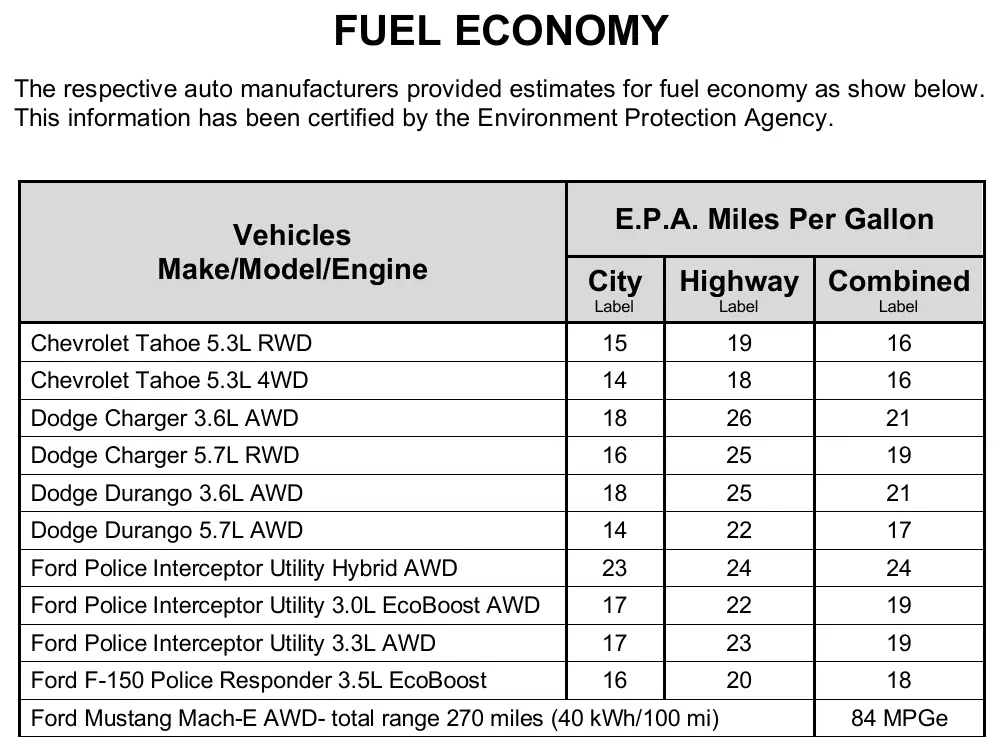
The Mach-E’s fuel line gives a total range of 270 miles and 40 kWh per hundred miles, and the manufacturer’s highlights on its specification page an 88 kWh usable battery; the book prints no city or highway figure for it. The V6 Charger’s highway figure is 26 this year, against 27 in 2021.
What 2022 settled
The first electric patrol car in these books arrived in 2022. A Mustang Mach-E reached 60 mph in 4.03 seconds, a time no car in the books held here had bettered until the 2023 Mach-E ran 3.93, and stopped shorter than anything else in the field. It also lapped slowest of the cars and scored lowest for communications installation, and the book says the manufacturers had agreed on forty minutes of charging between runs; the discussions had gone on for two years.
And for the first time in the books held here, every specification page printed the manufacturer’s limit. Eleven of the fifteen vehicles topped out exactly at it, and for both Chargers and two of the motorcycles the book printed a practical top speed, with a definition: the point at which engine power is reduced before the nominal figure.