
Michigan test archive
2005 Michigan State Police Patrol Vehicle Test
The sport utility returns as a PPV after six years, an E85 patrol vehicle appears, and the report says every vehicle in the test arrived with a speed limiter.
Ten published vehicles were evaluated from September 18 through 20, 2004, by the bulletin’s account (every dated sheet in the report reads the 18th): five police package and five special service. Two Dodge Magnum prototypes were also run in a non-published category, whose data the book leaves with the manufacturer. The police sedan had been reduced to two nameplates. The entire police category was a Chevrolet Impala, two Ford Police Interceptors differing only in axle ratio, and two Chevrolet Tahoes. The Tahoe returned to the police category as a police-package PPV with a 285-horsepower 5.3-litre V8. The Tahoes of 2001 to 2004 had been special service; the 1997 and 1998 bulletins had counted the rear-drive Tahoe among their police patrol package cars, and the 1999 book ran it in its main field.
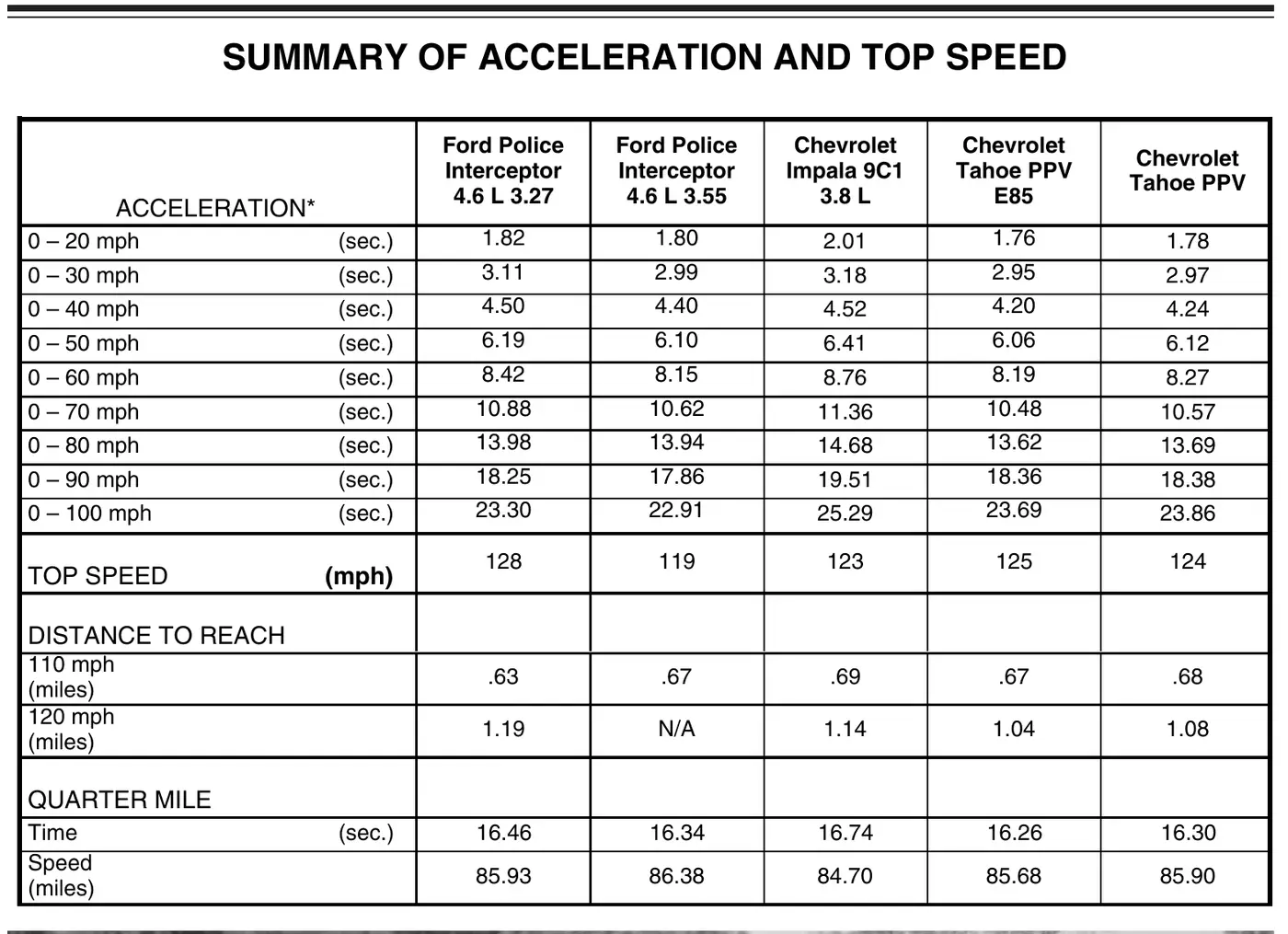
It did not embarrass itself. The Tahoe PPV reached 60 mph in 8.27 seconds, 100 in 23.86 and ran 124 mph — quicker to 60 and to 100 than the Impala, and quicker to 60 than a Police Interceptor with the tall axle. Six years earlier the rear-drive Tahoe had needed 10.16 seconds to 60, slower than every petrol sedan, wagon and coupe in the 1999 test; the natural-gas Police Interceptor took 12.40, and the four-wheel-drive Cherokee 10.88.
One of the two Tahoes ran on E85. The flexible-fuel PPV — regular unleaded or an ethanol and gasoline blend — was slightly the quicker of the pair at 8.19 to 60 and 125 mph, and it is the first alternative-fuel vehicle to appear in these tables since the 2001 natural-gas Crown Victoria; the natural-gas cars of 1996 to 2001 were the slowest sedans to 60 in their tests. This one wasn’t.
And read what the report says about the whole field, in its General Information section: every vehicle had an electronic speed limiter. The 2003 and 2004 bulletins had said the same of their fields; the 1998 bulletin marked ten of fifteen. The fastest figure in the test is 128 mph.
The police package vehicles
| Vehicle | Engine | 0–60 (s) | 0–100 (s) | Top speed | Dynamics | Brakes (ft/s²) | 60–0 (ft) |
|---|---|---|---|---|---|---|---|
| Ford Police Interceptor (3.55 axle) | 4.6L V8 | 8.15 | 22.91 | 119 | 1:42.43 | 26.20 | 147.8 |
| Ford Police Interceptor (3.27 axle) | 4.6L V8 | 8.42 | 23.30 | 128 | 1:42.81 | 26.59 | 145.6 |
| Chevrolet Tahoe PPV 2WD (E85) | 5.3L V8 | 8.19 | 23.69 | 125 | 1:46.70 | ‡ | ‡ |
| Chevrolet Tahoe PPV 2WD | 5.3L V8 | 8.27 | 23.86 | 124 | 1:47.13 | 26.87 | 144.1 |
| Chevrolet Impala | 3.8L V6 | 8.76 | 25.29 | 123 | 1:44.74 | 28.41 | 136.3 |
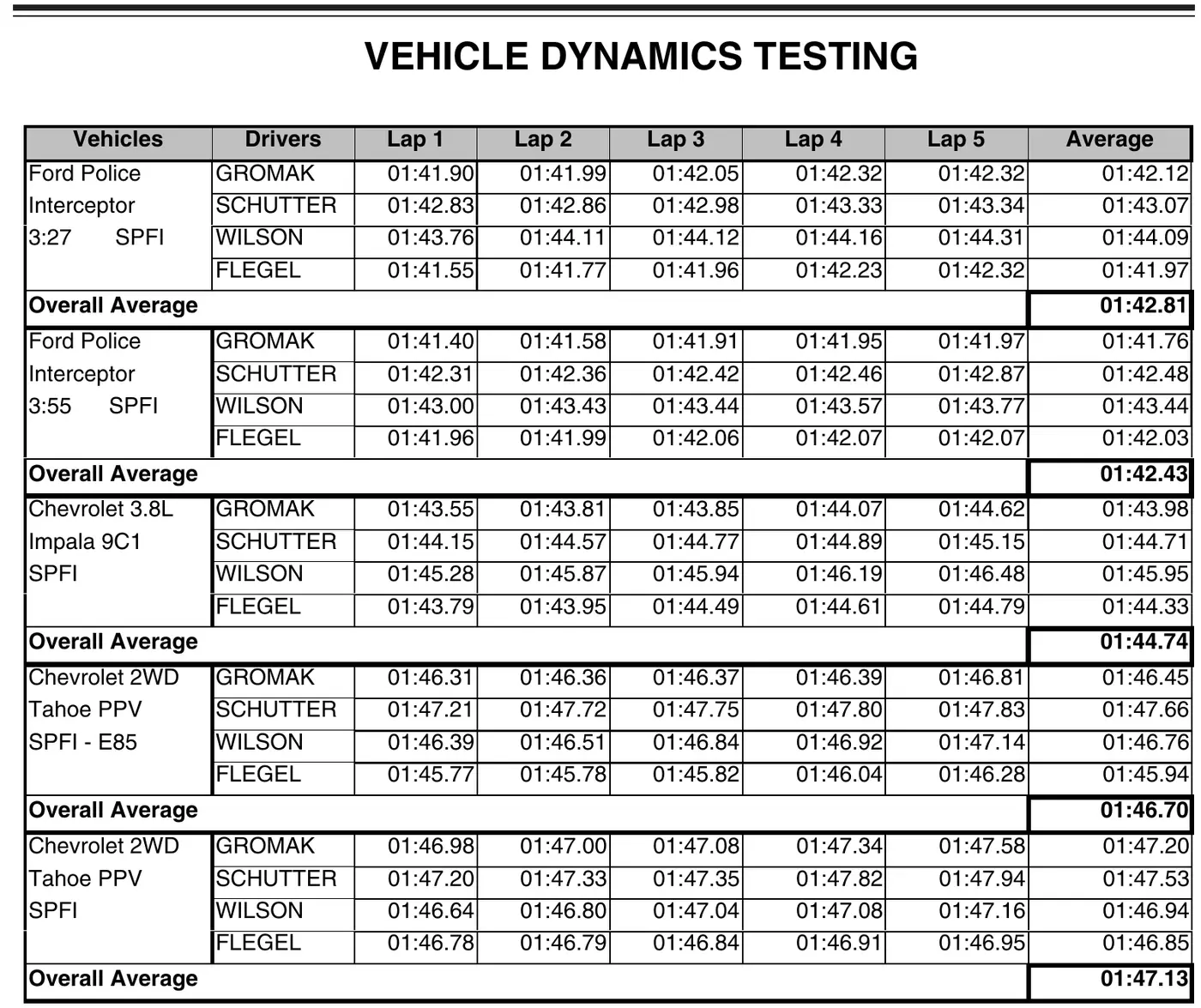
Gold row: quickest vehicle in the test to both 60 and 100 mph, and quickest around the course. But look at the pair of Interceptors together, because this is a controlled experiment: the 2004 bulletin had run the same pair, and in 1992 and 1993 Michigan tested two Caprices that differed in their gears. Same car, same engine, two axles: the 3.55 is 0.27 seconds quicker to 60 and 0.39 to 100, and gives up nine miles an hour on top — 119 against 128. The 3.27 car stops a little shorter as well. There is no free lunch in a final drive ratio, and here it is measured to the hundredth.
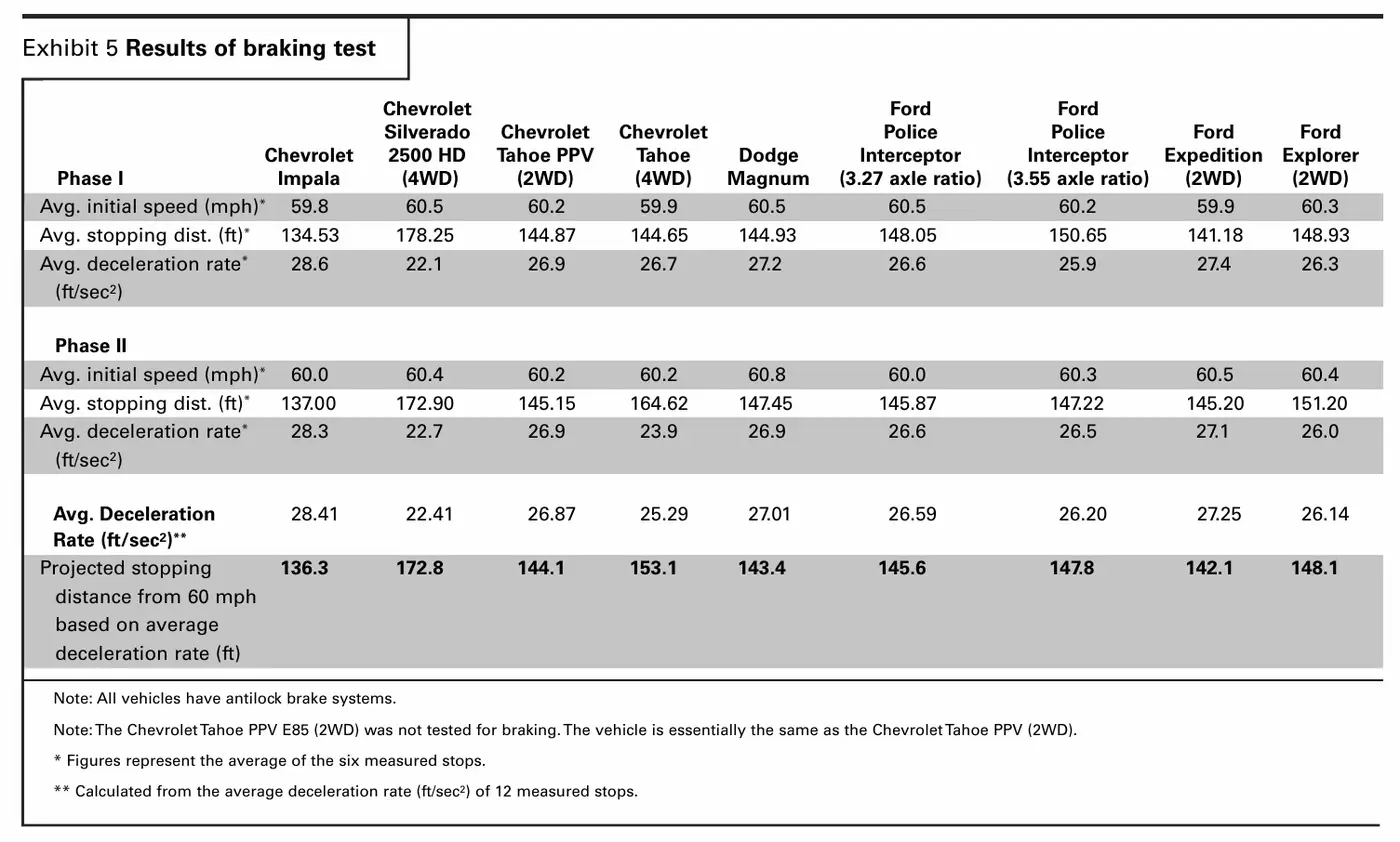
And the Impala’s answer to being the slowest police-package vehicle to 60 and to 100 is the braking column: 28.41 ft/s² and a projected 136.3-foot stop, comfortably the best in the field, more than nine feet shorter than either Interceptor. Add 20 mpg in the city against the Ford’s 15.
See the original pages: the acceleration and top speed summary and the vehicle dynamics data in the 2005 book
The special-service vehicles
| Vehicle | Engine | 0–60 (s) | 0–100 (s) | Top speed | Dynamics | Brakes (ft/s²) | 60–0 (ft) |
|---|---|---|---|---|---|---|---|
| Chevrolet Tahoe (4WD) | 5.3L V8 | 9.46 | N/A | 98 | ** | 25.29 | 153.1 |
| Dodge Magnum | 3.5L V6 | 9.10 | 24.96 | 117 | ** | 27.01 | 143.4 |
| Ford Explorer (2WD) | 4.6L V8 | 9.01 | 27.58 | 107 | ** | 26.14 | 148.1 |
| Ford Expedition (2WD) | 5.4L V8 | 9.80 | N/A | 99 | ** | 27.25 | 142.1 |
| Chevrolet Silverado 2500 HD (4WD) | 6.6L diesel | 10.97 | N/A | 91 | ** | 22.41 | 172.8 |
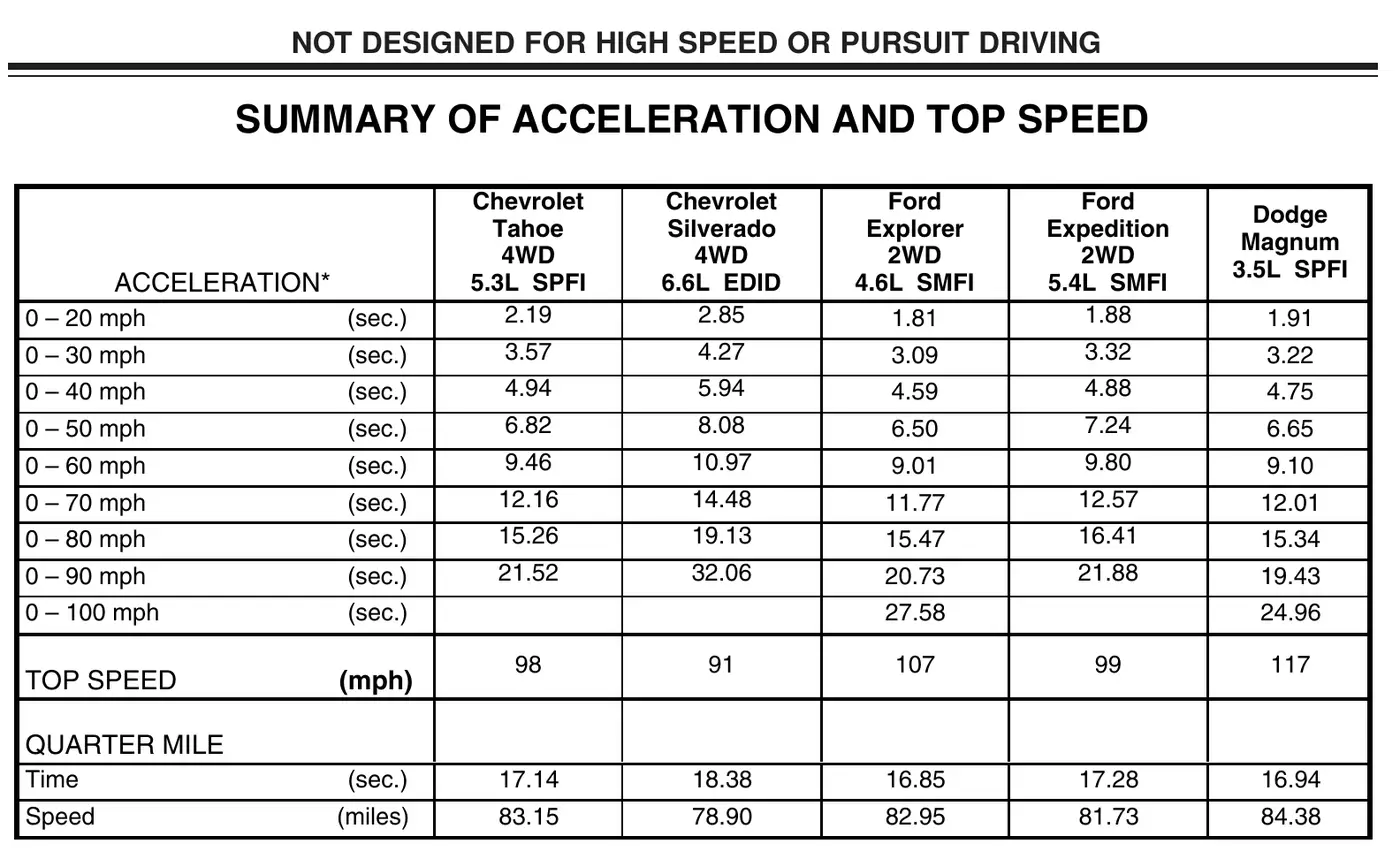
The Dodge Magnum is here as the replacement for the discontinued Intrepid police package — rear-wheel drive, 250 horsepower, offered for 2005 as special service only, with the bulletin noting it might be introduced as a police package for 2006. Its projected 143.4-foot stop is shorter than either Tahoe PPV’s 144.1, and it reached 100 mph in 24.96 seconds, which the four-wheel-drive Tahoe never did; both Tahoe PPVs were quicker to 100, at 23.86 and 23.69. It ran no road course. The book attributes the special-service classification to the manufacturers and gives no reason for it.
At the far end sits the year’s genuine oddity: a Silverado 2500 HD, a crew cab according to the bulletin, seven thousand one hundred and eighty-seven pounds, a 6.6-litre direct-injection diesel, 10.97 seconds to 60, 91 mph with a limiter fitted and a 172.8-foot stop. The bulletin lists it as an Extended Mobility Package initially available through the federal GSA schedule; the report prints “Chevrolet EMP”. Michigan was now testing pickup trucks.
See the original page: the special-service summary in the 2005 book
Complete acceleration ladders — every 10-mph increment, all ten vehicles
| 0 to… | Impala | Silverado | Tahoe PPV E85 | Tahoe PPV 2WD | Tahoe 4WD | Magnum | PI 3.27 | PI 3.55 | Expedition | Explorer |
|---|---|---|---|---|---|---|---|---|---|---|
| 20 mph | 2.01 | 2.85 | 1.76 | 1.78 | 2.19 | 1.91 | 1.82 | 1.80 | 1.88 | 1.81 |
| 30 mph | 3.18 | 4.27 | 2.95 | 2.97 | 3.57 | 3.22 | 3.11 | 2.99 | 3.32 | 3.09 |
| 40 mph | 4.52 | 5.94 | 4.20 | 4.24 | 4.94 | 4.75 | 4.50 | 4.40 | 4.88 | 4.59 |
| 50 mph | 6.41 | 8.08 | 6.06 | 6.12 | 6.82 | 6.65 | 6.19 | 6.10 | 7.24 | 6.50 |
| 60 mph | 8.76 | 10.97 | 8.19 | 8.27 | 9.46 | 9.10 | 8.42 | 8.15 | 9.80 | 9.01 |
| 70 mph | 11.36 | 14.48 | 10.48 | 10.57 | 12.16 | 12.01 | 10.88 | 10.62 | 12.57 | 11.77 |
| 80 mph | 14.68 | 19.13 | 13.62 | 13.69 | 15.26 | 15.34 | 13.98 | 13.94 | 16.41 | 15.47 |
| 90 mph | 19.51 | 32.06 | 18.36 | 18.38 | 21.52 | 19.43 | 18.25 | 17.86 | 21.88 | 20.73 |
| 100 mph | 25.29 | N/A | 23.69 | 23.86 | N/A | 24.96 | 23.30 | 22.91 | N/A | 27.58 |
| Top speed | 123 | 91 | 125 | 124 | 98 | 117 | 128 | 119 | 99 | 107 |
The Silverado’s ladder is worth following to the end: 19.13 seconds to 80 mph, then 32.06 to 90 — nearly thirteen seconds for that single ten-mile-an-hour increment — and then nothing. A three-and-a-half ton diesel pickup topping out at 91 mph.
Complete braking data — both phases, nine vehicles
| Vehicle | Phase I speed | Phase I distance (ft) | Phase I rate | Phase II speed | Phase II distance (ft) | Phase II rate | Average rate | 60–0 projected (ft) |
|---|---|---|---|---|---|---|---|---|
| Chevrolet Impala | 59.8 | 134.53 | 28.6 | 60.0 | 137.00 | 28.3 | 28.41 | 136.3 |
| Ford Expedition (2WD) | 59.9 | 141.18 | 27.4 | 60.5 | 145.20 | 27.1 | 27.25 | 142.1 |
| Dodge Magnum | 60.5 | 144.93 | 27.2 | 60.8 § | 147.45 | 26.9 | 27.01 | 143.4 |
| Chevrolet Tahoe PPV (2WD) | 60.2 | 144.87 | 26.9 | 60.2 | 145.15 | 26.9 | 26.87 | 144.1 |
| Ford Police Interceptor (3.27) | 60.5 | 148.05 | 26.6 | 60.0 | 145.87 | 26.6 | 26.59 | 145.6 |
| Ford Police Interceptor (3.55) | 60.2 | 150.65 | 25.9 | 60.3 | 147.22 § | 26.5 | 26.20 | 147.8 |
| Ford Explorer (2WD) | 60.3 | 148.93 | 26.3 | 60.4 | 151.20 | 26.0 | 26.14 | 148.1 |
| Chevrolet Tahoe (4WD) | 59.9 | 144.65 | 26.7 | 60.2 | 164.62 | 23.9 | 25.29 | 153.1 |
| Chevrolet Silverado 2500 HD (4WD) | 60.5 | 178.25 | 22.1 | 60.4 | 172.90 | 22.7 | 22.41 | 172.8 |
The four-wheel-drive Tahoe is the one to watch. Its Phase I stops averaged 144.65 feet against the police-package PPV’s 144.87, though its printed Phase I rate was slightly lower (26.67 against 26.88 ft/s²); then, after six hard stops and a four-minute heat soak, its six stops averaged 164.62 feet. Twenty feet of fade in one session, and a deceleration rate that fell from 26.7 to 23.9 ft/s². The police-package Tahoe’s average rose by 0.28 feet and its sheet answers no to severe fading; the only other vehicle in the test to answer yes was the special-service Explorer. The difference does not show in the Phase I averages; it shows after the heat soak.
See the original page: Exhibit 5 in the December 2004 bulletin
Ergonomics, communications and fuel
| Vehicle | Ergonomics & communications | City | Highway | Combined |
|---|---|---|---|---|
| Chevrolet Tahoe PPV 2WD | 210.40 | 15 | 20 | 16.5 |
| Chevrolet Tahoe PPV 2WD (E85) | 210.40 | 14 | 18 | 16.5 |
| Chevrolet Tahoe (4WD) | 209.70 | 15 | 19 | 16.5 |
| Chevrolet Silverado 2500 HD (4WD) | 203.30 | N/A | N/A | N/A |
| Chevrolet Impala | 199.92 | 20 | 29 | 23 |
| Ford Police Interceptor (3.27 axle) | 199.89 | 15 | 21 | 18 |
| Ford Police Interceptor (3.55 axle) | 199.89 | 15 | 21 § | 18 |
| Ford Expedition (2WD) | 198.60 | 14 | 19 | 16 |
| Ford Explorer (2WD) | 186.90 | 15 | 20 | 16 |
| Dodge Magnum | 184.87 | 19 | 27 | 25.4 |
| Vehicle | Description page | Fuel Economy section, page 41 |
|---|---|---|
| Ford Police Interceptor (3.27 axle) | 15 / 21 / 18 | 16 (17.7) / 21 / 18 |
| Ford Police Interceptor (3.55 axle) | 15 / 21 / 18 § | 16 (17.7) / 21 / 18 |
| Chevrolet Impala | 20 / 29 / 23 | 19 (20.9) / 27 / 22 |
| Chevrolet Tahoe PPV 2WD (E85) | 14 / 18 / 16.5 | 10 (11.3) / 12 / 16 |
| Chevrolet Tahoe PPV 2WD | 15 / 20 / 16.5 | 13 (14.3) / 14 / 16 |
The two Tahoe PPVs take the top two places, as sport utilities had in 1997, 1998, 1999 and every test from 2002 to 2004, though not in 1992 to 1996, 2000 or 2001, and the gap to the sedans is narrower. In 1998 the Tahoe led the Crown Victoria by nineteen points; here the Tahoe PPV leads the Police Interceptor by 10.51 on the report’s totals (8.31 on the bulletin’s) and the Impala by 10.48, and the Impala returns five more miles per gallon in the city than the Ford and five or six more than the Tahoe PPVs. The E85 Tahoe’s description page gives 14 city and 18 highway against the other PPV’s 15 and 20, without saying which fuel the figures are for; the scored Fuel Economy section gives 11.3 city against 14.3.
Two combined-economy figures, printed in both the report and the bulletin, don’t reconcile with their own city and highway numbers — the Magnum’s 25.4 and the two Tahoe PPVs’ 16.5 (the four-wheel-drive Tahoe’s 16.5 is close to its own 15 and 19). On page 41 the Tahoe PPVs’ combined 16 is higher than both their city and highway figures. They are printed here as published rather than quietly corrected.
What the manufacturers changed for 2005
Chevrolet brought the Tahoe back to the police category after six years away as the Tahoe PPV, which the bulletin expands as Police Package Vehicle and calls “pursuit-capable”, two-wheel drive only, with the 5.3-litre 285-horsepower V8 and an available E85 flexible-fuel option. A four-wheel-drive Tahoe remained on the special-service list with a standard 4.8-litre V8, though the car tested carried the optional 5.3. The Impala continued in both 9C1 police and 9C3 unmarked packages with no significant change, still front-wheel drive with the 200-horsepower 3.8 V6. New for the year was the Silverado 2500 HD Crew Cab Extended Mobility Package, special service only, initially through the GSA schedule.
Ford left the Police Interceptor essentially unchanged from 2004, again offering the standard 3.27 rear axle or the optional 3.55 — both of which were submitted, which is why they appear as two entries. One addition is worth recording plainly: an automatic fire suppression system with manual override was to become available as an option on Police Interceptors built later in the model year. The Explorer and Expedition returned as special-service packages. The 2004 bulletin had called 2004 the Excursion’s final production year; the 2005 bulletin lists it as still available, though Ford did not submit it for testing.
Dodge discontinued the Intrepid police package and offered the new rear-drive Magnum in its place — special service for 2005, with the bulletin noting it might be introduced as a police-package vehicle for 2006.
Notes on this page’s source and the gap before it
This page is built from Michigan’s own report, 2005 Model Year Police Vehicle Evaluation Program (Michigan State Police Training Division, October 2004, 83 pages), which carries the per-driver lap times and the individual brake stops behind the tables above. Some of the manufacturer notes, the test dates and the phase-average braking table on this page come from the eight-page NLECTC bulletin of December 2004 that summarised it. The two are different documents; until 28 September this page credited everything to the bulletin.
The dynamics course changed between 2000 and 2001: the 2000 bulletin describes a 1.635-mile road course, and from 2001 the test ran at Grattan Raceway on the two-mile configuration used here.
What 2005 settled
From 2001 to 2004 the Tahoe had been tested as special service, which the 2003 and 2004 bulletins define as a vehicle not designed or manufactured for high-speed or pursuit situations. In 2005 Chevrolet brought a Tahoe that was quicker to 60 and to 100 than the Impala, showed no severe fading through a full heat soak while the special-service four-wheel-drive Tahoe’s average stop grew by twenty feet, and was listed in the police category.
The other lesson is in a pair of Fords that differ by one number. Same engine, same body, same everything except a final drive: 3.55 gears bought 0.27 seconds to 60 and cost nine miles an hour on top; 3.27 gears did the reverse. Michigan had been demonstrating that trade since at least 1992, when it ran two Caprices with different axles, and the 2004 bulletin ran this same pair. Here it is again, priced to the hundredth of a second.