
Michigan test archive
1995 Michigan State Police Patrol Vehicle Test
The LT1 era at full song: 155-mph Camaros, a 129-mph station wagon — and a Taurus that missed the new 0–60 gate by eight tenths.
Set this page beside the 1989 test and the transformation is total. The qualification bar that stood at 12.7 seconds to 60 six years earlier now demanded 10.0 flat — with 80 mph in 17.2, 100 in 28.2, 110 mph inside one mile and 120 inside two, plus a formal braking floor of 24.2 ft/s²: the same distances and floor the 1994 specification had set, with 10.1, 17.5 and 29.6 seconds. Every carbureted sedan in this archive’s earlier pages would have failed it. Nine vehicles ran between 27 and 29 August 1994: five police package cars and, in the program’s second category, four “special service” vehicles — two B4C Camaros, an LT1 Caprice station wagon, and a four-wheel-drive Jeep Cherokee, in these pages since the 1992 test.
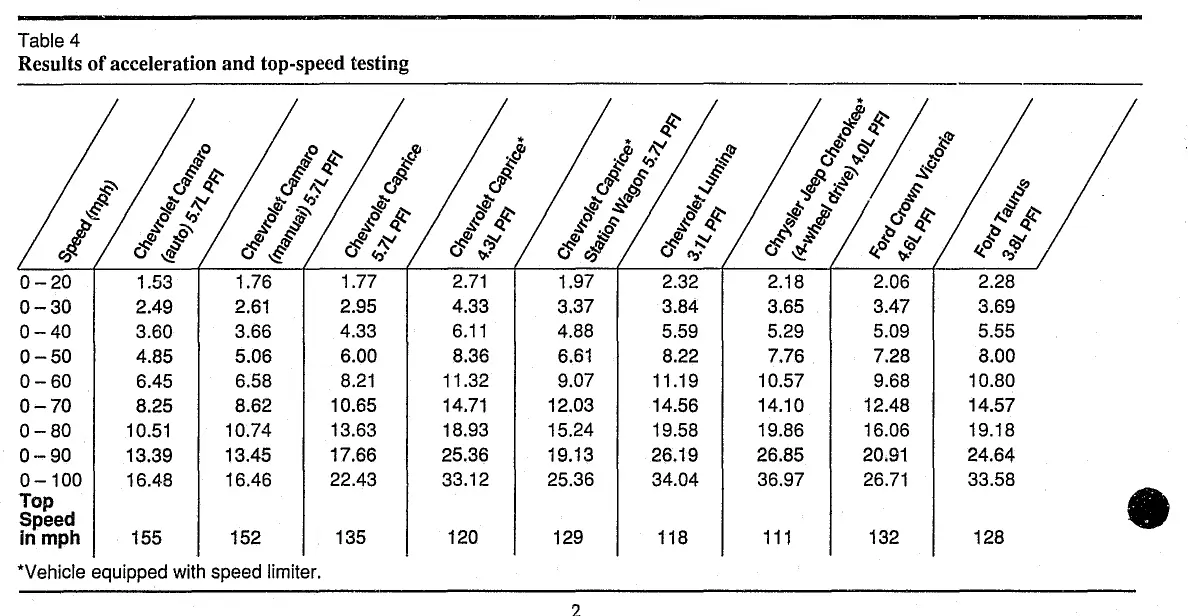
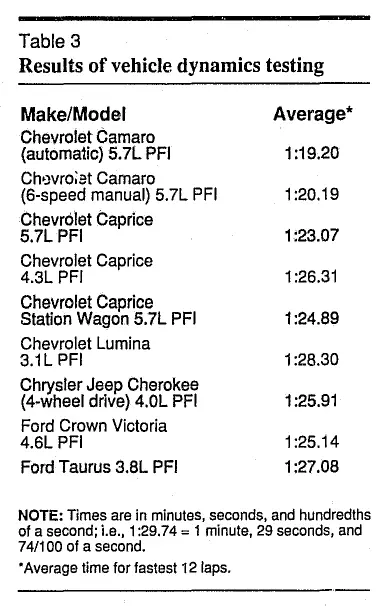
Three storylines stand out. The 5.7-liter LT1 Caprice ran 60 in 8.21 seconds and 100 in 22.43 — quicker to 100 than the 1983 test’s Mustang — and the station wagon version did 9.07 and 129 mph. The Camaros ran 6.45 seconds to 60, 100 mph in 16.48, 155 mph and a 1:19.20 lap average, the last two the best in these books to that point, with the automatic beating the 6-speed both to 60 and around the course. And the Ford Taurus — promised to Michigan for 1988 and withdrawn before the 1987 test, and a 3.8 police package in these books since 1990 — missed the new 0–60 gate by eight tenths.
Also worth noticing: for the sixth test running in this archive there is no Chrysler sedan in the field at all, as in every test since 1990. The only Chrysler product present is a Jeep, as in 1992, 1993 and 1994. This page is built from the NIJ’s TAP bulletin (September 1994); the full 1995 book has not been found online.
The police package cars
| Car | Engine | 0–60 (s) | 0–80 (s) | 0–100 (s) | Top speed (mph) | Dynamics (s) |
|---|---|---|---|---|---|---|
| Chevrolet Caprice 5.7L | 5.7L LT1 PFI | 8.21 | 13.63 | 22.43 | 135 | 83.07 |
| Ford Crown Victoria | 4.6L PFI | 9.68 | 16.06 | 26.71 | 132 | 85.14 |
| Chevrolet Caprice 4.3L | 4.3L (265 cid V8) PFI | 11.32 | 18.93 | 33.12 | 120 * | 86.31 |
| Ford Taurus | 3.8L PFI | 10.80 | 19.18 | 33.58 | 128 | 87.08 |
| Chevrolet Lumina | 3.1L PFI | 11.19 | 19.58 | 34.04 | 118 | 88.30 |
Measured against the year’s gates: only the LT1 Caprice and the Crown Victoria cleared the acceleration requirements. The 4.3 Caprice, the Taurus and the Lumina all missed the 10-second 0–60 gate and the 28.2-second 0–100 gate. Note the 4.3 here is a 265-cubic-inch V8 — not the old 262 V6 of the eighties pages. The bulletin does not name the year’s winner — the scoring belongs to the full report (see below).
See the original pages: Tables 4 and 3 in the 1995 bulletin
The special service vehicles
| Vehicle | Engine | 0–60 (s) | 0–80 (s) | 0–100 (s) | Top speed (mph) | Dynamics (s) |
|---|---|---|---|---|---|---|
| Chevrolet Camaro (automatic) | 5.7L LT1 PFI | 6.45 | 10.51 | 16.48 | 155 | 79.20 |
| Chevrolet Camaro (6-speed) | 5.7L LT1 PFI | 6.58 | 10.74 | 16.46 | 152 | 80.19 |
| Chevrolet Caprice Station Wagon | 5.7L LT1 PFI | 9.07 | 15.24 | 25.36 | 129 * | 84.89 |
| Jeep Cherokee (4WD) | 4.0L PFI | 10.57 | 19.86 | 36.97 | 111 * | 85.91 |
Gold row: fastest vehicle of the entire test — the automatic B4C Camaro’s 1:19.20 lap average and 155 mph are records for the program’s published series to this point; its 6.45 seconds to 60 is not, the 1993 Camaros having run 6.10 and 6.18. The 6-speed car was two hundredths quicker to 100. And read the wagon’s row twice: a 129-mph station wagon that out-accelerated three of the five police package sedans.
Complete acceleration data — every 10-mph increment
| 0 to… | Camaro auto | Camaro 6-spd | Caprice 5.7 | Caprice 4.3 | Wagon 5.7 | Lumina 3.1 | Cherokee 4.0 | Crown Vic 4.6 | Taurus 3.8 |
|---|---|---|---|---|---|---|---|---|---|
| 20 mph | 1.53 | 1.76 | 1.77 | 2.71 | 1.97 | 2.32 | 2.18 | 2.06 | 2.28 |
| 30 mph | 2.49 | 2.61 | 2.95 | 4.33 | 3.37 | 3.84 | 3.65 | 3.47 | 3.69 |
| 40 mph | 3.60 | 3.66 | 4.33 | 6.11 | 4.88 | 5.59 | 5.29 | 5.09 | 5.55 |
| 50 mph | 4.85 | 5.06 | 6.00 | 8.36 | 6.61 | 8.22 | 7.76 | 7.28 | 8.00 |
| 60 mph | 6.45 | 6.58 | 8.21 | 11.32 | 9.07 | 11.19 | 10.57 | 9.68 | 10.80 |
| 70 mph | 8.25 | 8.62 | 10.65 | 14.71 | 12.03 | 14.56 | 14.10 | 12.48 | 14.57 |
| 80 mph | 10.51 | 10.74 | 13.63 | 18.93 | 15.24 | 19.58 | 19.86 | 16.06 | 19.18 |
| 90 mph | 13.39 | 13.45 | 17.66 | 25.36 | 19.13 | 26.19 | 26.85 | 20.91 | 24.64 |
| 100 mph | 16.48 | 16.46 | 22.43 | 33.12 | 25.36 | 34.04 | 36.97 | 26.71 | 33.58 |
Brakes — a threshold with teeth, and two cars tested twice
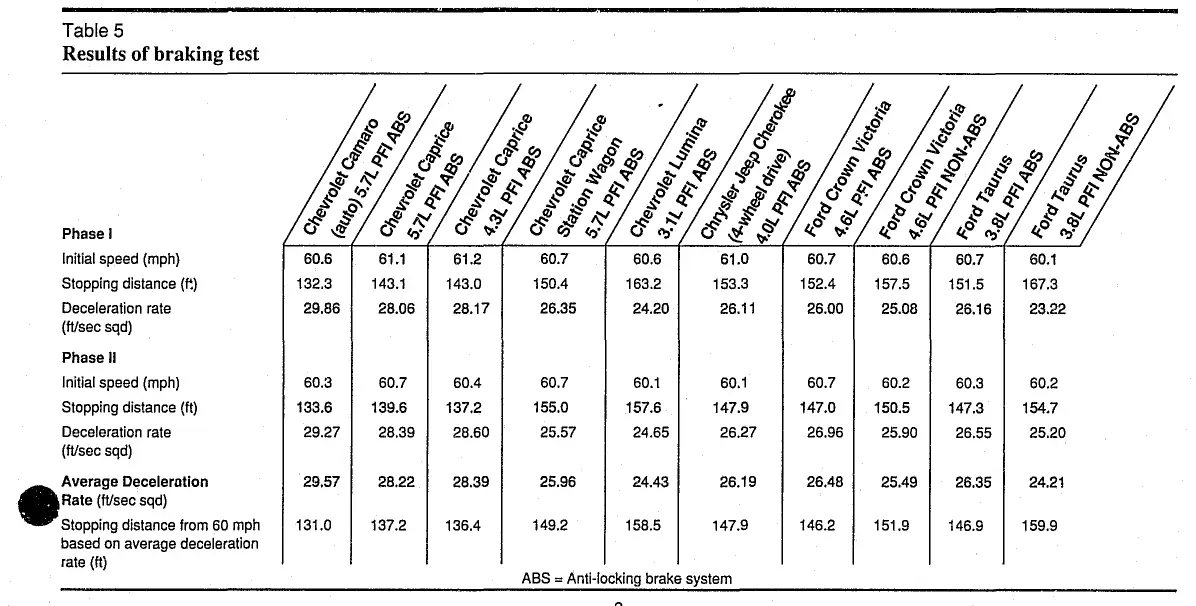
Braking carried 20 points in the scoring, as it already did in the 1994 book (the 1992 book weighted it 10), and the impending-skid average was a formal qualification gate, as the 1994 specification had already made it: 24.2 ft/s² or the car is out. Only the automatic Camaro was brake-tested, and it led the field: 29.57 ft/s², a computed 131.0-foot stop from 60 mph. The two Caprice sedans were next — the 4.3L at 28.39, the 5.7L at 28.22. Across the whole field the averages ran from 29.57 down to 24.21, the non-ABS Taurus sitting essentially on the qualification floor.
The bulletin’s braking table has ten columns for nine vehicles: the Crown Victoria and the Taurus each appear twice, tested with and without anti-lock brakes. All four runs cleared the floor; in each pair the ABS run stopped harder, by 0.99 ft/s² for the Crown Victoria and 2.14 for the Taurus.
Complete braking data — both phases, ten test configurations
| Vehicle | Phase I speed | Phase I distance (ft) | Phase I rate | Phase II speed | Phase II distance (ft) | Phase II rate | Average rate | 60–0 computed (ft) |
|---|---|---|---|---|---|---|---|---|
| Chevrolet Camaro (automatic) | 60.6 | 132.3 | 29.86 | 60.3 | 133.6 | 29.27 | 29.57 | 131.0 |
| Chevrolet Caprice 5.7L | 61.1 | 143.1 | 28.06 | 60.7 | 139.6 | 28.39 | 28.22 | 137.2 |
| Chevrolet Caprice 4.3L | 61.2 | 143.0 | 28.17 | 60.4 | 137.2 | 28.60 | 28.39 | 136.4 |
| Chevrolet Caprice Station Wagon | 60.7 | 150.4 | 26.35 | 60.7 | 155.0 | 25.57 | 25.96 | 149.2 |
| Chevrolet Lumina | 60.6 | 163.2 | 24.20 | 60.1 | 157.6 | 24.65 | 24.43 | 158.5 |
| Jeep Cherokee (4WD) | 61.0 | 153.3 | 26.11 | 60.1 | 147.9 | 26.27 | 26.19 | 147.9 |
| Ford Crown Victoria (ABS) | 60.7 | 152.4 | 26.00 | 60.7 | 147.0 | 26.96 | 26.48 | 146.2 |
| Ford Crown Victoria (non-ABS) | 60.6 | 157.5 | 25.08 | 60.2 | 150.5 | 25.90 | 25.49 | 151.9 |
| Ford Taurus (ABS) | 60.7 | 151.5 | 26.16 | 60.3 | 147.3 | 26.55 | 26.35 | 146.9 |
| Ford Taurus (non-ABS) | 60.1 | 167.3 | 23.22 | 60.2 | 154.7 | 25.20 | 24.21 | 159.9 |
Gold row: best braking in the test. The 6-speed Camaro was not brake-tested. The bulletin lists one Crown Victoria and one Taurus in its field and prints each twice here, with and without anti-lock brakes; it does not say which configuration ran the acceleration and top-speed tests.
See the original page: Table 5 in the 1995 bulletin
Ergonomics and fuel economy
| Vehicle | Ergonomics (pts) | EPA city (mpg) |
|---|---|---|
| Chevrolet Caprice | 234.25 | 16.7 (5.7) / 17.6 (4.3) |
| Chevrolet Caprice Station Wagon | 228.18 | 16.7 |
| Ford Crown Victoria | 196.32 | — |
| Ford Taurus | 195.33 | 18.8 |
| Jeep Cherokee (4WD) | 176.71 | 14.5 |
| Chevrolet Camaro | 162.22 | 16.6 (auto) / 16.8 (6-speed) |
| Chevrolet Lumina | 158.93 | 18.7 |
The big Caprice’s 234.25 is below the 1994 book’s top totals (244.61 for the Caprice and the Explorer), but above every ergonomics total held from 1981 to 1993; the 1978 and 1980 books graded longer lists of items and scored communications separately, and no totals are held for 1979 or 1988. A rolling office at the peak of its development, a year before the American B-body Caprice’s last Michigan test.
What the bulletin doesn’t hold
This TAP bulletin is a synopsis; the detailed report it references — with the per-lap dynamics, quarter-mile times, final weighted scoring, the year’s winner, bid prices and hardware specifications — has not been found online. Those numbers will be added to this page from an original copy of the full 1995 book; as far as I can tell, they are not available anywhere else online.
What 1995 settled
The program’s center of gravity had moved. A qualification bar of 10.0 seconds to 60 — unthinkable when a 12.72-second Diplomat was competitive — now sorted a field where every engine was injected, the fastest patrol sedan ran 135 mph, and the pursuit specialists were 155-mph Camaros. Of the five police package cars, only two cleared the gates; the mid-size experiments — Lumina, Taurus — showed that front-drive sixes weren’t the answer yet.
And there’s a quieter constant in the field list: a four-wheel-drive Jeep Cherokee, tested seriously, timed properly, printed alongside the sedans, as it had been since 1992. Within a decade, this archive’s tables would belong to its descendants.