
Michigan test archive
1983 Michigan State Police Patrol Vehicle Test
Fifteen cars, a propane-fueled Canadian Plymouth, the Mustang’s 132-mph debut — and a book dedicated to a driver.
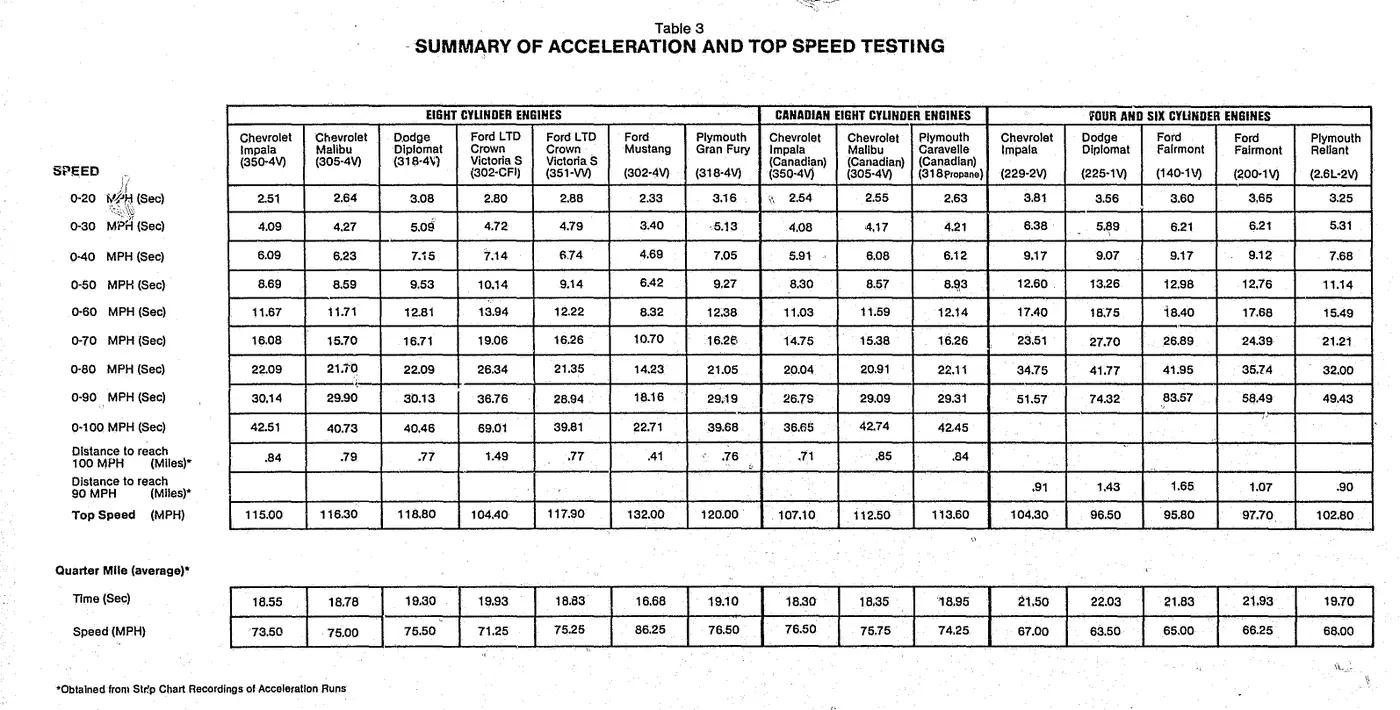
A year after Michigan tested a Mustang and declined to print the numbers, the numbers arrived — and they were worth the wait. The Ford Mustang 302 H.O. with a four-speed manual reached 60 mph in 8.32 seconds, crossed the quarter mile at 86.25 mph, hit 100 in 22.71 seconds — needing only four tenths of a mile — and topped out at 132.0 mph. The next-quickest US-market car in this test was seventeen seconds behind it to 100; the Canadian Impala, fourteen. It also had the fastest lap average of the test, 1:28.31.
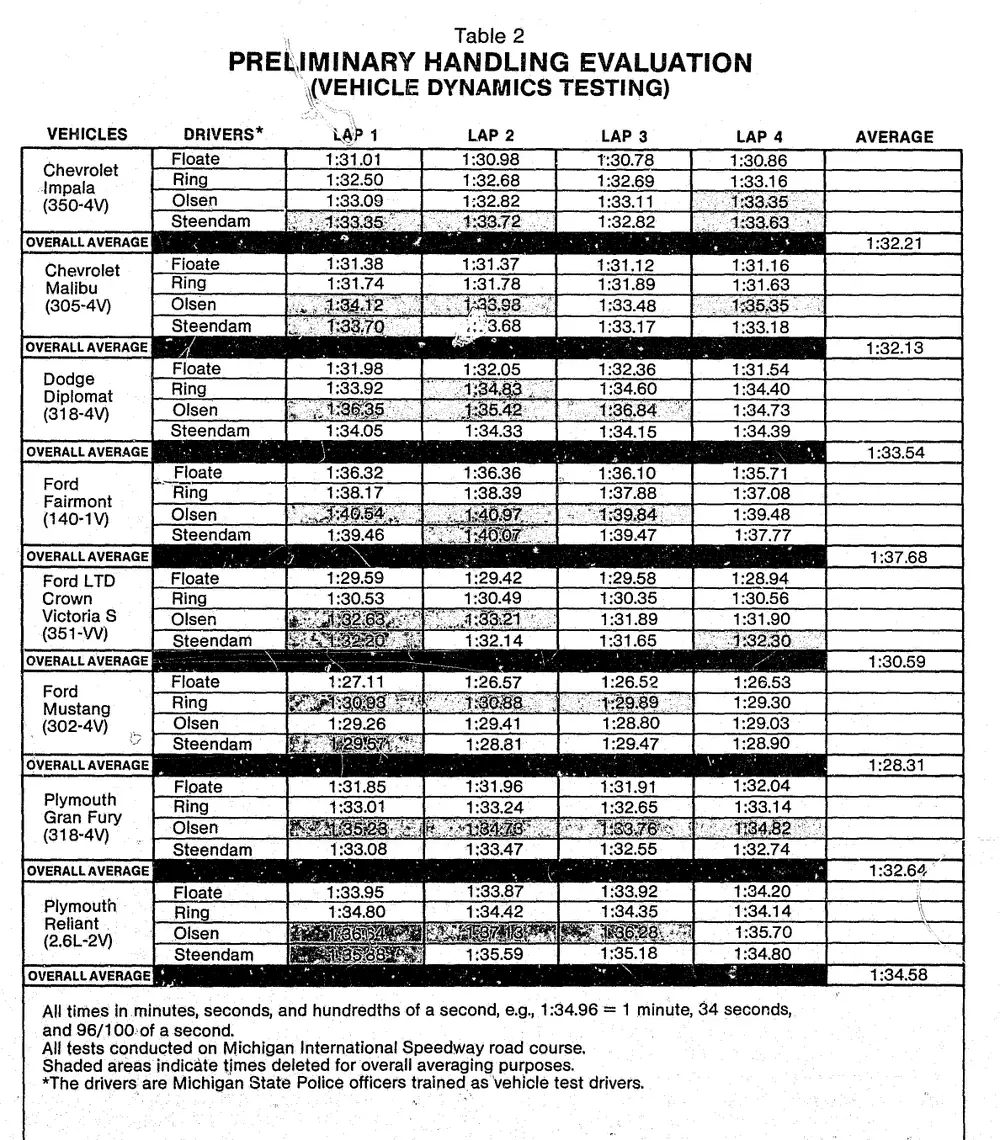
Fifteen cars ran in all: five competing against the Michigan specification, a fuel-injected LTD and a Plymouth Reliant among the cars not scored, four small-engine cars, and three Canadian-market cars with different emissions packages, including a Plymouth Caravelle running its 318 on propane. The straight-line tests ran at Chrysler’s proving grounds on 18 September 1982, between 50 and 62 °F in winds of 4 to 14 mph; the dynamics laps on the 1.635-mile Michigan International Speedway road course, now scored as the average of the 12 fastest of 16 laps.
For the second year running, the bids were still sealed when the book went to print, so the book prints category scores and totals but no award.
The five competing cars — full evaluation
| Car | Engine | 0–60 (s) | ¼-mile (s @ mph) | 0–100 (s) | Top speed (mph) | Miles to 100 mph | Dynamics (s) |
|---|---|---|---|---|---|---|---|
| Ford LTD Crown Victoria S | 351 H.O.-VV | 12.22 | 18.83 @ 75.25 | 39.81 | 117.9 | 0.77 | 90.59 |
| Plymouth Gran Fury | 318-4V | 12.38 | 19.10 @ 76.5 | 39.68 | 120.0 | 0.76 | 92.64 |
| Dodge Diplomat | 318-4V | 12.81 | 19.30 @ 75.5 | 40.46 | 118.8 | 0.77 | 93.54 |
| Chevrolet Malibu | 305-4V | 11.71 | 18.78 @ 75.0 | 40.73 | 116.3 | 0.79 | 92.13 |
| Chevrolet Impala | 350-4V | 11.67 | 18.55 @ 73.5 | 42.51 | 115.0 | 0.84 | 92.21 |
Gold row: highest total weighted score (see the scoring table below). The Gran Fury’s 120.0 mph was the highest sedan top speed in this test; the Crown Victoria S, with dual exhaust, had the fastest dynamics average of the five scored cars, 90.59 seconds. On this book’s averaging, the 12 fastest of 16 laps, that is two tenths behind the 1981 Malibu 350’s 90.37, an average of all twelve of its laps; on all 16 laps the Crown Victoria S averages 91.09. The two-door Mustang lapped quicker, in 1:28.31.
See the original pages: Tables 3 and 2 in the 1983 book
Tested but not competing
| Car | Engine | 0–60 (s) | ¼-mile (s @ mph) | 0–90 (s) | 0–100 (s) | Top speed (mph) | Dynamics (s) |
|---|---|---|---|---|---|---|---|
| Ford Mustang | 302 H.O.-4V, 4-speed | 8.32 | 16.68 @ 86.25 | 18.16 | 22.71 | 132.0 | 88.31 |
| Ford LTD Crown Victoria S | 302-CFI | 13.94 | 19.93 @ 71.25 | 36.76 | 69.01 | 104.4 | — |
| Plymouth Reliant | 2.6L-2V | 15.49 | 19.70 @ 68.0 | 49.43 | — | 102.8 | 94.58 |
| Chevrolet Impala (6-cyl) | 229-2V | 17.40 | 21.50 @ 67.0 | 51.57 | — | 104.3 | — |
| Ford Fairmont Futura (6-cyl) | 200-1V | 17.68 | 21.93 @ 66.25 | 58.49 | — | 97.7 | — |
| Dodge Diplomat (6-cyl) | 225-1V | 18.75 | 22.03 @ 63.5 | 74.32 | — | 96.5 | — |
| Ford Fairmont Futura (4-cyl) | 140-1V | 18.40 | 21.83 @ 65.0 | 83.57 | — | 95.8 | 97.68 |
The fuel-injected LTD, the only injected car of the field, missed the 0–80 requirement by a third of a second and the 0–100 requirement by more than twenty seconds (69.01 against 48.5). A year later the 1984 book’s mid-size LTD, a 302 H.O. with central fuel injection, beat every scored car to 60, 80 and 100 mph; the 302-CFI Crown Victoria was again outside the bar. The Mustang, which the preface counts among its “15 police package cars”, was not one of the five cars run against the specification and was not scored; its 151.3-foot Phase I stop from 60 mph was the shortest of the test.
The Canadian cars
| Car | Engine | 0–60 (s) | ¼-mile (s @ mph) | 0–100 (s) | Top speed (mph) | Miles to 100 mph |
|---|---|---|---|---|---|---|
| Chevrolet Impala (Canadian) | 350-4V | 11.03 | 18.30 @ 76.5 | 36.65 | 107.1† | 0.71 |
| Chevrolet Malibu (Canadian) | 305-4V | 11.59 | 18.35 @ 75.75 | 42.74 | 112.5 | 0.85 |
| Plymouth Caravelle (Canadian) | 318, propane fuel | 12.14 | 18.95 @ 74.25 | 42.45 | 113.6 | 0.84 |
† The book’s own note: the Canadian Impala reached 107.1 mph, after which its speed steadily decreased due to mechanical difficulties. Before that, it reached 100 mph in 36.65 seconds, the quickest sedan time of the test and nearly six seconds ahead of the US Impala with the same displacement. The book attributes no cause; besides their emissions packages, the two Impalas differed in rated horsepower (155 and 165), transmission (the US car’s 700R4 four-speed, the Canadian car’s three-speed 350C) and test weight (3,993 and 3,839 lb). The propane-fueled 318 Caravelle reached 60 mph sooner than three of the five US competitors.
Complete acceleration data — every 10-mph increment
| 0 to… | Impala 350 | Malibu 305 | Diplomat 318 | LTD CV-S 351 | LTD CV-S 302 | Mustang 302 | Gran Fury 318 |
|---|---|---|---|---|---|---|---|
| 20 mph | 2.51 | 2.64 | 3.08 | 2.88 | 2.80 | 2.33 | 3.16 |
| 30 mph | 4.09 | 4.27 | 5.09 | 4.79 | 4.72 | 3.40 | 5.13 |
| 40 mph | 6.09 | 6.23 | 7.15 | 6.74 | 7.14 | 4.69 | 7.05 |
| 50 mph | 8.69 | 8.59 | 9.53 | 9.14 | 10.14 | 6.42 | 9.27 |
| 60 mph | 11.67 | 11.71 | 12.81 | 12.22 | 13.94 | 8.32 | 12.38 |
| 70 mph | 16.08 | 15.70 | 16.71 | 16.26 | 19.06 | 10.70 | 16.26 |
| 80 mph | 22.09 | 21.70 | 22.09 | 21.35 | 26.34 | 14.23 | 21.05 |
| 90 mph | 30.14 | 29.90 | 30.13 | 28.94 | 36.76 | 18.16 | 29.19 |
| 100 mph | 42.51 | 40.73 | 40.46 | 39.81 | 69.01 | 22.71 | 39.68 |
| 0 to… | Impala 350 (Cdn) | Malibu 305 (Cdn) | Caravelle 318 propane |
|---|---|---|---|
| 20 mph | 2.54 | 2.55 | 2.63 |
| 30 mph | 4.08 | 4.17 | 4.21 |
| 40 mph | 5.91 | 6.08 | 6.12 |
| 50 mph | 8.30 | 8.57 | 8.93 |
| 60 mph | 11.03 | 11.59 | 12.14 |
| 70 mph | 14.75 | 15.38 | 16.26 |
| 80 mph | 20.04 | 20.91 | 22.11 |
| 90 mph | 26.79 | 29.09 | 29.31 |
| 100 mph | 36.65 | 42.74 | 42.45 |
| 0 to… | Reliant 2.6L | Impala 229 | Fairmont 200 | Diplomat 225 | Fairmont 140 |
|---|---|---|---|---|---|
| 20 mph | 3.25 | 3.81 | 3.65 | 3.56 | 3.60 |
| 30 mph | 5.31 | 6.38 | 6.21 | 5.89 | 6.21 |
| 40 mph | 7.68 | 9.17 | 9.12 | 9.07 | 9.17 |
| 50 mph | 11.14 | 12.60 | 12.76 | 13.26 | 12.98 |
| 60 mph | 15.49 | 17.40 | 17.68 | 18.75 | 18.40 |
| 70 mph | 21.21 | 23.51 | 24.39 | 27.70 | 26.89 |
| 80 mph | 32.00 | 34.75 | 35.74 | 41.77 | 41.95 |
| 90 mph | 49.43 | 51.57 | 58.49 | 1:14.32 | 1:23.57 |
The book’s quarter-mile lesson this year: the US Gran Fury and the Canadian Impala both crossed the quarter at exactly 76.50 mph — but the Canadian car got there eight tenths of a second sooner, because cars do not accelerate at a uniform rate.
Brakes, fuel economy, ergonomics
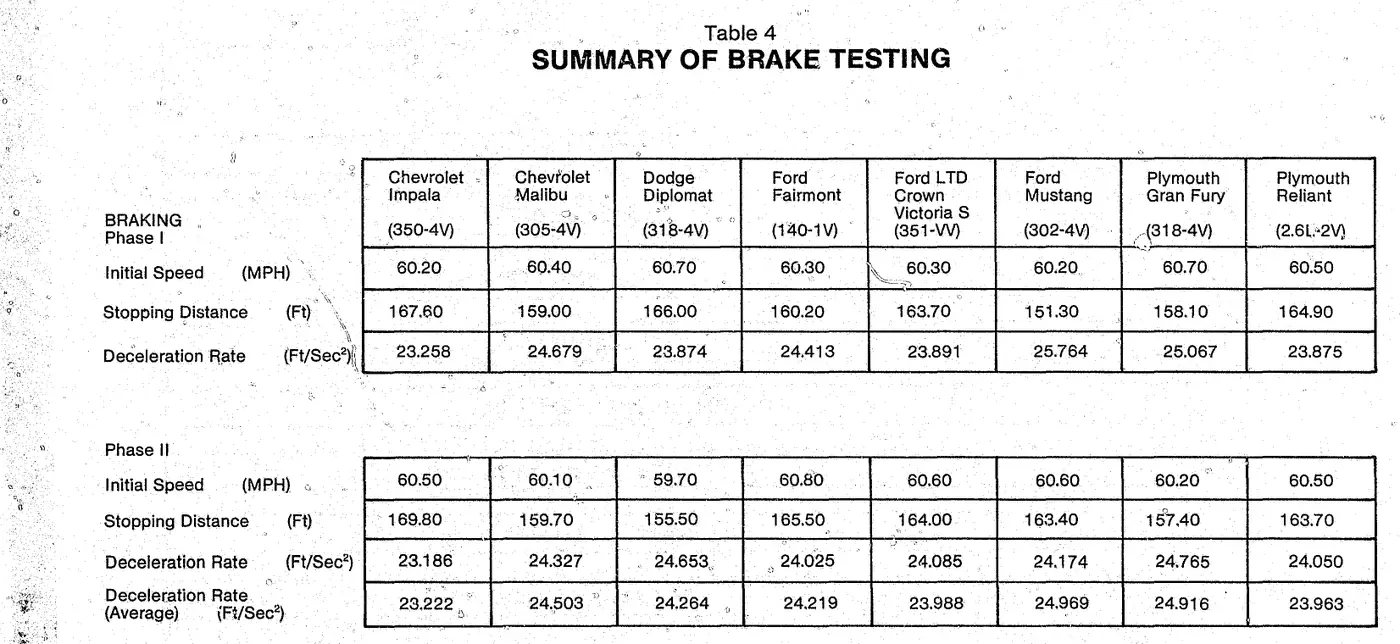
| Car | 60–0 Phase I (ft) | 60–0 Phase II (ft) | Avg decel (ft/s²) | EPA city (mpg) | Ergonomics (pts) |
|---|---|---|---|---|---|
| Ford Mustang 302 | 151.3 | 163.4 | 24.97 | 17* | — |
| Plymouth Gran Fury 318 | 158.1 | 157.4 | 24.92 | 14.0 | 196.31 |
| Chevrolet Malibu 305 | 159.0 | 159.7 | 24.50 | 17.8 | 185.11 |
| Dodge Diplomat 318 | 166.0 | 155.5 | 24.26 | 14.0 | 196.31 |
| Ford Fairmont Futura 140 | 160.2 | 165.5 | 24.22 | 20.9 | — |
| Ford LTD Crown Victoria S 351 | 163.7 | 164.0 | 23.99 | 14.0 | 202.93 |
| Plymouth Reliant 2.6L | 164.9 | 163.7 | 23.96 | 23.6 | — |
| Chevrolet Impala 350 | 167.6 | 169.8 | 23.22 | 14.8 | 188.43 |
| Ford LTD Crown Victoria S 302-CFI | — | — | — | 16.6 | — |
| Chevrolet Impala (6-cyl) | — | — | — | 18.6 | — |
| Dodge Diplomat (6-cyl) | — | — | — | 18.7 | — |
| Ford Fairmont Futura (6-cyl) | — | — | — | 18.6 | — |
* “Figures supplied by Ford Motor Corporation”, printed as a whole number. The Diplomat and Gran Fury ergonomics totals are identical as printed; Table 1 gives the two cars the same length, wheelbase and height. The Crown Victoria S had the best ergonomics score of the five cars rated. Table 4 prints the Impala’s and Malibu’s average rates as 23.222 and 24.503; the scoring table (Table 7) prints 23.23 and 24.51. The last four rows are the cars tested only for acceleration, which were not braked; their EPA city figures are from Table 6.
See the original page: Table 4 in the 1983 book
Hardware: horsepower, axle ratios, test weights
| Car | HP (SAE net) | Axle ratio | Test weight (lb) | Transmission |
|---|---|---|---|---|
| Ford Mustang 302 | 175 | 3.08 | 2,970 | 4-speed manual w/ overdrive |
| Ford LTD Crown Victoria S 351 H.O.-VV | 165 | 2.73 | 4,059 | 4-sp auto w/ overdrive (AOD) |
| Ford LTD Crown Victoria S 302-CFI | 130 | 3.08 | 3,892 | 4-sp auto w/ overdrive (AOD) |
| Dodge Diplomat 318 | 165 | 2.94 | 3,887 | 3-sp auto (A727) |
| Plymouth Gran Fury 318 | 165 | 2.94 | 3,881 | 3-sp auto (A727) |
| Chevrolet Impala 350 | 155 | 3.08 | 3,993 | 4-sp auto w/ overdrive (700R4) |
| Chevrolet Malibu 305 | 145 | 2.73 | 3,516 | 3-sp auto (350C) |
| Chevrolet Impala (Canadian) | 165 | 3.08 | 3,839 | 3-sp auto (350C) |
| Chevrolet Malibu (Canadian) | 145 | 2.73 | 3,443 | 3-sp auto (350C) |
| Chevrolet Impala (6-cyl) | 110 | 2.73 | 3,713 | 3-sp auto (250C) |
| Dodge Diplomat (6-cyl) | 90 | 2.94 | 3,688 | 3-sp auto (A904) |
| Ford Fairmont Futura (6-cyl) | 92 | 2.73 | 2,872 | 3-sp auto (PEN-C) |
| Ford Fairmont Futura 140 | 90 | 3.08 | 2,979 | 3-sp auto (C3) |
| Plymouth Reliant 2.6L | 93 | 3.02 | 2,659 | 3-sp auto (A470) |
The LTD kept the AOD overdrive automatic it had in 1981 and 1982, and the US Impala now had the 700R4 four-speed overdrive automatic. The US Impala was rated at 155 horsepower against the Canadian car’s 165 — and the Canadian was six tenths quicker to 60 and nearly six seconds quicker to 100.
The scoring — the Crown Victoria’s year
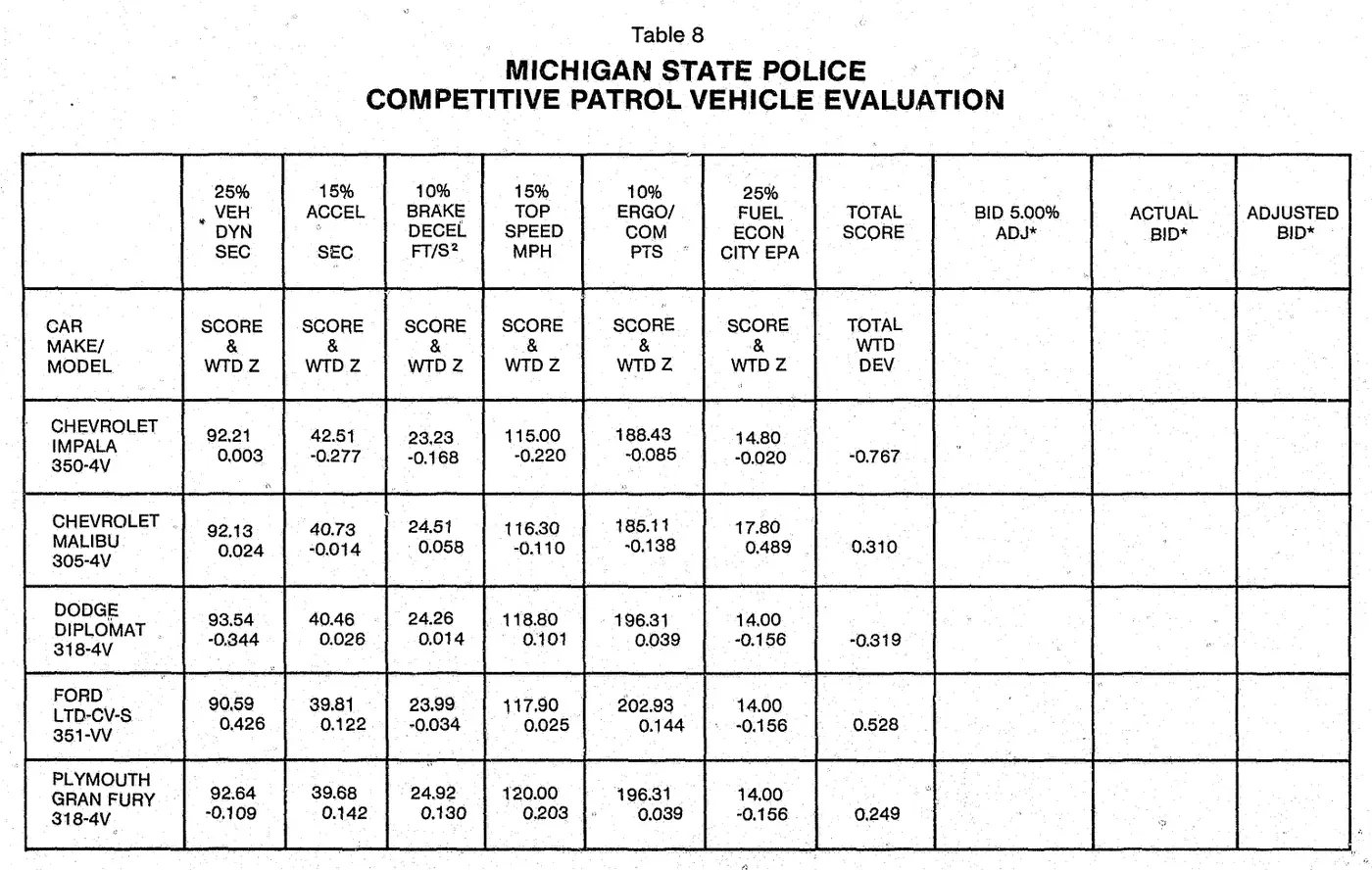
The weighting held at 25% dynamics, 25% fuel economy, 15% acceleration (0–100 time), 15% top speed, 10% brakes, and 10% ergonomics, for the last time in the books held here: the 1984 book moves to 30 for dynamics, 20 each for acceleration and top speed, and 10 each for brakes, fuel economy and ergonomics. With the bids still sealed at print time there was no award; the highest total weighted score was the dual-exhaust Crown Victoria S’s, +0.528. Of the five scored cars it was fastest around the pursuit course by a second and a half, had the best ergonomics, and was second-quickest to 100.
| Car | Dynamics (s) | 0–100 (s) | Brakes (ft/s²) | Top speed (mph) | Ergonomics (pts) | EPA city (mpg) | Total weighted score |
|---|---|---|---|---|---|---|---|
| Ford LTD Crown Victoria S 351 | 90.59 | 39.81 | 23.99 | 117.9 | 202.93 | 14.0 | +0.528 |
| Chevrolet Malibu 305 | 92.13 | 40.73 | 24.51 | 116.3 | 185.11 | 17.8 | +0.310 |
| Plymouth Gran Fury 318 | 92.64 | 39.68 | 24.92 | 120.0 | 196.31 | 14.0 | +0.249 |
| Dodge Diplomat 318 | 93.54 | 40.46 | 24.26 | 118.8 | 196.31 | 14.0 | −0.319 |
| Chevrolet Impala 350 | 92.21 | 42.51 | 23.23 | 115.0 | 188.43 | 14.8 | −0.767 |
See the original page: Table 8 in the 1983 book
What Michigan’s specification called for
The September 1982 specification (Mich. 3905-0010) kept the familiar bones — the ⅛-inch steel roof plate welded under the roof panel, with a hole drilled through it and wires run down the corner post; Unity #225 spotlights with aircraft landing lamps on both A-pillars, individually fused; a limited-slip differential, maximum cooling, an 80-amp alternator with 45 amps at idle, and a 455 cold-cranking-amp battery; seats in cloth, or cloth and vinyl (blue), with all-vinyl not acceptable; paint to Dulux 93-032 on Goodyear rayon police radials.
Two additions collectors should note on a 1983 survivor: a tilt steering wheel was now required equipment, and the specification spelled out a calibrated speedometer — accurate to ±3 mph, in 2-mph increments, reading to at least 120 (the specification in the 1981 book had required one; the one in the 1982 book did not). A front license plate bracket was also written in; factory power door locks had already been required in the September 1981 specification. See how to identify a genuine police package car and the police package option codes guide.
What 1983 settled
The Mustang, not scored, had the highest top speed (132.0 mph), the quickest times to every speed, the fastest lap average and the shortest single stop in this test, reaching 100 mph within about four tenths of a mile. Of the five scored cars, the Crown Victoria S had the highest total, without the highest top speed or the quickest time to 100.
Among the other cars: the Canadian Impala reached 100 mph nearly six seconds sooner than the US Impala, the propane Caravelle reached 60 sooner than three of the five scored cars, and the fuel-injected LTD missed the 0–80 and 0–100 requirements; a year later the 1984 book’s fuel-injected mid-size LTD beat every scored car to 60, 80 and 100 mph.