
Michigan test archive
1996 Michigan State Police Patrol Vehicle Test
The last test of the B-body Caprice: 139 mph, four miles an hour up on the year before.
Eleven vehicles were evaluated, with acceleration, top speed and braking at the Chrysler Proving Grounds on September 16, 1995 and dynamics at the Michigan International Speedway road course. It was the twentieth annual evaluation, and the last for the B-body Caprice; the Caprice name returns in these tests from 2011. The B-body went out at the top of its own game: 8.02 seconds to 60 mph, 21.47 to 100, and a top speed of 139 — four miles an hour up on its 1995 self, though short of the 1994 car’s 141.2. Among sedans, the next year’s Volvo 850 Turbo ran 145 in the same police category, and the 2000 Volvo S-70 T5 sedan 153. Among American sedans, nothing in the books held went above 139 again until the 2006 Dodge Charger’s 150 — recorded, as the 2006 book says of every vehicle in it, with an electronic speed limiter fitted. Its projected stop from 60 was 133.1 feet, and it lapped in 1:23.35.
Ford’s Crown Victoria ran 135 mph with a projected 133.4-foot stop — three tenths of a foot behind the Caprice. In the next year’s test it and its natural-gas version were, with the Lumina and the Volvo, the only entries that were neither Camaros nor sport utilities.
Two other entries are worth a pause. Ford again submitted a non-ABS Crown Victoria for brake testing only, as it had a Crown Victoria and a Taurus in 1994 — the 1995 test had run a Crown Victoria and a Taurus both ways — giving a direct comparison against its own anti-lock car on the same day. And Chevrolet entered a Geo Tracker — a 1.6-litre two-wheel-drive compact SUV that needed 16.29 seconds to reach 60 mph, could only reach 90 on two of its four runs, and recorded the lowest ergonomics points total in these books (the 2018 and later books print averages instead).
Acceleration, top speed, quarter mile and braking
| Vehicle | 0–60 (s) | 0–100 (s) | Top speed | ¼ mile | Dynamics | Brakes (ft/s²) | 60–0 (ft) |
|---|---|---|---|---|---|---|---|
| Chevrolet Caprice 5.7L | 8.02 | 21.47 | 139 | 16.14 @ 88.00 | 1:23.35 | 29.10 | 133.1 |
| Chevrolet Camaro (automatic) | 6.51 | 16.65 | 159 | 14.98 @ 94.90 | 1:19.21 | 28.10 | 137.8 |
| Chevrolet Camaro (6-speed) | 6.59 | 15.99 | 157 | 14.99 @ 96.68 | 1:20.57 | ‡ | ‡ |
| Ford Crown Victoria | 9.10 | 25.18 | 135 ** | 16.89 @ 83.83 | 1:24.79 | 29.02 | 133.4 |
| Chevrolet Caprice 4.3L | 10.79 | 32.00 | 120 ** | 18.05 @ 80.18 | 1:27.20 | 28.41 | 136.3 |
| Chevrolet Lumina | 10.67 | 32.19 | 122 | 17.90 @ 79.25 | 1:28.03 | 25.03 | 154.7 |
| Jeep Cherokee (4×4) | 10.31 | 35.84 | 112 ** | 17.78 @ 77.53 | 1:26.35 | 25.97 | 149.1 |
| Ford Explorer (4×4) | 11.85 | 49.23 | 106 ** | 18.64 @ 74.30 | 1:31.28 | 25.17 | 153.8 |
| Ford Crown Victoria (CNG) | 12.07 | 37.59 | 107 ** | 18.93 @ 77.08 | 1:28.46 | 26.84 | 144.3 |
| Chevrolet Geo Tracker (2WD) | 16.29 | never reached | 99 | 21.21 @ 66.70 | 1:34.12 | 26.53 | 146.0 |
| Ford Crown Victoria (non-ABS) | submitted for brake testing only | 25.90 | 149.5 | ||||
Gold row: the last B-body Caprice. Its 139 mph is four up on 1995 but short of the 1994 Caprice’s 141.2, the best by an American police sedan in these books until 2006. Sedans did go faster in the books that follow — the Volvo 850 Turbo at 145 the very next year, the Volvo S-70 T5 at 153 in 2000 — but no American sedan did until the 2006 Dodge Charger’s 150, recorded with an electronic speed limiter fitted. The 1996 Caprice cleared its 0–60 requirement by nearly two seconds and its 0–100 by almost seven.
The Camaro’s 159 mph settles a long-standing question in this archive: the figure is real and it belongs to 1996, four miles an hour up on the 1995 car’s 155. Its 1:19.21 lap is one hundredth of a second off the 1995 Camaro’s 1:19.20 — over a 1.635-mile course, the two cars are indistinguishable.
The bottom row is the year’s side-by-side comparison. Ford entered a Crown Victoria without anti-lock brakes, for braking only, tested the same day at the same site as the ABS car. The ABS car averaged 29.02 ft/s² and a projected 133.4-foot stop; the non-ABS car managed 25.90 and 149.5 feet. Sixteen feet, on the same model, the same day. The 1995 test had made the same comparison with a Crown Victoria and a Taurus and found gaps of 5.7 and 13.0 feet, the 1994 test, with a non-ABS Crown Victoria and Taurus submitted for braking only, 10.3 and 11.8 feet, the 1993 bulletin, with a Crown Victoria and a Taurus each way, 9.7 and 15.7 feet, and the 1992 test, where an anti-lock Crown Victoria appears only in the braking results, 16.0 feet. This is the widest of the eight, essentially level with 1992’s (16.07 against 16.01 feet before rounding).
See the original pages: the 1996 report’s summary pages
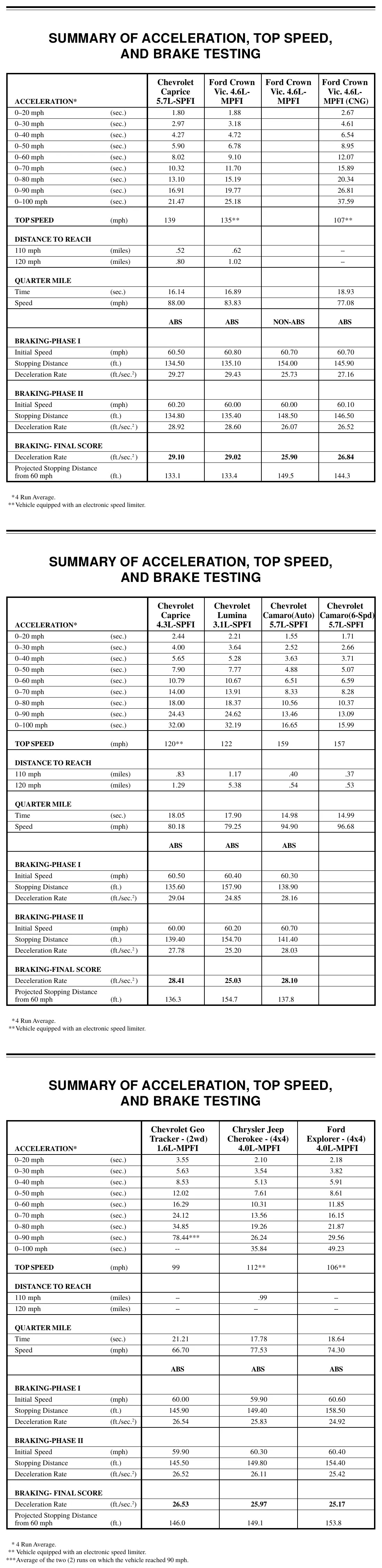
Complete acceleration ladders — every 10-mph increment
| 0 to… | Caprice 5.7 | Crown Vic | Crown Vic CNG | Caprice 4.3 | Lumina | Camaro auto | Camaro 6-spd | Geo Tracker | Cherokee | Explorer |
|---|---|---|---|---|---|---|---|---|---|---|
| 20 mph | 1.80 | 1.88 | 2.67 | 2.44 | 2.21 | 1.55 | 1.71 | 3.55 | 2.10 | 2.18 |
| 30 mph | 2.97 | 3.18 | 4.61 | 4.00 | 3.64 | 2.52 | 2.66 | 5.63 | 3.54 | 3.82 |
| 40 mph | 4.27 | 4.72 | 6.54 | 5.65 | 5.28 | 3.63 | 3.71 | 8.53 | 5.13 | 5.91 |
| 50 mph | 5.90 | 6.78 | 8.95 | 7.90 | 7.77 | 4.88 | 5.07 | 12.02 | 7.61 | 8.61 |
| 60 mph | 8.02 | 9.10 | 12.07 | 10.79 | 10.67 | 6.51 | 6.59 | 16.29 | 10.31 | 11.85 |
| 70 mph | 10.32 | 11.70 | 15.89 | 14.00 | 13.91 | 8.33 | 8.28 | 24.12 | 13.56 | 16.15 |
| 80 mph | 13.10 | 15.19 | 20.34 | 18.00 | 18.37 | 10.56 | 10.37 | 34.85 | 19.26 | 21.87 |
| 90 mph | 16.91 | 19.77 | 26.81 | 24.43 | 24.62 | 13.46 | 13.09 | 78.44 *** | 26.24 | 29.56 |
| 100 mph | 21.47 | 25.18 | 37.59 | 32.00 | 32.19 | 16.65 | 15.99 | — | 35.84 | 49.23 |
| Top speed | 139 | 135 ** | 107 ** | 120 ** | 122 | 159 | 157 | 99 | 112 ** | 106 ** |
The Geo Tracker’s 78.44 seconds to 90 mph is, as the asterisk says, the average of the two runs out of four on which the vehicle got there at all. Beside it, the Lumina needed 5.38 miles to reach 120 mph, the longest such distance we have found in the books held here.
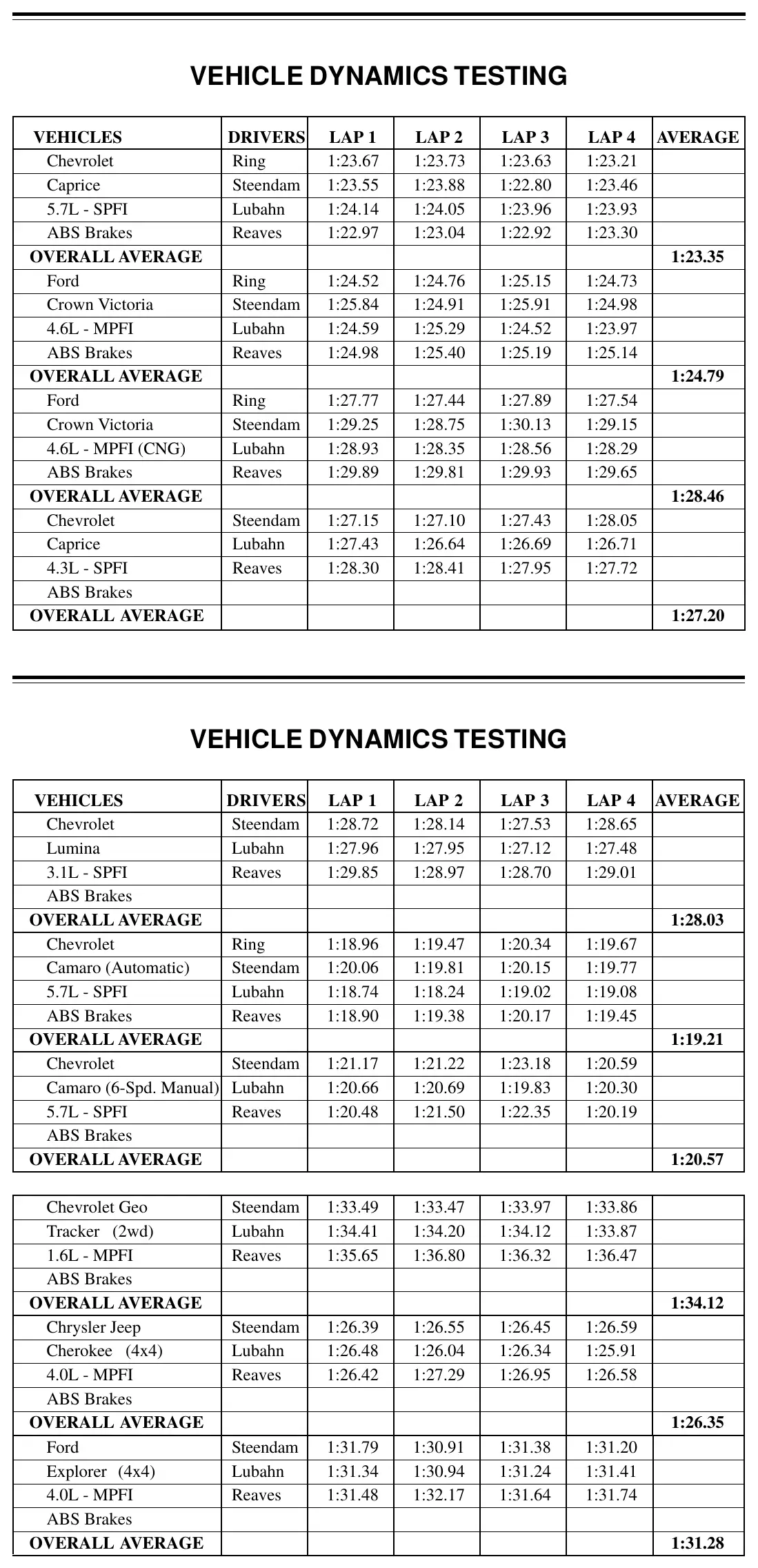
Vehicle dynamics at Michigan International Speedway — every lap, every driver
The book’s rule is at least twelve timed laps by at least three drivers over the 1.635-mile road course, scored on the average of the fastest nine or more. Four vehicles ran sixteen laps with four drivers and are scored on their fastest twelve; the other six — the 4.3L Caprice, the Lumina, the 6-speed Camaro, the Tracker, the Cherokee and the Explorer — ran twelve laps with three drivers and are scored on their fastest nine.
| Vehicle | Driver | Lap 1 | Lap 2 | Lap 3 | Lap 4 |
|---|---|---|---|---|---|
| Chevrolet Camaro (automatic) | overall average 1:19.21 | ||||
| Ring | 1:18.96 | 1:19.47 | 1:20.34 | 1:19.67 | |
| Steendam | 1:20.06 | 1:19.81 | 1:20.15 | 1:19.77 | |
| Lubahn | 1:18.74 | 1:18.24 | 1:19.02 | 1:19.08 | |
| Reaves | 1:18.90 | 1:19.38 | 1:20.17 | 1:19.45 | |
| Chevrolet Camaro (6-speed manual) | overall average 1:20.57 | ||||
| Steendam | 1:21.17 | 1:21.22 | 1:23.18 | 1:20.59 | |
| Lubahn | 1:20.66 | 1:20.69 | 1:19.83 | 1:20.30 | |
| Reaves | 1:20.48 | 1:21.50 | 1:22.35 | 1:20.19 | |
| Chevrolet Caprice 5.7L | overall average 1:23.35 | ||||
| Ring | 1:23.67 | 1:23.73 | 1:23.63 | 1:23.21 | |
| Steendam | 1:23.55 | 1:23.88 | 1:22.80 | 1:23.46 | |
| Lubahn | 1:24.14 | 1:24.05 | 1:23.96 | 1:23.93 | |
| Reaves | 1:22.97 | 1:23.04 | 1:22.92 | 1:23.30 | |
| Ford Crown Victoria | overall average 1:24.79 | ||||
| Ring | 1:24.52 | 1:24.76 | 1:25.15 | 1:24.73 | |
| Steendam | 1:25.84 | 1:24.91 | 1:25.91 | 1:24.98 | |
| Lubahn | 1:24.59 | 1:25.29 | 1:24.52 | 1:23.97 | |
| Reaves | 1:24.98 | 1:25.40 | 1:25.19 | 1:25.14 | |
| Chevrolet Caprice 4.3L | overall average 1:27.20 | ||||
| Steendam | 1:27.15 | 1:27.10 | 1:27.43 | 1:28.05 | |
| Lubahn | 1:27.43 | 1:26.64 | 1:26.69 | 1:26.71 | |
| Reaves | 1:28.30 | 1:28.41 | 1:27.95 | 1:27.72 | |
| Jeep Cherokee (4×4) | overall average 1:26.35 | ||||
| Steendam | 1:26.39 | 1:26.55 | 1:26.45 | 1:26.59 | |
| Lubahn | 1:26.48 | 1:26.04 | 1:26.34 | 1:25.91 | |
| Reaves | 1:26.42 | 1:27.29 | 1:26.95 | 1:26.58 | |
| Chevrolet Lumina | overall average 1:28.03 | ||||
| Steendam | 1:28.72 | 1:28.14 | 1:27.53 | 1:28.65 | |
| Lubahn | 1:27.96 | 1:27.95 | 1:27.12 | 1:27.48 | |
| Reaves | 1:29.85 | 1:28.97 | 1:28.70 | 1:29.01 | |
| Ford Crown Victoria (CNG) | overall average 1:28.46 | ||||
| Ring | 1:27.77 | 1:27.44 | 1:27.89 | 1:27.54 | |
| Steendam | 1:29.25 | 1:28.75 | 1:30.13 | 1:29.15 | |
| Lubahn | 1:28.93 | 1:28.35 | 1:28.56 | 1:28.29 | |
| Reaves | 1:29.89 | 1:29.81 | 1:29.93 | 1:29.65 | |
| Ford Explorer (4×4) | overall average 1:31.28 | ||||
| Steendam | 1:31.79 | 1:30.91 | 1:31.38 | 1:31.20 | |
| Lubahn | 1:31.34 | 1:30.94 | 1:31.24 | 1:31.41 | |
| Reaves | 1:31.48 | 1:32.17 | 1:31.64 | 1:31.74 | |
| Chevrolet Geo Tracker (2WD) | overall average 1:34.12 | ||||
| Steendam | 1:33.49 | 1:33.47 | 1:33.97 | 1:33.86 | |
| Lubahn | 1:34.41 | 1:34.20 | 1:34.12 | 1:33.87 | |
| Reaves | 1:35.65 | 1:36.80 | 1:36.32 | 1:36.47 | |
The Jeep’s laps come with a footnote from the preface: during dynamics testing the Cherokee’s front brake rotors had to be replaced after four timed laps because of excessive rotor run-out — they had warped. Its published average is the fastest nine of its twelve laps; four of the twelve were run before the replacement.
See the original pages: the 1996 report’s lap sheets
Ergonomics, communications and fuel
| Vehicle | Ergonomics & communications | EPA city (mpg) |
|---|---|---|
| Chevrolet Caprice | 217.19 | 16.8 (5.7) / 18.0 (4.3) |
| Ford Crown Victoria (CNG) | 206.67 | 17.3 |
| Ford Crown Victoria | 206.12 | 16.7 |
| Ford Explorer (4×4) | 198.91 | 14.9 |
| Chevrolet Lumina | 179.55 | 18.7 |
| Jeep Cherokee (4×4) | 178.43 | 15.0 |
| Chevrolet Camaro | 158.15 | 17.0 (auto) / 16.4 (6-speed) |
| Chevrolet Geo Tracker (2WD) | 132.16 | 22.0 |
The Geo Tracker’s 132.16 is the lowest ergonomics and communications points total in these books (the 2018 and later books print averages instead), below the 1989 Mustang’s 144.40 and the 2001 Hummer’s 144.43, though the books graded different numbers of items. Three of its line items are printed as dashes rather than scores — power window switch, automatic door lock switch and outside mirror controls — and the book gives no reason; its total is the sum of the other 25. It also returned the best fuel economy in the test at 22 mpg city, which is the only column it won.
The Caprice topped this category, and its margin over the Crown Victoria — 11.07 points — came from three places: the front seat (4.15 points), the communications section (3.92, where the technicians who had to fit radios into it scored the Chevrolet 1.0 to 1.5 points higher on dashboard, trunk and engine-compartment access) and the rear seat (2.71). On visibility the two cars were level; instrumentation favoured the Caprice by 0.42 and controls the Crown Victoria by 0.13.
Three things in this book’s front pages
Who started the programme. The acknowledgments thank Sgt. Bill McFall, F/Lt. Curtis L. VanDenBerg (retired) and Sgt. David B. Storer (retired) for their continued assistance with the programme which they originated 20 years ago. Those are the three men who began the Michigan tests. VanDenBerg had by then become president of Independent Testing & Consulting, Inc., the firm that prepared this very report.
The programme’s own start date. This preface calls 1996 the 20th annual evaluation. The 1999 report says 23rd year and the 2001 report says 25th. All three are consistent with a first evaluation of the 1977 models in the autumn of 1976, and the 1980 report says the programme was developed in 1976. The 1990 preface speaks of a belief held “since we began testing in 1977”, which could be read either way, so the date of the first test is not settled.
You could order the video. In 1988 the MSP produced a short videotape of the evaluation programme, and this book explains how to get a copy: send Sgt. Bob Ring a good quality blank VHS cassette, at least T–30 in length, with a self-addressed return mailing label. The AutoBid selection software ran on MS-DOS with at least 512K of RAM, and the NIJ offered limited copies free to law enforcement agencies that wrote in on letterhead.
What 1996 settled
The last of the B-body Caprices was the quickest of them in these books, 8.02 seconds to 60 and 21.47 to 100, and the best-braking, though the 1994 car’s 141.2 mph beat its 139 and the 1995 car lapped quicker. The 1996 Caprice’s projected stop was 133.1 feet, it topped the ergonomics column, and of the two cars the book scored, the Caprice and the Crown Victoria, it led in every category. No American police sedan in the books held went faster than the 1994 car’s 141.2 until 2006, when the Dodge Charger ran 150 and the Impala 142, recorded, like every vehicle in that book, with an electronic speed limiter fitted.
The rest of the entry list: a front-drive Lumina that needed 5.38 miles to reach 120 mph, a Cherokee that warped its own brake rotors after four laps, an Explorer that took 49 seconds to reach 100, and a Geo Tracker with three ergonomics items left blank and a 78-second run to 90. In the next year’s test, five of the eleven vehicles were sport utilities.