
Michigan test archive
2012 Michigan State Police Patrol Vehicle Test
The Panther is gone. Nineteen vehicles, six of them wearing a Ford badge, and every car brake sheet now runs to twenty measured stops.
Every earlier Michigan test in this archive, back to 1978, had a big rear-drive Ford sedan somewhere in the results. In 2012 there isn’t one. No Crown Victoria was entered, and Ford brought six vehicles instead: a Police Interceptor sedan in front-drive, all-wheel-drive, all-wheel-drive E85 and turbocharged EcoBoost forms, and a Police Interceptor Utility in front-drive and all-wheel-drive E85. Nineteen cars ran in total, the largest car field in this archive, with six motorcycles alongside.
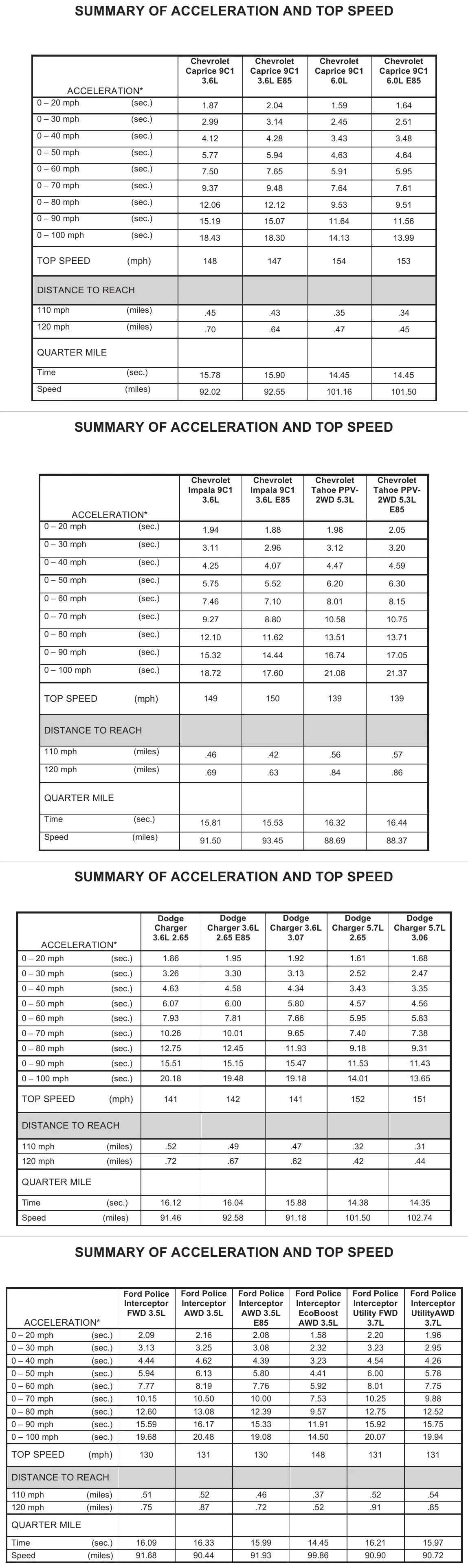
The headline numbers went to Chevrolet and Dodge. The Caprice 9C1 6.0L ran 154 mph, the highest top speed any sedan had recorded in these tests to that point: one mile an hour up on the 2000 Volvo S-70 T5’s 153 and four up on the 2006 HEMI Charger’s 150. Later Caprices ran 155 and, in 2015, 156. The 6.0 Caprice reached 100 mph in 14.13 seconds. The Charger 5.7 with 3.06 gears reached 60 mph in 5.83 seconds, the quickest car in this test, and crossed the quarter mile at 102.74 mph, the highest trap speed a four-door has recorded in these tests.
The braking figures need a note before they are compared with anything. The Caprice 6.0’s projected stop from 60 mph was 125.8 feet, the shortest stop in this test. Every car brake sheet in this book runs ten 60-to-0 full-ABS stops in each of two phases, twenty in all; the 2009 book, the last earlier one held here, scored twelve measured stops. The 2012 book does not describe the change. Three cars stopped in 127 feet or less: the 6.0 Caprice at 125.8, the 3.6 Caprice at 126.2 and the V6 Charger at 127.0. None of the three is directly comparable with a figure from a twelve-stop book.
And Ford’s new turbocharged sedan ran with the quickest cars in the test. The EcoBoost Police Interceptor reached 60 in 5.92 seconds, within a tenth of the HEMI Charger and the 6.0 Caprice, and ran 148 mph from a turbocharged 3.5-litre engine.
The police category — Chevrolet and Dodge
| Vehicle | 0–60 (s) | 0–100 (s) | Top speed | ¼ mile | Brakes (ft/s²) | 60–0 (ft) |
|---|---|---|---|---|---|---|
| Chevrolet Caprice 9C1 6.0L | 5.91 | 14.13 | 154 | 14.45 @ 101.16 | 30.77 | 125.8 |
| Chevrolet Caprice 9C1 6.0L (E85) | 5.95 | 13.99 | 153 | 14.45 @ 101.50 | ‡ | ‡ |
| Dodge Charger 5.7L (3.06 axle) | 5.83 | 13.65 | 151 | 14.35 @ 102.74 | § | § |
| Dodge Charger 5.7L (2.65 axle) | 5.95 | 14.01 | 152 | 14.38 @ 101.50 | § | § |
| Chevrolet Impala 9C1 3.6L (E85) | 7.10 | 17.60 | 150 | 15.53 @ 93.45 | ‡ | ‡ |
| Chevrolet Impala 9C1 3.6L | 7.46 | 18.72 | 149 | 15.81 @ 91.50 | 29.20 | 132.6 |
| Chevrolet Caprice 9C1 3.6L | 7.50 | 18.43 | 148 | 15.78 @ 92.02 | 30.67 | 126.2 |
| Chevrolet Caprice 9C1 3.6L (E85) | 7.65 | 18.30 | 147 | 15.90 @ 92.55 | ‡ | ‡ |
| Dodge Charger 3.6L (3.07 axle) | 7.66 | 19.18 | 141 | 15.88 @ 91.18 | 30.49 | 127.0 |
| Dodge Charger 3.6L (2.65 axle, E85) | 7.81 | 19.48 | 142 | 16.04 @ 92.58 | ‡ | ‡ |
| Dodge Charger 3.6L (2.65 axle) | 7.93 | 20.18 | 141 | 16.12 @ 91.46 | ‡ | ‡ |
| Chevrolet Tahoe PPV 2WD | 8.01 | 21.08 | 139 | 16.32 @ 88.69 | 28.93 | 133.8 |
| Chevrolet Tahoe PPV 2WD (E85) | 8.15 | 21.37 | 139 | 16.44 @ 88.37 | ‡ | ‡ |
Every vehicle on this page had a speed limiter fitted. The report states it for the whole field in its General Information section, printed page 2: “All vehicles listed in this report were equipped with electronic speed limiters.”
Unqualified, as it is in every document held here from 2003 to 2014 (the 2003, 2004 and 2005 bulletins and the 2005, 2006, 2009, 2012 and 2013 books). No exceptions, no motorcycle clause: every vehicle in the table above had a limiter fitted, so any top speed in it may be a setting rather than what the vehicle could do.
Gold row: 154 mph and a 125.8-foot stop, the highest top speed and the shortest stop in this test, in the same car. The previous Caprice in these books was the 1996 car; the nameplate returned in 2011.
The V6 Caprice is close behind. The 3.6-litre Caprice ran 148 mph and stopped in 126.2 feet: the same top speed as the V8 Caprice of the previous year, and the second-shortest stop in this test after its 6.0-litre sibling. The 3.6 Impala reached 100 mph in 18.72 seconds against the 3.9-litre car’s 23.74 the year before: five seconds found in one model year.
Michigan also ran the axle comparison twice over. Two 5.7 HEMI Chargers, 2.65 against 3.06: the taller gear gives up 0.12 seconds to 60 and gains one mile an hour on top. Two 3.6 Chargers, 2.65 against 3.07: the shorter gear is 0.27 seconds quicker to 60 and level on top speed.
Ford’s replacements for the Crown Victoria
| Vehicle | 0–60 (s) | 0–100 (s) | Top speed | ¼ mile | Brakes (ft/s²) | 60–0 (ft) |
|---|---|---|---|---|---|---|
| Police Interceptor EcoBoost AWD 3.5L | 5.92 | 14.50 | 148 | 14.45 @ 99.86 | 29.83 | 129.8 |
| Police Interceptor Utility AWD 3.7L (E85) | 7.75 | 19.94 | 131 | 15.97 @ 90.72 | 29.40 | 131.7 |
| Police Interceptor AWD 3.5L (E85) | 7.76 | 19.08 | 130 | 15.99 @ 91.93 | ‡ | ‡ |
| Police Interceptor FWD 3.5L | 7.77 | 19.68 | 130 | 16.09 @ 91.68 | 29.55 | 131.0 |
| Police Interceptor Utility FWD 3.7L | 8.01 | 20.07 | 131 | 16.21 @ 90.90 | 30.15 | 128.4 |
| Police Interceptor AWD 3.5L | 8.19 | 20.48 | 131 | 16.33 @ 90.44 | 29.38 | 131.8 |
Gold row: the turbocharged car, the only one in the test, and the only one of the six that belongs in the same conversation as the Caprice and the Charger. Its 5.92-second 0–60 is 0.01 seconds off the 6.0-litre Caprice and its 148 mph matches the V6 Caprice exactly.
The naturally aspirated cars are a different matter. At 7.75 to 8.19 seconds and 130 or 131 mph with limiters fitted they are quicker than the 2011 Crown Victoria, which needed 8.87 seconds and ran 119 with the 3.55 axle, but they are slower than every Caprice and both Impalas. Against the three V6 Chargers the result is split: the three quickest Fords (7.75 to 7.77 seconds) beat two of them, and the 3.07-axle Charger’s 7.66 beats all five.
The braking spread is narrow: 128.4 to 131.8 feet, with the front-drive Utility shortest at 128.4 feet. Note also that every Ford in the test carried “N/A” in the fuel economy table, with a pointer to Ford’s website for the official figures.
See the original pages in the 2012 book: acceleration
What went wrong during testing
The book’s General Information page (printed p.2) and its motorcycle introduction (printed p.88) record these. Before test day Chrysler technicians replaced the front brake calipers on all of its cars “to more accurately reflect 2012 components”. The 3.07-axle V6 Charger lost a caliper slide bolt at the conclusion of its brake test; the book says the final brake results were not affected. The EcoBoost Police Interceptor broke two lug bolts at Grattan, attributed to the pre-production wheels, and its hub was replaced. The 3.6 Caprice showed a coolant over-temperature light, traced to air in the cooling system. The E85 Impala pulled a half-shaft out on its last run, after logging six timed laps, which the book says was sufficient to establish a timed average; the dynamics table still prints four drivers’ five laps for it (printed p.34). The 6.0 Caprice lost ABS and stability control on lap 3 of its last run, again on the last lap after a blown fuse was replaced, traced to a wiring harness touching the A/C compressor pulley. Among the motorcycles, the BMW showed rear-wheel lift under braking, and the Victory Vision came with an aftermarket exhaust that the maker said is standard on the police model.
Apart from the slide bolt, the book does not say whether any of these affected a published figure.
Vehicle dynamics
| Vehicle | Overall average |
|---|---|
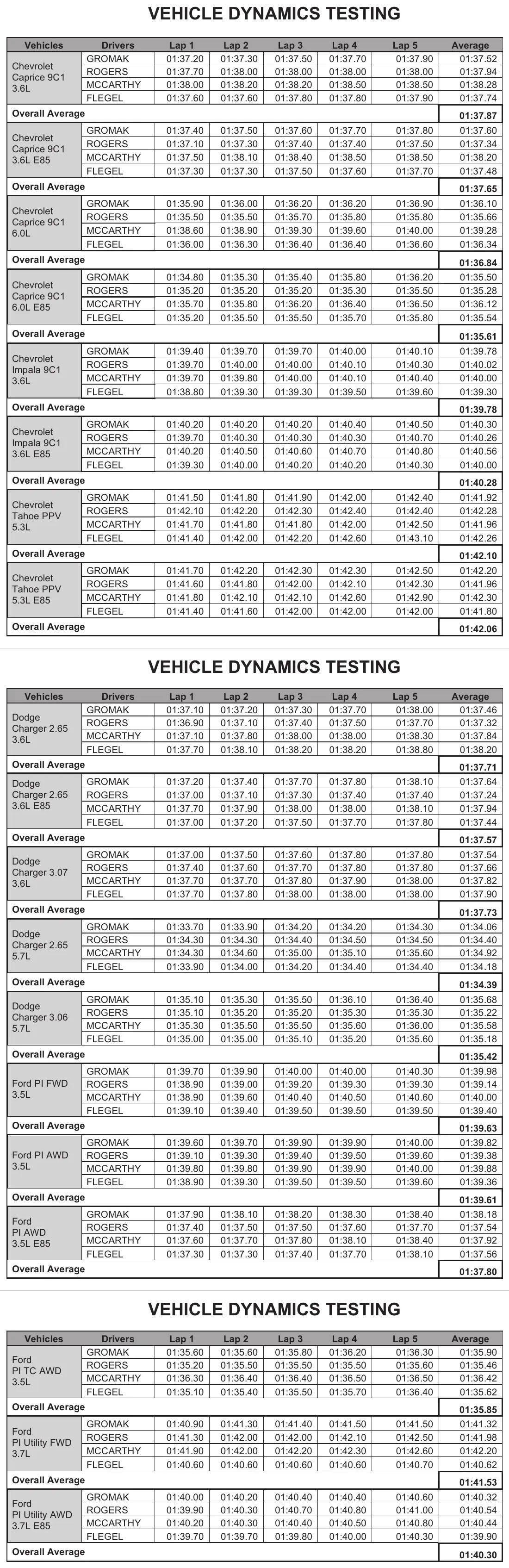
| Dodge Charger 5.7L (2.65 axle) | 1:34.39 |
| Dodge Charger 5.7L (3.06 axle) | 1:35.42 |
| Chevrolet Caprice 9C1 6.0L (E85) | 1:35.61 |
| Police Interceptor EcoBoost AWD 3.5L | 1:35.85 |
| Chevrolet Caprice 9C1 6.0L | 1:36.84 |
| Dodge Charger 3.6L (2.65 axle, E85) | 1:37.57 |
| Chevrolet Caprice 9C1 3.6L (E85) | 1:37.65 |
| Dodge Charger 3.6L (2.65 axle) | 1:37.71 |
| Dodge Charger 3.6L (3.07 axle) | 1:37.73 |
| Police Interceptor AWD 3.5L (E85) | 1:37.80 |
| Chevrolet Caprice 9C1 3.6L | 1:37.87 |
| Police Interceptor AWD 3.5L | 1:39.61 |
| Police Interceptor FWD 3.5L | 1:39.63 |
| Chevrolet Impala 9C1 3.6L | 1:39.78 |
| Chevrolet Impala 9C1 3.6L (E85) | 1:40.28 |
| Police Interceptor Utility AWD 3.7L (E85) | 1:40.30 |
| Police Interceptor Utility FWD 3.7L | 1:41.53 |
| Chevrolet Tahoe PPV 2WD (E85) | 1:42.06 |
| Chevrolet Tahoe PPV 2WD | 1:42.10 |
Gold row: 1:34.39 is the best car lap average at Grattan anywhere in this archive. Nineteen cars ran, and the spread from quickest to slowest is 7.71 seconds.
Note where the EcoBoost sedan finishes. Its 1:35.85 is fourth of nineteen, ahead of three of the four Caprices and 1.95 seconds clear of the quickest naturally aspirated Ford, the AWD E85 sedan at 1:37.80.
See the original pages in the 2012 book: lap times
| Machine | Overall average |
|---|---|
| BMW R 1200 RT-P | 1:40.19 |
| Kawasaki Concours 14 ABS Police | 1:43.26 |
| Harley-Davidson Road King FLHP | 1:49.63 |
| Harley-Davidson Electra Glide FLHTP | 1:49.66 |
| Victory Vision | 1:51.54 |
| Victory Commander I | 1:52.34 |
The motorcycles
| Machine | 0–60 (s) | 0–100 (s) | Top speed | ¼ mile | Brakes (ft/s²) | 60–0 (ft) |
|---|---|---|---|---|---|---|
| Kawasaki Concours 14 ABS Police | 4.02 | 8.29 | 126 | see test sheet | 26.94 | 143.7 |
| BMW R 1200 RT-P | 4.41 | 10.75 | 131 | see test sheet | 27.65 | 140.0 |
| Victory Commander I | 5.86 | 18.74 | 117 | 14.65 @ 92.03 | 24.68 | 156.9 |
| Victory Vision | 5.93 | 20.02 | 120 | 14.78 @ 91.03 | 25.96 | 149.2 |
| Harley-Davidson Road King FLHP | 5.66 | 21.28 | 109 | 14.53 @ 91.95 | 26.32 | 147.1 |
| Harley-Davidson Electra Glide FLHTP | 6.10 | 31.60 | 104 | 14.97 @ 88.89 | 27.85 | 139.0 |
Gold row: the Kawasaki set two motorcycle bests for these tests at the time. 4.02 seconds to 60 mph beat the BMW’s 4.10 from 2008, and 8.29 seconds to 100 took nearly a second and a half off its own 2011 figure of 9.70. No car tested to 2012 had come close to either. Both have since been beaten: the 2015 BMW reached 60 in 3.99 seconds and the 2020 Yamaha reached 100 in 8.19.
Two Victory machines appear for the first time — the Vision and the Commander I. Both reach 100 mph sooner than either Harley and run eight to sixteen miles an hour faster, but the Road King is quicker than both of them to 60 (5.66 seconds) and over the quarter mile. The Electra Glide’s 31.60 seconds to 100 mph is the slowest run to that speed anywhere in the motorcycle records, though it posted the best braking figure of the six at 139.0 feet.
Ergonomics and communications
| Vehicle | Ergonomics & communications |
|---|---|
| Chevrolet Tahoe PPV | 235.88 |
| Dodge Charger | 223.18 |
| Chevrolet Caprice 9C1 | 217.14 |
| Chevrolet Impala 9C1 | 209.99 |
| Ford Police Interceptor Utility | 209.44 |
| Ford Police Interceptor | 201.62 |
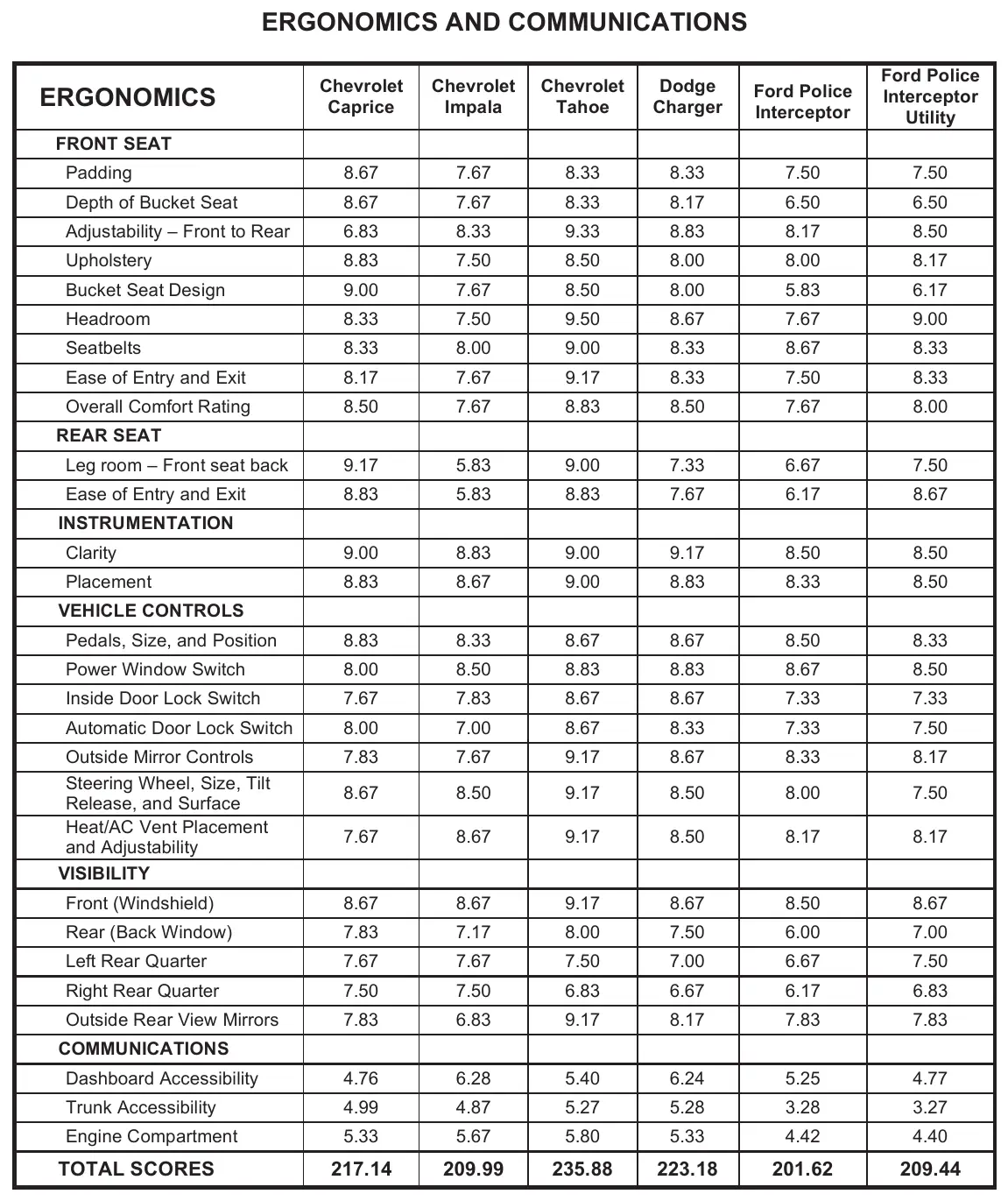
On the book’s scale 5 is “average” (printed p.70), and the communications marks, given by DIT Communications personnel for the difficulty of installing equipment, sit around it. Trunk accessibility scored 3.28 for the Police Interceptor sedan and 3.27 for the Utility, with the Caprice at 4.99 and the Charger, highest of the group, at 5.28. Every vehicle in this test scored between 4.4 and 6.3 on engine-compartment and dashboard access.
The Caprice again shows the split that defined it in 2011: 9.17 for rear-seat legroom, the highest mark in the test for that item (the Tahoe scored 9.00), and 4.76 for dashboard accessibility, the lowest for that item.
See the original page in the 2012 book: ergonomics
What 2012 settled
No Crown Victoria was entered, and Michigan measured Ford’s six new vehicles on the same courses as everything else. The EcoBoost sedan, the only turbocharged car in the test, ran with the quickest cars in it; the naturally aspirated Fords sat behind every Caprice and both Impalas on acceleration; and both Ford bodies scored below the book’s “average” of 5 for trunk access.
The 6.0 Caprice posted the highest top speed and the shortest stop in the test: 154 mph, the fastest sedan figure in these books to that point, and 125.8 feet under the twenty-stop procedure. The book names no winner; it calls itself “not an endorsement of products”. The Caprice had been absent from these tests for fifteen years before its return in 2011, and its last entry here is 2017.