
Michigan test archive
2009 Michigan State Police Patrol Vehicle Test
Eight vehicles. No special-service category, no Ford but the Interceptor — and the first police sedan in these books to break six seconds.
Look at the size of this test. The 2008 evaluation, as this archive records it, ran sixteen cars and trucks across two categories, plus three motorcycles. The 2009 evaluation ran eight, all of them in the police category, and the special-service section is simply absent — no Explorer, no Expedition, no Suburban, no pickup, no four-wheel-drive Tahoe. For the first time since the 1999 book gave special-service vehicles an appendix of their own, not one special-service vehicle was submitted.
The Dodge Magnum is gone too, leaving the Charger alone from Chrysler. What remains is four nameplates: two Police Interceptors differing only in axle, an Impala in petrol and E85, a Tahoe PPV in petrol and E85, and two Chargers. These vehicles were tested in the autumn of 2008, and the thinness of the entry list is the most eloquent thing on the page.
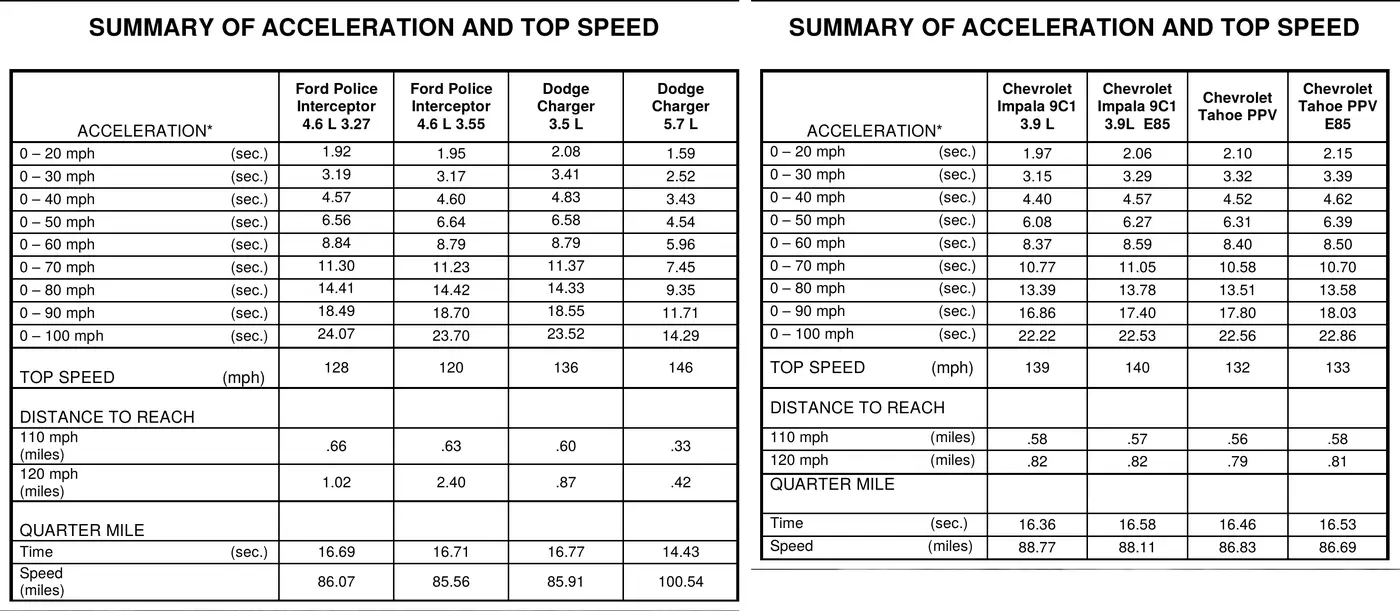
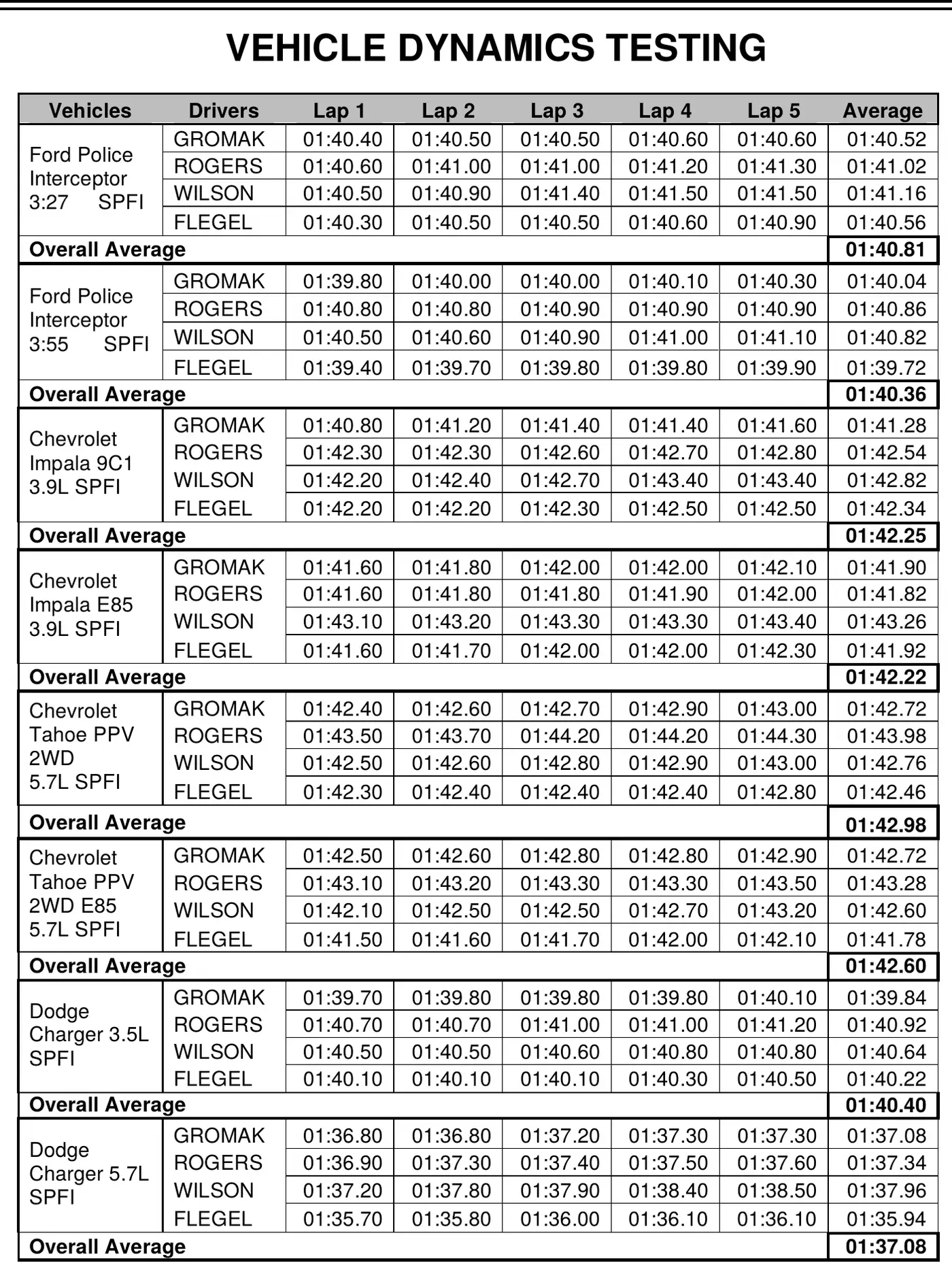
What did show up went very fast. The Charger 5.7 reached 60 mph in 5.96 seconds — the first police-package sedan in this archive to break six seconds — ran 100 in 14.29, crossed the quarter mile in 14.43 at 100.54 mph, and lapped Grattan in 1:37.08. Its projected stop was 135.2 feet. In 2002 a Dodge police sedan missed its braking requirement by four hundredths; seven years later it was the quickest, fastest and among the best-braking cars in the test.
The police category
| Vehicle | 0–60 (s) | 0–100 (s) | Top speed | ¼ mile | Dynamics | Brakes (ft/s²) | 60–0 projected (ft) |
|---|---|---|---|---|---|---|---|
| Dodge Charger 5.7L HEMI | 5.96 | 14.29 | 146 | 14.43 @ 100.54 | 1:37.08 | 28.65 | 135.2 |
| Chevrolet Impala 9C1 3.9L | 8.37 | 22.22 | 139 | 16.36 @ 88.77 | 1:42.25 | ‡ | ‡ |
| Chevrolet Tahoe PPV 2WD | 8.40 | 22.56 | 132 | 16.46 @ 86.83 | 1:42.98 | 27.04 | 143.2 |
| Chevrolet Tahoe PPV 2WD (E85) | 8.50 | 22.86 | 133 | 16.53 @ 86.69 | 1:42.60 | ‡ | ‡ |
| Chevrolet Impala 9C1 3.9L (E85) | 8.59 | 22.53 | 140 | 16.58 @ 88.11 | 1:42.22 | 26.84 | 144.2 |
| Dodge Charger 3.5L | 8.79 | 23.52 | 136 | 16.77 @ 85.91 | 1:40.40 | 28.66 | 135.1 |
| Ford Police Interceptor (3.55 axle) | 8.79 | 23.70 | 120 | 16.71 @ 85.56 | 1:40.36 | ‡ | ‡ |
| Ford Police Interceptor (3.27 axle) | 8.84 | 24.07 | 128 | 16.69 @ 86.07 | 1:40.81 | 27.19 | 142.4 |
Every vehicle in the police category had a speed limiter fitted. The report states it for the whole field in its General Information section, printed page 2: “All vehicles listed in this report were equipped with electronic speed limiters.”
Unqualified, as it is in every document held here from 2003 to 2014 (the 2003, 2004 and 2005 bulletins and the 2005, 2006, 2009, 2012 and 2013 books). No exceptions, no motorcycle clause — every vehicle in the table above had a limiter fitted, so any top speed in it may be a setting rather than what the vehicle could do.
Gold row: 5.96 seconds to 60 mph, the first sub-six-second police sedan in this archive, and a 1:37.08 lap that is 3.28 seconds clear of anything else in the test. Its 14.43-second quarter at 100.54 mph is the first sedan to break 100 mph through the traps here.
Below it the field is remarkably tight — seven vehicles separated by 0.47 seconds to 60 mph. The Impala is quickest of them and runs 139 mph; the Tahoe PPV, a full-size sport utility, reaches 60 in 8.40 and runs 132, which is twelve miles an hour faster than a Police Interceptor with the 3.55 axle. The 3.55 Ford needed 2.40 miles to reach 120 mph, against 0.87 for the Charger 3.5 and 0.42 for the HEMI.
The braking column belongs to Dodge: both Chargers have projected stops of almost exactly 135 feet — 135.1 and 135.2 — against 142.4 for the Interceptor and 143.2 for the Tahoe.
See the original pages: the acceleration and top speed summary and the vehicle dynamics data in the 2009 book
The motorcycles
| Machine | 0–60 (s) | 0–100 (s) | Top speed | ¼ mile | Brakes (ft/s²) | 60–0 projected (ft) |
|---|---|---|---|---|---|---|
| BMW R1200RT-P | 4.41 | 11.27 | 130 | 13.10 @ 106.11 | 26.24 | 147.6 |
| Buell Ulysses | 5.15 | 13.58 | 106 | 13.87 @ 100.80 | 24.68 | 156.9 |
| Harley-Davidson Electra Glide FLHTP | 5.31 | 28.13 | 104 | 15.74 @ 88.08 | 23.82 | 162.6 |
| BMW G650 XChallenge | 5.58 | — | 101 | 14.63 @ 88.92 | 24.94 | 155.3 |
| Harley-Davidson Road King FLHP | 7.56 | 30.02 | 105 | 15.87 @ 87.37 | 22.87 | 169.3 |
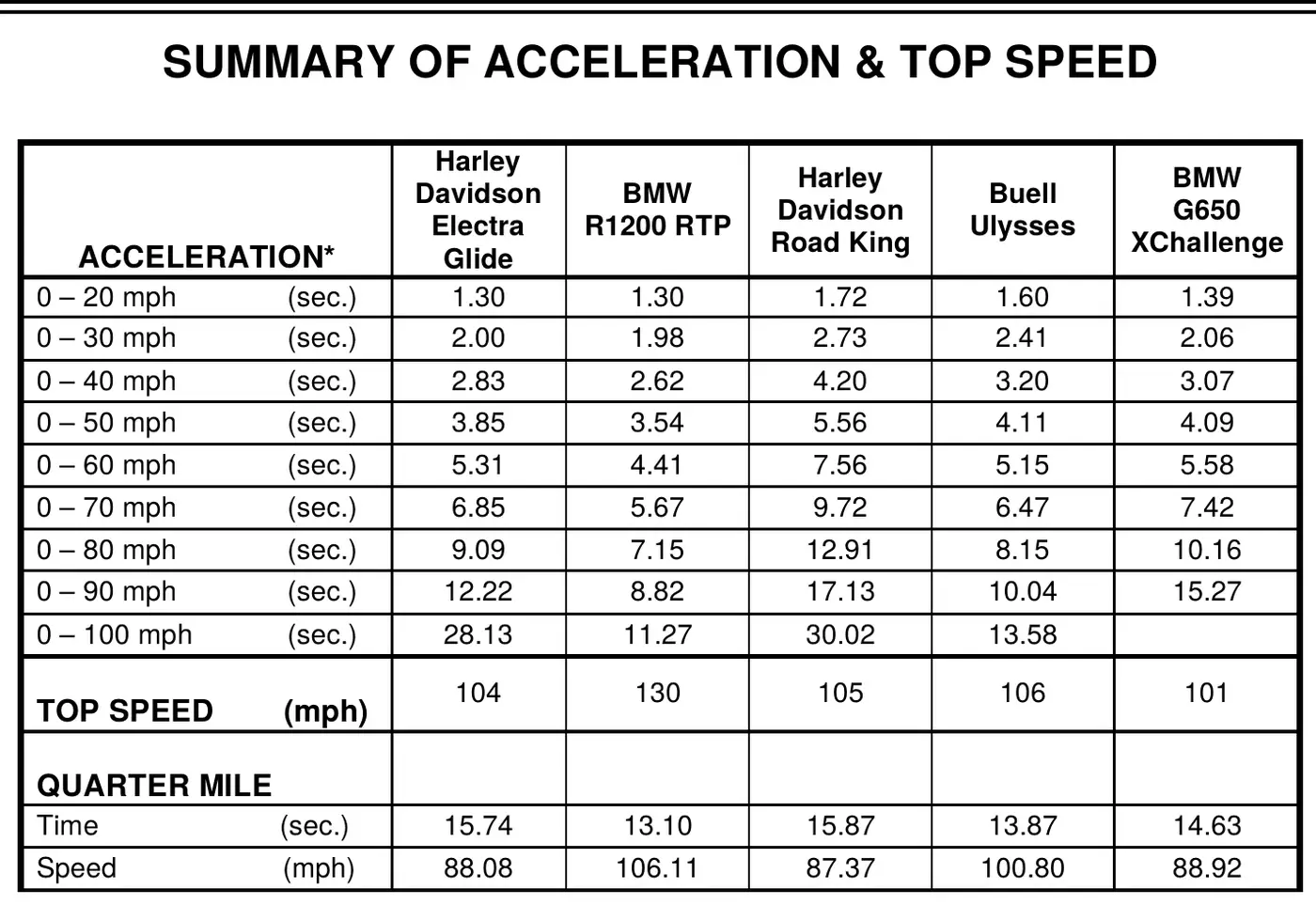
The Buell Ulysses, in the first of its two appearances in this archive (it returns in 2010), reached 60 in 5.15 seconds and 100 in 13.58, and ran the quarter in 13.87 at 100.80 mph: quicker on all three than every car in the test, the HEMI Charger included. The BMW G650 XChallenge, a single-cylinder machine, reached 60 in 5.58, has no 0–100 time printed, and out-braked both Harleys. The slowest acceleration on the page is the Road King’s: 7.56 seconds to 60 and 30.02 to 100.
The Harleys’ braking has not recovered from its 2008 fall. At 22.87 and 23.82 ft/s² they need 169.3 and 162.6 feet — the longest stopping distances anywhere in the 2009 test, on two wheels or four.
See the original page: the motorcycle acceleration and top speed summary in the 2009 book
Ergonomics, communications and fuel
| Vehicle | Ergonomics & communications | City mpg (EPA label) |
|---|---|---|
| Chevrolet Tahoe PPV | 210.87 | 14 (PPV 2WD) / 10 (E85) |
| Dodge Charger | 197.70 | 16 (3.5) / 16 (5.7) |
| Ford Police Interceptor | 194.07 | 14 |
| Chevrolet Impala 9C1 | 178.40 | 17 (9C1) / 12 (E85) |
The motorcycle top speeds on this page were measured over a shorter run-up than the cars’. The book sets the car objective as the top speed “attainable by each test vehicle within a distance of 14 miles from a standing start” and the motorcycle objective as the top speed “attainable by each test motorcycle within a distance of 10 miles from a standing start” — two different distances in the same volume. The 2007 book is not held here; the 2012 and 2013 books already give 14 miles for both. So a motorcycle figure from these early years and a car figure from the same book are not measured the same way, and the bikes had four fewer miles to reach their number.
One blank is worth noting. The BMW G650 XChallenge is credited with a top speed of 101 mph but no 0–100 mph time: the book prints four 0–100 times for five machines. Top speed comes from a continued run of up to ten miles and the 0–100 from the acceleration runs, so the two need not conflict, but the book does not explain the blank.
The E85 penalty is severe on the label figures: the E85 Tahoe is rated 10 mpg city against the petrol Tahoe’s 14, and the E85 Impala 12 against 17, both about 29 percent lower, for acceleration within 0.31 seconds of their petrol twins to 60 and to 100 (the E85 Impala was 0.54 seconds slower to 90).
The Impala’s ergonomics total is the lowest here. It is lowest or joint lowest on 19 of the 28 items, with 3.60 out of ten for rear-seat legroom, 3.40 for rear-seat entry and exit and 4.60 for the outside mirrors.
Note also that the Charger’s two engines carry the same 16 mpg city label (the unadjusted figures are 20.9 and 19.3), while the 3.5 V6 gives away 2.83 seconds to 60 mph and ten miles an hour on top.
What 2009 settled
The entry list is the story, and it is a short one. Sixteen cars and trucks became eight. The special-service category, with its Explorers and Expeditions, produced not a single submission. All three car makers took part, with fewer models.
What did turn up made its case emphatically. A Dodge Charger with a HEMI reached 60 mph in 5.96 seconds, ran 146, had a projected stop of 135.2 feet and lapped 3.28 seconds clear of everything else. Seven years earlier Chrysler had come back to these tables with an Intrepid that missed its braking requirement by four hundredths of a foot per second squared. Its Charger now led the police category on acceleration, top speed and the road course, and stopped within a tenth of a foot of the best car, its own V6 sibling.