
Michigan test archive
1994 Michigan State Police Patrol Vehicle Test
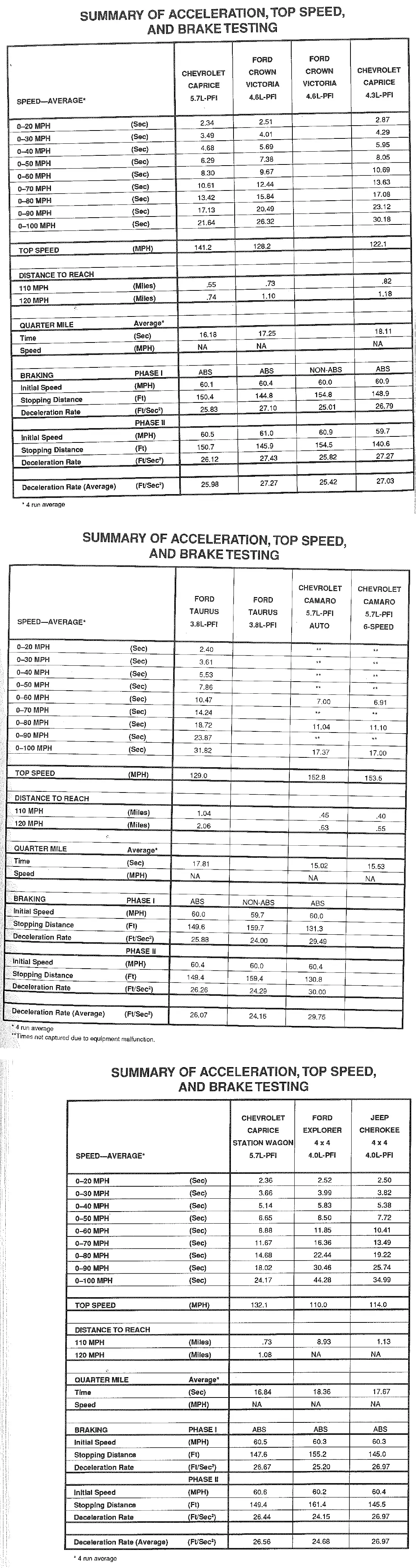
A port-injected Caprice runs 141.2 mph, the Camaros run 153, a Ford Explorer makes its first appearance, and five vehicles arrive with electronic limiters.
Nine vehicles ran the 1994 test, from 18 to 20 September 1993, and two more were brought for the brakes alone. The straight-line runs and the brake tests were made at the Chrysler Proving Grounds on 18 September, and the laps on the 1.635-mile Michigan International Speedway road course. The book counts “6 police patrol package cars and 5 special service package vehicles”. The six are the Caprice 5.7 and 4.3, the Crown Victoria and the Taurus, plus a Crown Victoria and a Taurus without anti-lock brakes that “were submitted for brake testing only”. The five are two Camaros, a Caprice station wagon, a Ford Explorer and a Jeep Cherokee.
The headline is the Chevrolet Caprice 5.7, now with sequential port fuel injection and 260 horsepower: 60 mph in 8.30 seconds, 100 in 21.64, a quarter mile in 16.18 and 141.2 mph. That is the highest top speed by any sedan in the books held here to that point, eight mph above the 1992 Caprice’s 133.0. No American police sedan in these books went faster until 2006, when the Charger ran 150 and the Impala 142; the last Caprice of the 1990s, in 1996, ran 139. Its 21.64 to 100 was also the quickest by a sedan in the books held to that point, until that 1996 car’s 21.47. Michigan’s bid specification names only the Caprice and the Crown Victoria, and those are the two cars the book scores. The Caprice had the lower weighted score, 0.940 against 6.470, and lost points only on braking. The book prints no bids.
The Camaros were the quickest vehicles in the test. The six-speed reached 60 in 6.91 seconds and 100 in 17.00 and ran 153.5 mph. The automatic lapped in 1:19.38 and ran the quarter mile in 15.02 seconds, both the quickest in the books held to that point (the 1993 Camaro’s 1:19.52; for the quarter mile, the 1992 Camaro’s 15.10, the 1991 and 1993 bulletins printing no quarter-mile times). It also braked best in the test. The Ford Explorer, the first in these books, was run in two-wheel drive at Ford’s request. It was the slowest vehicle to 60, 80 and 100 mph, over the quarter mile and round the road course, needing 44.28 seconds to reach 100 mph.
The preface records five vehicles with electronic limiters, equipment failures that lost every quarter-mile speed and the Camaros’ intermediate times, and three cars that wore out a right-front tyre on the road course. Each is quoted below.
The police patrol package cars
| Vehicle | Engine | 0–60 (s) | 0–80 (s) | 0–100 (s) | ¼-mile (s @ mph) | Top speed (mph) | Miles to 110 mph | Miles to 120 mph | Dynamics |
|---|---|---|---|---|---|---|---|---|---|
| Chevrolet Caprice 5.7L | 5.7L (350 cid) PFI | 8.30 | 13.42 | 21.64 | 16.18 | 141.2 | 0.55 | 0.74 | 1:23.80 |
| Ford Crown Victoria | 4.6L (281 cid) PFI | 9.67 | 15.84 | 26.32 | 17.25 | 128.2 ** | 0.73 | 1.10 | 1:25.79 |
| Ford Crown Victoria (non-ABS) | 4.6L (281 cid) PFI | submitted for brake testing only (see the braking table) | |||||||
| Chevrolet Caprice 4.3L | 4.3L (265 cid) PFI | 10.69 | 17.08 | 30.18 | 18.11 | 122.1 ** | 0.82 | 1.18 | 1:26.76 |
| Ford Taurus | 3.8L (232 cid) PFI | 10.47 | 18.72 | 31.82 | 17.81 | 129.0 ** | 1.04 | 2.06 | 1:26.69 |
| Ford Taurus (non-ABS) | 3.8L (232 cid) PFI | submitted for brake testing only (see the braking table) | |||||||
Gold row: the Caprice 5.7 was quickest, fastest and quickest round the road course of the four sedans. It beat or tied the Crown Victoria in every column of the bid score except braking, where the Crown Victoria’s 27.27 ft/s² beat its 25.98. Its top speed is printed four times in the book: as 141.2 on the run sheet (page 34) and in the summary (page 28), and as 141.20 in the raw scores (page 57) and on the evaluation sheet (page 58). The NIJ bulletin’s Table 4 prints it as 141.20.
The Crown Victoria cleared every printed minimum, and so did the Caprice 5.7. Against the same times, the Caprice 4.3 missed 60 mph (10.69 seconds against 10.1) and 100 mph (30.18 against 29.6). The Taurus missed all three times, 10.47, 18.72 and 31.82, and needed 1.04 miles to reach 110 and 2.06 to reach 120. Neither has a time requirement on its run sheet, and the book names neither as failing. The 4.3 is the 265-cubic-inch Caprice; it reached 120 in 1.18 miles and topped out at 122.1.
See the original pages: the 1994 book’s summary of test data
The special service vehicles
| Vehicle | Engine | 0–60 (s) | 0–80 (s) | 0–100 (s) | ¼-mile (s @ mph) | Top speed (mph) | Miles to 110 mph | Miles to 120 mph | Dynamics |
|---|---|---|---|---|---|---|---|---|---|
| Chevrolet Camaro (automatic) | 5.7L (350 cid) PFI | 7.00 | 11.04 | 17.37 | 15.02 | 152.8 | 0.45 | 0.63 | 1:19.38 |
| Chevrolet Camaro (6-speed) | 5.7L (350 cid) PFI | 6.91 | 11.10 | 17.00 | 15.53 | 153.5 | 0.40 | 0.55 | 1:19.95 |
| Chevrolet Caprice Station Wagon | 5.7L (350 cid) PFI | 8.88 | 14.68 | 24.17 | 16.84 | 132.1 ** | 0.73 | 1.08 | 1:26.20 |
| Jeep Cherokee (4WD) | 4.0L (242 cid) PFI | 10.41 | 19.22 | 34.99 | 17.67 | 114.0 | 1.13 | — | 1:26.26 |
| Ford Explorer (4WD) | 4.0L (245 cid) PFI | 11.85 | 22.44 | 44.28 | 18.36 | 110.0 ** | 8.93 | — | 1:32.16 |
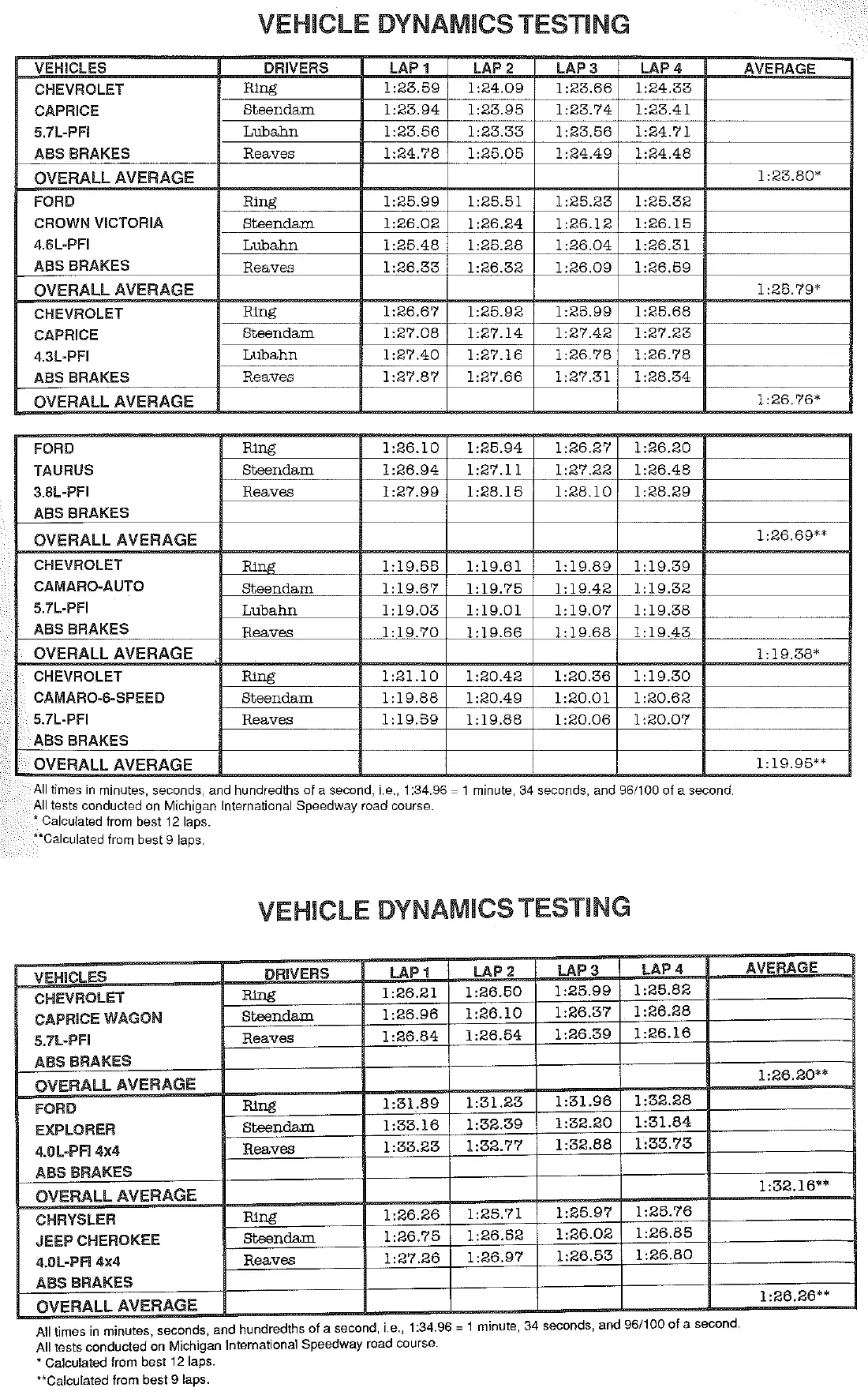
Gold row: the automatic Camaro. The six-speed was quicker to 60 and to 100 and 0.7 mph faster on top, and the automatic was quicker to 80, round the course and over the quarter mile. The quickest single lap printed is Lubahn’s 1:19.01 in the automatic. The automatic’s 1:19.38 average beat the 1993 Camaro’s 1:19.52, the best in the books held to that point, and stood until the 1995 car’s 1:19.20.
The station wagon ran 132.1 mph, faster than the Crown Victoria and the Taurus and the fastest Caprice wagon in the books held. It reached 100 in 24.17 seconds, quicker than every sedan in the test except the Caprice 5.7. The Cherokee lapped in 1:26.26, within six hundredths of the wagon and ahead of the Taurus and the Caprice 4.3. The Explorer was last in acceleration, top speed, lap time and quarter mile. It took 8.93 miles to reach 110 mph, its top speed, and the book prints that figure on both its run sheet and the summary. Measured against the printed minimums, the Cherokee and the Explorer missed all three acceleration times and the 110-mph distance and never reached 120 mph, and the wagon and both Camaros cleared them all.
Complete acceleration ladders — every 10-mph increment
| 0 to… | Chevrolet Caprice 5.7L | Ford Crown Victoria | Chevrolet Caprice 4.3L | Ford Taurus | Chevrolet Camaro (automatic) | Chevrolet Camaro (6-speed) | Chevrolet Caprice Station Wagon | Ford Explorer (4WD) | Jeep Cherokee (4WD) |
|---|---|---|---|---|---|---|---|---|---|
| 20 mph | 2.34 | 2.51 | 2.87 | 2.40 | not captured | not captured | 2.36 | 2.52 | 2.50 |
| 30 mph | 3.49 | 4.01 | 4.29 | 3.61 | not captured | not captured | 3.66 | 3.99 | 3.82 |
| 40 mph | 4.68 | 5.69 | 5.95 | 5.53 | not captured | not captured | 5.14 | 5.83 | 5.38 |
| 50 mph | 6.29 | 7.38 | 8.05 | 7.86 | not captured | not captured | 6.65 | 8.50 | 7.72 |
| 60 mph | 8.30 | 9.67 | 10.69 | 10.47 | 7.00 | 6.91 | 8.88 | 11.85 | 10.41 |
| 70 mph | 10.61 | 12.44 | 13.63 | 14.24 | not captured | not captured | 11.67 | 16.36 | 13.49 |
| 80 mph | 13.42 | 15.84 | 17.08 | 18.72 | 11.04 | 11.10 | 14.68 | 22.44 | 19.22 |
| 90 mph | 17.13 | 20.49 | 23.12 | 23.87 | not captured | not captured | 18.02 | 30.46 | 25.74 |
| 100 mph | 21.64 | 26.32 | 30.18 | 31.82 | 17.37 | 17.00 | 24.17 | 44.28 | 34.99 |
By 50 mph the Caprice 5.7 was more than a second ahead of the Crown Victoria, 6.29 seconds against 7.38. The Explorer stayed within a few tenths of the Crown Victoria, the Taurus and the Caprice 4.3 as far as 40 mph (5.83 seconds) and then fell away: 30.46 seconds to 90 against the Cherokee’s 25.74.
Every acceleration run, as printed on the run sheets
| Run sheet | Interval | Run 1 | Run 2 | Run 3 | Run 4 | Average | Conditions at start |
|---|---|---|---|---|---|---|---|
| Chevrolet Caprice 5.7L | 0–60 | 8.06 | 8.11 | 8.39 | 8.63 | 8.30 | 9:48 am, 55.5°F, wind 4.8 mph from 294° |
| 0–80 | 13.24 | 13.30 | 13.43 | 13.71 | 13.42 | ||
| 0–100 | 21.27 | 21.71 | 21.66 | 21.93 | 21.64 | ||
| Ford Crown Victoria | 0–60 | 9.86 | 9.64 | 9.48 | 9.70 | 9.67 | 9:18 am, 53.5°F, wind 2.2 mph from 329° |
| 0–80 | 15.96 | 16.05 | 15.17 | 16.17 | 15.84 | ||
| 0–100 | 26.38 | 26.21 | 26.20 | 26.48 | 26.32 | ||
| Chevrolet Caprice 4.3L | 0–60 | 10.56 | 10.75 | 10.51 | 10.92 | 10.69 | 10:08 am, 57.8°F, wind 4.9 mph from 323° |
| 0–80 | 16.99 | 17.29 | 16.81 | 17.23 | 17.08 | ||
| 0–100 | 29.87 | 30.48 | 29.76 | 30.61 | 30.08 (as printed) | ||
| Ford Taurus | 0–60 | 10.76 | 10.54 | 10.24 | 10.35 | 10.47 | 10:46 am, 64.0°F, wind 5.9 mph from 305° |
| 0–80 | 19.22 | 18.77 | 18.46 | 18.43 | 18.72 | ||
| 0–100 | 32.06 | 32.27 | 30.76 | 32.18 | 31.82 | ||
| Chevrolet Camaro (automatic) | 0–60 | 7.06 | 7.07 | 6.91 | 6.96 | 7.00 | 2:42 pm, 69.6°F, wind 4.0 mph from 287° |
| 0–80 | 11.18 | 11.07 | 10.77 | 11.14 | 11.04 | ||
| 0–100 | 17.42 | 17.44 | 17.15 | 17.46 | 17.37 | ||
| Chevrolet Camaro (6-speed) | 0–60 | 6.92 | 7.01 | 6.77 | 6.93 | 6.91 | 3:10 pm, 67.7°F, wind 4.5 mph from 297° |
| 0–80 | 11.15 | 11.33 | 10.87 | 11.04 | 11.10 | ||
| 0–100 | 17.00 | 17.24 | 17.08 | 16.66 | 17.00 | ||
| Chevrolet Caprice Station Wagon | 0–60 | 8.81 | 8.80 | 8.79 | 9.12 | 8.88 | 10:27 am, 60.3°F, wind 4.9 mph from 326° |
| 0–80 | 14.60 | 14.63 | 14.58 | 14.89 | 14.68 | ||
| 0–100 | 23.92 | 24.62 | 23.71 | 24.43 | 24.17 | ||
| Ford Explorer (4WD) | 0–60 | 11.99 | 11.61 | 11.79 | 11.99 | 11.85 | 1:16 pm, 67.8°F, wind 2.9 mph from 325° |
| 0–80 | 22.40 | 22.46 | 22.36 | 22.55 | 22.44 | ||
| 0–100 | 45.44 | 45.35 | 43.04 | 43.28 | 44.28 | ||
| Jeep Cherokee (4WD) | 0–60 | 10.50 | 10.60 | 10.34 | 10.21 | 10.41 | 12:48 pm, 66.8°F, wind 7.4 mph from 316° |
| 0–80 | 19.66 | 19.50 | 18.80 | 18.90 | 19.22 | ||
| 0–100 | 37.10 | 35.97 | 33.72 | 33.16 | 34.99 |
The one slip in the book is the Caprice 4.3’s 0–100 average: the sheet prints 30.08, and its four runs, 29.87, 30.48, 29.76 and 30.61, average 30.18, the figure the summary and the bulletin print. The Explorer’s four 0–100 runs spread over 2.4 seconds, from 43.04 to 45.44.
Vehicle dynamics at Michigan International Speedway — every lap, every driver
| Driver | Lap 1 | Lap 2 | Lap 3 | Lap 4 |
|---|---|---|---|---|
| Chevrolet Camaro (automatic) — overall average 1:19.38 (best 12 of 16 laps) | ||||
| Ring | 1:19.55 | 1:19.61 | 1:19.89 | 1:19.39 |
| Steendam | 1:19.67 | 1:19.75 | 1:19.42 | 1:19.32 |
| Lubahn | 1:19.03 | 1:19.01 | 1:19.07 | 1:19.38 |
| Reaves | 1:19.70 | 1:19.66 | 1:19.68 | 1:19.43 |
| Chevrolet Camaro (6-speed) — overall average 1:19.95 (best 9 of 12 laps) | ||||
| Ring | 1:21.10 | 1:20.42 | 1:20.36 | 1:19.30 |
| Steendam | 1:19.88 | 1:20.49 | 1:20.01 | 1:20.62 |
| Reaves | 1:19.59 | 1:19.88 | 1:20.06 | 1:20.07 |
| Chevrolet Caprice 5.7L — overall average 1:23.80 (best 12 of 16 laps) | ||||
| Ring | 1:23.59 | 1:24.09 | 1:23.66 | 1:24.33 |
| Steendam | 1:23.94 | 1:23.95 | 1:23.74 | 1:23.41 |
| Lubahn | 1:23.56 | 1:23.33 | 1:23.56 | 1:24.71 |
| Reaves | 1:24.78 | 1:25.05 | 1:24.49 | 1:24.48 |
| Ford Crown Victoria — overall average 1:25.79 (best 12 of 16 laps) | ||||
| Ring | 1:25.99 | 1:25.51 | 1:25.23 | 1:25.32 |
| Steendam | 1:26.02 | 1:26.24 | 1:26.12 | 1:26.15 |
| Lubahn | 1:25.48 | 1:25.28 | 1:26.04 | 1:26.31 |
| Reaves | 1:26.33 | 1:26.32 | 1:26.09 | 1:26.59 |
| Chevrolet Caprice Station Wagon — overall average 1:26.20 (best 9 of 12 laps) | ||||
| Ring | 1:26.21 | 1:26.50 | 1:25.99 | 1:25.82 |
| Steendam | 1:26.96 | 1:26.10 | 1:26.37 | 1:26.28 |
| Reaves | 1:26.84 | 1:26.54 | 1:26.39 | 1:26.16 |
| Jeep Cherokee (4WD) — overall average 1:26.26 (best 9 of 12 laps) | ||||
| Ring | 1:26.26 | 1:25.71 | 1:25.97 | 1:25.76 |
| Steendam | 1:26.75 | 1:26.52 | 1:26.02 | 1:26.85 |
| Reaves | 1:27.26 | 1:26.97 | 1:26.53 | 1:26.80 |
| Ford Taurus — overall average 1:26.69 (best 9 of 12 laps) | ||||
| Ring | 1:26.10 | 1:25.94 | 1:26.27 | 1:26.20 |
| Steendam | 1:26.94 | 1:27.11 | 1:27.22 | 1:26.48 |
| Reaves | 1:27.99 | 1:28.15 | 1:28.10 | 1:28.29 |
| Chevrolet Caprice 4.3L — overall average 1:26.76 (best 12 of 16 laps) | ||||
| Ring | 1:26.67 | 1:25.92 | 1:25.99 | 1:25.68 |
| Steendam | 1:27.08 | 1:27.14 | 1:27.42 | 1:27.23 |
| Lubahn | 1:27.40 | 1:27.16 | 1:26.78 | 1:26.78 |
| Reaves | 1:27.87 | 1:27.66 | 1:27.31 | 1:28.34 |
| Ford Explorer (4WD) — overall average 1:32.16 (best 9 of 12 laps) | ||||
| Ring | 1:31.89 | 1:31.23 | 1:31.96 | 1:32.28 |
| Steendam | 1:33.16 | 1:32.39 | 1:32.20 | 1:31.84 |
| Reaves | 1:33.23 | 1:32.77 | 1:32.88 | 1:33.73 |
The preface: “On the MIS road course, three vehicles exhibited accelerated tire wear of the right front tire. The Ford Crown Victoria, the Chevrolet Caprice Wagon, and the Chevrolet Camaro automatic, all required changing of the right front tire after completing 8 timed laps.” On the Explorer: “Also at MIS, two drivers voiced concerns about the Ford Explorer which we will simply pass along to you without further comment. One driver noted significant brake fade after several laps, and another experienced what he called excessive “bucking” in hard cornering. These characteristics may explain the relatively slow lap times achieved by this vehicle.”
See the original pages: the 1994 book’s lap sheets
Brakes — both stops, with and without anti-lock
| Vehicle | Brakes | Phase I speed | 60–0 Phase I (ft) | Phase I rate | Phase II speed | 60–0 Phase II (ft) | Phase II rate | Avg decel (ft/s²) | 60–0 from average (ft) |
|---|---|---|---|---|---|---|---|---|---|
| Chevrolet Camaro (automatic) | ABS | 60.0 | 131.3 | 29.49 | 60.4 | 130.8 | 30.00 | 29.75 | 130.16 |
| Ford Crown Victoria | ABS | 60.4 | 144.8 | 27.10 | 61.0 | 145.9 | 27.43 | 27.27 | 142.00 |
| Chevrolet Caprice 4.3L | ABS | 60.9 | 148.9 | 26.79 | 59.7 | 140.6 | 27.27 | 27.03 | 143.25 |
| Jeep Cherokee (4WD) | ABS | 60.3 | 145.0 | 26.97 | 60.4 | 145.5 | 26.97 | 26.97 | 143.57 |
| Chevrolet Caprice Station Wagon | ABS | 60.5 | 147.6 | 26.67 | 60.6 | 149.4 | 26.44 | 26.56 | 145.79 |
| Ford Taurus | ABS | 60.0 | 149.6 | 25.88 | 60.4 | 149.4 | 26.26 | 26.07 | 148.53 |
| Chevrolet Caprice 5.7L | ABS | 60.1 | 150.4 | 25.83 | 60.5 | 150.7 | 26.12 | 25.98 | 149.04 |
| Ford Crown Victoria (non-ABS) | conventional | 60.0 | 154.8 | 25.01 | 60.9 | 154.5 | 25.82 | 25.42 | 152.33 |
| Ford Explorer (4WD) | ABS | 60.3 | 155.2 | 25.20 | 60.2 | 161.4 | 24.15 | 24.68 | 156.90 |
| Ford Taurus (non-ABS) | conventional | 59.7 | 159.7 | 24.00 | 60.0 | 159.4 | 24.29 | 24.15 | 160.34 |
| Chevrolet Camaro (6-speed) | ABS | not brake tested: its braking system was identical to the automatic’s | |||||||
A second Crown Victoria and a second Taurus, both without anti-lock brakes, were “submitted for brake testing only”. On the same day the anti-lock Crown Victoria averaged 27.27 ft/s² against 25.42, 142.0 feet from 60 against 152.3. The anti-lock Taurus averaged 26.07 against 24.15, 148.5 feet against 160.3. The non-ABS Taurus’s 24.15 is the only average in the test below the specification’s 24.2 minimum. The 1992 test made the same comparison with an anti-lock Crown Victoria braked alone, the 1993 bulletin with a Crown Victoria and a Taurus each way, and the 1995 bulletin and 1996 book repeat it. Every 1994 car without that suffix had anti-lock brakes.
The Camaro’s 29.75 average and its 130.8-foot second stop are the best in the test. The Caprice 5.7 stopped from 60 in 149.0 feet, the longest of the anti-lock sedans, and its 25.98 cost it all of its 0.940 weighted points. The Explorer’s second stop, 161.4 feet, is the longest single stop on the page.
Ergonomics, communications and fuel
| Vehicle | Ergonomics (pts) | EPA city (mpg) | EPA highway (mpg) | EPA combined (mpg) |
|---|---|---|---|---|
| Chevrolet Caprice 5.7L | 244.61 | 16.7 | 25 | 20 |
| Chevrolet Caprice 4.3L | 244.61 | 17.6 | 26 | 21 |
| Ford Crown Victoria | 243.36 | 16.7 | 23 | 19 |
| Chevrolet Caprice Station Wagon | 242.40 | 16.7 | 25 | 20 |
| Ford Explorer (4WD) | 244.61 | 15.3 | 20 | 17 |
| Ford Taurus | 227.60 | 18.8 | 28 | 22 |
| Jeep Cherokee (4WD) | 216.60 | 14.8 | 20 | 17 |
| Chevrolet Camaro (automatic) | 209.26 | 16.6 | 24 | 19 |
| Chevrolet Camaro (6-speed) | 209.26 | 16.8 | 26 | 20 |
The Caprice and the Explorer tied at 244.61, the highest totals in any book held here after 1978 (only the 1978 book, which graded a much longer list of items, prints higher ones; totals depend on how many items a year graded). The Crown Victoria was 1.25 points behind, and the wagon 2.21. The Explorer gained 1.36 points on the front seat and 1.33 on the three communications items; the Caprice won them back on the rear seat (1.51), the instruments (0.83), visibility (0.33) and the controls (0.02). The Crown Victoria had the best front seat of all, 81.33 points over nine items. The Camaro scored 4.17 for rear legroom and 2.33 for rear entry and exit, and finished last at 209.26. On fuel the Taurus led at 18.8 mpg city and the Cherokee trailed at 14.8; the Caprice 5.7, its wagon and the Crown Victoria all scored 16.7, so fuel cost neither bid car a point.
Ergonomics and communications — all 28 items
| Item | Caprice | Crown Victoria | Taurus | Camaro | Caprice Wagon | Explorer | Cherokee |
|---|---|---|---|---|---|---|---|
| Front seat | |||||||
| Padding | 8.83 | 9.00 | 8.00 | 8.00 | 9.00 | 8.67 | 7.60 |
| Depth of Bucket Seat | 8.50 | 8.50 | 6.67 | 8.67 | 8.40 | 8.67 | 8.00 |
| Adjustability—Front to Rear | 8.67 | 9.33 | 8.83 | 9.00 | 7.20 | 9.17 | 7.60 |
| Upholstery | 8.17 | 8.83 | 7.83 | 8.67 | 8.00 | 8.67 | 7.40 |
| Bucket Seat Design | 8.33 | 8.33 | 7.00 | 8.67 | 8.00 | 9.17 | 8.60 |
| Headroom | 9.50 | 9.50 | 9.00 | 7.00 | 9.40 | 9.67 | 9.40 |
| Seatbelts | 9.50 | 9.50 | 8.33 | 7.33 | 9.60 | 8.17 | 9.60 |
| Ease of Entry and Exit | 9.00 | 9.17 | 8.17 | 6.17 | 9.40 | 9.17 | 8.60 |
| Overall Comfort Rating | 8.83 | 9.17 | 7.83 | 8.17 | 9.00 | 9.33 | 7.80 |
| Rear seat | |||||||
| Legroom—Front Seat Back | 9.67 | 9.17 | 5.67 | 4.17 | 9.40 | 8.83 | 6.40 |
| Ease of Entry and Exit | 9.67 | 8.83 | 6.00 | 2.33 | 9.40 | 9.00 | 6.20 |
| Instrumentation | |||||||
| Clarity | 9.50 | 8.33 | 8.67 | 8.83 | 9.40 | 9.17 | 8.40 |
| Placement | 9.17 | 8.00 | 7.83 | 8.83 | 9.20 | 8.67 | 8.40 |
| Vehicle controls | |||||||
| Pedals, Size and Position | 9.33 | 9.50 | 8.33 | 9.00 | 9.20 | 8.83 | 8.80 |
| Position of Power Window/Controls | 9.00 | 9.67 | 9.00 | 9.00 | 9.20 | 9.50 | 6.20 |
| Position of Inside Door Release | 9.00 | 9.17 | 8.83 | 8.83 | 9.00 | 8.33 | 8.40 |
| Position of Automatic Door Lock Switch | 8.83 | 8.00 | 8.00 | 9.00 | 8.80 | 8.83 | 6.60 |
| Pos. of Outside Rear-View Mirror Controls | 9.17 | 9.17 | 9.17 | 8.83 | 9.20 | 9.33 | 7.20 |
| Steering Wheel, Size/Tilt Release/Surface | 8.67 | 9.00 | 8.83 | 9.00 | 8.40 | 8.83 | 7.60 |
| Heat/AC Vent Placement and Adjustability | 8.00 | 8.17 | 8.67 | 8.33 | 7.60 | 8.33 | 7.00 |
| Visibility | |||||||
| Front | 9.67 | 9.33 | 9.50 | 8.00 | 9.40 | 9.17 | 9.40 |
| Rear | 9.00 | 8.83 | 8.67 | 5.83 | 8.80 | 8.67 | 9.00 |
| Left Rear Quarter | 8.33 | 8.50 | 8.33 | 6.50 | 8.60 | 8.00 | 8.40 |
| Right Rear Quarter | 8.00 | 8.83 | 8.50 | 6.17 | 8.80 | 8.33 | 8.80 |
| Outside Rear-View Mirrors | 9.00 | 9.00 | 8.67 | 7.33 | 8.40 | 9.50 | 7.40 |
| Communications | |||||||
| Dash Accessibility | 7.20 | 7.00 | 7.20 | 4.80 | 7.40 | 7.60 | 6.00 |
| Trunk Accessibility | 6.40 | 6.20 | 7.40 | 4.80 | 7.20 | 7.00 | 5.80 |
| Engine Accessibility | 7.67 | 7.33 | 8.67 | 8.00 | 7.00 | 8.00 | 6.00 |
| Total | 244.61 | 243.36 | 227.60 | 209.26 | 242.40 | 244.61 | 216.60 |
Hardware: horsepower, axle ratios, test weights, tyres
| Vehicle | HP (SAE net) | Torque (lb-ft) | Axle ratio | Transmission | Test weight (lb) | Wheelbase (in) | Tyres | Brakes | Ground clearance (in) |
|---|---|---|---|---|---|---|---|---|---|
| Chevrolet Caprice 5.7L | 260 @ 5000 | 330 @ 3200 | 3.08 | 4-speed automatic, overdrive (4L60E) | 4,244 | 115.9 | P235/70R15 102V | disc / disc | 6.2 |
| Ford Crown Victoria | 210 @ 4600 | 270 @ 3400 | 3.27 | 4-speed automatic, overdrive (PKC-E) | 3,997 | 114.4 | P225/70R15 100H | disc / disc | 6.1 |
| Chevrolet Caprice 4.3L | 200 @ 5200 | 245 @ 2400 | 3.23 | 4-speed automatic, overdrive (4L60E) | 4,178 | 115.9 | P225/70R15 100H | disc / disc | 6.2 |
| Ford Taurus | 160 @ 4400 | 225 @ 3000 | 3.37 | 4-speed automatic transaxle, overdrive (PNA-EK) | 3,348 | 106.0 | P205/70R15 95V | disc / disc | 5.5 |
| Chevrolet Camaro (automatic) | 275 @ 5000 | 325 @ 2400 | 3.23 | 4-speed automatic, overdrive (4L60E) | 3,463 | 101.1 | P245/50ZR16 | disc / disc | 4.4 |
| Chevrolet Camaro (6-speed) | 275 @ 5000 | 325 @ 2400 | 3.42 | 6-speed manual (MM6) | 3,463 | 101.1 | P245/50ZR16 | disc / disc | 4.4 |
| Chevrolet Caprice Station Wagon | 260 @ 5000 | 330 @ 3200 | 2.56 | 4-speed automatic, overdrive (4L60E) | 4,520 | 115.9 | P225/70R15 100H | disc / drum | 5.5 |
| Ford Explorer (4WD) | 160 @ 4500 | 220 @ 2200 | 3.73 | 4-speed automatic, overdrive, no lock-up (A4LD) | 4,306 | 111.9 | P225/70R15 SL | disc / drum | 6.3 |
| Jeep Cherokee (4WD) | 190 @ 4750 | 225 @ 4000 | 3.55 | 4-speed automatic, four-wheel drive (AW3043LE) | 3,554 | 101.4 | P225/70R15 100H | disc / drum | 8.5 |
The Caprice 5.7 is listed with “Sequential Port Fuel Injection (PFI)”, 260 horsepower and a 10.0:1 compression ratio, against the Crown Victoria’s 210 and 9.0:1. Every Caprice on the year pages before this one is carbureted or throttle-body injected. The Camaros were rated at 275. The wagon carried the tallest axle in the test, 2.56, and weighed 4,520 lb. The Cherokee had the most ground clearance, 8.5 inches, and the Camaros the least, 4.4. On tyres the preface explains two exceptions to the specification’s Goodyear Eagle GT+4: “Ford Motor Company changed the tire size on the Taurus for 1994. The Goodyear Eagle GT+4 is not available in the new size, and consequently the Taurus will only be available with General XP-2 tires. As a result, the Taurus was tested with the General tires. The Ford Explorer will only be offered with Firestone tires, and hence it was tested on Firestones of the size noted in the Informational Hardware Description section of this report.”
How the bid was scored
| Vehicle | Weighted: lap (30) | Weighted: 0–100 (20) | Weighted: braking (20) | Weighted: top speed (15) | Weighted: ergonomics (10) | Weighted: fuel (5) | Total weighted score | Bid |
|---|---|---|---|---|---|---|---|---|
| Chevrolet Caprice 5.7L | 0 | 0 | 0.940 (0.047) | 0 | 0 | 0 | 0.940 | not printed |
| Ford Crown Victoria | 0.720 (0.024) | 4.320 (0.216) | 0 | 1.380 (0.092) | 0.050 (0.005) | 0 | 6.470 | not printed |
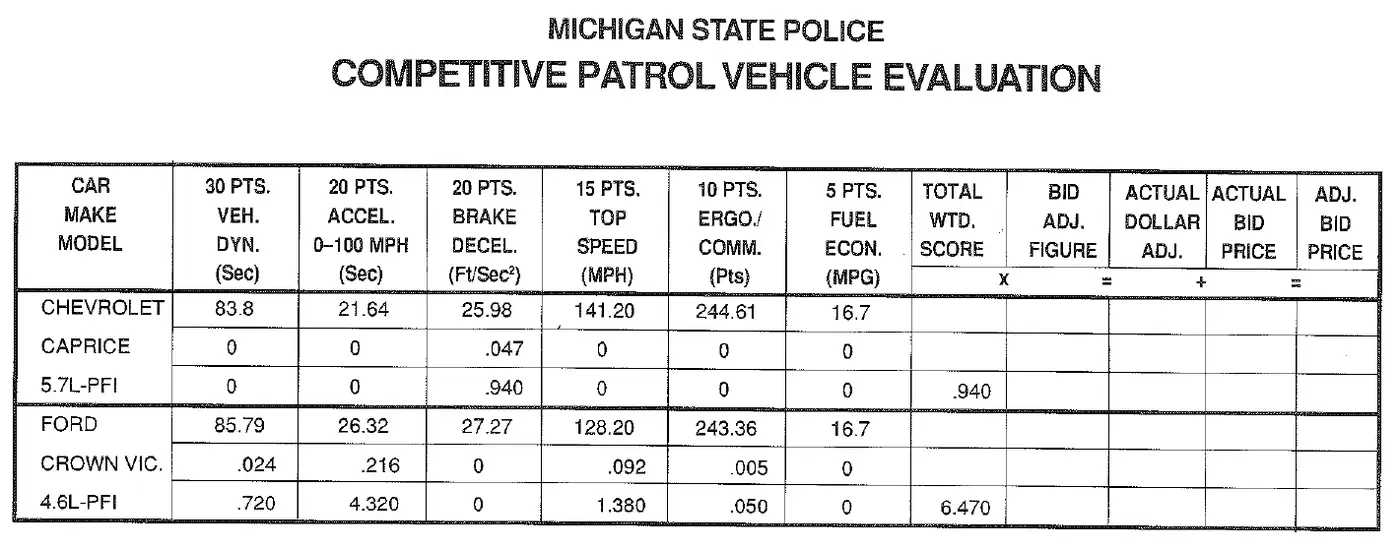
The raw scores behind it are 1:23.80 against 1:25.79 for the lap (printed in seconds: 83.80 and 85.79 in the raw scores, 83.8 and 85.79 on the evaluation sheet), 21.64 against 26.32 seconds to 100, 25.98 against 27.27 ft/s², 141.20 against 128.20 mph, 244.61 against 243.36 points and 16.7 against 16.7 mpg. The scores were meant to turn into money: the specification adds 1% of the lowest bid, multiplied by each car’s total, to that car’s bid, and “the vehicle to be purchased will be determined by the adjusted low bid price. Purchase price will be that quoted by the vendor.” With no bids printed, the book does not show which car Michigan bought. Its worked example on pages 55–56 is an illustration (lowest bid $9,966.13) and uses a different set of weights from 1994’s.
See the original page: the 1994 book’s competitive evaluation
Where the book and the bulletin differ
| Figure | Book | Elsewhere | Figure of record |
|---|---|---|---|
| Caprice 4.3 average 0–100 | 30.08 on its run sheet (page 35) | 30.18 in the book’s summary (page 28) and the bulletin’s Table 4 | 30.18: the four printed runs average 30.18 |
| Taurus torque | 225 lb-ft @ 3000 on its hardware page (page 11) | 220 on the hardware summary (page 17) | 225, the vehicle’s own page; both shown |
| Explorer axle ratio | 3.73:1 on its hardware page (page 15) | 3.27:1 on the hardware summary (page 18), the Crown Victoria’s ratio | 3.73, the vehicle’s own page; both shown |
| Size of the field | “6 police patrol package cars and 5 special service package vehicles”, counting the two non-ABS cars (page III) | “five special service package cars … and four police patrol package cars” (bulletin page 1) | Eleven cars: nine in the performance tests, two for braking only |
| Ergonomics attributes | 28 scored rows, each total their exact sum (pages 51–52) | “each of 29 attributes” (bulletin Table 6) | 28, as counted |
| Explorer brakes | “BRAKE SYSTEM: ABS” (page 47) | the bulletin’s Table 5 heads every column ABS or NON-ABS except the Explorer’s | ABS |
| Top speeds | one decimal on the run sheets and summary (141.2), two in the raw scores and on the evaluation sheet (141.20) | two decimals in the bulletin (141.20) | the same figures |
What the preface says about the equipment and the cars
The limiters. “The Chevrolet Caprice 4.3L, Chevrolet Caprice Station Wagon 5.7L, Ford Crown Victoria 4.6L, Ford Taurus 3.8L, and Ford Explorer 4.0L all have electronic limiters which control either the maximum top speeds or engine RPMs attainable.” The book’s tables carry no mark for them; the ** on this page’s top speeds is taken from that sentence. It does not say which of the two each car had, at what setting, or whether a car reached it. The Caprice 5.7, the Camaros and the Cherokee are not on the list. In the books held here the 1992 book is the first to mention a limit, “governors” on two Caprices, and this preface is the first to say “electronic limiters”. The 1995 bulletin was the next to mark individual cars.
The lost measurements. “During the Acceleration and Top Speed tests we experienced a failure with our primary speed/distance measuring equipment and had to utilize a backup system. This did not, in our opinion, affect the reliability of the data in any way. It did, however, make it impossible for us to capture the 1/4 mile speed. A further equipment breakdown, this time involving our backup equipment, made it impossible for us to record the acceleration times for each 10 mile-per-hour increment on the two Chevrolet Camaros. We were, however, able to capture the times to 60, 80, and 100 mph, as well as top speed information.”
Two- and four-wheel drive. “All three companies, Chevrolet, Ford, and Chrysler, indicated that their vehicles should be run in “OverDrive.” For the 4-Wheel-Drive vehicles, Ford requested that the Explorer be run in the 2-Wheel-Drive mode for all performance tests, while Chrysler asked that the Jeep Cherokee be driven in Full-Time 4-Wheel-Drive for all tests.”
A clean roof. “All of the vehicles were tested with a clean roof (no overhead light or lightbar), and without spotlights. … Obviously, once overhead lights, spotlights, radios, sirens, and other emergency equipment are installed, overall performance will probably be somewhat lower than we report.”
Who it was for. “The factors upon which we base our scores, particularly in the acceleration and top speed categories, are tailored to the needs of the Michigan State Police, and they may be quite different from the needs of your agency. … Put most simply, the best car for your agency may be a different one than we’ve identified for our use.” The preface is signed with the contacts F/Lt. Curtis L. VanDenBerg and Sgt. Robert Ring of the Training Division’s Specialized Training Section.
What else this file holds
The specification. Beyond the tests, Michigan’s July 1993 specification asks for a 130-amp alternator, a battery of at least 730 cold-cranking amps, “heavy duty, limited slip or electronic traction control”, the largest engine available in the model, 45/45 or 40/40 bucket seats with at least ten inches between them for the radio, a speedometer “calibrated to within ±3 mph accuracy, 0–140 mph scale minimum”, Unity #225 spotlights on both A-pillars, a steel plate under the roof for the light bar, paint “To be same color as Dulux 93-032”, heavy-duty cloth or cloth-and-vinyl upholstery in blue (“All vinyl not acceptable”) and 15-inch black wheels. The equipment list ends: “No dealer advertising to be on vehicles.”
The places and the people. The acknowledgments thank “Chrysler Motors Corporation for allowing us to once again utilize their Chelsea Proving Grounds facility, and … the Penske Corporation for the use of the Michigan International Speedway road course facility”. They single out Sgt. William F. McFall and Sgt. David B. Storer (retired) “for their contributions to the program over the past 18 years”. The book reprints the programme’s 1988 video offer and a notice for AutoBid, a free MS-DOS program from the Office of Law Enforcement Standards that ranked vehicles “by their test scores alone” and “by their bid price adjusted for their test scores”. Three pages list the out-of-state participants, from the Alabama Department of Public Safety to West Virginia, among them the Ontario Provincial Police and the RCMP.
The bulletin. The NIJ’s four-page summary of October 1993 comes first in the file. This copy was mailed to the State Police Director, Gerald L. Hough, and carries an Office of the Director received stamp dated April 1994. Its figures match the book’s (see the table above).
What 1994 settled
The port-injected Caprice gave Michigan a sedan that ran 141.2 mph, reached 100 in under 22 seconds and lapped within four and a half seconds of a Camaro. On the bid score it beat or tied the Crown Victoria in every column but braking, though the book prints no prices to say which car was bought. No American police sedan in these books ran faster until 2006.
The field was also changing. Five of the nine vehicles carried electronic limiters, a front-drive Taurus and two four-wheel-drive trucks ran alongside the sedans, and the Explorer appears for the first time in these books.