
Michigan test archive
2015 Michigan State Police Patrol Vehicle Test
Michigan prints a Ford’s retest in red — and a V6 Charger records the best twenty-stop braking rate in these books to that point.
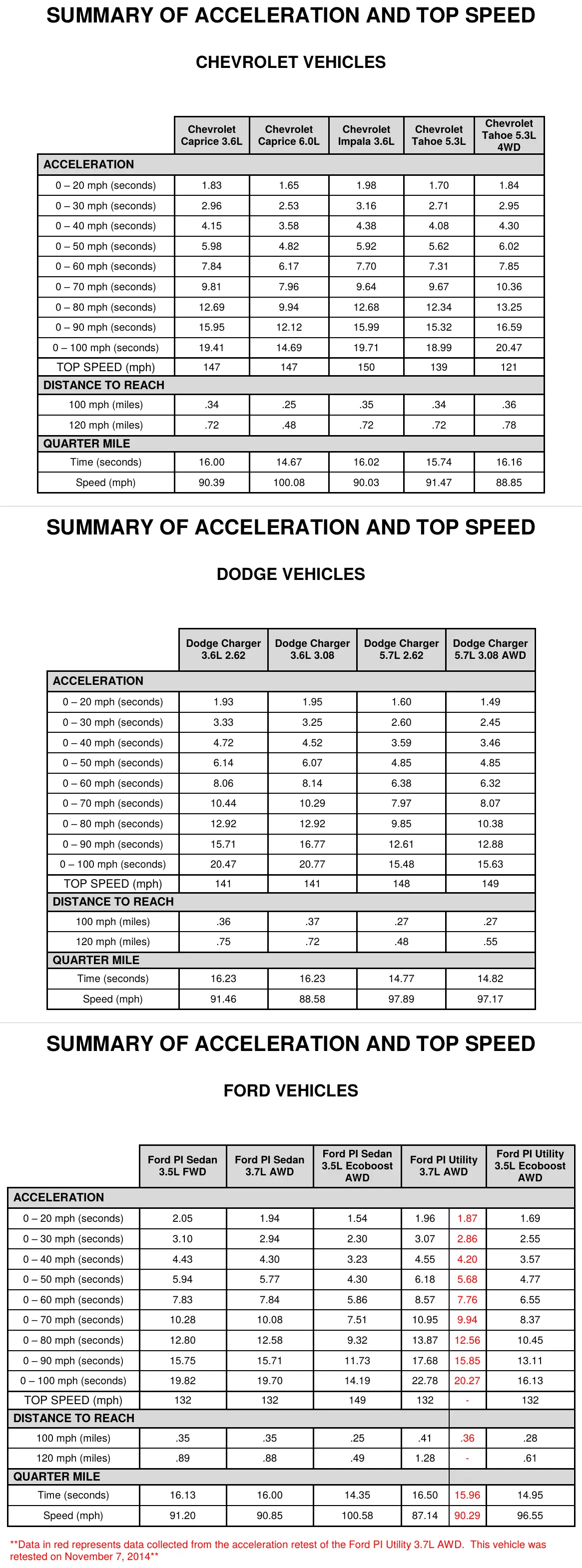
Fourteen vehicles and seven motorcycles, and the most revealing thing in the book is a colour. The Ford Police Interceptor Utility 3.7 AWD appears twice in the acceleration table, and the second set of figures is printed in red with a footnote explaining that the vehicle was retested on 7 November 2014, weeks after the main session. The difference is substantial: 8.57 seconds to 60 on the first attempt, 7.76 on the second — eight tenths of a second, and more than two seconds to 100 mph. Michigan printed both.
That is the same instinct as the 1999 report, which recorded that a Volvo was retested at the manufacturer’s request and then scored on the worse of the two runs. Sixteen years apart, the same department showing its working rather than quietly publishing the number it preferred.
The year’s outright result is a braking figure, and it comes from an unexpected place. The 3.6-litre V6 Charger with 3.08 gears averaged 31.04 ft/s² across twenty stops — the highest twenty-stop deceleration rate in these books to that point, with a projected 60-to-0 distance of 124.7 feet. Its HEMI sibling was right behind at 30.95. The two best twenty-stop braking rates to that point are both Dodges, and one of them is the slow one.
And a four-wheel-drive Tahoe was listed in the police category, a first in the books held here. It left the track during the dynamics test, and its road-course figure is from a retest on 23 October.
The police category
| Vehicle | 0–60 (s) | 0–100 (s) | Top speed | ¼ mile | Dynamics | Brakes (ft/s²) | 60–0 (ft) |
|---|---|---|---|---|---|---|---|
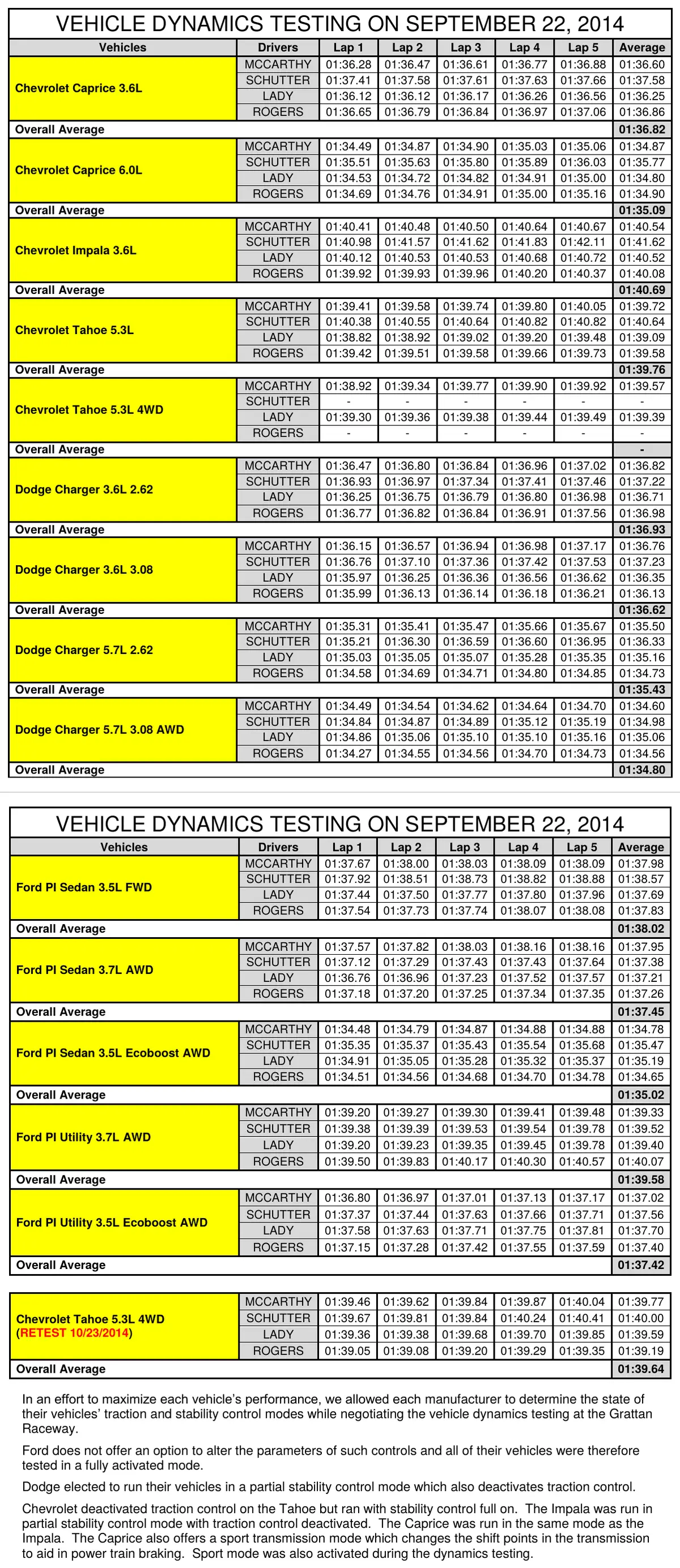
| Dodge Charger 3.6L (3.08) | 8.14 | 20.77 | 141 | 16.23 @ 88.58 | 1:36.62 | 31.04 | 124.7 |
| Dodge Charger 5.7L (2.62) | 6.38 | 15.48 | 148 | 14.77 @ 97.89 | 1:35.43 | 30.95 | 125.1 |
| Chevrolet Caprice 6.0L | 6.17 | 14.69 | 156 § (147 as first run) | 14.67 @ 100.08 | 1:35.09 | 30.54 | 126.8 |
| Dodge Charger 5.7L (3.08 AWD) | 6.32 | 15.63 | 149 | 14.82 @ 97.17 | 1:34.80 | 29.46 | 131.4 |
| Ford PI Sedan EcoBoost AWD 3.5L | 5.86 | 14.19 | 149 | 14.35 @ 100.58 | 1:35.02 | 29.45 | 131.5 |
| Dodge Charger 3.6L (2.62) | 8.06 | 20.47 | 141 | 16.23 @ 91.46 | 1:36.93 | 30.35 | 127.6 |
| Chevrolet Caprice 3.6L | 7.84 | 19.41 | 147 | 16.00 @ 90.39 | 1:36.82 | 29.83 | 129.8 |
| Ford PI Utility EcoBoost AWD 3.5L | 6.55 | 16.13 | 132 | 14.95 @ 96.55 | 1:37.42 | 29.22 | 132.5 |
| Ford PI Sedan AWD 3.7L | 7.84 | 19.70 | 132 | 16.00 @ 90.85 | 1:37.45 | 29.10 | 133.1 |
| Ford PI Sedan FWD 3.5L | 7.83 | 19.82 | 132 | 16.13 @ 91.20 | 1:38.02 | 28.96 | 133.7 |
| Ford PI Utility AWD 3.7L | 8.57 | 22.78 | 132 | 16.50 @ 87.14 | 1:39.58 | 29.00 | 133.5 |
| Ford PI Utility AWD 3.7L — retest, 7 Nov 2014 | 7.76 | 20.27 | not re-run | 15.96 @ 90.29 | not re-run | not re-run | not re-run |
| Chevrolet Tahoe 5.3L | 7.31 | 18.99 | 139 | 15.74 @ 91.47 | 1:39.76 | 28.54 | 135.7 |
| Chevrolet Impala 3.6L | 7.70 | 19.71 | 150 | 16.02 @ 90.03 | 1:40.69 | 28.72 | 134.8 |
| Chevrolet Tahoe 5.3L 4WD | 7.85 | 20.47 | 121 | 16.16 @ 88.85 | 1:39.64 | 28.56 | 135.6 |
See the original pages in the 2015 book: lap times and acceleration
Every car and truck on this page had a speed limiter fitted, unless the book notes otherwise. The General Information section, printed page 2, states it for the whole field: “All vehicles listed in this report were equipped with electronic speed limiters unless otherwise noted, or with the exception of certain motorcycles.” That is the sentence the 2005, 2006, 2009, 2012 and 2013 books held here carry, with a caveat added — so by 2015 the blanket statement no longer covers everything on the page, and some of the motorcycles may be outside it.
Gold row: 31.04 ft/s², the highest twenty-stop deceleration rate in these books to that point; the 2016 and 2017 Can-Am Spyders, the 2017 Charger and the 2023 and 2026 Mach-Es later beat it. The 3.08-geared V6 Charger and the 2.62-geared HEMI stopped shorter than any Chevrolet or Ford on the page, and the 2.62-geared V6 shorter than all of them but the Caprice 6.0. Note that the AWD HEMI, quickest around the road course at 1:34.80, has the worst braking of the four Dodges by a clear margin.
The four-wheel-drive Tahoe is listed in the police category, a first in the books held here. It ran 121 mph — eighteen slower than the two-wheel-drive version and the lowest top speed of any police-category vehicle in this archive since the Crown Victoria left — and it met every printed requirement.
§ The Caprice 6.0’s 147 mph is not the car’s figure. It was submitted with an incorrect speed-limiting calibration; Michigan says so on printed page 3 and retested it on 7 October 2014 with the proper calibration, when it ran 156 mph — printed on its own sheet as “RETEST TOP SPEED ATTAINED”. Michigan’s own wording is “The test car submitted had the incorrect speed-limiting calibration and tested at 147 mph. When retested with the proper calibration, the vehicle reached 156 mph. Both results are shown in this book.” The book’s summary table and chart print 147; this archive uses 156 as its figure and keeps 147 beside it as the first run. That makes it the fastest speed any police sedan has recorded here, ahead of the 155 on the 2014, 2016 and 2017 pages.
On 22 September two drivers completed their laps in the four-wheel-drive Tahoe and the other two rows are dashes; the book says the vehicle left the track, and General Motors traced it to a temporary brake torque output difference. It was retested on 23 October 2014 and the book prints that run as a separate row, “Chevrolet Tahoe 5.3L 4WD (RETEST 10/23/2014)”, at 1:39.64.
The motorcycles
| Machine | 0–60 (s) | 0–100 (s) | Top speed | ¼ mile |
|---|---|---|---|---|
| BMW R 1200 RT-P | 3.99 | 9.14 | 141 | 12.51 @ 116.08 |
| Moto Guzzi Norge 1200 | 4.69 | 12.51 | 127 | 13.29 @ 107.07 |
| Moto Guzzi California 1400 | 4.94 | 15.01 | 117 | 13.84 @ 99.33 |
| Harley-Davidson Electra Glide FLHTP Special | 5.27 | 15.48 | 110 | 14.39 @ 89.32 |
| Harley-Davidson Road King FLHP | 5.49 | 20.11 | 113 | 14.15 @ 98.00 |
| Harley-Davidson Electra Glide FLHTP | 5.62 | 19.34 | 113 | 14.44 @ 94.70 |
| Can-Am Spyder RT-P | 6.55 | 20.56 | 114 | 15.11 @ 96.00 |
The BMW’s 12.51 seconds at 116.08 mph is the quickest and fastest of the quarter-mile times printed in these books (the 2018 and later books print none for motorcycles), and it reached 100 in 9.14 seconds; the 2012 Kawasaki Concours had run 8.29.
| Machine | Dynamics | Brakes (ft/s²) | 60–0 (ft) |
|---|---|---|---|
| Can-Am Spyder RT-P | 1:54.60 | 30.71 | 126.1 |
| Moto Guzzi Norge 1200 | 1:43.10 | 29.71 | 130.3 |
| BMW R 1200 RT-P | 1:39.84 | 29.04 | 133.3 |
| Moto Guzzi California 1400 | 1:51.03 | 28.88 | 134.1 |
| Harley-Davidson Road King FLHP | 1:48.74 | 27.03 | 143.3 |
| Harley-Davidson Electra Glide FLHTP | 1:49.09 | 26.80 | 144.5 |
| Harley-Davidson Electra Glide FLHTP Special | 1:47.78 | 26.45 | 146.4 |
Gold row: the Can-Am Spyder RT-P, the first three-wheeled machine in this archive, and it stopped better than every motorcycle here by a wide margin — 30.71 ft/s², 17.2 feet shorter than the best Harley and better than every car in the test except two Dodges. It was also the slowest thing around the road course, by 3.57 seconds.
A second Electra Glide appears this year, a factory-supported performance version the report calls the FLHTP Special. It lapped 1.31 seconds quicker than the standard Electra Glide and braked slightly worse. Harley-Davidson now occupied three of the seven motorcycle slots and the bottom three braking positions.
Ergonomics, communications and fuel
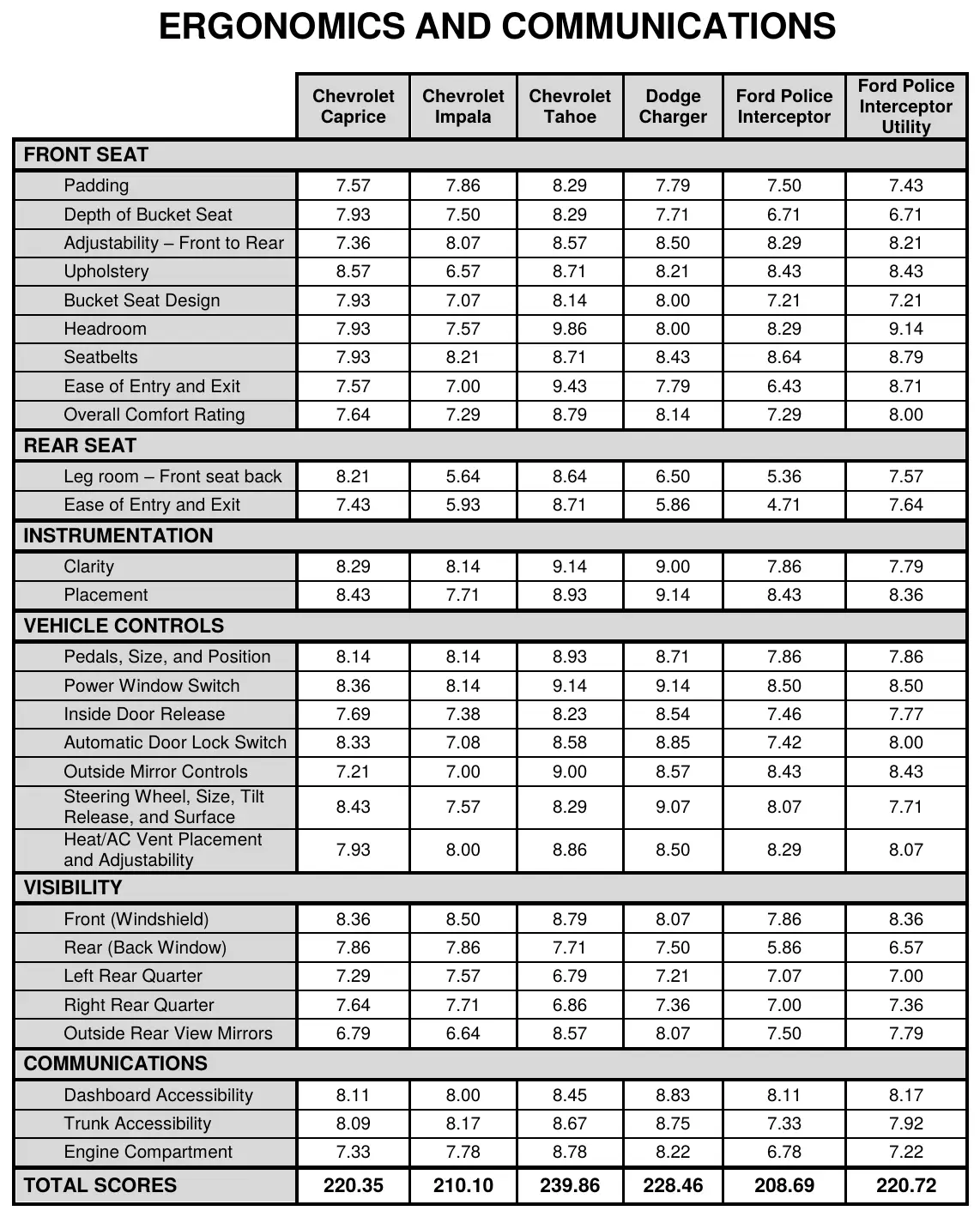
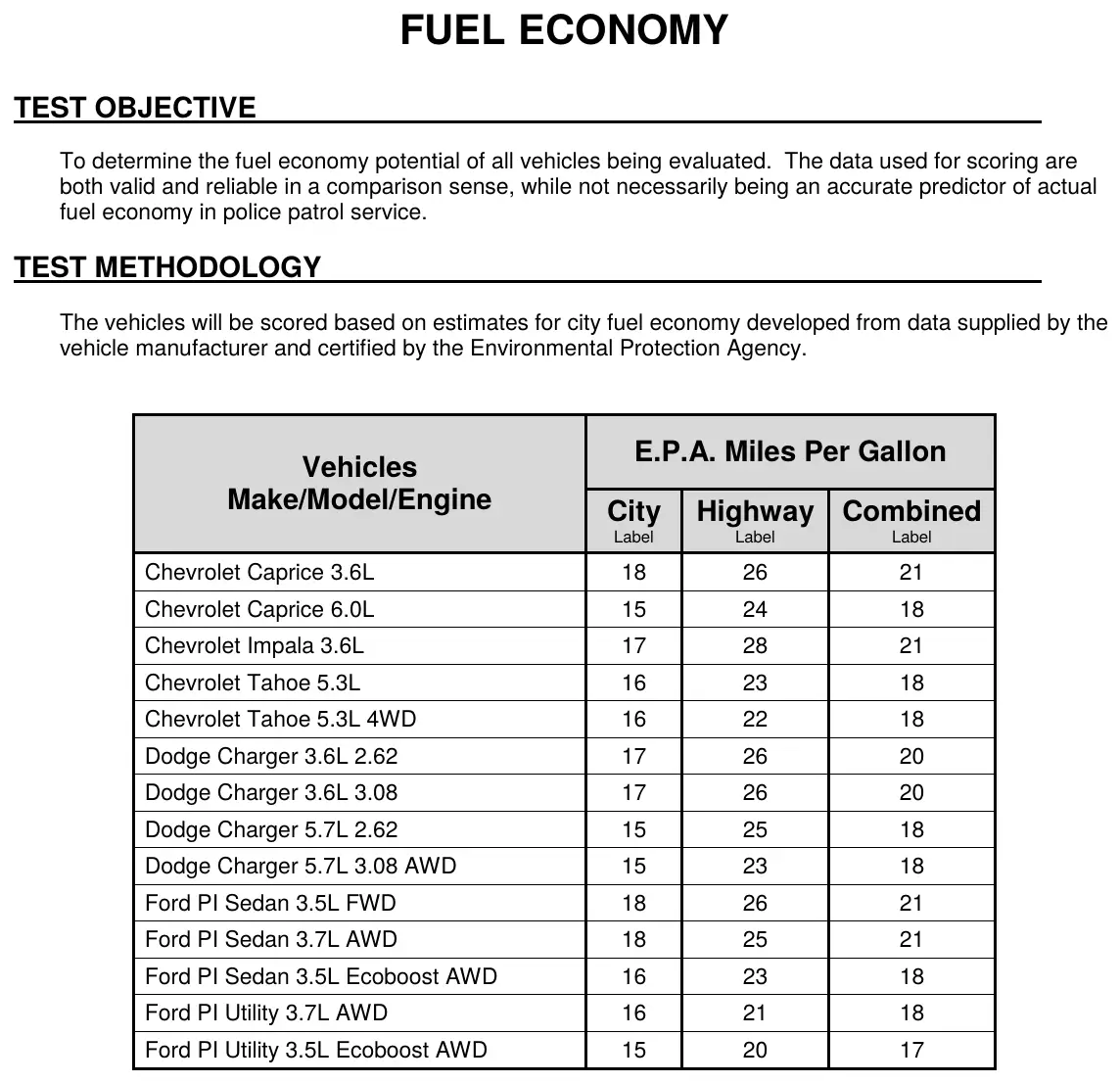
| Vehicle | Ergonomics & communications | City mpg |
|---|---|---|
| Chevrolet Tahoe | 239.86 | 16 |
| Dodge Charger | 228.46 | 17 (3.6) / 15 (5.7) |
| Ford Police Interceptor Utility | 220.72 | 16 (3.7) / 15 (EcoBoost) |
| Chevrolet Caprice | 220.35 | 18 (3.6) / 15 (6.0) |
| Chevrolet Impala | 210.10 | 17 |
| Ford Police Interceptor sedan | 208.69 | 18 (FWD) / 18 (AWD 3.7) / 16 (EcoBoost) |
The Tahoe’s 239.86 beats the 2012 Tahoe’s 235.88, the best total in this archive from 2003 to 2014, and it earned it on the lines that matter for the job: 9.86 for headroom, 9.43 for ease of entry and exit, 8.64 for rear legroom. The Ford sedan finishes last, as it does on the 2014 page, and its weak point, as in 2013, is the back: 5.36 for rear legroom and 4.71 for rear-seat entry and exit, the lowest single score on the page. The Utility scores 7.57 and 7.64 on those two lines.
See the original pages in the 2015 book: ergonomics and fuel economy
What 2015 settled
Michigan showed its working again. A Ford Utility was run, produced a poor number, was brought back about seven weeks later and produced a much better one — and the book printed both, in different colours, with the date of the second attempt and the reason: Ford engineers had found loose hose clamps that may have affected performance.
The performance story, meanwhile, has quietly inverted. The quickest car in the test was a turbocharged all-wheel-drive Ford sedan. The best-stopping car was a V6 Dodge. The best-liked was a sport utility. The 6.0-litre rear-drive V8 Caprice, the traditional answer, was fastest only on its retest and finished third of fourteen on brakes, and the quickest lap belonged to the all-wheel-drive HEMI Charger. No single car led more than one kind of test.