
Michigan test archive
1981 Michigan State Police Patrol Vehicle Test
Five full-size sedans, four mid-size V8s, two sixes — and one Buick that couldn’t reach 100 mph.
The 1981 book calls itself “the third in a series of publications” presenting police patrol vehicle test results, the first of which covered the 1979 model year; the IACP’s Technology Assessment Program Information Center reproduced it for interested police departments. (The earliest Michigan book held here is the 1978 one.) Buick entered the full-size class with a LeSabre carrying a 125-horsepower 252 four-barrel — and it never reached 100 mph at all. It topped out at 97.1 mph and does not appear in the book’s competitive tables, though the book never names it as eliminated.
The acceleration and top speed runs were made at Chrysler’s proving grounds on 25 October 1980, in temperatures of 34–38 °F with winds up to 18 mph. The twelve dynamics laps ran on the 1.635-mile Michigan International Speedway road course — three drivers, four laps each.
Two oddities from the book itself: all mid-size acceleration runs were made on a wet track (the testers judged the effect insignificant for comparison), and the Chevrolet Malibu submitted was actually a 1979 body with the 1981 drivetrain and suspension fitted — Chevrolet’s roofline had changed, and the book plainly tells readers to use their own judgment about whether the aerodynamics carried over.
Full-size results
| Car | Engine | 0–60 (s) | ¼-mile (s @ mph) | 0–100 (s) | Top speed (mph) | Miles to 105 mph | Dynamics (s) |
|---|---|---|---|---|---|---|---|
| Chevrolet Impala | 350-4V | 11.93 | 18.95 @ 75.0 | 39.98 | 113.8 | 0.99 | 90.72 |
| Dodge St. Regis | 318-4V | 13.14 | 19.63 @ 74.5 | 45.72 | 114.7 | 1.08 | 93.93 |
| Ford LTD | 351 H.O.-VV | 12.76 | 19.35 @ 74.75 | 42.16 | 116.4 | 1.00 | 92.40 |
| Plymouth Gran Fury | 318-4V | 12.76 | 19.40 @ 75.25 | 42.22 | 115.1 | 0.98 | 93.60 |
| Buick LeSabre | 252-4V | 17.51 | 21.88 @ 66.25 | — | 97.1 | n/a | 98.48 |
Gold row: lowest adjusted bid in class. The LeSabre missed the 0–60 and 0–80 requirements (17.51 and 36.26 seconds against 14.5 and 26.0) and never attained 100 or 105 mph. It ran its twelve dynamics laps, which the book prints (Table 2), but it does not appear in the book’s competitive evaluation table.
Mid-size results
| Car | Engine | 0–60 (s) | ¼-mile (s @ mph) | 0–100 (s) | Top speed (mph) | Miles to 105 mph | Dynamics (s) |
|---|---|---|---|---|---|---|---|
| Chevrolet Malibu | 350-4V | 11.42 | 18.15 @ 74.75 | 40.27 | 111.9 | 1.19 | 90.37 |
| Chrysler LeBaron | 318-4V | 12.86 | 18.90 @ 73.5 | 45.24 | 114.7 | 1.11 | 92.54 |
| Dodge Diplomat | 318-4V | 12.84 | 19.38 @ 75.5 | 42.71 | 116.3 | 1.10 | 91.98 |
| Ford Fairmont | 255-2V | 13.63 | 19.68 @ 71.0 | 1:05.79 | 106.4 | 4.60 | 93.50 |
| Chrysler LeBaron (6-cyl) | 225-1V | 21.06 | 22.80 @ 61.75 | — | 92.5 | n/a | — |
| Ford Fairmont (6-cyl) | 200-1V | 18.77 | 21.78 @ 63.5 | — | 92.3 | n/a | — |
The Fairmont 255 missed the 0–80 and 0–100 requirements (27.15 and 65.79 seconds against 26.0 and 48.5) and needed 4.60 miles to reach 105 mph against the three allowed. It ran its twelve laps (Table 2) but does not appear in the book’s mid-size competitive evaluation table. Neither six-cylinder car ever reached 100 mph.
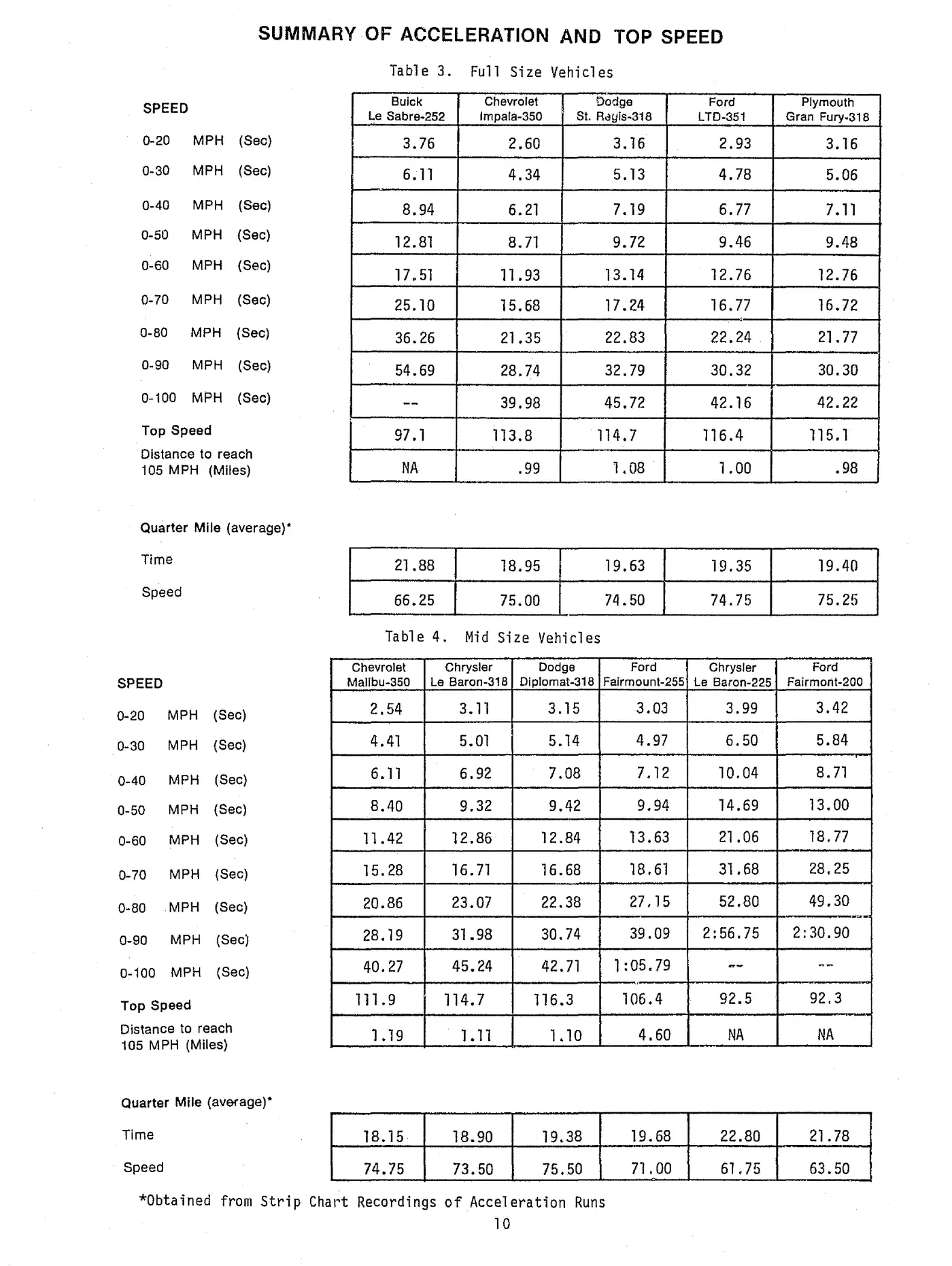
Complete acceleration data — every 10-mph increment, all eleven cars
| 0 to… | LeSabre 252 | Impala 350 | St. Regis 318 | LTD 351 | Gran Fury 318 |
|---|---|---|---|---|---|
| 20 mph | 3.76 | 2.60 | 3.16 | 2.93 | 3.16 |
| 30 mph | 6.11 | 4.34 | 5.13 | 4.78 | 5.06 |
| 40 mph | 8.94 | 6.21 | 7.19 | 6.77 | 7.11 |
| 50 mph | 12.81 | 8.71 | 9.72 | 9.46 | 9.48 |
| 60 mph | 17.51 | 11.93 | 13.14 | 12.76 | 12.76 |
| 70 mph | 25.10 | 15.68 | 17.24 | 16.77 | 16.72 |
| 80 mph | 36.26 | 21.35 | 22.83 | 22.24 | 21.77 |
| 90 mph | 54.69 | 28.74 | 32.79 | 30.32 | 30.30 |
| 100 mph | — | 39.98 | 45.72 | 42.16 | 42.22 |
| 0 to… | Malibu 350 | LeBaron 318 | Diplomat 318 | Fairmont 255 | LeBaron 225 | Fairmont 200 |
|---|---|---|---|---|---|---|
| 20 mph | 2.54 | 3.11 | 3.15 | 3.03 | 3.99 | 3.42 |
| 30 mph | 4.41 | 5.01 | 5.14 | 4.97 | 6.50 | 5.84 |
| 40 mph | 6.11 | 6.92 | 7.08 | 7.12 | 10.04 | 8.71 |
| 50 mph | 8.40 | 9.32 | 9.42 | 9.94 | 14.69 | 13.00 |
| 60 mph | 11.42 | 12.86 | 12.84 | 13.63 | 21.06 | 18.77 |
| 70 mph | 15.28 | 16.71 | 16.68 | 18.61 | 31.68 | 28.25 |
| 80 mph | 20.86 | 23.07 | 22.38 | 27.15 | 52.80 | 49.30 |
| 90 mph | 28.19 | 31.98 | 30.74 | 39.09 | 2:56.75 | 2:30.90 |
| 100 mph | 40.27 | 45.24 | 42.71 | 1:05.79 | — | — |
The book itself notes why quarter-mile time and trap speed don’t rank the same way: cars accelerate unevenly. The Fairmont 255 reached 70 mph in 18.61 seconds having already covered nearly 1,200 feet, crossing the quarter at 71 mph — while the Diplomat hit 70 in 16.68 seconds within about 1,000 feet and kept pulling to 75.5 mph at the line.
See the original page: Tables 3 and 4 in the 1981 book
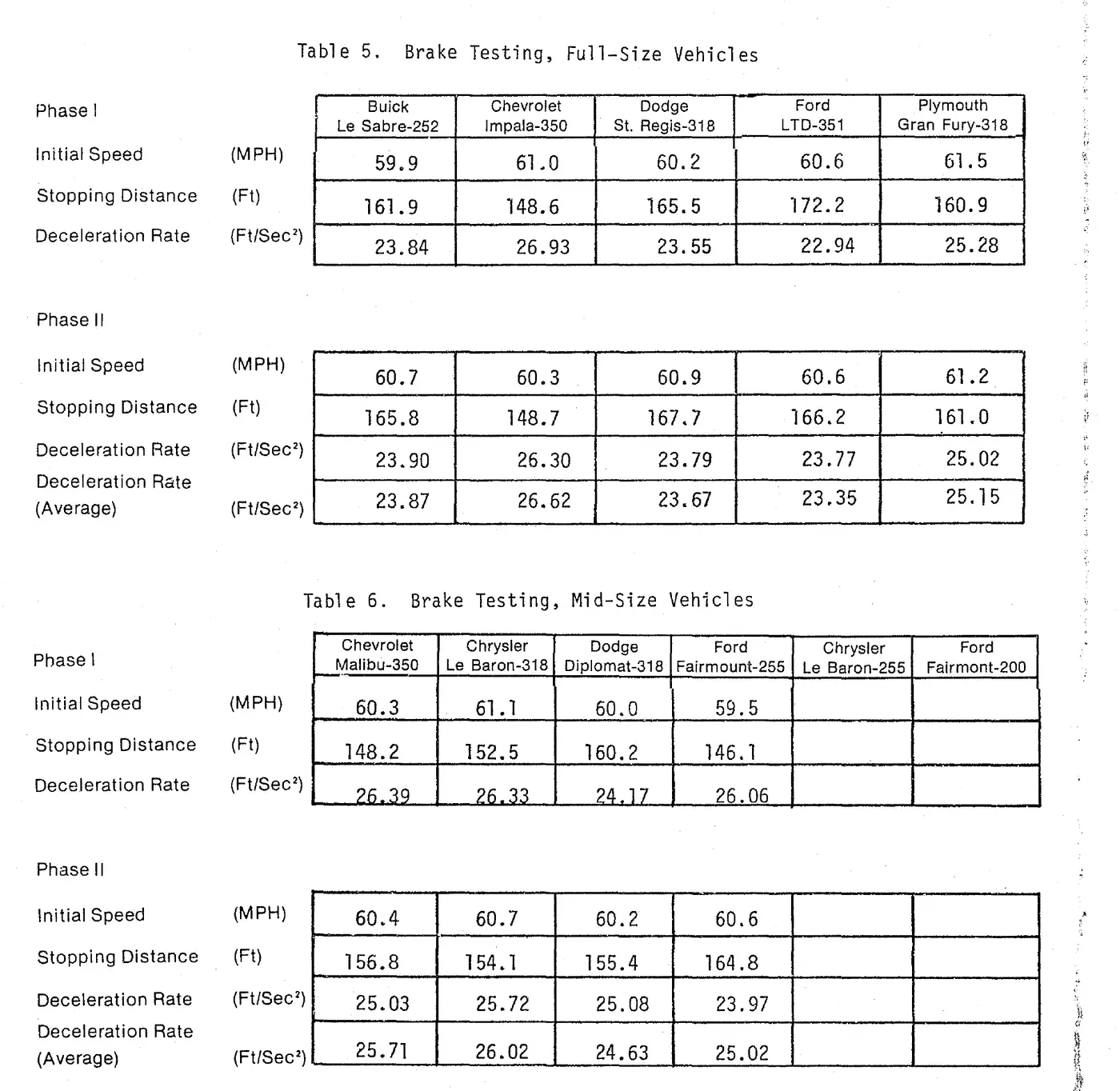
Brakes, fuel economy, ergonomics
| Car | 60–0 Phase I (ft) | 60–0 Phase II (ft) | Avg decel (ft/s²) | EPA city (mpg) | Ergonomics (pts) |
|---|---|---|---|---|---|
| Full-size | |||||
| Chevrolet Impala 350 | 148.6 | 148.7 | 26.62 | 14.7* | 193.94 |
| Plymouth Gran Fury 318 | 160.9 | 161.0 | 25.15 | 15.5 | 193.83 |
| Buick LeSabre 252 | 161.9 | 165.8 | 23.87 | 18.5 | 186.87 |
| Dodge St. Regis 318 | 165.5 | 167.7 | 23.67 | 15.5 | 193.58 |
| Ford LTD 351 | 172.2 | 166.2 | 23.35 | 15.3* | 189.24 |
| Mid-size | |||||
| Ford Fairmont 255 | 146.1 | 164.8 | 25.02 | 18.1 | 163.09 |
| Chevrolet Malibu 350 | 148.2 | 156.8 | 25.71 | 14.7* | 187.55 |
| Chrysler LeBaron 318 | 152.5 | 154.1 | 26.02 | 15.5 | 192.30 |
| Dodge Diplomat 318 | 160.2 | 155.4 | 24.63 | 15.5 | 192.30 |
| Chrysler LeBaron (6-cyl) | — | — | — | 17.9 | — |
| Ford Fairmont (6-cyl) | — | — | — | 19.8 | — |
* Manufacturer’s figure as submitted to the EPA — the official EPA number was unavailable when the book went to print. All cars also passed a full four-wheel-lock panic stop from 60 mph within their own lane. The LeBaron and Diplomat ergonomics totals are identical as printed; Table 1 gives the two cars the same length, wheelbase, head and leg room, and interior volumes within a cubic foot. The book prints no braking or ergonomics figures for the two six-cylinder cars; their EPA city figures are from its Table 9.
See the original page: Tables 5 and 6 in the 1981 book
Hardware: horsepower, axle ratios, test weights
| Car | HP (SAE net) | Axle ratio | Test weight (lb) | Overdrive |
|---|---|---|---|---|
| Buick LeSabre 252 | 125 | 3.23 | 3,834 | No |
| Chevrolet Impala 350 | 165† | 3.08 | 3,927 | No |
| Dodge St. Regis 318 | 165 | 2.94 | 4,086 | No |
| Ford LTD 351 | 165 | 2.73 | 4,060 | Yes (AOD) |
| Plymouth Gran Fury 318 | 165 | 2.94 | 4,090 | No |
| Chevrolet Malibu 350 | 165† | 2.73 | 3,579 | No |
| Chrysler LeBaron 318 | 165 | 2.94 | 3,856 | No |
| Dodge Diplomat 318 | 165 | 2.94 | 3,851 | No |
| Ford Fairmont 255 | 115 | 2.73 | 3,156 | No |
| Chrysler LeBaron (6-cyl) | 85 | 2.94 | 3,694 | No |
| Ford Fairmont (6-cyl) | 88 | 2.73 | 2,944 | No |
† Chevrolet’s 1981 ratings were not yet published when the book went to print; the figures are the book’s estimates based on the 1980 engines. The LTD was the only car in the test with an overdrive automatic, dual exhaust and a variable-venturi carburetor, and its 116.4 mph was the highest top speed in this test.
The money: bids before and after adjustment
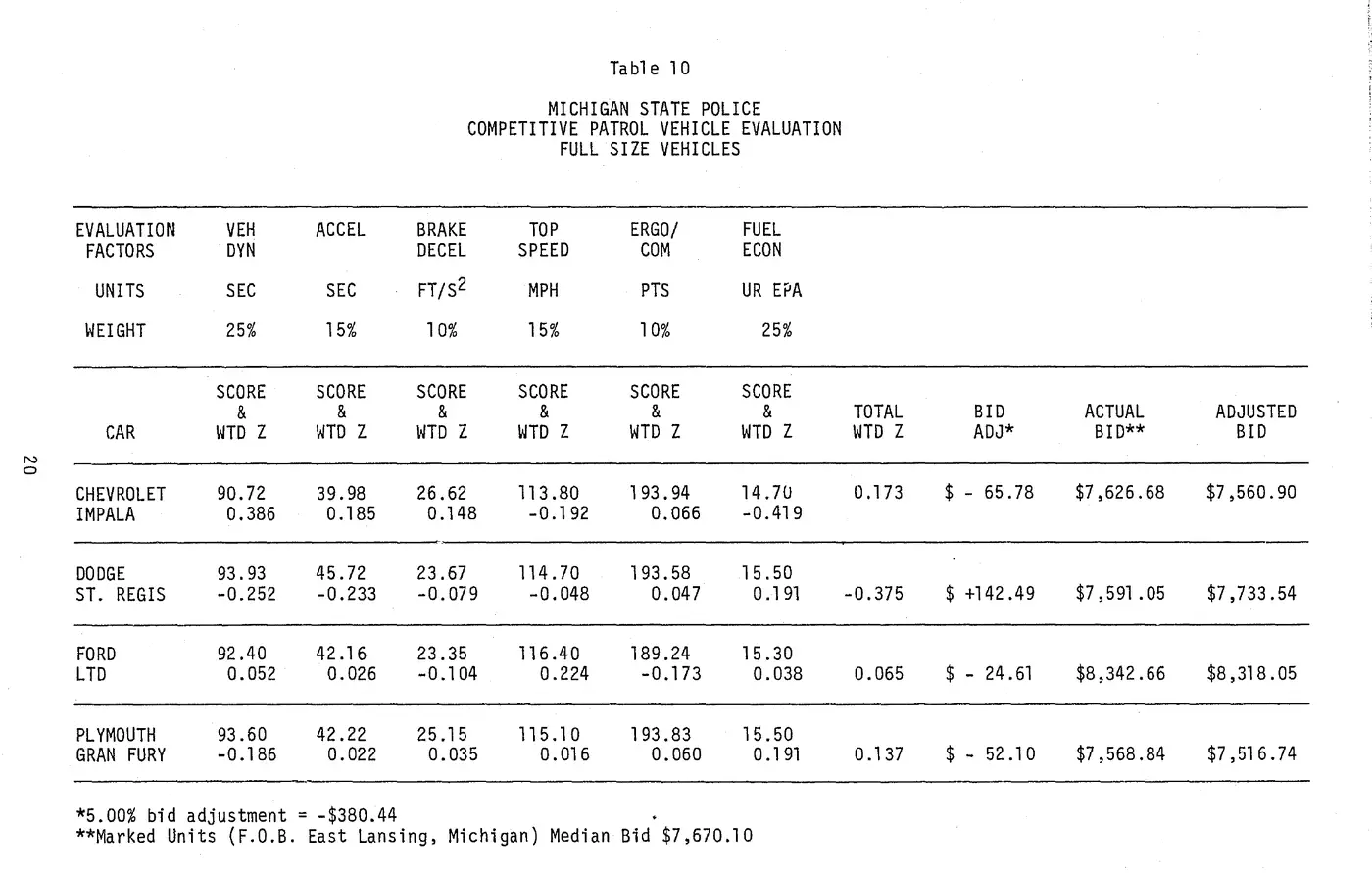
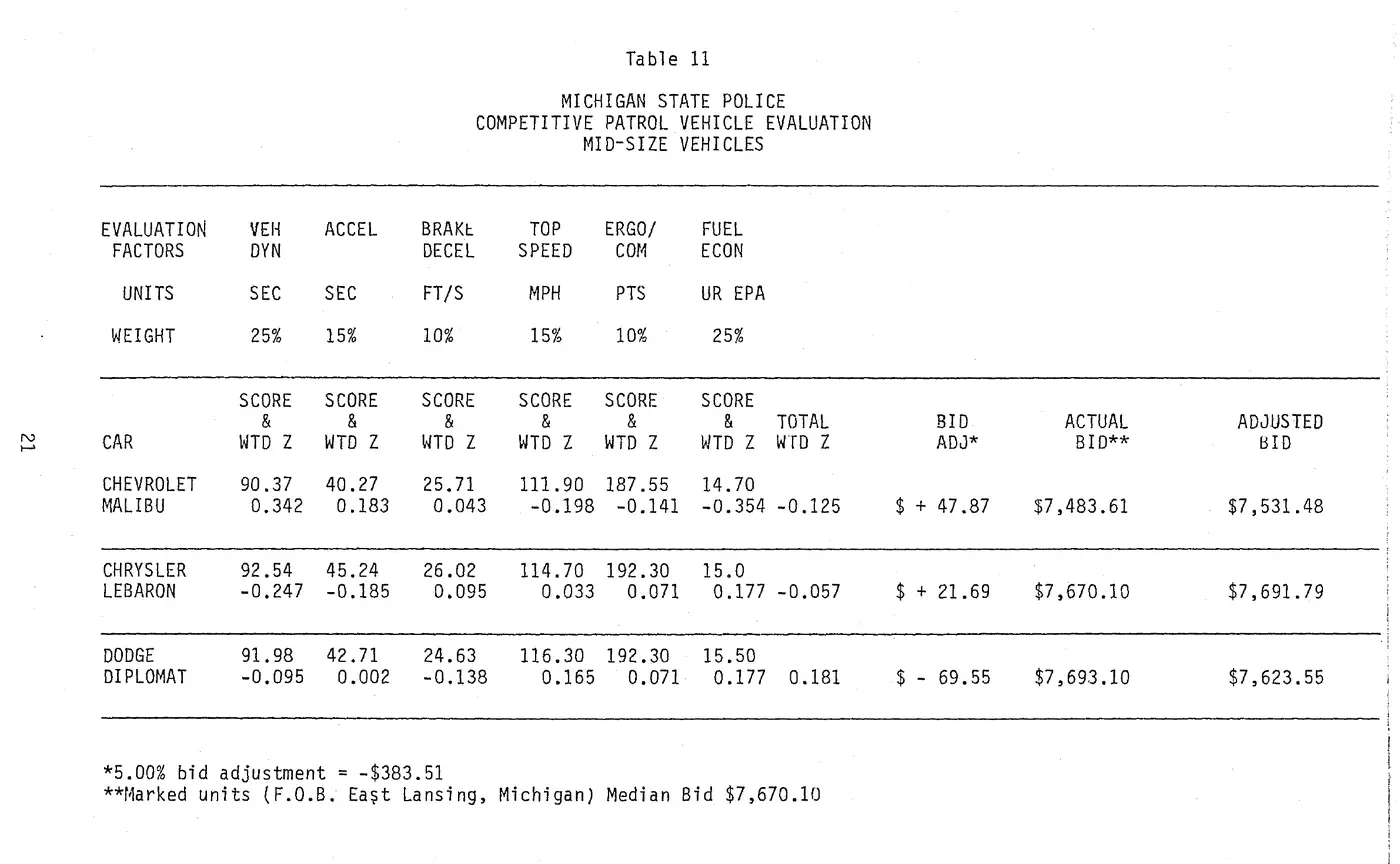
Michigan’s system let performance move the price. Each car’s scores were weighted — 25% dynamics, 25% fuel economy, 15% acceleration, 15% top speed, 10% brakes, 10% ergonomics. The book states the policy as paying “as much as five percent more” than the average bid for a car that scores well; in practice each car’s total weighted score was multiplied by five percent of its class’s median bid ($380.44 full-size, $383.51 mid-size; the full-size table’s footnote nonetheless prints the mid-size median, $7,670.10) and taken off its actual bid, so a below-average score raised it. The book explains two of the weights: vehicle dynamics is “a critical performance characteristic”, and fuel consumption “a major consideration for any police department”. In the end the math changed nothing: the cheapest cars also scored well enough to stay cheapest.
| Car | Class | Actual bid | Adjusted bid |
|---|---|---|---|
| Plymouth Gran Fury 318 | Full-size | $7,568.84 | $7,516.74 |
| Chevrolet Impala 350 | Full-size | $7,626.68 | $7,560.90 |
| Dodge St. Regis 318 | Full-size | $7,591.05 | $7,733.54 |
| Ford LTD 351 | Full-size | $8,342.66 | $8,318.05 |
| Chevrolet Malibu 350 | Mid-size | $7,483.61 | $7,531.48 |
| Dodge Diplomat 318 | Mid-size | $7,693.10 | $7,623.55 |
| Chrysler LeBaron 318 | Mid-size | $7,670.10 | $7,691.79 |
See the original pages: Tables 10 and 11 in the 1981 book
What Michigan’s specification called for
The bid specification in the back of the book (Appendix A, dated 1 September 1980) describes the car a collector would hope to find today. It called for a ⅛-inch steel plate, ten inches wide, welded under the roof panel, with a hole drilled through roof and plate and at least three wires run down the inside of the corner post. Unity #225-6 six-inch spotlights with aircraft landing lamps, left- and right-hand, on the pillar or another approved mount, individually fused. The speedometer had to be calibrated to within ±3 mph, in 2-mph increments, with a scale to at least 120.
Beneath: a limited-slip differential, the largest cooling system available, an 80-amp alternator and a 465 cold-cranking-amp battery, on Goodyear rayon police radials to the state’s own tire specification. Inside: a heavy-duty split bench, “60-40 preferable, or 50-50 acceptable”, in cloth or cloth and vinyl (blue) — all-vinyl was explicitly not acceptable — rubber floor mats, and armrests without ash trays or with the ash tray made inoperable. Paint to Dulux 93-032. If you’re checking whether a survivor is genuine, this specification is a list to check it against — see how to identify a genuine police package car and the police package option codes guide.
What 1981 settled
The Ford LTD’s 116.4 mph was the highest top speed in this test — by one tenth of a mile per hour over the mid-size Dodge Diplomat, whose bid was $650 lower. The first document held in which a Diplomat has the adjusted low bid is the 1985 scoring sheet.
The Plymouth Gran Fury posted the lowest adjusted full-size bid and the Chevrolet Malibu the lowest mid-size bid. The Buick LeSabre had the best EPA city figure of the full-size field, 18.5 mpg, and was the only full-size car that never reached 100 mph, topping out at 97.1.